Concept2 and Your AI Coach: Turn Erg Data Into Training
Your Concept2 logbook holds the cleanest power data in training. Distance, time, split, watts, stroke rate, every erg session imports the lot, and then nobody opens the file again after the result posts. Because the logbook is a lockbox. Your erg numbers sit inside it walled off from your running, your cycling, and your strength work. The coach sees isolated training.
Here is the honest difference an integrated erg system makes. Your coach reads a 2K test at 1:50 as a 2K test, knows you rowed hard yesterday so today's suggested run comes back easy, and can trade a Friday hard row for a Saturday run when you need to offload shoulder stress before a meet. It programs your entire training week because it knows how hard you rowed, not because it is guessing from general rowing wisdom.
What the Concept2 OAuth integration actually does
One OAuth connection in the app's Integrations section links your Concept2 Logbook account, you grant read access to your results, and from there every row, ski, and bike session syncs on its own without you touching a thing. A manual "sync now" button backfills your history if you have older entries.
Each piece imports with full detail:
- Distance and time. Core facts.
- Pace per 500 metres (your split). The headline number. Row a 2K at 1:55/500m and that metric lands in your training data.
- Average watts. Concept2 derives this from its pace-power formula: watts = 2.80 / (seconds-per-metre)³. A 1:50 split is 110 seconds per 500m, or 0.22 seconds per metre, which works out to about 263 watts, and the app stores that figure so a whole season of power trend sits there without you recalculating anything by hand.
- Stroke rate (strokes per minute). The cadence of your rowing. Typically 18 to 36 SPM.
- Heart rate. If your erg or Garmin watched your heart rate during the row and sent it to Concept2, it syncs too.
- Calories. What the machine reports.
- Workout type. Steady state, intervals, mixed, custom label.
These land in your normal training history next to your runs, rides, and lifts, and the session card puts your /500m split front and centre, so you see erg work in the same list as your other workouts instead of a separate erg-only silo.
Why erg data is so clean and what that means
A Garmin run carries GPS drift, terrain, wind, and whatever your pacing did across the hills, and a cycling power meter carries sensor calibration and installation on top of that. An erg is bolted to the ground. It measures stroke rate, resistance, and time per stroke with mechanical simplicity, so the split you see is the split you rowed.
That precision matters when the coach reads your data. A 2K test at 1:52/500m is a real 2K test, and your Wednesday steady-state row at 2:05/500m is steady state on the number rather than a figure assembled out of heart rate and perceived effort. The coach can trust the power metric.
Stroke rate accuracy matters too. A 2K rowed at 32 SPM is a different effort than the same split at 26 SPM: one is a sprint with high drive, one is a grinding push, and the coach sees both, so it can reason about your strategy alongside your speed. Strokes per minute also reveals whether you are fighting the machine, cadence spiralling up, or holding form at a steady rate across a hard set.
Reading your splits and what the numbers mean
Your split is pace: time per 500 metres. A 1:50 split is 1 minute, 50 seconds per 500m, the pace you hold across a 2K or a steady-state block.
Watts is power, derived from your split. Most rowers find it easier to think in splits, your 2K baseline and your steady-state pace, but watts hand you one number to track across a season, and two rowers at the same split produce the same watts, light or heavy, because the number comes from pace alone. Bodyweight shows up in comparison. A lighter rower holding 263 watts works at a higher output relative to their size, which is what a weight-adjusted erg score captures. For your own progress, watch split and heart rate together. Same split, lower heart rate, week after week: the engine is getting stronger.
Stroke rate is efficiency. For steady-state work, most coaching frameworks point to a lower cadence than you would expect, and Concept2's own guidance puts comfortable steady-state rowing in the 24-28 SPM range, with some base-building protocols going lower still. Here is the tell. If your split holds constant while your SPM drifts up across a session, your driving power is dropping and you are rowing a faster leg-beat to hold the same pace, and if SPM falls while pace holds, the drive is stronger and you are gliding longer. Neither is good or bad on its own. The change tells you where your fatigue sits.
An erg calculator turns any split into watts, pace, and calories, so you can sanity-check a session's numbers without doing the math by hand.
A 2K predictor takes your test result and projects your paces at other distances: 500m, 6K, a 30-minute piece. Rowing-specific, because pace scales differently with duration on the erg than it does for running.
Using the erg as training and the zones that matter
Your erg life divides into three intensity zones.
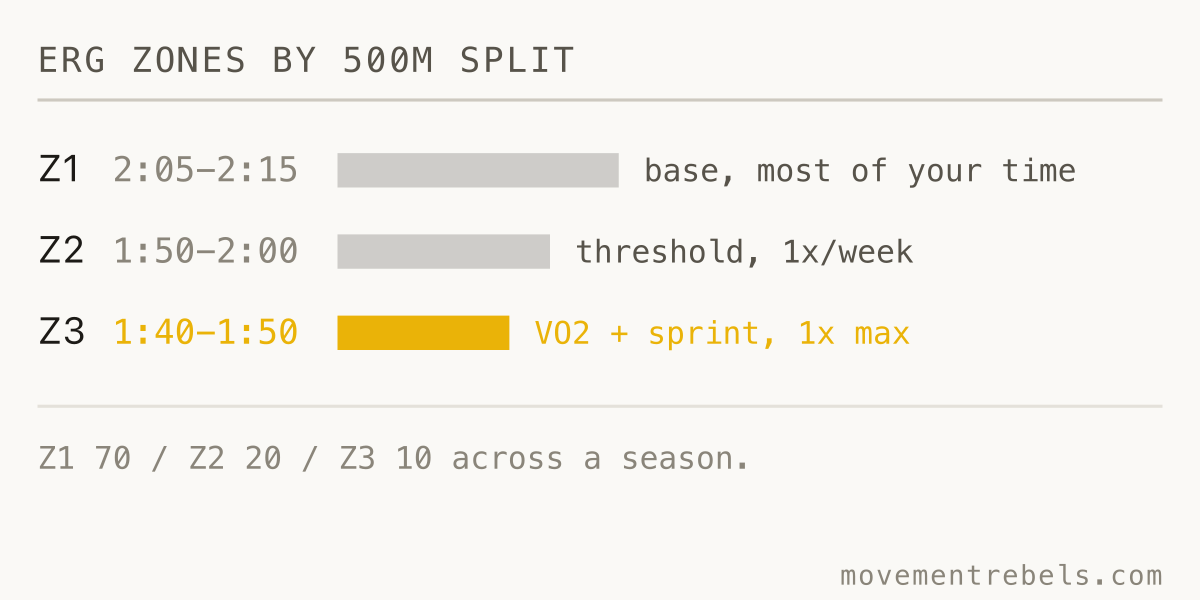
Zone 1: Steady state. Long, controlled rows at an easy, conversational pace. Rowing coaches broadly place true steady-state work at least 15-25 seconds per 500m slower than your 2K pace, heart rate rises and stabilizes into your aerobic zone, and you can hold a conversation in fragments. Duration: 20 minutes to an hour. This is the base of your fitness, your big-volume work. If you do not know your heart rate training zones from your max or resting heart rate, a calculator gives you the bpm bands to hit.
Most of your erg time should live here. A program that loads you up with steady state teaches your body to burn aerobic fuel efficiently, and the coach uses your recent steady-state data to calibrate the zone: a last steady row of 2:07 at 142 bpm tells it that is your Zone 1 pace, so it recommends that band through your base-building weeks.
Zone 2: Threshold. Rows at a hard but sustainable effort, typically a few seconds per 500m slower than your 2K race pace, and the distinction matters: threshold, sometimes called anaerobic threshold or AT, sits below your all-out 2K speed. Racing pace and threshold pace are not the same zone. Heart rate climbs into the high 160s to mid-170s, you can speak a sentence if pushed, and duration runs 3 to 12 minutes, usually repeated with recovery between sets.
Threshold work trains the power you can sustain across a 6-10 minute effort. A well-done threshold session runs three to five hard blocks of 4 minutes each, recovery rows of 2 minutes at Zone 1 in between, plus a warm-up and a cool-down. The coach lands threshold work after you have built a base, and it will not stack threshold on threshold across back-to-back days.
Zone 3: VO2-max and sprint. Short, hard efforts at your 2K split or faster, 1:40 to 1:50 per 500m or harder. Heart rate climbs to maximum. You cannot talk. Duration under 5 minutes, usually 500m to 2 min repeats, high recovery between.
VO2-max work is smaller volume, high intensity. A single VO2-max session per week is enough in most plans, two in a week risks staling you, and the coach reads your recent erg tests, knows your max power, and will not prescribe VO2 work that requires a higher split than you have proven.

The 2K test as your annual or seasonal standard
A Concept2 2K test is a maximal effort: row 2,000 metres as fast as you can, empty the tank, stop. It takes 6-10 minutes depending on your level.
This is your headline number. A 2K at 1:52/500m is your baseline, and every 2-4 months you test again to see if the training improved you or if you have drifted. A drop of 3-5 seconds per 500m across a training block is real progress, and a rise of 3 seconds suggests fatigue, injury, or a deload stealing your fitness.
Use the 2K predictor to set your threshold and sprint zones from your test result, so you know what splits to hold in each session instead of guessing.
Test in a known state. 48 hours of light training, fed normally, slept well. Avoid testing after a heavy strength day, because a 2K rowed on the back of hard squats or deadlifts hands you exhaustion with a lower number instead of a real test.
Cross-domain load: how the coach reads your erg work
Your rowing is one piece of your total training. The coach sees it alongside your runs, your rides, your strength sessions, and your recovery.
A hard 2K row is a nervous-system effort. Different stress than a 3-mile tempo run, still stress. Test on a Tuesday and your Wednesday easy run stays easy, and if you hit a hard threshold block on Thursday with a Friday long run already on the calendar, the coach might move one of them. Two hard days in a row is possible, but not around critical sessions.
The coach also reads your stroke rate and power curves across your erg history. A month of steady-state rows trending up in split at the same SPM means your power is dropping, so it pulls back the hard sessions and lets you recover. If you rowed a 1:52 2K last month and your steady rows have been sluggish ever since, the coach knows you are still recovering and holds threshold work back.
That is the point of integrated training: one app watching all your stress and recovery across every domain. Garmin sees your runs, Movement Rebels sees your erg, you log your strength and your meals, and the coach assembles one coherent week instead of three separate programs that quietly conflict.
Erg training for hybrid and HYROX athletes
A hybrid athlete, strength plus endurance, has a real problem: both domains want the same recovery. A heavy leg day plus a hard 2K row on the same Friday is a stressor stack, and the coach sees both and pulls one back to lower the combined load.
HYROX athletes especially. Your race is eight 1 km runs, each followed by a station: SkiErg, sled push, sled pull, burpee broad jumps, rowing, farmers carry, sandbag lunges, and wall balls. Train all of it. The coach can shape your week so Monday is a heavy strength day (sandbag, wall ball, sled push), Wednesday is erg work (RowErg and SkiErg repeats), Thursday is a tempo run for the movement under fatigue, and the week stays coherent. Your long Saturday goes HYROX-specific, a run with two workstation rounds, instead of a volume session. The erg work trains your engine. The stations and the strength train your economy.
Common erg mistakes
Avoid these, and your erg training compounds.
Chasing stroke rate. A fast cadence on a 2K feels faster and is usually less efficient. Concept2's published guidance puts the recommended racing cadence for distances up to 2K at 30-36 SPM, with the emphasis on powerful, complete drives rather than spinning, so if you are pulling well above that range you are spinning rather than rowing and your split suffers for it. Hold a cadence. Let the pace come.
Ignoring drag factor. Drag factor is how much air the fan moves per stroke, set by the damper lever and shown as a number on the monitor. It is not resistance in the gym sense. It changes the feel of the stroke. Most rowers settle between 110 and 130, and if the stroke feels like you are fighting the machine or slipping through with no load at all, check the damper and read your drag factor off the monitor. Five points shifts the feel.
All-out every session. Steady-state work is not optional. Most of your erg time should be controlled, sustainable pace: one hard 2K per week, one threshold session per week, and the rest base-building. Rowers who row hard every day get burned out or injured, then take months off, while a structure of 70% easy, 20% threshold, 10% VO2 scales your erg training across a season.
Not testing regularly. No benchmark, no idea whether you are improving. A 2K test every 8-12 weeks, done in a rested state, is the measure, and without it you are guessing your power and your zones.
Ignoring heart rate trends. Steady rows climbing in heart rate at the same split mean your cardiovascular fitness is dropping, and heart rate falling at the same split week-to-week means you are getting stronger. The coach reads this trend and adjusts the load. Watch it yourself too: a resting heart rate rising across three days is a fatigue signal, a reason to dial back or take a day off.
How Movement Rebels fits
The honest limit of the Concept2 logbook: it is a vault. Great for the number, terrible for everything else. Rowing does not exist in a vacuum. A rower who trains strength, runs for endurance, eats for recovery, and sleeps eight hours is a different athlete than one who rows twice a day and ignores the rest.
The Movement Rebels coach connects your erg data to your full training life. It reads your 2K test and sets your zones. It sees your Wednesday threshold row and shapes your Thursday run around the leftover fatigue, watches your steady-state pace trend across weeks and pulls back when it is drifting up, reads your Garmin runs, spots the tempo run that landed on Tuesday, and pushes Friday's planned threshold row to Saturday. It does not track your Rebel Fuel log, so if you are eating light, say so in Notes for your coach and it will read a sagging HRV against that rather than as a training problem. One coherent week instead of four separate training siloes.
Start with a test. A fresh 2K, rested and ready. Connect your Concept2 logbook, build a base phase of mostly steady state, one test retest in eight weeks. Then watch the erg data layer into your total training picture and adapt. The coach reads all of it.
One app instead of five.
Strength, endurance, recovery, fueling, planning, and your AI coach. All under a 7-day free trial. No card.
Start 7-day trial2K Erg Pacing: How to Execute Without Blowing Up at 1500m
How to pace a 2000m rowing ergometer test: energy systems, pacing phases, split calculations, and the mental strategy to crush you
Connect Training Data to ChatGPT or Claude: Why the Workflow Breaks
You can export your Garmin data and paste it into ChatGPT. The problem isn't the data format. It's that you have to ask at all. He
Garmin AI Coach: What Your Watch Knows vs. What a Coach Needs to Know
Garmin's built-in coaching balances run and ride load using its own metrics. An AI coach reading the same data programs everything
Apple Health as an AI Coach Data Layer: What It Passes Through
Movement Rebels reads Apple Health natively on iOS. But WHOOP doesn't export HRV, Oura's readiness score stays locked, and the coa