Garmin AI Coach: What Your Watch Knows vs. What a Coach Needs to Know
Your Garmin is doing real physiology. Training Readiness, HRV Status, Body Battery, Daily Suggested Workouts: these are not marketing features. They are built on Firstbeat Analytics algorithms that combine acute training load, chronic load, VO2 max trends, sleep, and overnight HRV to nudge you toward the right intensity for today. For a pure runner or cyclist who trains one sport and follows the watch faithfully, the built-in coaching is useful and costs nothing extra.
The honest version of the conversation is this: that system has known, structural limits. It programs running and cycling. It treats strength work as invisible except when it shows up as stress in HRV. It cannot ask you a question, update your goal, or absorb a week of life disruption. Garmin Coach has expanded significantly since its original launch: as of 2024 it covers running (5K, 10K, half marathon, marathon), cycling (century rides, gran fondos, time trials), triathlon (sprint, Olympic, half Ironman, full Ironman), and strength training. For most recreational athletes, though, the structural limits of any algorithm-only system still apply regardless of which plan type you choose.
An AI coach that reads your Garmin data does something different. It programs everything else alongside the running and riding, treats the watch metrics as inputs rather than outputs, and can actually talk to you. What it does not do better: deterministic load math. Garmin's Firstbeat model at computing your training load across recorded activities is more precise than any LLM prompt. An AI coach earns its keep in the domains where an algorithm cannot go.
What Garmin's built-in coaching actually does well
Worth understanding before comparing. The Daily Suggested Workouts feature reads your Training Readiness score each morning (which itself combines sleep quality, HRV Status, stress, and recovery time) and suggests a session type matched to where you are in the load-recovery curve. It adapts session-to-session. A bad sleep night shifts the suggestion toward easy. A string of light days opens the door to harder work.
Training Readiness and HRV Status are designed to smooth out short-term noise. HRV Status displays a 7-day rolling average so a single outlier night does not trigger an overreaction, and the personal baseline it compares against is built from roughly 90 days of nightly data. Body Battery handles the shorter time scale: how much energy you have today, given sleep plus stress plus yesterday's activity. The combination is a real signal, not noise. For a deeper look at how resting heart rate trends layer on top of this picture, see resting heart rate as a 28-day signal.
For a runner using a Garmin and nothing else, following Daily Suggested Workouts is a reasonable approach to avoiding overtraining without knowing much about periodization.
Where the watch algorithm hits its ceiling
The same research source that praises Daily Suggested Workouts also names the ceiling plainly: the system cannot account for training it never sees. Strength sessions, yoga, cross-training that is not a recorded run or ride, none of it enters the load calculation. Garmin forums confirm this directly: non-running and non-cycling activities affect your stress metrics (and therefore HRV), but they do not factor into the actual workout suggestions. Three heavy strength days plus a long run shows up in the algorithm as just one hard day.
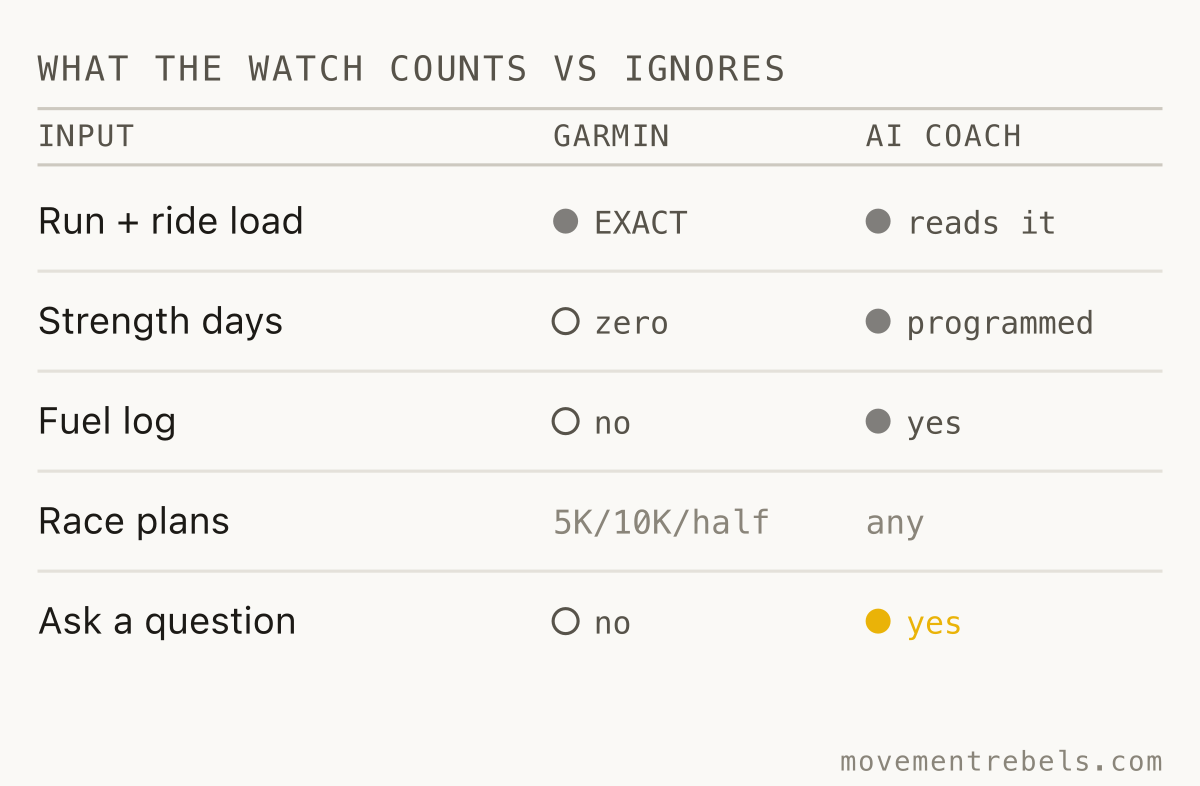
That gap matters more as training gets more complex. A triathlete, a hybrid athlete, a CrossFit competitor, anyone running alongside serious lifting: the watch model is working with a partial picture. It sees a Tuesday Z2 run. It does not see that you squatted heavy on Monday and your CNS is still absorbing it.
The second ceiling is context. The algorithm produces a session type, not a conversation. It cannot adjust for the fact that you have a race in four weeks, that you ate 1,800 calories yesterday on a hard training day, that your left knee has been flagging, or that you swapped Tuesday for Thursday because work ran long. It also cannot tell you why it suggested a threshold session today, or whether to swap it for a bike ride. The watch suggests. You interpret.
Garmin Coach, even with its broader sport coverage, shares this context ceiling. Community feedback across the forums shows that the plans can be difficult to interpret when the algorithm makes unexpected adjustments, and users often cannot tell whether a training change reflects a genuine fitness signal or a quirk in the model. The plans do not have a conversation with you.
What an AI coach reading Garmin data does differently
Once you connect Garmin Connect to Movement Rebels (OAuth, 90 days of history backfills automatically), the coach reads the same raw metrics your watch uses: HRV trend, Training Load, sleep score and stages, resting heart rate, VO2 max direction, and every completed activity with its full file data. Then it adds what the watch cannot see. If you want to cross-check the watch number against a field test, you can estimate VO2 max without a lab from a Cooper run.
Everything you train, not just what the watch algorithm knows. Strength sessions logged in MR, recovery tools run inside the app (breathwork, NSDR, cold exposure), and meal data from Rebel Fuel all feed into the same coach thread. The coach knows you did a heavy squat session on Tuesday before it writes Wednesday's plan. The watch does not.
A brief, not a score. Every morning you get a short written read of your readiness: what the Garmin data shows, how it stacks against your 28-day baseline, and what it means for today's session. Specific, not generic. "HRV down 9% off your baseline, RHR up 2 bpm, Rebel Fuel logged 1,700 kcal yesterday on a hard training day. Keep today's run easy, drop the Thursday threshold block to next week, eat at maintenance today." That reasoning cannot fit on a watch face. To set the easy and threshold targets behind that read, the calculator for heart rate training zones from your max or resting HR gives you the bpm ranges to run them in.
Plan generation that reads the full week. When you ask for a new week, the coach looks at your last 14 activities, your strength log, and the persistent athlete profile it has been building from every previous conversation. It writes a week shaped to where you actually are, not where a template expects you to be. Hybrid training, triathlon blocks, strength-plus-endurance weeks: all programmable.
Post-ride and post-run debriefs. Every completed Garmin activity triggers an automatic coach analysis in your thread. Lap splits, heart-rate drift, power profile. One paragraph in plain language, free for Pro+ subscribers, no extra credits. For how HRV-guided training fits into reading those debrief signals week over week, that guide runs through the practical framework.
Structured workouts pushed back to the watch. The coach writes today's session with warm-up, intervals, targets, and cooldown, then pushes it as a structured workout to Garmin Connect and onto your watch. You hit start, the watch guides you through. The plan and the device stay synchronized.
The ability to ask a question. "Should I swap Thursday's intervals for an easy ride given that my knee is sore?" "Is this HRV trend worth being worried about?" "My race moved from 8 weeks to 5 weeks, what do we cut?" None of that is possible with an algorithm. All of it is possible with the coach.
What the AI coach does not do better than the watch
Honest answer: load math on recorded activities. Garmin's Firstbeat model at quantifying training stress from a completed run or ride is deterministic and precise. An AI coach reading the same activity can reason about it qualitatively but does not improve on the numeric load calculation. If you want the sharpest possible quantified load score for your endurance training, the Garmin model is the right source. Movement Rebels uses it as an input, not a replacement. The Training Stress Score explainer covers how that load math works and what the numbers actually mean, and you can calculate Training Stress Score from power and FTP for any session yourself.
Also honest: for a pure runner or cyclist who has no interest in strength training, nutrition tracking, or coach chat, and who just wants a free adaptive suggestion each morning, Garmin's built-in tools cover that use case well. The AI coach earns its value when your week spans more than one sport, when you want to actually understand what your metrics mean, or when you need a plan that responds to real life.
What you still need a human coach for
Video analysis of technical movement, elite race strategy, and the relational accountability of someone who notices you have gone quiet. If you are chasing a qualifying standard or dealing with a complex injury, hire a human.
For the majority of recreational athletes training 4 to 12 hours a week across multiple disciplines, juggling work and family, and tired of stitching five apps together: the AI coach is the practical call. Available daily, costs less than one personal training session per month, reads more data than any human coach has time to, and the rest of the app handles everything you would otherwise need four other apps for.
One honest note on Strava: MR replaces Strava's training and analysis layer (adaptive plans, coach chat, load tracking, recovery reading) but not its reach. MR has a feed, crews, follows and high fives of its own, and no segments. Your activities still land in your friends' Strava feed automatically via the write integration. Keep Strava for the social layer. Run the training in MR.
Pricing
Movement Rebels is free for 7 days: full coach access, full Garmin sync, full strength logger, full Rebel Fuel, full recovery tools, no credit card. After the trial, Pro+ is $20/month for unlimited AI coaching.
One app instead of five.
Strength, endurance, recovery, fueling, planning, and your AI coach. All under a 7-day free trial. No card.
Start 7-day trialApple Health as an AI Coach Data Layer: What It Passes Through
Movement Rebels reads Apple Health natively on iOS. But WHOOP doesn't export HRV, Oura's readiness score stays locked, and the coa
Adaptive Training Plans: How the Plan Adjusts to You
Adaptive training is real science with honest limitations. What peer-reviewed research says about autoregulation and HRV-guided pl
HRV-Guided Training: Read the Signal, Skip the Noise
One low HRV night tells you almost nothing. The 7-day-vs-28-day trend tells you nearly everything. Here is what the evidence actua
Hybrid Athlete Training: Concurrent Done Right
The interference effect is real but smaller than you think, and the rules for avoiding it are simpler than the hype suggests. Here