Hybrid Athlete Training: Concurrent Done Right
The honest starting point: the interference effect is real, it is smaller than coaches claimed for thirty years, and the rules for avoiding it are simple enough that most recreational athletes ignore them anyway and still make progress. What actually breaks hybrid athletes is not the molecular biology. It is the gray zone: running every "easy" run too hard, stacking modalities with no separation, and never pulling back load because the program does not build in a deload.
Get those three things right and you can build a respectable squat and a respectable half marathon at the same time. Not at world-class level simultaneously, but at a level most people would be satisfied with.
What the Research Actually Says
The interference effect entered the conversation through Hickson's landmark 1980 study. After ten weeks of concurrent training, the strength group kept gaining; the concurrent group plateaued at week seven and started sliding. The mechanism: endurance work activates AMPK signaling, which suppresses mTOR, the switch that drives muscle hypertrophy. The popular read became "endurance kills gains," and coaches told athletes to pick one.
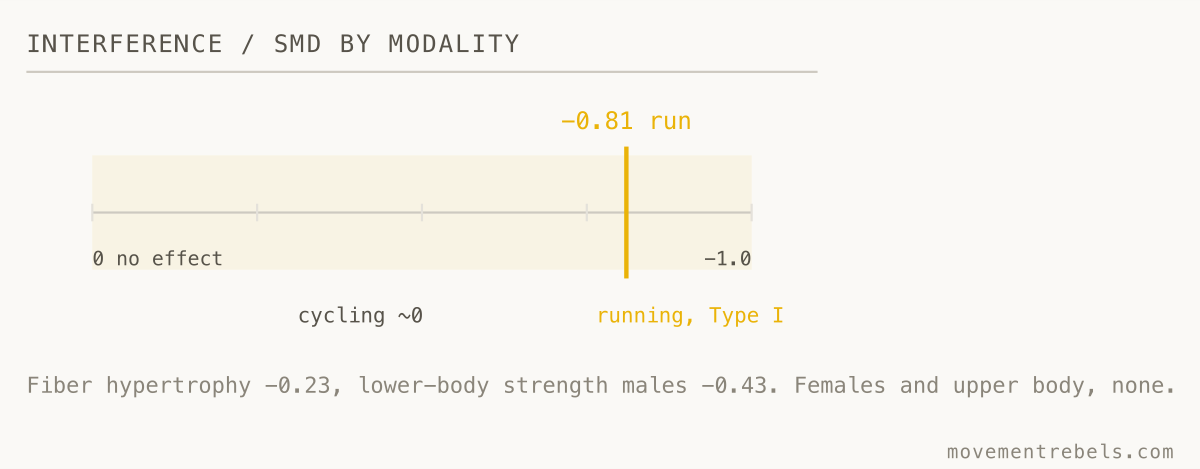
The modern evidence is more nuanced. A 2024 systematic review and meta-analysis in Sports Medicine found that concurrent training produces a small interference effect on lower-body strength in males (SMD -0.43) but no significant interference in females. For upper-body strength, no significant interference was found regardless of training status. For VO2max, trained and highly trained athletes showed no meaningful blunting, though untrained individuals did show reduced VO2max gains from concurrent training. Separate meta-analytic work on muscle fiber hypertrophy puts the overall attenuation as real but small. The effect is modality-dependent: running produced a clearer interference on Type I fiber growth while cycling showed less negative effect, likely because running's eccentric loading adds a fatigue debt cycling does not.
So the practical summary from the literature: interference scales with endurance volume, intensity, modality, and how close sessions are stacked. It is not a fixed tax on all concurrent training. It is a variable you can manage.
The Molecular Lever Most Programs Miss
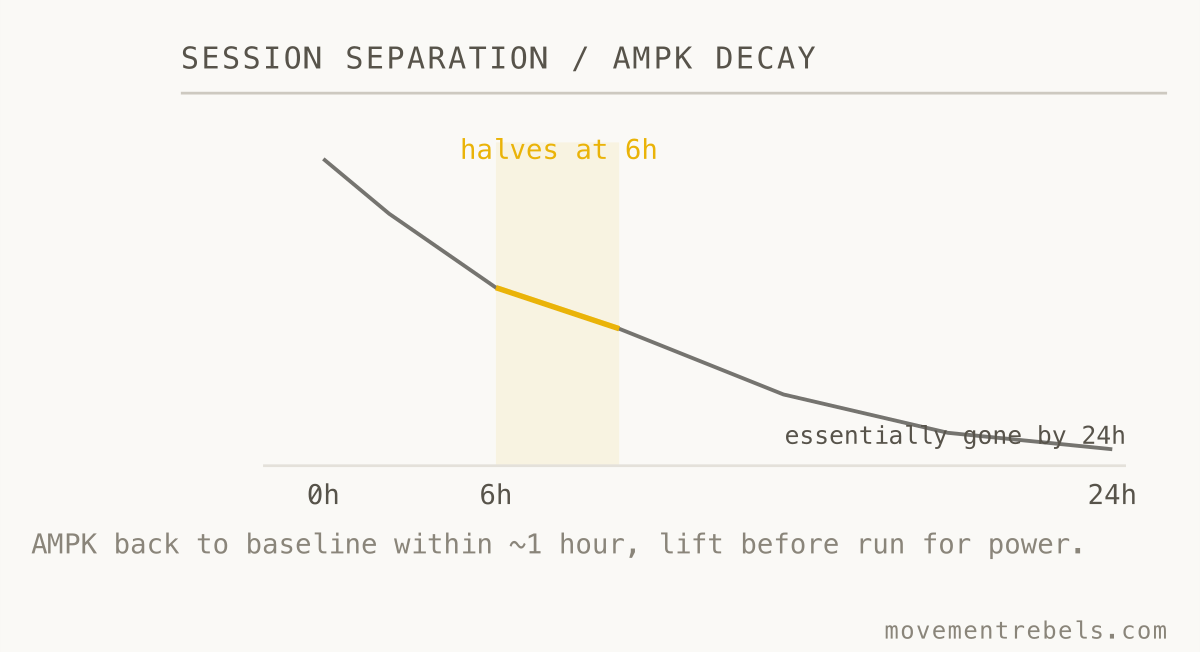
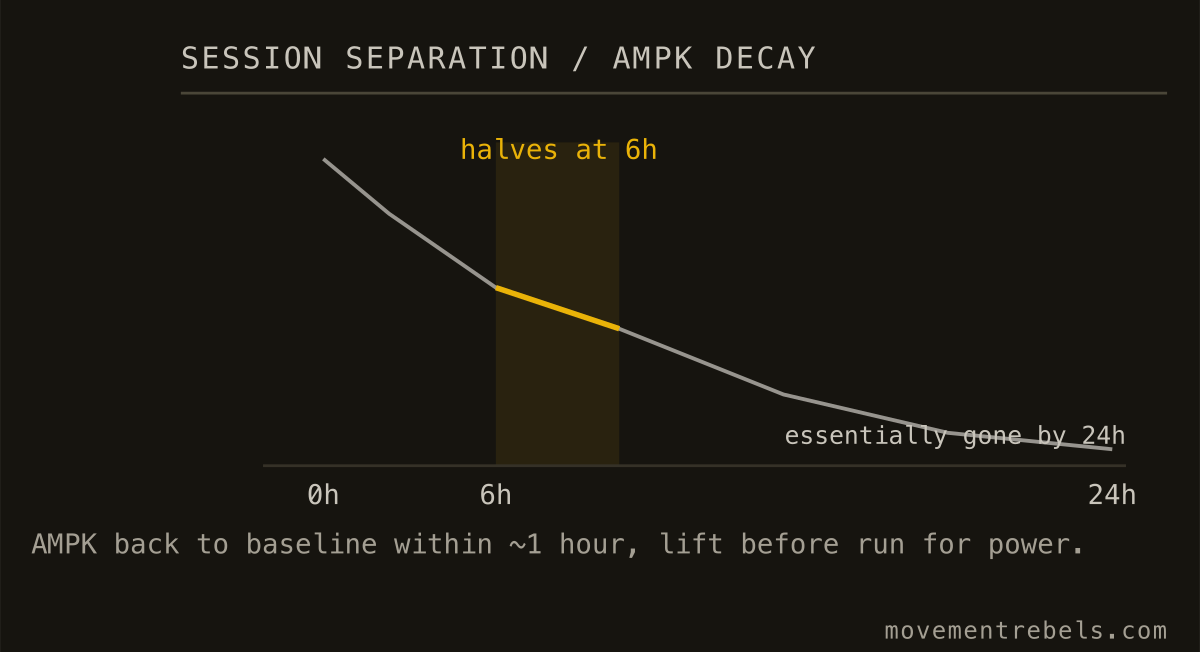
AMPK does not stay elevated forever. The evidence broadly suggests AMPK activity returns toward baseline within roughly an hour to a few hours after endurance work. The research on session order is less symmetrical than it first appears: most evidence points toward lifting before running as the superior sequence when hypertrophy is a priority. Resistance-first order tends to preserve mTOR signaling better than endurance-first order. Both sequences appear to support aerobic adaptation similarly, but the sequences are not interchangeable for muscle-building purposes.
This collapses the "you can never do two things in one day" rule into something more precise: if you do two sessions on the same day, separate them by at least an hour, and lift before you run when power development matters. Twenty-four hours between sessions removes the question entirely.
The Three Knobs
Hybrid programming comes down to three decisions, and they cascade in this order.
Modality split. Which days are strength, which are endurance, which are combined. The cleanest concurrent template alternates: strength Monday, Wednesday, Friday; endurance Tuesday, Thursday, Saturday; full rest Sunday. The Hyrox template stacks two pure strength days, two pure run days, and two mixed engine days. Tactical Barbell runs a fixed three-day strength cluster and slots conditioning around it based on which operator template you choose. All three work. The split that fails is the one with no clear priority because the week fills in randomly. A training volume calculator to balance lifting load against running with MEV, MAV and MRV bands helps you keep the combined load inside what you can recover from once two modalities are competing for the same budget.
Intensity distribution. This is the lever most amateurs get wrong, and it matters more than the split. If your endurance work sits 80% in Zone 2 and 20% at threshold or above, interference stays low and aerobic ceiling stays high. If everything drifts into the gray zone, moderate-hard all the time, interference spikes and aerobic adaptation stalls. The research is blunt here: the one thing every camp agrees on is that easy sessions must be truly easy. Read Zone 2 training: when it works, when it's a waste before you build a hybrid block, because the gray-zone mistake costs more than almost any other programming error.
Recovery window. Six hours between modalities is the threshold where molecular interference roughly halves. Twenty-four hours and it is essentially gone. The practical rule: never train the same muscle group hard in two modalities inside six hours. If you squat heavy at 7 a.m., push the run to the next morning, not the same evening.

Hyrox, CrossFit, Tactical Barbell: Same Family, Different Tilts
Hyrox tilts toward muscular endurance under glycolytic load: sled push, wall balls, burpee broad jumps interleaved with 1 km runs. The strength work that supports it lives in the 5-10 rep range with short rest, plus heavier compound lifts twice a week to keep the engine block big. Volume is high. The interference risk is real because the competition itself is concurrent. If you are training for a race, a HYROX finish time predictor gives you a target to build the block around, and you can check where your HYROX time ranks by age and division to know whether that target is realistic. To set the run and erg pacing for the compromised running a Hyrox demands, HYROX training zones from your 5k time maps your current speed onto race-day efforts.
CrossFit tilts toward mixed-modal capacity across timeframes. The trap is that the MetCons are usually too hard to count as endurance work and too fatiguing to count as recovery. Many CrossFit athletes live in the gray zone by design. That produces broad general fitness at recreational level but makes it hard to build serious numbers in either strength or endurance specifically. If you want a sub-3 marathon and a 2x bodyweight squat, CrossFit alone is probably not the vehicle.
Tactical Barbell is the cleanest framework for "I want to lift heavy and run far at the same time." It uses a three-day strength cluster with conditioning slotted around it via fixed templates, and it programs the lifts as percentages of your max, so a 1RM calculator for the strength half of your program gives you the working numbers. The discipline of separating modalities by 24 hours where possible is built into the system rather than left to athlete discipline.
None of these systems are complete without an honest approach to periodization. The athletes who plateau inside a concurrent block almost always skip structured periodization: they run the same template for twenty weeks, then wonder why adaptation stalled around week ten.
Recovery Is Where Hybrid Programs Live or Die
Two modalities means double the recovery debt. The hybrid athletes who fall apart at week five are not training too hard by count of sessions. They are recovering too little and ignoring the signals.
Sleep is the first non-negotiable. Eight hours minimum, nine on heavy weeks. HRV and resting heart rate tell you whether last week's load landed cleanly or left residual fatigue before you feel it. The HRV-guided training guide walks through how to read the signal. The short version: a declining HRV trend across seven days with no taper planned is a deload signal, not a motivation problem.
Fuel is the second non-negotiable. Hybrid athletes burn more than they think and eat less than they need, especially in the endurance sessions that do not feel heavy enough to warrant serious carbohydrate intake. Fueling around long sessions covers the specifics. Under-fueling is also the fastest route to overreaching. If your overnight HRV drops alongside a caloric deficit that has run three days in a row, the coach does not prescribe more load.
Deloads are the third. A hybrid block that does not build in a lighter week every third or fourth week compounds fatigue until the body enforces the rest itself, usually as a soft-tissue injury or an illness. Read when to deload: reading the signals right for the concrete thresholds. The signs of overtraining are often visible in wearable data weeks before athletes admit them subjectively.
How Movement Rebels Handles This
One app, one timeline. Strength sessions logged against the full codex with form cues and prescribed tempo. Endurance sessions pulled from Garmin after the fact, or pushed to your Garmin watch as a structured workout before you leave the door, so the watch guides you through intervals, Zone 2 caps, and pace targets without a phone.
The coach reads Apple Health natively on iOS: HRV, resting heart rate, sleep, and workouts from Apple Watch and any device that exports to Apple Health (Oura Ring sends sleep and HRV there; Garmin sends activities). WHOOP does not export its recovery and strain scores to Apple Health, so if you use WHOOP, bring that context to the coach chat and it works with what you tell it. Strava is a live connection: your activities sync in automatically, and the coach writes a session summary back to your Strava description after each analysis. Strava is not an AI input, it is a feed and a write-back.
What this means practically: when you program a hybrid block through Movement Rebels, the coach can see both modalities at once. It spots the pattern where your Zone 2 runs are creeping above the cap, where your squat day is landing six hours before your threshold session, and where your HRV trend says the third week of a block needs pulling back even though you feel fine. No single modality lives in isolation.
Tell the coach your goal: "I want to PR my half marathon while keeping a 1.5x bodyweight squat," or "I am doing Hyrox Pro Doubles in October." The adaptive weekly plan builds a split with the right modality alternation, the right intensity distribution, and the recovery windows baked in. It adjusts week by week based on what actually happened, not just what was planned.
Pricing
Movement Rebels is one app for the full picture: strength, endurance, hybrid planning, coaching, fueling, recovery, and tracking. A 7-day free trial covers the entire surface. After the trial, Pro+ is $20/month for unlimited coaching. No card on the trial.
One app instead of five.
Strength, endurance, recovery, fueling, planning, and your AI coach. All under a 7-day free trial. No card.
Start 7-day trialPeriodization for Recreational Athletes: Which Model, and How Much You Need
Linear, block, undulating: the honest evidence on which periodization model recreational athletes actually need, and what the rese
Zone 2 Training: When It Works, When It's a Waste
Zone 2 is real, old, and oversold. Here's the honest version: when low-intensity volume is your highest-leverage work, when it isn
When to Deload: Reading the Signals Right
The 4-week deload rule is a template, not a law. Here are the actual physiological signals that tell you when your body is asking
HRV-Guided Training: Read the Signal, Skip the Noise
One low HRV night tells you almost nothing. The 7-day-vs-28-day trend tells you nearly everything. Here is what the evidence actua