The Data-Driven Athlete: What It Means in Practice
Most athletes who call themselves data-driven are not. They collect data. That is different. Collection is what your watch does automatically while you sleep. Data-driven means a decision actually changed because of what the data showed. That is a much harder bar, and most of the industry built to serve these athletes quietly ignores it.
This guide is for the athlete who already owns a Garmin or Apple Watch, already logs workouts, already has more numbers than they know what to do with, and is starting to wonder why none of it is making training simpler. The answer is usually not more data. It is fewer tools that actually talk to each other.
The gap between collecting and deciding
Walk into any endurance forum and you will see threads about TSS, CTL, ATL, ramp rate, normalized power, and decoupling. Walk into any strength forum and you will see RPE, RIR, e1RM trends, volume-load, and fatigue index. Walk into any recovery forum and you will see HRV, RHR, sleep stages, body battery, and readiness scores.
Every one of those numbers is real. Every one tells you something, and if you want to actually produce one rather than read about it you can calculate your training stress score from power and duration. The problem is not the metrics. The problem is that no recreational athlete has the mental bandwidth to weigh seventeen signals before deciding whether to do tempo intervals on Tuesday or push them to Thursday. So they do not. They glance at one number, feel informed, and then train the way they were already going to train. A headline figure like VO2 max is the classic case: most athletes quote the watch estimate without ever checking it, when a VO2 max calculator lets them compute it from a field test and see how far off the device sits.
Research backs this up plainly. A PMC study on wearable fitness tracker engagement found that while users report increased exercise after owning devices, the research cannot establish whether the data itself drove the behavior or whether already-motivated people were simply buying devices. Pre-existing motivation explains the pattern better than the dashboard does.
That is the gap between data-driven as a marketing claim and data-driven as a practice. The decision did not change.
What data-driven actually requires
Three things, all of them inconvenient if you are stitching tools together.
First, the data has to live in one place. HRV from your wrist, sleep quality from last night, resting HR trend over 14 days, completed sessions from Garmin, strength PRs from your lifting log, what you ate yesterday, how many sessions you actually completed in the last 14 days versus what was planned. If any of those signals lives in a separate app, it does not get weighed. Out of sight, out of decision.
Second, the data has to feed a plan, not just a chart. Knowing your HRV dropped 12% is interesting. Having tomorrow's tempo run automatically shifted to Thursday and replaced with Z2 because of that drop is data-driven. The first is information. The second is a decision. A raw max HR reading is information too until you find your real heart rate zones and turn it into the targets a plan can prescribe against. A 2025 systematic review in PMC on HRV-guided training found that daily individual HRV monitoring used to guide training intensity produced greater performance gains in endurance athletes than standardized prescribed training. The monitoring alone was not enough. The key was that the data changed the prescription.
Third, the system has to read fueling and recovery alongside training load. You cannot make a Tuesday volume call without knowing the athlete ran 600 kcal under maintenance three days in a row. You cannot push intensity without knowing they have had four nights under six hours of sleep. Strength coaches who see only lifting numbers and endurance coaches who see only watts are both blind in one eye. This cross-domain view is what makes HRV-guided training actionable rather than decorative: the signal means something only when the context around it is visible.
The monitoring evidence is messier than the marketing
Here is the part most guides skip.
HRV is a useful signal, but it is not a clean one. A 2021 study on recreational endurance athletes at PMC found that despite real improvements in performance from both higher-intensity and higher-volume training blocks, HRV showed no systematic change in either group. The metric that the wearable industry markets hardest did not move in a meaningful direction even as athletes got fitter. Nocturnal heart rate and a submaximal HR index proved more responsive in that study.
A 2025 study on sleep monitoring and training adaptations added another layer: objective sleep metrics stayed stable during intensified training blocks even as subjective recovery scores worsened. What actually correlated with performance adaptation was autonomic nervous system markers, specifically changes in nocturnal HR and HRV combined. Not sleep duration alone. Not a single readiness number.
The ACWR, the acute:chronic workload ratio that powers many training load tools, sits in similarly mixed territory. The framework is useful for tracking whether you ramped too fast, but the evidence for specific ratio thresholds predicting injury is contested. The IOC endorsed it, but independent reviews note heterogeneous measurement methods and arbitrary time windows. It is a useful compass, not a precise sensor.
The honest conclusion: individual metrics fluctuate, misfire, and disagree. The signal-to-noise ratio improves when multiple markers move in the same direction at the same time. One bad HRV reading means little. HRV down plus sleep duration down plus subjective soreness up plus a ramp-rate spike is a story worth acting on. That pattern matching across streams is something a well-structured system handles better than a human checking five separate apps each morning. For a deeper look at which signals to trust and which to ignore, fitness data overwhelm covers the triage logic.
The five-tool tax
Most recreational athletes who consider themselves data-driven are running this kind of stack: Garmin or Apple Watch for HRV and workouts, Strava for activity feed, a strength logger for lifts, a food logger for nutrition, and either a coach app or a spreadsheet for planning. That is five apps, five places to check, and five separate contexts that none of the others can see.
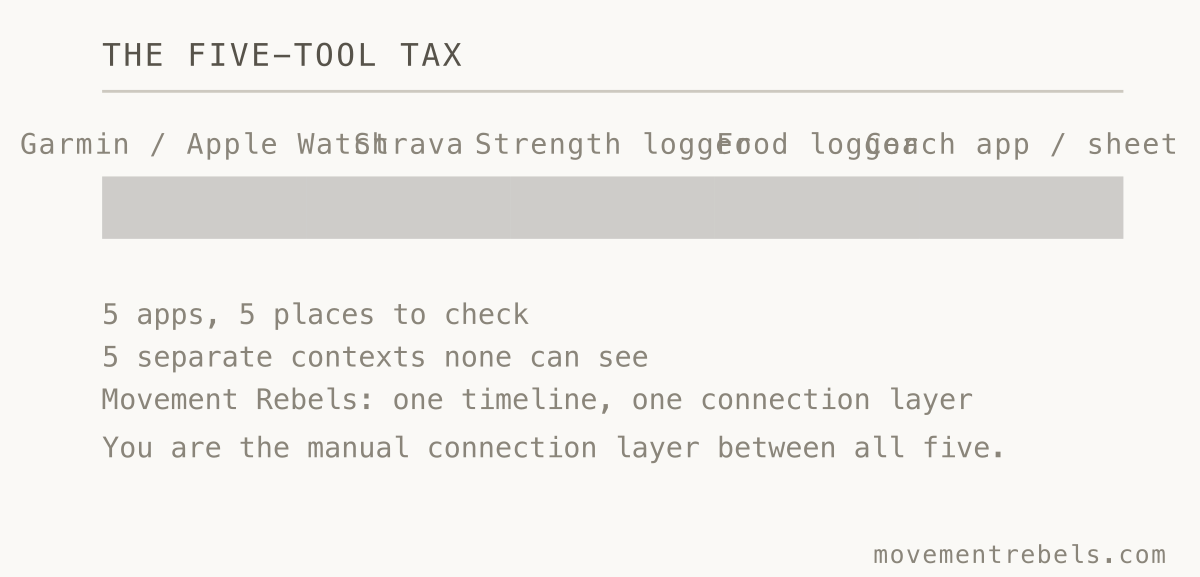
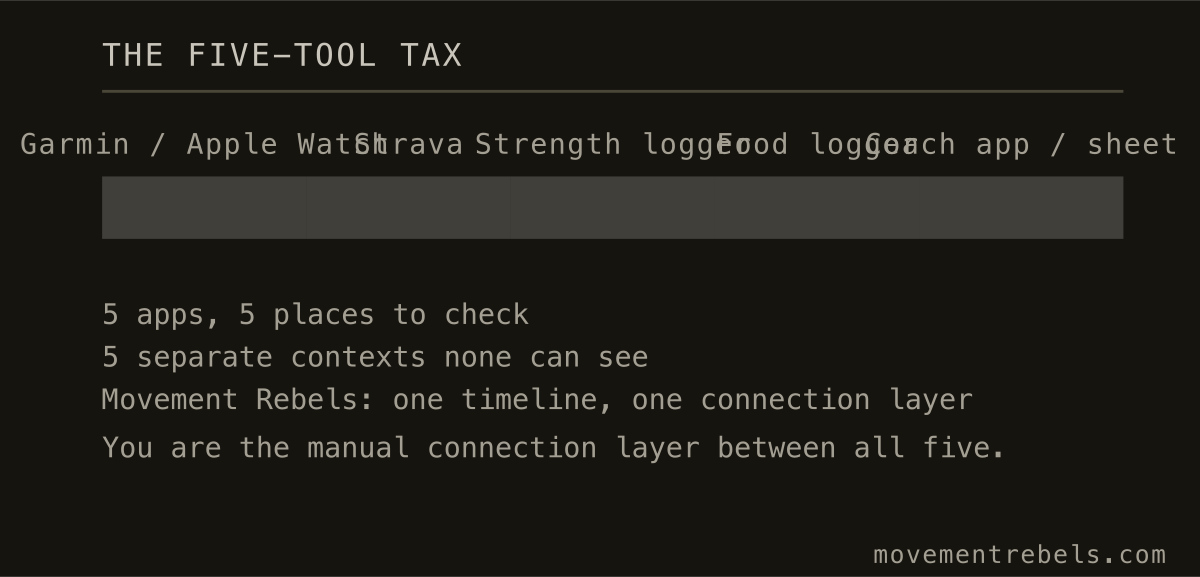
The result is not five times the insight. It is decision fatigue plus integration debt, with the athlete serving as the manual connection layer between everything.
The failure mode on the other side is equally common: one platform that claims to do everything but is secretly one thing with extras bolted on. The "AI coach" that is actually a chat window with no read access to your actual training data. The "adaptive plan" that never adapts because it cannot see your sleep or your fueling. For a breakdown of what a real adaptive plan requires under the hood, see adaptive training plans.
A real data-driven setup needs: a comprehensive exercise library so all training gets logged in one place; a planner that shifts the plan when recovery markers move; a fueling layer, because under-eating breaks the adaptation signal; recovery tools that log to the same timeline; and a coach layer that reads all of it. Anything less and you are back to being your own integration engineer.
How Movement Rebels connects the streams
When you connect Garmin (native OAuth) and Apple Health (native HealthKit on the iOS app, which is also where Oura and Polar data flows via Apple Health export), Movement Rebels pulls in the full picture: HRV trend, resting HR baseline, sleep duration, every completed run, ride, swim, and lift. Strava is native read and write. Completed sessions land in your activity feed automatically, and the coach writes a session summary back to the Strava activity description so your log is complete.
That is the input side. Here is what changes because of it.
Weekly plan generation reads your HRV, your sleep average, your completed-versus-planned session ratio, your strength PRs from the exercise log, and your last 14 activities. Rebel Fuel stays your own log: the coach does not read your meals, calories or macros. What it reads is the trail under-fuelling leaves, a resting heart rate climbing while HRV sags, and it pulls training volume rather than pushing through a session you do not have the glycogen to absorb. Write "eating at a deficit" into Notes for your coach and it reads that trend against the context instead of guessing at it.
The morning brief reads the same data and delivers a decision in plain language. Not "your readiness is 64." Something like: sleep was short last night and HRV is down from baseline. Move today's tempo to Thursday. Today is 45 minutes Z2 plus the upper-body session you have been undershooting on volume. That is the difference between a dashboard and a coach. For endurance athletes specifically, the same logic applies to pacing: see marathon training with heart rate data for how the model handles intensity when recovery data is in the same view.
When you start the session, it pushes to your Garmin with the structured prescription already loaded. No manual entry. After the session, the coach reads the file back and grades execution. Spend 38 minutes of a 60-minute Z2 ride above the cap and it flags it, asks what happened (heat, hills, a hard day at work), and adjusts the next prescription. For athletes who want a structured push direct to the watch, pushing workouts to your Garmin covers exactly that flow.
Recovery tools, breathwork, NSDR, cold exposure, fasting timer, log to the same timeline as training. So when you ask the coach why your HRV is suppressed two weeks out from a target race, it can see the four cold plunges and three sauna sessions in the last five days and tell you to dial the recovery stressors back rather than diagnosing a training problem that does not exist.
Cross-domain context works here too. The coach knows female cycle phase if you have logged it, knows masters-specific recovery timelines, knows what a postpartum return-to-training plan should look like. That breadth matters because training, fueling, and life stack on top of each other, and a system that sees only training data gives advice that fits only training data.
One honest gap: there is a feed, there are crews, follows and high fives, but no segments and a much smaller network than Strava. Keep Strava for the reach. Movement Rebels handles the training and coaching half.
What data-driven is not
It is not owning a better device. A $500 watch and a $300 ring producing two separate dashboards you check in the morning before going to the session you planned three weeks ago is data-decorated, not data-driven.
It is not a readiness score. A single proprietary number that summarizes everything into one digit cannot be interrogated or verified, and it cannot update tomorrow's session plan. It tells you how you are. A coaching system tells you what to do about it.
It is not volume. More metrics, more integrations, more charts do not produce better decisions. They produce more to check. The signal comes from the pattern across a short list of reliable markers. The when to deload guide covers exactly this: what combination of signals is actually worth acting on versus normal day-to-day variation.
Data-driven, done right, feels less like tracking and more like having a coach who read your logs before you walked in the door. The signals are in the background. What you notice is that the plan makes sense today, not just in theory.
How Movement Rebels handles this
One app. Strength (hypertrophy, powerlifting, Olympic, calisthenics, strongman, full exercise library with form videos). Endurance (running, cycling, swimming, triathlon, Hyrox, ultra). Hybrid and concurrent. Adaptive weekly plans that read recovery and fueling. Coach chat with cross-domain knowledge. Rebel Fuel with snap-meal photo tracking, macro estimate, hydration, supplements. Recovery tools on the same timeline. Wearables native: Garmin direct, Apple Health on iOS for the Oura and Polar crowd. Strava read and write.
Pricing
A 7-day free trial covers the full surface, no card. After the trial, Pro+ is $20/month for unlimited coaching.
One app instead of five.
Strength, endurance, recovery, fueling, planning, and your AI coach. All under a 7-day free trial. No card.
Start 7-day trialWhat Your Readiness Score Means Today
Understand what your Garmin Training Readiness and Body Battery scores measure. Learn which metrics matter, why devices disagree,
How the AI Coach Learns From Your Data: Periodization, Adaptation, and Feedback Loops
Adaptive is the most abused word in fitness apps. Here is what learning from your data means in practice: three feedback loops, re
HRV-Guided Training: Read the Signal, Skip the Noise
One low HRV night tells you almost nothing. The 7-day-vs-28-day trend tells you nearly everything. Here is what the evidence actua
Fitness Data Overwhelm: Signal vs Noise
Most wearable metrics are mildly interesting, not actionable. Six signals actually drive training decisions. Here is how to find t