Your First Triathlon: A Sustainable Training Week
Most people quit triathlon training before race day because they try to train like an Ironman athlete on the schedule of a normal person with a job, and when something has to give it is never the job. It is the training. You do not need that schedule. Most beginners finish a first sprint strong on 8 to 12 weeks and 3 to 5 sessions a week, so here is the week, the paces, and the two or three things that decide whether you cross the line walking or running.
Pick a sprint, not the brave option
Your first race is a sprint. The standard sprint is a 750m swim, a 20km bike and a 5km run, which is enough race to be proud of and nowhere near enough race to break you, and some pool-based sprints go shorter still, around 400m to 500m in the water. Friendliest entry point there is.
Skip the Olympic distance for race one. It is a 1.5km swim, a 40km bike and a 10km run, so everything doubles, the swim, the bike, the run, the training load, and the number of ways a first-timer gets hurt or burned out before the start line ever arrives.
A few things to weigh when choosing the actual event:
- Pool swim vs open water. A pool-leg sprint removes the single biggest source of first-race anxiety, so if one lands near you inside your timeline, take it.
- Flat bike course. Hills punish a beginner who has not built bike-specific strength. Rolling or flat.
- 8 to 12 weeks out. That window is enough to build the swim and lock in three weekly sport touches without cramming, and if your race is sooner than 6 weeks and you cannot swim 400m continuously, change the race rather than the plan.
Sign up. Something real, something dated. A booked race is the difference between training and intending to train.
The week that fits a life
Chasing volume is the mistake. Touching all three sports every week without missing the sessions sounds too small to be the whole answer, and it is close to the whole answer anyway, because three sessions you complete every week for ten weeks build more fitness than five sessions you abandon by week four. Consistency beats heroics. It is not close.
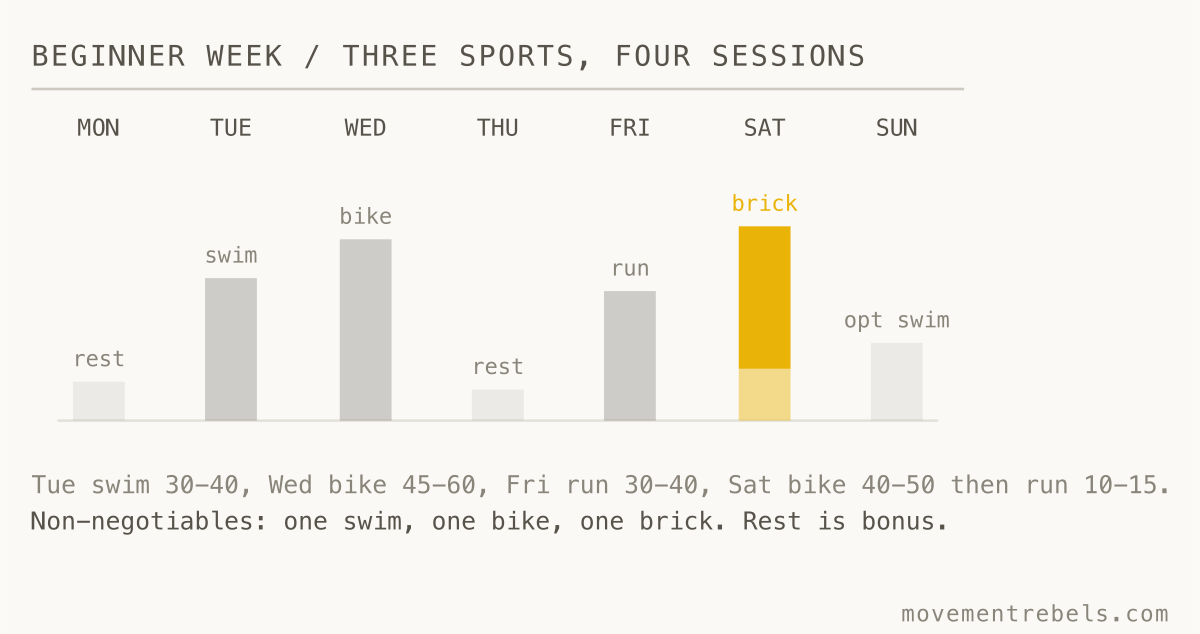
A sustainable 4-session week for a beginner with limited time:
- Monday: Rest, or 20 to 30 min easy walk. Recovery is training.
- Tuesday: Swim, 30 to 40 min. Technique plus intervals.
- Wednesday: Bike, 45 to 60 min, mostly easy aerobic with a few harder efforts.
- Thursday: Rest or mobility.
- Friday: Run, 30 to 40 min easy, conversational pace.
- Saturday: Brick. Bike 40 to 50 min, then run 10 to 15 min off the bike.
- Sunday: Optional second swim, or a longer easy bike if you have the legs.
Three sessions is all you have? Drop the Friday run and hang a short run off the end of the Wednesday bike, and keep one swim, one bike and one brick as the non-negotiables, because everything after those three is a bonus.
Most of your bike and run time sits at an easy aerobic effort where you can still speak in full sentences. Zone 2. Endurance gets built there without digging a recovery hole, and if you are unsure where that line falls for you, read zone-2 training and set your easy effort by feel or heart rate before you add a single hard session.
The swim: technique first, then a little fitness
The swim drowns more first-timers' confidence than their fitness. For a 750m race the goal is relaxed and continuous. Not fast.
Give the first 3 to 4 weeks to form, not yardage:
- Breathe every 3 strokes to keep your stroke balanced left and right, because bilateral breathing pays off in open water on the day you need to sight away from chop on one side.
- Drill the catch. Reach long, fingertips entering before the elbow, pull water back past your hip. Long stroke beats splashy.
- Build continuous distance. Work from 25m repeats with rest up to 100m, then 200m, then a continuous 400m, and once you can swim 750m without stopping you are race-ready in the water. Pace is a later problem.
A Tuesday pool session that works: 200m easy warm-up, 8 x 50m with 20 seconds rest holding good form, 200m continuous, 100m cool-down. Roughly 1,100m, 35 minutes. Newer than that? Scale the reps down. Once you can swim continuously, a Critical Swim Speed calculator for your swim paces turns one short timed swim into the training paces for every interval above.
Open water vs pool: train for the race you booked
Open-water race? Then you need at least two or three open-water swims before race day, because the pool does not teach you what the lake does.
- Sighting. Every 6 to 8 strokes, lift your eyes forward and find a buoy or a fixed landmark. You will swim crooked at first. Everyone does.
- The wetsuit changes everything. Buoyancy lifts your legs, which makes you faster and changes how the whole stroke feels, so swim in it at least twice before the race and never let race morning be its first outing.
- Cold-water gasp is real. The first 30 seconds of cold open water can trigger panic breathing in anyone, so get in early, splash your face, float on your back for a few breaths, and let it settle before the gun.
Pool-based race? Skip all of this and train in the pool. Train for the race you booked, not a harder version of it.
The brick: the session that decides your run
A brick is a bike followed immediately by a run, back to back, no real break. The first time you do it your legs feel like wood and your stride feels borrowed from somebody else for the first 5 to 10 minutes, which is normal, and the brick is the only way to train your body through that before it happens to you on race day.
One brick a week from week three onward. Keep it short:
- Bike 40 to 50 min, steady and controlled.
- Rack it, change shoes fast, run 10 to 15 min straight off.
- Run the first kilometer slower than feels right. Your legs catch up by the second.
Distance is beside the point. You are teaching your legs the transition and proving to your head that you can run on legs that feel strange, which is the part nobody rehearses, and for session structures, common mistakes and how to build brick volume, read the brick workout guide. Want the splits set for you? A brick workout generator to master the transition does that.
Pace the bike so you can run
The single most common race-day error looks like this. A beginner hammers the 20km bike feeling strong, steps off, and cannot run a step. The bike is where you bury your run.
Hold something back. Careful though, because holding back over a sprint is nowhere near a conversational effort, and sprint distance is short enough that the consensus among coaches is to push closer to your threshold than you would for a longer race. The 20km bike leg takes most beginners 30 to 40 minutes, and the 5km run after it is short enough to survive a hard bike, so the error is going out at maximum pace in the first few kilometers rather than riding hard across the leg overall.
A practical target for a first sprint:
- Clearly uncomfortable, still sustainable. A full conversation should be off the table. Training with power on a Garmin head unit? The general coaching guidance puts sprint pacing well above what you can sustain for an hour, not below it.
- First 3 to 5 minutes, dial back slightly until you settle, then ride your pace.
- Last 2km of the bike, ease off a touch and spin a higher cadence, which primes your legs for the run change.
A triathlon split calculator for your sprint race turns your goal finish time into target swim, bike and run splits, so you know how much to hold back on that 20km.
You will pass people on the run who passed you on the bike. That is the trade, working in your favor.
Gear, fuel, and race-day logistics
You need less than the marketing implies. No triathlon bike for a first sprint. No power meter.
The honest minimum:
- Bike. Any road bike or hybrid in working order, tires inflated, brakes checked.
- Helmet. Mandatory. No helmet, no start.
- Goggles and a swim cap. The race usually hands you the cap.
- Wetsuit. Only if the swim is open water and cold. Many races rent them.
- Running shoes you have already run in, because race day is not the day to break in a new pair.
- A race belt so you clip your number on instead of pinning it to a wet shirt.
Sprint fueling is short, which makes it easy. Eat a normal carb-based breakfast 2 to 3 hours before the start, and for a race under 90 minutes you mostly need water plus maybe one gel or a few sips of sports drink on the bike, which is the whole feeding strategy. For longer-course racing later, fueling around long sessions covers it.
Transitions, the fourth discipline:
- T1 (swim to bike): Wetsuit off, helmet on before you touch the bike, shoes on, run the bike to the mount line. Helmet on and chin strap fastened before the bike moves is a firm rule, and under standard triathlon rules an unfastened strap in transition earns a time penalty while the same strap on the bike course is a disqualification. Clip it before you touch the bike.
- T2 (bike to run): Rack the bike, helmet off, running shoes on, go. Lay your gear out in transition in the order you will use it, and practice both transitions in your driveway once, because it saves minutes and it saves panic.
Walk the transition area before the start. Know exactly where your bike is racked and which way the run exit faces.
How Movement Rebels fits
Building this week by hand is doable. Keeping it honest week after week, around your sleep, your missed sessions and the swim that went badly, is the hard part, and that is where the Movement Rebels AI coach earns its keep, because it reads your Garmin and Apple Health data, sees which sessions you completed, and builds the next week off your real training and recovery. Miss a brick? Sleep four hours? It adjusts, instead of pretending the plan is still on track.
Train like you mean to finish
A first triathlon is a finishing event. Nobody is chasing a podium in race one. Swim relaxed, ride within yourself, run off legs you have already trained to feel strange, and the day mostly handles itself once ten weeks of consistent sessions sit behind you. Book the race. Then go swim on Tuesday.
One app instead of five.
Strength, endurance, recovery, fueling, planning, and your AI coach. All under a 7-day free trial. No card.
Start 7-day trialOpen Water Swimming: Sighting and Swimming Straight
Pool fitness does not transfer straight to open water. How to sight without losing speed, swim straight, draft legally, and stay c
Brick Workouts for Triathletes: When and Why to Do Them
Bricks train one thing: the 679-meter sluggish zone after dismount. What peer-reviewed evidence says about the mechanism, how long
Zone 2 Training: When It Works, When It's a Waste
Zone 2 is real, old, and oversold. Here's the honest version: when low-intensity volume is your highest-leverage work, when it isn
Ironman Training With AI
Most age-groupers don't fail on race day because of fitness. They fail because no plan watched their nutrition, sleep, and recover