Ironman Training With AI
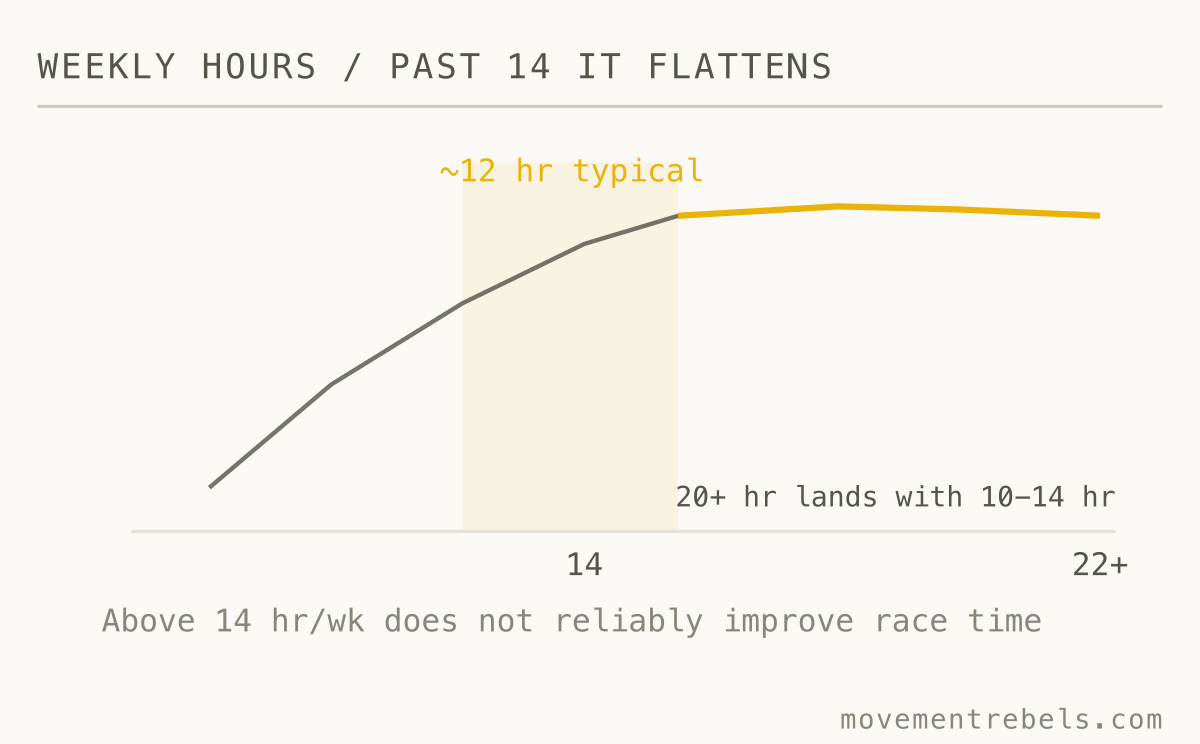
Here is the uncomfortable finding most Ironman content skips: training volume above 14 hours a week does not reliably improve race performance for age-groupers. Athletes logging 20-plus hours a week finish in the same ballpark as athletes logging 10-14. What does separate finishers is previous race experience and the absence of overtraining symptoms. Not the total hours. The quality of the hours, and whether the athlete arrived at the start line intact.
That reframe changes what an Ironman plan actually needs to do. It is not primarily a volume problem. It is an orchestration problem. The plan has to hold swim, bike, run, strength, fueling, and recovery in tension across 20 weeks and adjust when reality deviates from the schedule, which it always does. Most generic plans fail there: they tell you what to do on Monday but cannot see that you slept 5.5 hours Sunday night and skipped Saturday's long run.
This is what an AI coach changes.
What the research actually says about Ironman periodization
Recreational triathletes training for half-Ironman distances typically land around 12 hours a week during specific preparation. At that volume, neither polarized (mostly easy, some hard, minimal threshold) nor pyramidal (mostly easy, some threshold, less hard) intensity distributions produce clearly superior race results: research comparing the two approaches found finishers within seconds of each other over a half-Ironman race lasting close to six hours across the 13-week specific-preparation phase of a 20-week program. What that means in practice is that the intensity model matters less than the consistency model. Show up, stay below threshold on your easy days, do the hard days hard, and do not pile on volume expecting a linear payoff.
The other honest finding: wearable-measured nightly HRV and heart rate metrics correlate meaningfully with how well athletes adapt to a training overload. Athletes whose HRV dropped and nocturnal heart rate climbed during intensified blocks improved less on the performance test. Monitoring those signals over multi-day rolling averages, not single-night reads, gives early warning before the overtraining symptoms appear. That is the signal an AI coach should be reading. A static plan cannot.
How the AI builds and adjusts the 20-week structure
Movement Rebels structures the build in five blocks: base aerobic, strength endurance, race-specific, race simulation, and taper. The coach generates the coming week every Sunday based on what actually happened the prior week, not what was supposed to happen.
A mid-build week around week 11 looks roughly like this. Monday is a short swim with technique work plus a strength maintenance session of 25-40 minutes (heavy single-leg hip hinge, vertical pull, core). Tuesday is a Zone 2 bike, 90 minutes, with an explicit heart rate ceiling so it stays truly easy. See Zone 2 training for why that ceiling matters more than the time on the bike. Wednesday pairs a threshold run with an aerobic swim. Thursday is a long Zone 2 to tempo bike of two to three hours. Friday is full recovery or NSDR. Saturday is the long run, building from 90 minutes to 2:30 across the block. Sunday is the long bike with a brick run off the back, scaling from three hours up to six in race-simulation weeks.
Volume lands in the 12-18 hour range during the build, peaks near 20 hours in race-simulation weeks, and drops below eight during taper. The coach does not pick those numbers from a template. It reads your last four weeks of completed sessions, your HRV trend, your sleep, and the goal finish time you set in onboarding.
For how the brick sessions are structured within that week, see brick workouts for triathletes. To set realistic targets for each leg, a triathlon split calculator for Ironman pacing turns your goal finish time into swim, bike, run, and transition splits.
Strength: the part most plans sacrifice by week 14
The standard advice is to treat strength as optional and cut it when the swim-bike-run volume climbs. That works until it does not. Glutes that have been ignored for 12 weeks shut off on a 180 km ride. Lower back starts complaining on the run off the bike. Then the last six weeks of the build shift from training to damage control.
The fix is not more strength. It is enough strength, programmed inside the same plan rather than as a separate app on a separate schedule, so it does not disappear when the week gets full. The Movement Rebels strength codex sits in the same timeline as your bike intervals. Monday's session is two compounds and accessories with prescribed loads and a target RPE. Twenty-five to forty minutes. When fatigue accumulates mid-build, the coach drops accessory volume before it touches the compounds, because the compounds are what keeps your posture honest in hour eight.
If you are coming back from an injury or training around a structural weakness, see returning to training after injury for how that changes the strength programming approach.

Gut training: the race is decided in training, not on race day
GI distress is common among endurance athletes, with most research pointing to rates of 30-50% across long-course events. The cause is almost always inadequate gut training combined with a nutrition strategy that was never actually practiced under race conditions.
The physiology is well-documented. Repeated carbohydrate intake during training can upregulate intestinal glucose transporters and improve GI tolerance over time. Using glucose-fructose combinations targets two different intestinal transport pathways simultaneously, which raises the practical absorption ceiling from around 60 g/hour (the limit for single-source sugars) toward 90 g/hour or more. The multi-source ratio effect is available immediately once you switch fueling formats; the gut-training benefit of consistent practice is primarily reduced GI symptoms and improved comfort at those higher rates, not the transport ceiling itself. Either way, practicing your race nutrition on long training sessions matters. That practice does not happen by reading about it. A race nutrition planner for the long-course bike and run sets the per-hour carb and fluid targets to rehearse on those long sessions.
Movement Rebels programs gut training into the long sessions from week 8 onward. The Sunday long ride has a prescribed in-session fuel protocol: how many grams per hour, what format (gel, drink, real food), and when to take it relative to the workout structure. You log it in the same app you log the workout. By week 16, you have practiced the race-morning meal and the on-bike protocol fifteen times. Nothing on race day is a test. For the full fueling framework around long sessions, see fueling around long sessions.
Snap Meal lets you photograph your pre-session breakfast and get an instant carbohydrate estimate, so you know whether you are starting the long ride fueled or already in a deficit. Hydration logs on a separate tile so you can see the weekly trend rather than just today's intake. Sodium intake is referenced against your cramp history.
How Movement Rebels runs the full orchestration
The Sunday brief is not a copy-paste of last week with numbers bumped. Before writing it, the coach reads four data streams.
HRV and resting heart rate. Garmin connects natively via OAuth: completed workouts sync automatically and push structured sessions to the watch. The iOS app reads Apple Health natively, so metrics from devices that export to Apple Health flow to the coach. A seven-day rolling average trending down shortens the coming week or shifts intensity earlier in the block.
Sleep. Three nights below 6.5 hours and the harder session moves to Wednesday or intensity gets pulled. For the mechanism behind that decision, see sleep and training performance.
Completed sessions, not planned ones. If the Tuesday threshold run did not happen because of work, the coach does not stack it onto Wednesday. It rewrites the week from the current state.
Rebel Fuel. If you have logged 2,800 kcal three days running into a 12-hour training week, the brief opens with that. The coach names the gap and what it will cost on Sunday's long ride if not corrected. This is the loop that most triathlon apps do not close: recovery is not tracked in a separate app that never talks to the training plan. It is part of the prescription.
Strava connects in both directions. Your activities sync in. The coach writes a structured session summary back to the activity description so your Strava feed says what the session was for and what the target was. Movement Rebels does not replace Strava's social layer. It handles the coaching and planning layer Strava does not have. On the difference between what a platform reads and what a coach does with it, see the Strava AI coach comparison.
For the broader question of what an AI coach can and cannot do that a human coach can, see AI coach vs personal trainer.
Recovery tools (breathwork, NSDR, cold exposure, HRV-guided readiness) sit in the same app and can be prescribed by the coach. After a long brick, the brief might call for a 20-minute NSDR block before bed. After a recovery week, the readiness widget reads your HRV trend and tells you whether to start the build week on Monday or Tuesday. See HRV-guided training for what those readings actually mean and how to act on them. Biohack history logs every session so the coach can see whether recovery interventions are actually happening, not just prescribed.
The blind spot most Ironman AI plans share
The orchestration argument above assumes the AI coach is reading the right signals consistently. That breaks down when the athlete logs selectively: training sessions get logged because the watch does it automatically, but nutrition goes untracked three days a week and sleep data is absent on travel weeks. A plan that reacts to incomplete inputs does not adapt meaningfully. It just adjusts on the noise that was logged.
The practical discipline is not romantic: log your food, even roughly, on the hard weeks. Let the watch sync. The coach cannot see what was not recorded, and the weekly brief quality reflects exactly how much was.
Pricing
Seven-day free trial, no card. Movement Rebels Pro+ is $20 per month for unlimited coach use, unlimited plan generation, the full WOD library, every recovery tool, and the full strength codex. No separate Ironman-specific tier or upsell.
Swim CSS Calculator
Find your Critical Swim Speed and swim paces.
One app instead of five.
Strength, endurance, recovery, fueling, planning, and your AI coach. All under a 7-day free trial. No card.
Start 7-day trialAI Triathlon Coach: Three Sports, One Load
Most triathlon apps optimize three separate plans. An AI triathlon coach treats them as one load budget, detects your real limiter
Brick Workouts for Triathletes: When and Why to Do Them
Bricks train one thing: the 679-meter sluggish zone after dismount. What peer-reviewed evidence says about the mechanism, how long
HRV-Guided Training: Read the Signal, Skip the Noise
One low HRV night tells you almost nothing. The 7-day-vs-28-day trend tells you nearly everything. Here is what the evidence actua
Carbohydrate Timing for Athletes: Fueling Around Long Sessions
How many grams of carbohydrate and when: 1 to 4 g/kg before training, 30 to 90 g per hour through long sessions, and the 4 hour re