Zone 2 Training: When It Works, When It's a Waste
Zone 2 is real, old, and oversold. The aerobic base it builds is genuine physiology: mitochondrial density, capillary network, fat oxidation. It is also nothing new. Arthur Lydiard built Olympic champions on high-volume aerobic base work in the late 1950s, Phil Maffetone rebranded the idea as the MAF 180-minus-age method in the early 1980s, and the 1970s running boom called the same thing LSD, long slow distance. The recent wave just gave a 60-year-old idea a new number. Searches for "zone 2 training" rose sharply from 2020 onward, driven almost entirely by podcast appearances from Iñigo San Millán, Tadej Pogačar's coach, and Peter Attia, plus a lot of lactate meters sold along the way.
None of that makes it wrong. It makes it worth doing honestly instead of as a cult.
What Zone 2 actually is
Zone 2 is the highest intensity you can hold while staying almost entirely aerobic, with fat and lactate clearance keeping pace with lactate production. In lab terms it sits at or just below your first lactate threshold (LT1), often cited near 2.0 mmol/L blood lactate. In real life it is the pace where you can nose-breathe, hold a full conversation, and theoretically keep going for hours.
Be honest about the fuzziness, though. The exact boundary is contested. The 2.0 mmol number is a convention, not a law, and different methods of defining "Zone 2" can land on meaningfully different heart rates for the same person. That is not a reason to skip it. It is a reason to treat the cap as a working range, not a sacred line.
The benefits stack quietly over weeks: mitochondrial biogenesis, more capillaries around slow-twitch fibers, better fat oxidation that spares glycogen at higher intensities, a lower resting heart rate, a higher ceiling before lactate climbs. Boring on the day, transformative across a season. That delayed payoff is exactly why people skip it.
The honest filter: is Zone 2 even your highest-leverage work?
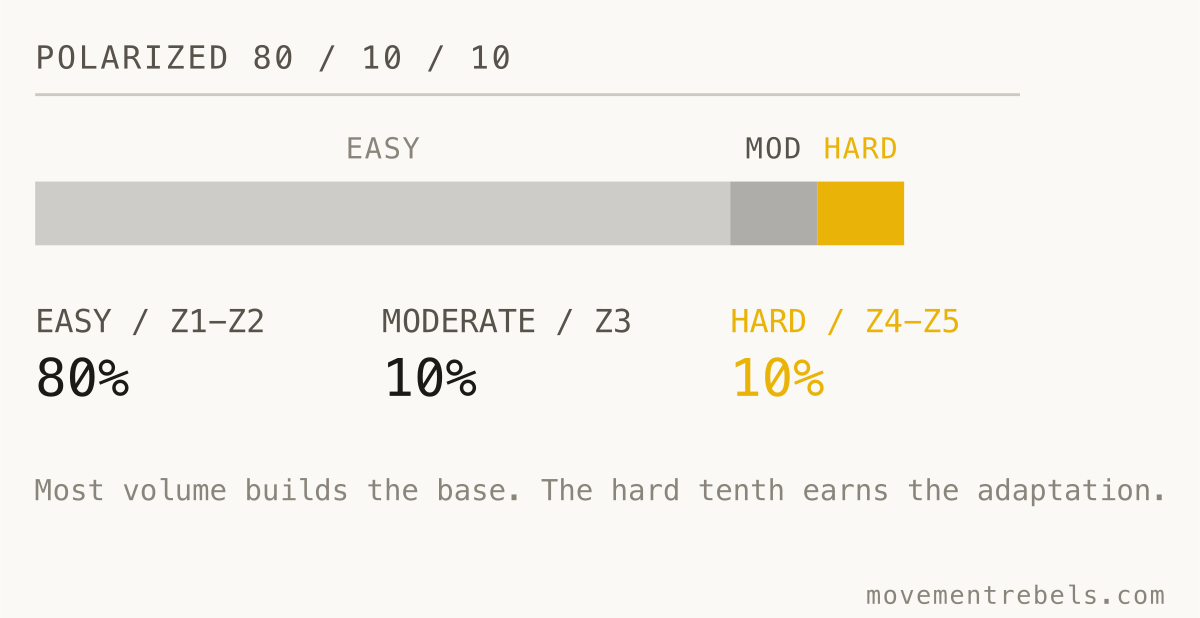
Here is the part the hype skips. The famous 80/20 split, 80% easy and 20% hard, comes from Stephen Seiler's research on elite endurance athletes training at high weekly session frequency, typically 10 to 13 sessions per week. For a fuller look at how to sequence these intensity blocks across a season, see periodization for recreational athletes. Seiler did not invent it. He measured what the best were already doing at huge volume. Copy that ratio on five hours a week and the math changes.
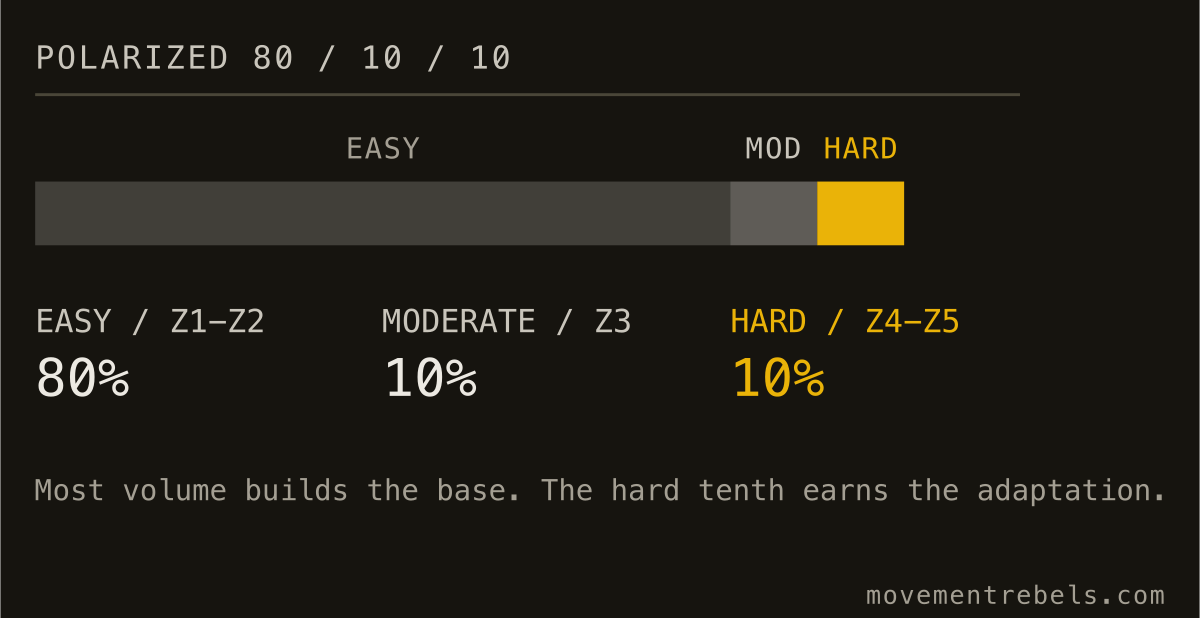
The research on people who train like normal humans is mixed, and that nuance matters more than any single number:
- For sub-elite and recreational athletes under about eight hours a week, the evidence broadly shows polarized and pyramidal distributions produce similar gains, and both clearly beat threshold-heavy "always medium" training.
- Some 2025 work even found that among recreational athletes, a pyramidal split (more moderate work, less ultra-easy volume) can edge out a strict polarized copy, the opposite of what holds for elites.
So before the how-to, the filter:
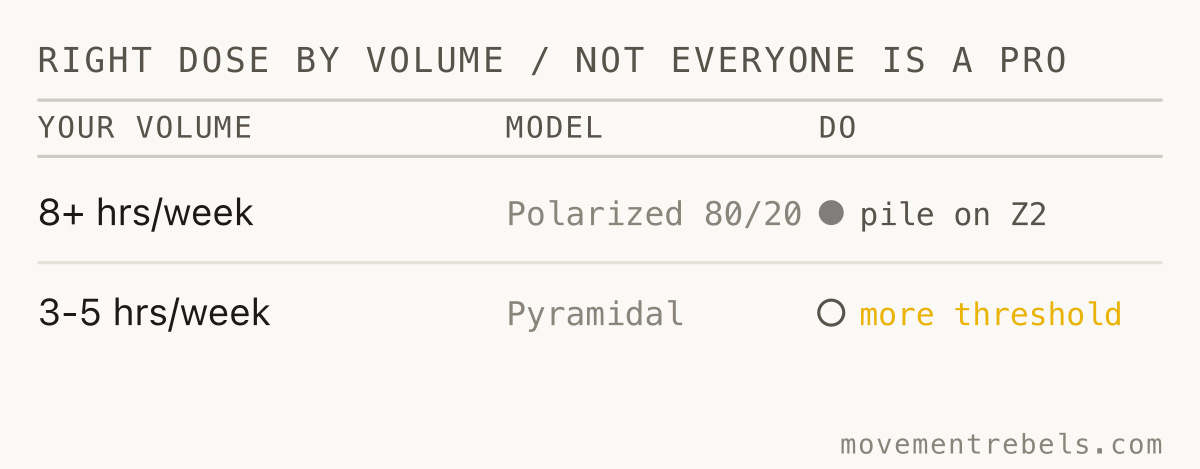
- Training 8+ hours a week, or endurance is your main sport? Zone 2 volume is the highest-leverage thing you can do. Pile it on.
- Training 3-5 hours a week and time-crunched? You still want some truly easy work, but a pure 80/20 elite copy is probably not your model. You likely get more from a pyramidal week with a bit more threshold and a bit less ultra-slow grinding.
The point is not "Zone 2 is overrated." The point is that the right dose depends on your volume, and most guides quietly assume you have the volume of a pro.
The "I'm going too hard" problem
Whatever your distribution, the one thing every camp agrees on is this: your easy days have to be truly easy. Run medium every day and you can never run truly hard, and the aerobic base never deepens. This is the single most robust finding in the whole debate, and the most violated.
Almost every recreational athlete drifts above Zone 2 within ten minutes of starting an easy session. Ego, the urge to "make it count", and the fact that real Zone 2 feels embarrassingly slow if you have any fitness at all. Runners should walk up hills. Cyclists should soft-pedal flats. Both feel wrong. Both are correct.
The signs you have left the zone: you can't finish a sentence without a breath, nose breathing breaks down, perceived effort drifts from 3/10 to 5/10, heart rate creeps past your cap and stays there. Ease off the moment any of those show up. The session does not get rescued by averaging back down. Once you spike lactate, that day's aerobic-adaptation budget shrinks.

Finding your Zone 2 ceiling
Three honest ways to set a cap, in order of accuracy:
- Lactate test. Gold standard. Find LT1, set the cap a few beats below. Most people will never do this, and that is fine.
- Talk test + nose breathing. Free, reliable, no gear. Nose-breathe and hold a conversation, you are in. Lose either, you are out.
- Heart rate cap from a field test. A 30-minute time trial is a useful anchor. Roughly 75-80% of your average HR from that effort sits near LT1 for most trained athletes. Age-based formulas are a poor starting point but better than nothing for a true beginner.
Pace is unreliable for Zone 2 on the run. Terrain, heat, fatigue, and altitude push HR up at the same pace. Power is steadier on the bike but still drifts on long sessions (cardiac drift). Heart rate plus the talk test is the working combination. See Zone 2 heart rate for the cap math. If you want pace bands to keep the hard days hard and the easy days easy, a VDOT calculator to set your easy and tempo paces gives you the targets off a recent race time.
The myth worth killing
You will read that "only Zone 2 builds mitochondria, in a way nothing else can." That is the overstatement that turned a useful tool into a religion. High-intensity intervals also drive mitochondrial adaptation, by a different pathway, and some evidence argues higher intensities produce greater mitochondrial capacity per minute. Even committed skeptics like Brad Stanfield argue the case for Zone 2's unique superiority is thinner than the marketing.
Zone 2's real edge is not magic. It is that you can accumulate hours at it without digging a recovery hole, week after week. Tracking cumulative load via Training Stress Score makes that balance visible across a training block. That is the whole point, and the whole catch. With no volume, the advantage mostly evaporates, which loops right back to the honest filter above.
How Movement Rebels handles Zone 2
The coach does not hand you a generic 80/20 template. It picks the intensity distribution that fits your weekly hours, polarized when you have the volume to earn it, more pyramidal when you are time-crunched, then prescribes each easy session with an explicit HR cap or pace ceiling, not a vague "easy".
When you start the workout, the structured session pushes to your Garmin watch through the native integration with the cap set as an alert. Drift past the ceiling for more than a couple of minutes and the watch buzzes. No more accidental tempo.
After the session, the coach reads the file back through Garmin or Apple Health (native on the iOS app) and grades it. Time-in-zone gets logged. Spend 38 minutes of a 60-minute Z2 ride above the cap and the coach flags it, asks why (heat? hills? life stress?), and adjusts the next prescription. Cross-discipline matters: Z2 cycling, running, and rowing all feed the same aerobic-base bucket, so a Tuesday spin substitutes cleanly for a missed Sunday long run when life intervenes. Managing that mix without letting the strength side erode is a hybrid athlete challenge worth planning for.
Fueling is where most Z2 plans quietly fall apart. Long aerobic sessions empty glycogen if you under-eat carbs across the week, and the next quality session suffers. The practical side of that is covered in fueling around long training sessions. Rebel Fuel logs meals and macros, and the coach watches for under-fueled patterns. Log a 90-minute Z2 ride on a day Rebel Fuel shows 1,800 kcal and 140g carbs total, and the coach will say so and set a refuel target before the next hard day. Recovery sits in the same app: breathwork for post-session down-regulation, NSDR for nap-replacement on heavy weeks, and the HRV-guided readiness read that decides whether tomorrow's intervals go ahead or shift to another easy day.
Pricing
Movement Rebels is one app for the full picture: strength, endurance, hybrid, planning, coaching, fueling, recovery, tracking. A 7-day free trial covers the entire surface. After the trial, Pro+ is $20/month for unlimited coaching. No card on the trial.
Heart Rate Zone Calculator
Find your five training zones, including Zone 2.
One app instead of five.
Strength, endurance, recovery, fueling, planning, and your AI coach. All under a 7-day free trial. No card.
Start 7-day trialZone 2 Heart Rate: Find Your Real Z2
Your watch zone is probably wrong. 220-age misses individual max HR by 10-15 bpm. Here's how to find your actual LT1 ceiling with
HRV-Guided Training: Read the Signal, Skip the Noise
One low HRV night tells you almost nothing. The 7-day-vs-28-day trend tells you nearly everything. Here is what the evidence actua
Periodization for Recreational Athletes: Which Model, and How Much You Need
Linear, block, undulating: the honest evidence on which periodization model recreational athletes actually need, and what the rese
Training Stress Score (TSS): Useful Number, Wrong Anchor
TSS quantifies session load well. The mistake is treating it as a recovery metric. Here's what it measures, where it breaks, and h