Brick Workouts for Triathletes: When and Why to Do Them
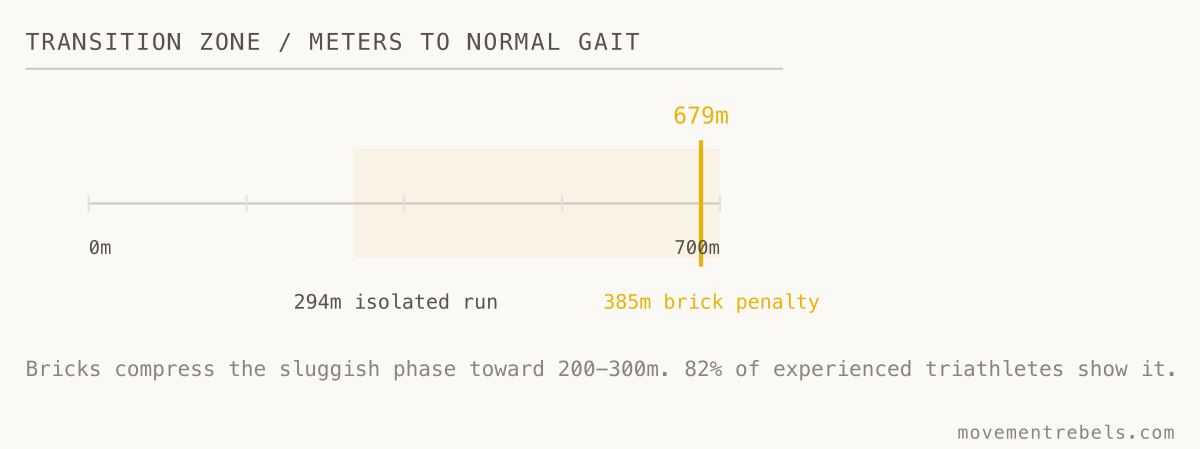
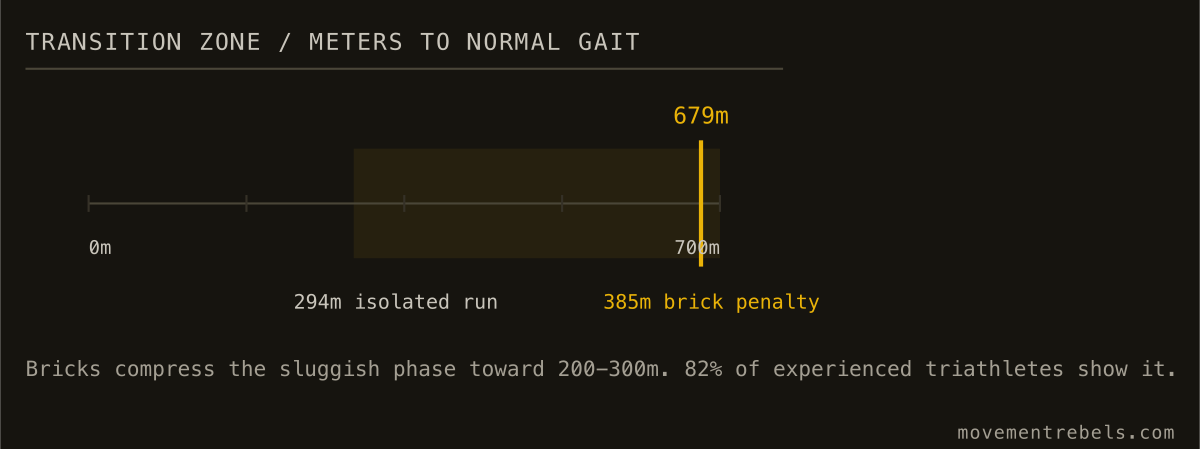
The first kilometer of your triathlon run is a specific, measurable problem. A 2022 Frontiers in Sports and Active Living study quantified exactly what happens to running mechanics after a cycling preload: 82% of experienced triathletes showed a transient "sluggish" phase, and the average distance before normal running coordination returned was 679 meters. In an isolated run with no prior cycling, that same disorganization resolved within 294 meters.
That 385-meter gap is the entire reason brick workouts exist.
What the research also found: the disruption was not a changed running style so much as wildly increased stride-to-stride variability. Your body knows how to run. After an hour on the bike, it just cannot decide, reliably, how to do it from one step to the next. That variability compresses with training exposure. Bricks do not eliminate the transition zone; they shorten it and make it predictable enough to pace through.
This guide covers the mechanism, how to structure bricks by race distance, the fueling trap that catches most age-groupers, and how to program them without accumulating injury risk faster than fitness.
What a Brick Actually Trains
The bike-to-run transition is a neuromuscular problem before it is a cardiovascular one. Cycling for 60-plus minutes locks your quads into a concentric, seated, ~85-95 rpm pattern. Running asks the same muscles to switch immediately to open-chain, weight-bearing, ~175 spm movement with significant eccentric load through the calf and hamstring. Your nervous system needs time to reorganize the firing pattern.
A PMC study on cycling's effect on running efficiency found that mechanical efficiency dropped from 48.2% in an isolated run to 42.1% after a 40-kilometer cycling bout, while anaerobic energy expenditure doubled (7.6 kJ to 16.3 kJ). Crucially, running economy measured by oxygen cost did not change significantly. The cardiovascular system was fine. The mechanical inefficiency was the problem, meaning wasted muscle recruitment and uncoordinated movement patterns burning more glycolytic fuel just to maintain pace.
Bricks train the nervous system to reorganize faster. Done consistently, the transition zone compresses from 679 meters toward something closer to 200-300 meters. Done sporadically or never, race day becomes an uncontrolled experiment with pace, fueling, and confidence all degraded in the first kilometer.
Beyond the neuromuscular adaptation, bricks serve three other things the bike and run in isolation cannot: pacing calibration (cycling at threshold and then holding race pace on the run is a sobering lesson), gut rehearsal under real race conditions (see the fueling section below), and the mental anchor of knowing exactly how the legs will feel at the dismount line.
The Honest Caveat on Evidence
The blog world overstates what research proves about brick training. The direct evidence for bricks as training stimulus is thinner than the evidence for the problem they solve. We have strong quantification of the transition-zone disruption. We have reasonable mechanistic explanations: concentric-to-eccentric shift, altered muscle spindle sensitivity, accumulated fatigue. What we have less of is controlled trial data comparing triathletes who do regular bricks against matched controls who do not.
The principle of specificity argues the logic clearly. The exercise science on neuromuscular pattern training argues it clearly. But if a coach tells you bricks are "proven" to cut your run split by a specific percentage, they are extrapolating. The honest statement is: the problem is well-documented, the solution is logically sound, and most experienced coaches and athletes report it works.
Brick Distances by Race
Brick volume scales to race distance, not to fitness or enthusiasm. The run portion loading already-fatigued tissue is where most age-grouper calf and hamstring injuries originate. That loading is necessary for adaptation. Too much of it too soon is an injury, not fitness.
If you want the splits and durations set for you, a brick workout generator for your race distance builds the bike and run blocks below from your target race.
Sprint (750m / 20K / 5K): Bike 30-45 minutes at race effort, run 10-15 minutes off the bike. The point is intensity, not duration. Open the run at race pace from minute one. Race-pace exposure matters more here than teaching pacing discipline.
Olympic (1.5K / 40K / 10K): Bike 60-75 minutes, run 20-30 minutes off the bike. Every other week, extend to a 90/45 split to rehearse the back-half feel. One proper brick per week is enough at this distance.
70.3 (1.9K / 90K / 21.1K): Bike 2-3 hours, run 30-60 minutes off. Build to one long brick (3 hours bike, 75 minutes run) 4-5 weeks out from race day. That single session tells you more about your pacing plan's viability than any other workout in the block.
Ironman (3.8K / 180K / 42.2K): Bike 4-5 hours, run 30-45 minutes off. Keep the run portion short. The cumulative load is already enormous. Two shorter bricks per week (for example: 3 hours bike plus 30-minute run, done twice in a build week) build more specific adaptation with less injury risk than one monster session. The run does not need to simulate the marathon. It needs to simulate the transition.
Bricks are where you rehearse the bike-to-run pacing you will use on race day, and a triathlon split calculator for bike-to-run pacing turns your goal time into the bike, transition, and run splits to test in these sessions.
The variable you adjust most is bike intensity, not duration. A race-pace bike with an easy run teaches you to pace correctly off a hard effort. An easy bike with a tempo run teaches a different lesson. Rotating these formats across your training block builds a more complete skill set than repeating the same session every week.
Four Formats Worth Using
Race-rehearsal brick. Bike at goal race watts or HR, run at goal race pace. The objective is making race day boring. Use this in your peak block, 4-6 weeks out. Do not start here.
Over-under brick. Bike at threshold for the final 20 minutes, then run easy. Simulates the worst-case scenario: you spend too much on the bike because someone surged, because the course had a tailwind on the way out and a headwind on the way back, because you got excited. You still have to run a controlled split. This format trains the discipline that saves races.
Strength-endurance brick. Hilly bike with sustained low cadence (55-65 rpm), then a flat steady run. Targets quad slow-twitch capacity and is mechanically specific to long-course racing. If you have done heavy strength work recently, note it. Loading fatigued quads this way the day after heavy squats compounds the injury risk. The hybrid athlete approach to sequencing your strength and endurance sessions matters here.
Mini-brick (transition repeats). Three to four short bike-to-run swaps (15 minutes bike, 5 minutes run, repeated) in one session. Pure neuromuscular pattern work with low total load. Useful in the two weeks before race day when you need the pattern fresh but cannot afford the accumulated fatigue from a full brick.

The Fueling Trap
Bricks are where most age-groupers discover their fueling strategy does not transfer from training to racing. The mechanism is well-documented: running sharply reduces splanchnic blood flow, meaning blood shunted away from the gut toward working muscles. Stomach motility slows. The gel you took at 45 minutes on the bike, absorbed comfortably while seated and pedaling, may resurface as a problem 5 minutes into the run.
A PMC review on exercise-induced gastrointestinal distress confirms that carbohydrate malabsorption is higher during running than cycling and that the mechanical bouncing of running adds a second stressor the gut did not face on the bike. The practical response: weight your carbohydrate intake toward the earlier portion of the bike leg, use multiple-transporter carbs (glucose plus fructose blends) for better absorption, and test every fueling product in brick sessions before race day. Never debut a gel at a race.
For sessions over 90 minutes, target 60-90g carbs per hour across both blocks. The heavier loading goes on the bike. A race nutrition planner for longer bricks sets your per-hour carb and fluid targets so you can practise them in the session, not at the race. For Ironman-distance bricks, anything you plan to run on needs to go through your gut during a long training brick at race pace. GI tolerance is trainable, which makes brick sessions as much gut rehearsal as neuromuscular work. For more on this, fueling around long sessions covers the absorption mechanics in detail.
Recovery After a Brick
The brick run piles eccentric load onto legs already glycogen-depleted from the bike. That combination is a meaningful recovery demand, and underestimating it is how peak-block athletes accumulate fatigue faster than fitness. See when to deload for the signals that tell you the load has tipped the wrong direction.
Practical recovery hierarchy after a brick: carbohydrate refuel within 30-45 minutes, protein to support muscle repair (0.4g/kg is a reasonable target for the immediate post-session window), and an honest read of the next 24 hours. A planned threshold run the morning after a major brick is often the wrong move. How your body responds to brick load is one of the clearest signals your weekly plan is calibrated correctly or not.
HRV and resting heart rate are the two metrics worth watching across a build block. Both trend downward under accumulated load and should recover meaningfully on easier days. If they do not, the bricks are doing damage faster than recovery can absorb. HRV-guided training covers how to read these signals without over-indexing on any single data point.
How Movement Rebels Handles This
Bricks are programmed as one continuous session on your calendar with the bike block, the transition window, and the run block sequenced together. The Garmin integration pushes the structured workout directly to your watch so bike intervals fire correctly and the run phase autostarts at the dismount. After the session, the coach reads the completed file back through Garmin Connect or Apple Health (native on the iOS app) and grades execution: time in zone, pacing discipline on the run, where you drifted.
The AI triathlon coach (see AI Triathlon Coach for a full breakdown) reads your last four weeks of training, your race date, and your readiness signal to set the brick format and intensity for the upcoming week. An over-under brick is not the right call when your HRV has been suppressed for three days. The coach makes that call automatically and tells you why.
Strava write-back posts a session summary to your activity description after the brick, so your training partners see what you did. The coach writes summaries back to Strava; it does not use Strava as a data input for coaching decisions. Data from Apple Health flows in through the native iOS integration, picking up sleep, HRV, and resting heart rate from any device that exports to Apple Health. Garmin connects directly.
One app for the full stack: planning, the workout file on your watch, the post-session grade, the fueling log, the recovery read, and the coach chat that ties it together.
Pricing
Movement Rebels covers the full picture: endurance coaching, structured workouts to Garmin, recovery tracking, fueling, and the AI coach that connects them. A 7-day free trial covers everything. After the trial, Pro+ is $20/month for unlimited coaching. No card required on the trial.
One app instead of five.
Strength, endurance, recovery, fueling, planning, and your AI coach. All under a 7-day free trial. No card.
Start 7-day trialOpen Water Swimming: Sighting and Swimming Straight
Pool fitness does not transfer straight to open water. How to sight without losing speed, swim straight, draft legally, and stay c
AI Triathlon Coach: Three Sports, One Load
Most triathlon apps optimize three separate plans. An AI triathlon coach treats them as one load budget, detects your real limiter
Ironman Training With AI
Most age-groupers don't fail on race day because of fitness. They fail because no plan watched their nutrition, sleep, and recover
Carbohydrate Timing for Athletes: Fueling Around Long Sessions
How many grams of carbohydrate and when: 1 to 4 g/kg before training, 30 to 90 g per hour through long sessions, and the 4 hour re