Carbohydrate Timing for Athletes: Fueling Around Long Sessions
Most athletes have carbohydrate timing upside down: they fuss over the 30 minutes after a session and ignore the 24 hours before it, which is where the fuel for a hard workout comes from. Timing does matter. Four situations: sessions over 90 minutes, two hard sessions in one day, race week, and the block where you are cutting weight. Here are the numbers for before, during and after, and the cases where you can skip them.
Every band below is a row in the reference table further down, which covers the full range from a 40-minute lift to a 5-hour ride, and that table is the part to bookmark. The prose around it argues the numbers out: the daily total that decides whether timing matters at all, the sodium and protein that sit alongside the carbohydrate, and the point where the supplement aisle stops being the answer.
Total intake first, timing second
About 600 g. That is how much carbohydrate your body holds as glycogen, roughly 500 g in muscle and 80 g in the liver, per a review of glycogen metabolism written for coaches, and that is the tank. At moderate intensity most athletes get somewhere around 90 minutes to two hours out of it, which is why the wall shows up when it does. Timing decides how full the tank is when you start and how fast it refills; daily intake decides whether it is ever full at all, and an athlete eating 3 g/kg a day while training two hours a day cannot fix that with a well-placed gel.
This is the part the three-window framework buries. Athletes who blow up at 90 minutes usually do not have a gel problem. They have a chronic under-fueling problem: carbohydrate intake across the whole week is too low, so they arrive at every long session with glycogen already at partial capacity, then wonder why the last 45 minutes feel like running in wet concrete.
The daily numbers scale with training load. A general fitness program of an hour or less at low intensity runs on 3-5 g/kg/day. Moderate training of about an hour a day sits at 5-7 g/kg, 1-3 hours a day of moderate-to-high intensity work needs 6-10 g/kg, and ultra-endurance loads of 4-5 hours a day climb to 8-12 g/kg, per the ACSM figures summarized in this endurance nutrition review. For a 70 kg athlete training 90 minutes a day that is 420-700 g of carbohydrate. No amount of clever timing lands you there by accident. A macro calculator to set your daily carbohydrate target turns bodyweight and training hours into grams.
Once the daily total is right, timing is where the last few percent live, and the International Society of Sports Nutrition's position stand on nutrient timing puts it plainly: outside situations where rapid recovery is needed, and when daily carbohydrate intake matches energy demands, the importance of timed carbohydrate intake is notably decreased. Match the day's intake to the day's load. Then read on for the cases where the clock matters.
Before: the 1-4 hour window
The pre-session meal has one job. Start with a full liver and a topped-up muscle store, without anything sitting in your stomach at minute ten. The guideline is 1-4 g/kg of carbohydrate in the 1-4 hours before exercise, and the two numbers move together: a full meal at the top of the range 4 hours out, a small, low-fibre, low-fat snack at the bottom of it 1 hour out. For a 70 kg athlete that spans 70 g (two slices of toast with jam and a banana) to 280 g (a large plate of rice, chicken and fruit), depending on how much time you have.
Liver glycogen is why a morning session feels different: the liver holds blood glucose steady overnight, so you wake with it partly drained while muscle glycogen is untouched. For an easy 45-minute run that matters little. For a morning interval session, eat a small carbohydrate snack 30-60 minutes out. A slice of toast with honey, a banana, or 30 to 40 g from any low-fibre carbohydrate source covers it without the gut penalty. Whether to skip it on purpose is covered in the fasted training guide.
One myth needs killing here. Carbohydrate in the hour before exercise raises insulin and can dip blood glucose in the first minutes. Some athletes feel it as a wobble. A review of the pre-exercise feeding evidence found almost all studies point toward unaltered or improved performance, that the symptoms are rarely linked to low glucose at all, and called the advice to avoid carbohydrate in that hour unfounded. Still feel the dip? Move the snack into the last 10-15 minutes or the warm-up itself, so exercise starts before insulin peaks.
During: scale the grams to the clock
How much to take in during a session depends almost entirely on how long it lasts. Intensity is the second dial.
- Under 45-60 minutes. Nothing. A full glycogen store covers it, and the guidelines agree that no exogenous carbohydrate is required under an hour.
- 45-75 minutes at high intensity. Small amounts. Even a mouth rinse works: in the original study, nine trained cyclists rinsed a 6.4% maltodextrin solution for 5 seconds at every eighth of a 1-hour time trial, spat it out, and finished in 59.6 minutes against 61.4 with water. A follow-up with brain imaging showed oral carbohydrate activating reward and cognitive-control regions, with 2-3% more power output. The benefit is central, not fuel.
- 1-2.5 hours. 30-60 g per hour. A gel is usually 20-25 g and a 500 ml bottle of 6-8% sports drink 30-40 g, so one gel plus a bottle each hour gets you there.
- Over 2.5 hours. Up to 90 g per hour, and only with mixed sources. Glucose and maltodextrin both cross the gut wall through the SGLT1 transporter, which saturates at around 60 g per hour, while fructose uses a different transporter, so adding it lifts oxidation up to 75% higher in the studies that compared them. That is why products come as 2:1 glucose:fructose, and newer work argues a ratio closer to 1:0.8 is more efficient.
- Over 2.5 hours, elite and gut trained. In a randomized trial of 20 elite mountain-marathon runners, the 120 g/h group finished the 42 km and roughly 4,000 m of climbing and descending with lower internal load and a fraction of the muscle-damage markers at 24 hours compared with the 60 and 90 g/h groups. One catch. Every runner had spent the prior four weeks practising 90 g/h at least twice a week, and reading that trial as permission to try 120 g/h on race morning is how people end up walking the last 10 km with stomach cramps.
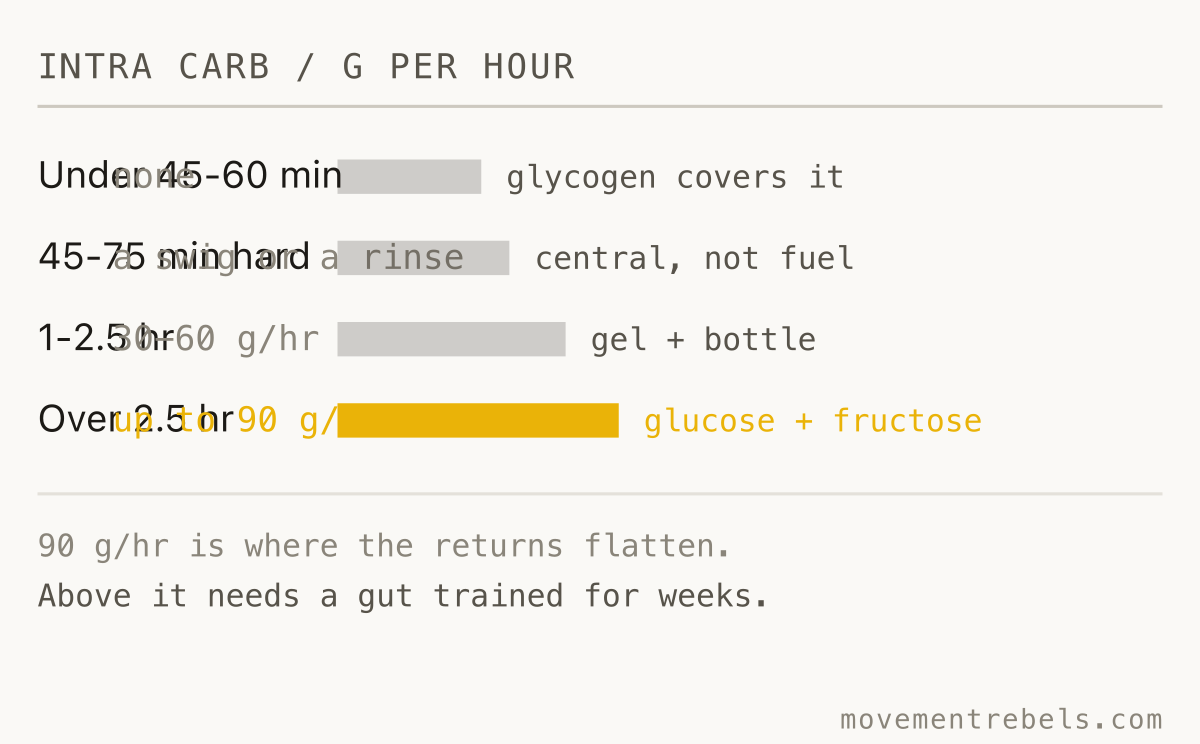
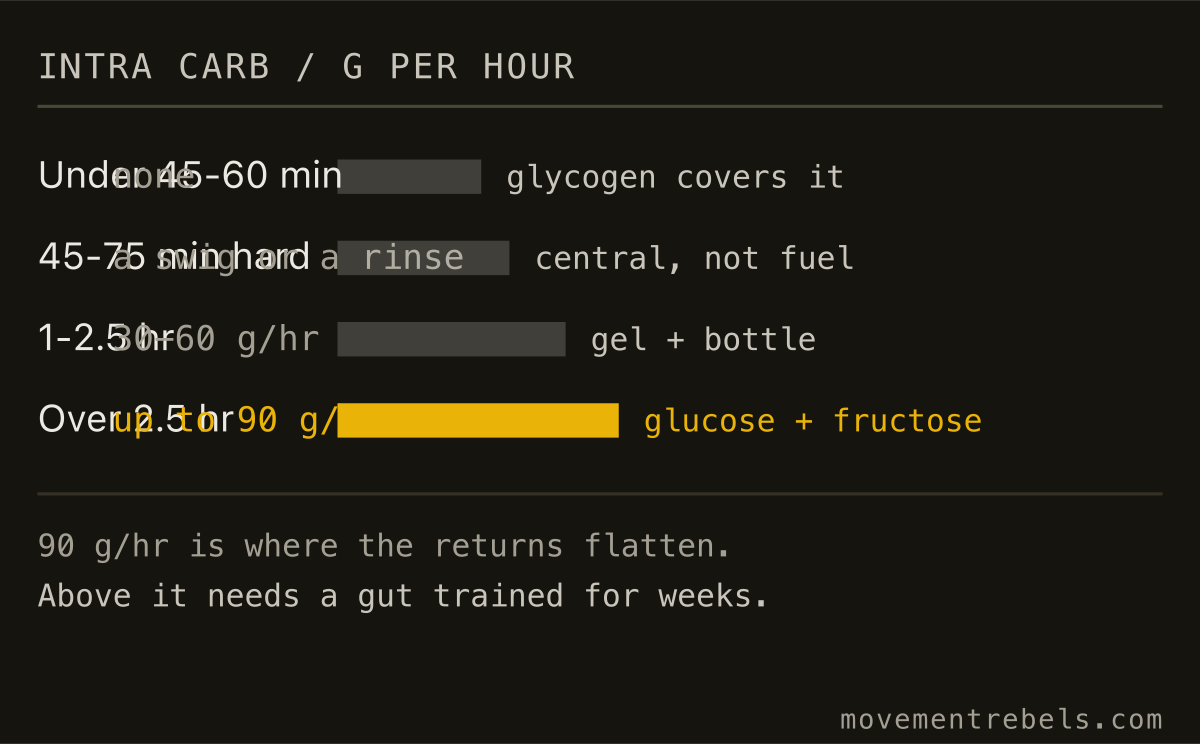
For most athletes, 90 g per hour is where the returns flatten. Above it the evidence is narrower and conditional, and the trials that show a benefit used athletes who had spent weeks training the gut for it.
The gut is trainable. Twenty-eight days on a high-carbohydrate diet (8.5 g/kg/day against 5.3) raised exogenous carbohydrate oxidation in trained cyclists, and intestinal glucose transporters increase within days to two weeks of a higher intake, per Jeukendrup's review on training the gut. Practise race intake in training. At race intensity. Weekly. The gut training guide has the progression, and a race nutrition planner converts a g/h target into gels and bottles.
Fueling at 90 g per hour also spares the liver. Intake above 1.5 g per minute can prevent liver glycogen depletion during moderate-intensity exercise, which is part of why the second half of a fuelled ride feels so different.
One nuance most guides skip: female athletes oxidize a higher proportion of fat and a lower proportion of carbohydrate at matched intensities compared to males, which shifts the math on how much carbohydrate is needed mid-session. The 2025 review by Cao et al. notes this explicitly and recommends periodised nutritional protocols over applying male-derived targets blindly to female athletes. Treat the bands above as a starting point to test in training, not a fixed prescription.
Sodium belongs in this window too. Aim for 500 to 1,000 mg of sodium per hour in moderate conditions, more in heat. Cramping is rarely pure dehydration. Sodium loss combined with a carbohydrate deficit and accumulated fatigue is a better model of what happens in the last hour of a long day. See the hydration tracking guide for the session-by-session approach to logging sweat losses.
After: the 4-hour clock, and who needs it
The classic timing study is from 1988. Twelve cyclists rode 70 hard minutes, then drank 2 g/kg of carbohydrate either immediately or 2 hours later, and in the first 2 hours the immediate group stored glycogen at 7.7 µmol per gram of muscle per hour while the delayed group managed 2.5. Even once the delayed group started eating, their rate stayed 45% slower than the immediate group's had been. The window is real. The question is whether you need it.
You need it when the gap is short. Around 8 hours is the cutoff the guidelines converge on: a two-a-day, a morning lift and evening intervals, or an evening session followed by a hard morning. One endurance review sets the trigger tighter still, calling for aggressive refeeding at 1.2 g/kg/h when another event is under 4 hours away. Either way the target is roughly 1.0-1.2 g/kg per hour for the first 4 hours, eaten in small doses: feeding every 15-30 minutes produced roughly 40% higher resynthesis rates than every 2 hours in the studies this recovery review compared. For a 70 kg athlete that is 70-84 g an hour. A recovery drink and a banana. A rice bowl an hour later. Then more. Note the unit: that is a rate per hour, not a single dose to hit once and forget.
If you cannot face that much, protein covers part of the gap. At or below 0.8 g/kg per hour of carbohydrate, adding 0.3-0.4 g/kg per hour of protein raises glycogen storage back toward the higher-carbohydrate rate, per the same review: 56 g of carbohydrate plus 21-28 g of protein an hour for our 70 kg athlete, which lands most athletes somewhere in the 20 to 40 g of protein per hour range depending on bodyweight. This is the one case where a milk-based recovery drink earns its place.
Back-to-back hard days are the grey zone. The reviews disagree about where the line sits: Podlogar and Wallis apply the same 1.0-1.2 g/kg/h protocol whenever the next session demanding high carbohydrate availability lands within 36 hours, which pulls Saturday's long run followed by Sunday's into scope. The practical version: the shorter the gap and the harder tomorrow is, the more the clock matters.
If tomorrow is easy, or the next hard session is a couple of days out, the clock loosens. From 4-24 hours out, the total amount of carbohydrate matters more than when or in what form you eat it, and a day at 8-10 g/kg restores pre-exercise glycogen within 24 hours, so eat a normal meal within a couple of hours because you are hungry, then hit the daily number. The 30-minute rush is for people with a second session. The rest of us can eat dinner.
Protein across the day
The same loosening applies to protein. The "anabolic window" was taught as 30 to 45 minutes, and the evidence does not support a frame that narrow: total daily protein intake explains far more of the muscle adaptation than the placement of any single feeding. The post-workout protein window guide walks through what survived the scrutiny.
What holds up is distribution. The evidence points to roughly 0.25 g of high-quality protein per kg of bodyweight per meal, spread across three to four meals every 3 to 4 hours. For a 75 kg athlete that is about 20 g a meal, four times a day. That pattern does more for adaptation than any single post-workout shake, and it is the part most athletes get wrong while optimising the half hour after a session. After a 3-hour ride: a meal of 25 to 35 g protein and 75 to 90 g carbohydrate within a couple of hours, then similarly structured meals through the rest of the day. Chicken and rice, a shake with banana and oats, Greek yogurt with granola and honey. None of these require a product.
The carbohydrate timing reference table
Read it top to bottom as a day: the daily rows set the total, and the before, during and after rows say where inside the day the grams go. The example column uses a 70 kg athlete, so scale by your own bodyweight. Where a row says none, that is the answer. Not a gap.
| Window | Situation | Target | 70 kg example |
|---|---|---|---|
| Daily | Light training, under 1 h/day, low intensity | 3-5 g/kg/day | 210-350 g |
| Daily | Moderate training, about 1 h/day | 5-7 g/kg/day | 350-490 g |
| Daily | 1-3 h/day at moderate-to-high intensity | 6-10 g/kg/day | 420-700 g |
| Daily | 4-5 h/day, ultra-endurance load | 8-12 g/kg/day | 560-840 g |
| Race week | 36-48 h before an event over 90 min | 10-12 g/kg/day | 700-840 g per day |
| Before | 1-4 h before a key session | 1-4 g/kg, smaller and simpler the closer you are | 70-280 g |
| During | Under 45-60 min | None needed | 0 g |
| During | 45-75 min, hard | Small amounts or a carbohydrate mouth rinse | A swig of sports drink every 10-15 min |
| During | 1-2.5 h | 30-60 g/h | 1 gel plus a bottle per hour |
| During | Over 2.5 h | Up to 90 g/h, glucose:fructose from 2:1 to 1:0.8 | 2 gels plus a bottle of 8% drink per hour |
| During | Over 2.5 h, elite, gut trained for weeks | Up to 120 g/h | Race-tested product only |
| During | Any session over 60 min | 500-1,000 mg sodium per hour, more in heat | 1 electrolyte tab or a salted bottle |
| After | Next hard session within 8 h | 1.0-1.2 g/kg/h for 4 h, fed every 15-30 min | 70-84 g per hour |
| After | Same, but appetite is gone | 0.8 g/kg/h carbohydrate + 0.3-0.4 g/kg/h protein | 56 g carbs + 21-28 g protein per hour |
| After | Next hard session 8-36 h out | Same protocol is worth running, reviews differ on how hard | Start eating within 2 h, then the daily row |
| After | Next hard session 2+ days out, or an easy day | No clock, hit the daily total | Normal meal within 2 h, then the daily row |
movementrebels.com
One note on the race week row. Loading at 10-12 g/kg/day for 36-48 hours only pays for events over 90 minutes; a carb loading calculator sizes it, and the marathon fueling guide covers the race itself.
Lifters, hybrid athletes and short intervals
Almost everything above is written for sessions with a clock. A 60-minute strength session runs on the glycogen already in the muscle, so what the lifter needs is the daily row and the before row: a carbohydrate-containing meal 1-3 hours before a heavy session, and a daily intake in the 3-5 or 5-7 g/kg band depending on what else the week holds. Training on a calorie deficit covers what happens to that band when you are cutting. That is when placing the carbohydrate you do eat around the session starts to matter.
The exceptions are the ones the table flags. A HYROX simulation or a 90-minute high-rep session lands in the 1-2.5 hour row, and a hybrid athlete who lifts at 07:00 and runs intervals at 17:00 has a two-a-day, so the after rows apply between them. Long zone 2 rides are the other trap: that is where the 60 to 90 g/h math lives, and where most athletes under-fuel, because moderate effort feels easy and never sets off the "I should eat something" alarm. The common failure: a 300 g day followed by evening intervals that feel like wading. Count the hours of training. Not the number of sessions. Hybrid athlete training covers how to place those sessions in the week.
Common mistakes
- Fueling the session you are not doing. Gels on a 50-minute easy run add calories and nothing else, so save the intra-session carbohydrate for the days the table says so.
- A flat daily intake. The same 350 g on a rest day and on a 3-hour day underfuels the hard day and overfuels the easy one. Move the daily row with the load.
- Trying 90 g per hour for the first time in a race. The gut has to be trained for weeks at race intensity first, so start at 60 g per hour in training and build.
- Too much fibre or fat close to the start. A meal 4 hours out can be a normal meal; a snack 1 hour out should be low in fibre and fat so it has emptied before the warm-up ends.
- Skipping the after window before a second session. Eight hours or less between hard sessions is where the 4-hour clock stops being optional.
- Fasted intervals. Easy aerobic work fasted is a choice. A threshold session on an empty liver is a slower session.
- Ignoring fluid. Gels need water and drinks bring it. A sweat rate calculator sets the volume, and hydration tracking for athletes covers the overdrinking risk on the other side.
The supplement economy is not your fueling strategy
Gels, chews and sports drinks have genuine utility at the upper end of intra-session intake, 60 g/h and above, because they are compact, gut-tested and easy to carry at pace. They are not magic. The glucose and fructose in them behave the same way as the glucose and fructose in diluted juice, white rice in a jersey pocket, or dates. The delivery format matters. The molecule does not.
The sports nutrition industry profits from the idea that getting fueling right is complicated and requires brand-specific products. Some of that complexity is real at elite volume and precision. For most athletes training 6 to 12 hours a week, the move that pays is eating more carbohydrate across the whole week, arriving at long sessions with a full tank, and putting something in your pocket for efforts over 90 minutes. Spend money on food before you spend it on supplements.
How Movement Rebels fits
Rebel Fuel inside Movement Rebels logs your pre, intra and post fueling against your planned sessions. Snap meal estimates a photo in seconds, the macro estimator handles anything you weighed, and hydration logging sits in the same view.
Carbohydrate timing is a plan you run against a training week, and the week is what the coach owns. The Movement Rebels AI coach reads your Garmin and Apple Health activities: duration, average heart rate, power and TSS on rides, pace and splits on runs. It sees the last 14 sessions and the calendar 7 days back to 7 days ahead, it counts a heavy squat session you logged there as load, not as a blank day, and it reads your morning check-in and your synced HRV and resting heart rate as well. Rebel Fuel it cannot read. Your meal log stays yours, and it does not know what you ate before Tuesday's intervals unless you tell it.
Telling it works. Write "3-hour ride Saturday, race-fuel practice at 80 g/h" in the notes for your coach, or on the activity afterwards, and the weekly plan treats Saturday as the long, hard session it was, with recovery the day after. Underfuel a block and the signals show up in the data it does read: a resting heart rate drifting up over a week and an HRV trend drifting down, the pattern a coach reads as a fueling problem before the athlete admits to one. It then lowers the next days' workload or moves the hard session rather than piling on. See HRV-guided training for how that readiness signal moves the daily plan.
Start with the daily row for the week you have planned, put the numbers next to the sessions in your calendar, and write the fueling practice into the notes for your coach so the long days carry it.
Pricing
Movement Rebels is one app for the full picture: endurance, strength, hybrid, planning, coaching, fueling, recovery, tracking. A 7-day free trial covers the entire surface. After the trial it is $20/month for unlimited coaching. No card on the trial.
One app instead of five.
Strength, endurance, recovery, fueling, planning, and your AI coach. All under a 7-day free trial. No card.
Start 7-day trialHow to Fuel a Marathon: Race-Day Nutrition From Start Line to Finish
Marathon fueling that holds up past 30K: carb loading numbers, race morning timing, carbs per hour, drinking to thirst, caffeine d
Gut Training: Build the Carb Tolerance Long Sessions Demand
Your gut is trainable. A progressive intra-workout carb protocol raises tolerance toward 90-120 g/hr over weeks. Here is the hones
Train Fasted or Fuel First? Morning Workout Nutrition
Fasted training raises fat oxidation and trains substrate flexibility. It does not improve performance or hard-session quality. Wh
The Post-Workout Protein Window Is a Myth
The 30-minute post-workout protein window is mostly a myth. Your real window is closer to a day. Here is what the research shows,