Heat Acclimation When You Train in a Cold Climate
Here is the honest version of this problem: you live somewhere cold, train through winter in layers, and then register for a race in Mallorca, Lanzarote, or southern Spain in late spring. You have twelve weeks. You cannot move somewhere warm. The race will be 28 degrees and humid, and you have never run a single step above 15 degrees in training.
That gap matters more than most athletes realize. Heat is not just uncomfortable. It is a physiological stressor that raises your heart rate by 8-16 beats per minute at the same pace, reduces time to exhaustion, cuts power output, and makes perceived effort spike well before your cardiovascular system reaches its actual limit. Elite athletes who compete regularly in heat have plasma volumes that are meaningfully larger than their cold-climate peers, earlier sweat onset, and a core temperature that starts and stays lower under load.
The good news is that the body adapts to heat faster than almost any other environmental stressor. Two weeks of deliberate exposure produces changes you can measure. The bad news is that the most popular cold-climate strategy, overdressing for runs, has almost no evidence behind it.
What heat acclimation actually does
The physiology is well established. Repeated heat exposure triggers a cascade of adaptations over roughly 10-14 days:
- Plasma volume expansion. The cardiovascular system adds fluid to the blood, reducing the competition between working muscles and the skin for cardiac output. A 2025 meta-analysis of 211 heat acclimation studies puts average plasma volume expansion at 5.6%. This contributes meaningfully to the post-acclimation reduction in exercise heart rate, which the same meta-analysis found averaged around 17 beats per minute lower at the same pace in heat.
- Earlier sweat onset. Sweat glands become more sensitive. You start sweating at a lower core temperature and produce more sweat per gland, spreading the cooling load before your core gets dangerously hot.
- Lower baseline core temperature. Resting and exercise core temperature both drop after acclimation, giving you more headroom before you hit the ceiling.
- Reduced perceived exertion. The same pace in the same heat simply feels less hard after two weeks of deliberate exposure.
Performance gains from a well-executed protocol are real: the same meta-analysis found time-trial performance improved by 3.1% on average, with time to exhaustion rising nearly 50% in some study designs. For a 4-hour marathoner heading to a hot race, that physiology matters.
The overdressing myth
Before building a protocol for cold-climate athletes, the honest move is to address the most widely recommended strategy first, because the evidence is weak.
The idea is appealing: you cannot get into heat, so you wear extra layers during your normal runs and create a microclimate of trapped sweat and warmth. Popular. Intuitive. But research that put this directly to the test over two weeks of outdoor training in temperate conditions found no meaningful physiological or perceptual signs of heat acclimation, and no performance improvement in a subsequent hot-condition time trial.
Why? Overdressing raises skin temperature and causes sweating, but it does not drive the core temperature elevation (roughly 1.0-1.5 degrees above baseline, sustained for 20-30 minutes) that triggers the hormonal and cardiovascular cascade behind genuine acclimation. You get uncomfortably warm. Your body does not think it is in a crisis. The stimulus is too diffuse to force adaptation.
This does not mean overdressing is useless for heat tolerance in an informal sense. Wearing more layers on easy runs does make heat feel more familiar. But treating it as a substitute for structured acclimation, as many Nordic athletes do, is a comfortable fiction.
The three strategies that work
The research supports three practical approaches for athletes who cannot train in actual heat, ranked by the strength of the evidence and the ease of implementation.
1. Post-exercise hot water immersion (hot bath)
This is the most practical option for most people. The protocol is: run or ride normally in whatever conditions you have, then get into a bath at 40 degrees Celsius (neck deep) for up to 40 minutes, starting immediately after exercise.
Research on this protocol in recreationally active athletes has found a genuine heat acclimation response: resting core temperature dropped around 0.36 degrees, exercise core temperature followed, heart rate and perceived exertion during heat tests declined. What made findings in this area notable was retention: adaptations were still present two weeks after the final session, longer than most short-format acclimation protocols. The mechanism is that post-exercise core temperature is already elevated, making the bath a much more efficient heat stimulus than bathing cold or at rest.
Practical implementation: six to ten days of daily hot baths, timed during your taper phase, finishing 10-14 days before race day. The timing matters because you want the adaptations consolidated but not decayed.
2. Post-exercise sauna
The sauna is the culturally obvious tool in the Nordic context, which is convenient because the evidence is reasonable. Research using elite cross-country skiers as subjects, a population trained in the cold and unaccustomed to heat, found that ten Finnish sauna sessions at 90 degrees Celsius for 45 minutes (three 15-minute segments with cooling showers between) produced meaningful cardiovascular changes: resting heart rate dropped by roughly 8 beats per minute and physiological strain during submaximal exercise declined. Plasma volume showed a moderate upward trend, though the magnitude varied considerably across individual athletes.
The adaptation was described as partial: thermoregulatory improvements were modest compared to active heat acclimation in hot environments, but cardiovascular markers moved meaningfully. For a Nordic athlete who cannot access a climate chamber, ten sauna sessions post-exercise over two to three weeks is a credible preparation strategy.
Protocol specifics: use the sauna after your training session, not before. Stay in for 15-minute segments with cool-down breaks between (step out, cool off, return). Aim to sustain a raised core temperature without driving it so high that the session becomes a stress event that compromises tomorrow's training.
3. Active exercise in heat (the gold standard, if you can access it)
If you have access to a gym with a heat chamber, a holiday in the race climate, or consistent access to an indoor environment above 30-35 degrees, active exercise in heat remains the most effective method. Most evidence points to 8-14 sessions of 60-90 minutes in a hot environment (30-40 degrees Celsius) as sufficient to produce the full adaptation suite. The catch is access: most athletes in cold climates simply do not have this option routinely.
How long, and when to time it
The research on heat acclimation decay shows adaptations fade without continued heat exposure. The decay is roughly gradual: heart rate adaptations drop meaningfully over two weeks without heat exposure, core temperature adaptations are somewhat more durable, and sweat rate adaptations sit between the two.
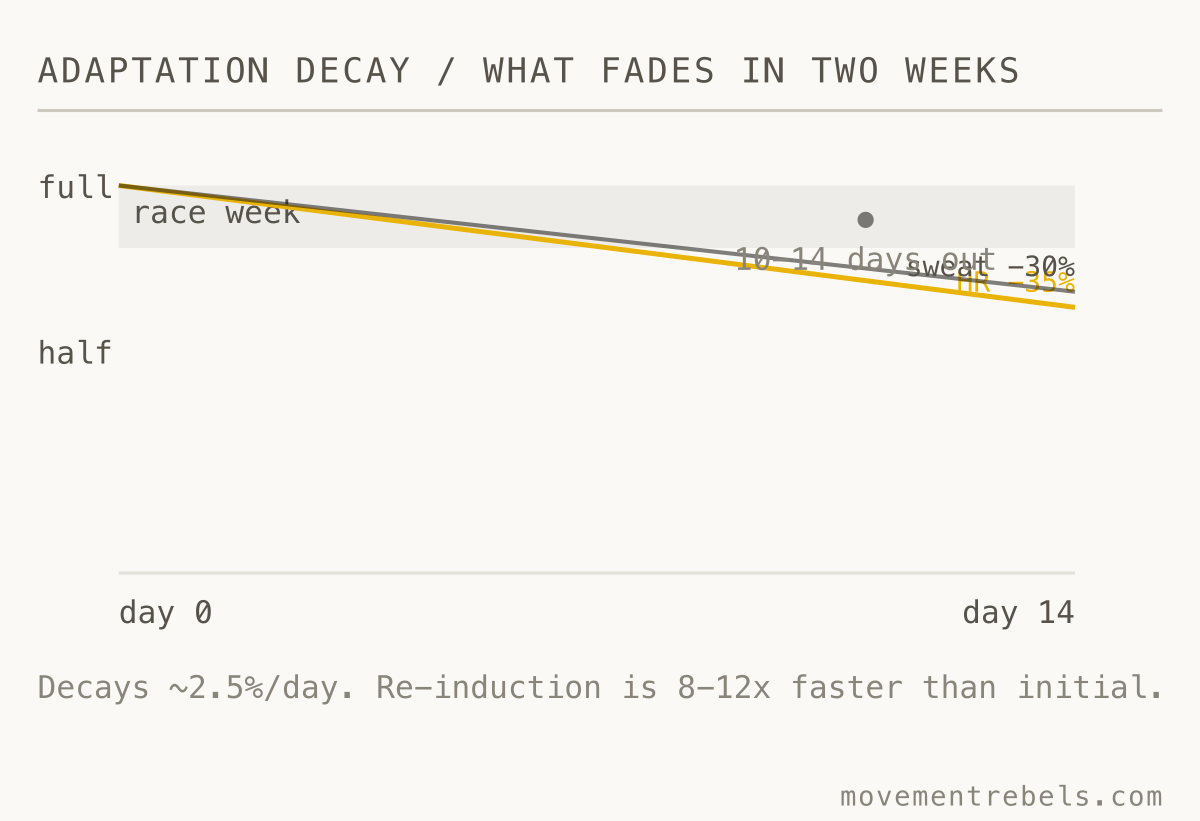
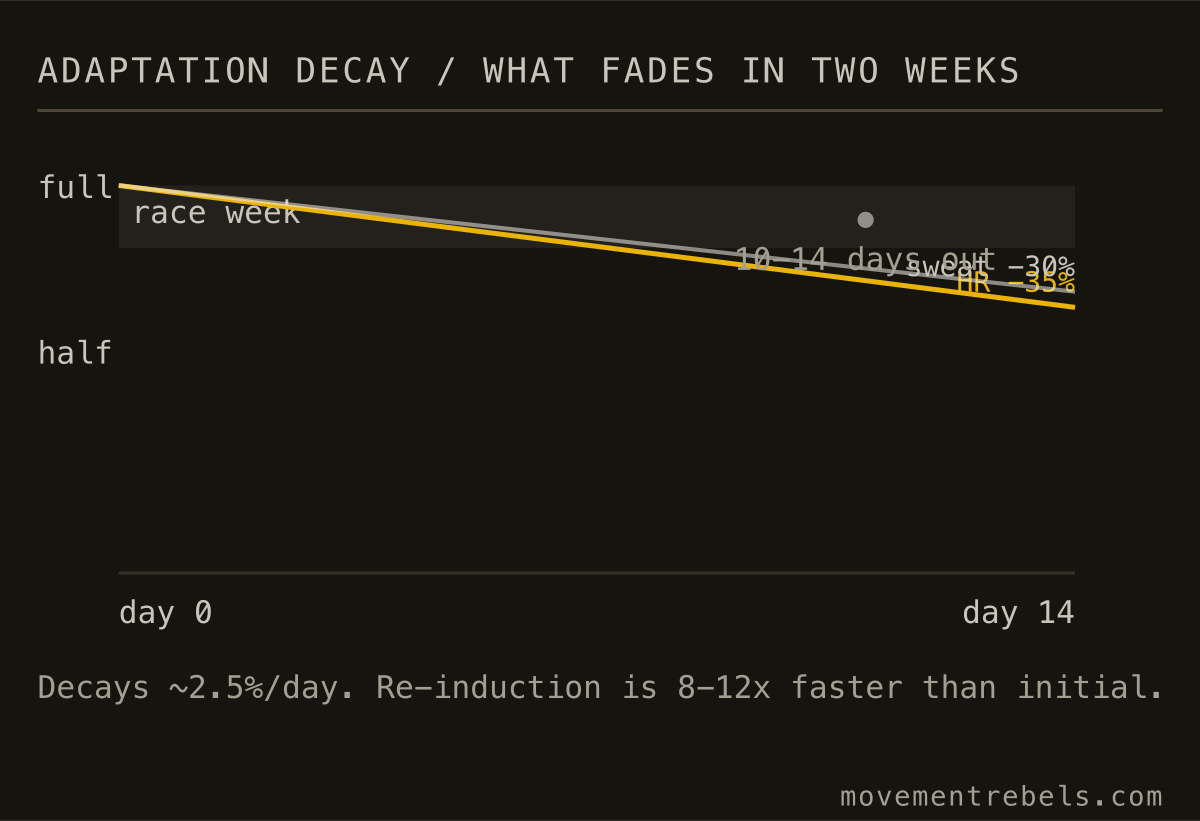
The practical implication for race timing: do not finish your acclimation protocol too early. A useful framework:
- 10-14 days before the race: complete the final sauna or hot bath session
- Race week: the adaptations are peaking and still largely intact; no heat exposure needed
- Option: short re-acclimation. If you acclimated 4-6 weeks ago, a 4-5 day re-exposure block in the week before the race can partially restore lost adaptations. Re-induction is generally much faster than initial induction, with most of the adaptation returning within a few sessions.
Taper timing and heat acclimation interact. If you are tapering over two weeks before a hot race, the final block of hot baths or sauna fits cleanly into the reduced training load. A taper calculator to peak for a hot race maps that volume drop so the heat block lands in the lighter days. Volume drops, so adding 40 minutes of hot water immersion to a shorter run is not an additional training burden. It fills the gap.
Heat safety: what the research does not say but common sense requires
Heat acclimation protocols are controlled physiological stressors. The studies work because they are supervised, incremental, and paired with adequate hydration. The following are not optional caveats:
Hydrate before and during. Core temperature rises faster when you are dehydrated. The hot bath and sauna protocols should begin well-hydrated and include fluids between sets. Hydration tracking during this period matters more than at any other point in your build. A practical guide to the numbers is in hydration tracking for athletes, and a sweat rate calculator for hot-session hydration sizes how much fluid you actually lose across a hot session.
Know the ceiling. Core temperature above 40 degrees Celsius for extended periods is dangerous, not adaptive. The protocol works because you raise core temperature to 38.5-39.5 and hold it. If you feel dizzy, nauseous, or confused during a sauna session, you are above the useful range. Exit, cool down, and shorten the next session.
HRV will likely dip. A genuine heat protocol is physiologically stressful. Expect elevated resting heart rate and suppressed HRV in the first five to seven days. That is the body adapting, not breaking down. HRV-guided training during this period should inform training load, not heat exposure decisions: keep the heat sessions consistent, reduce training intensity if recovery signals are poor.
Do not add heat sessions during heavy training blocks. The protocols described above work best in a taper phase or a reduced-load week. Adding 10 sauna sessions to an already-hard three-week build risks compound fatigue that undermines both the heat adaptation and the fitness work. This interaction is particularly relevant for triathletes managing high volume: fueling is already tight during heavy training, and heat adds caloric and hydration demand. See fueling around long training sessions for the carbohydrate context.
The Nordic reframe
Finnish sauna culture has a pleasant coincidence here. The tool that has existed in Nordic athletic culture for a century turns out to be a credible heat acclimation method when used correctly after training. The barrier is not access. It is protocol specificity.
Most Nordic athletes use the sauna for relaxation, not adaptation: they go in before bed, at low intensity, for as long as feels good. That is fine for recovery and cardiovascular health but it does not drive the hyperthermic stimulus needed for acclimation. Post-exercise timing, sustained core temperature elevation, and ten or more sessions over two to three weeks are what separate the adaptation response from a hot shower with better steam.
If you already own or have access to a Finnish sauna, you have an underused piece of race-preparation infrastructure. Use it for the right reasons and at the right time.
Comparing methods for a cold-climate athlete
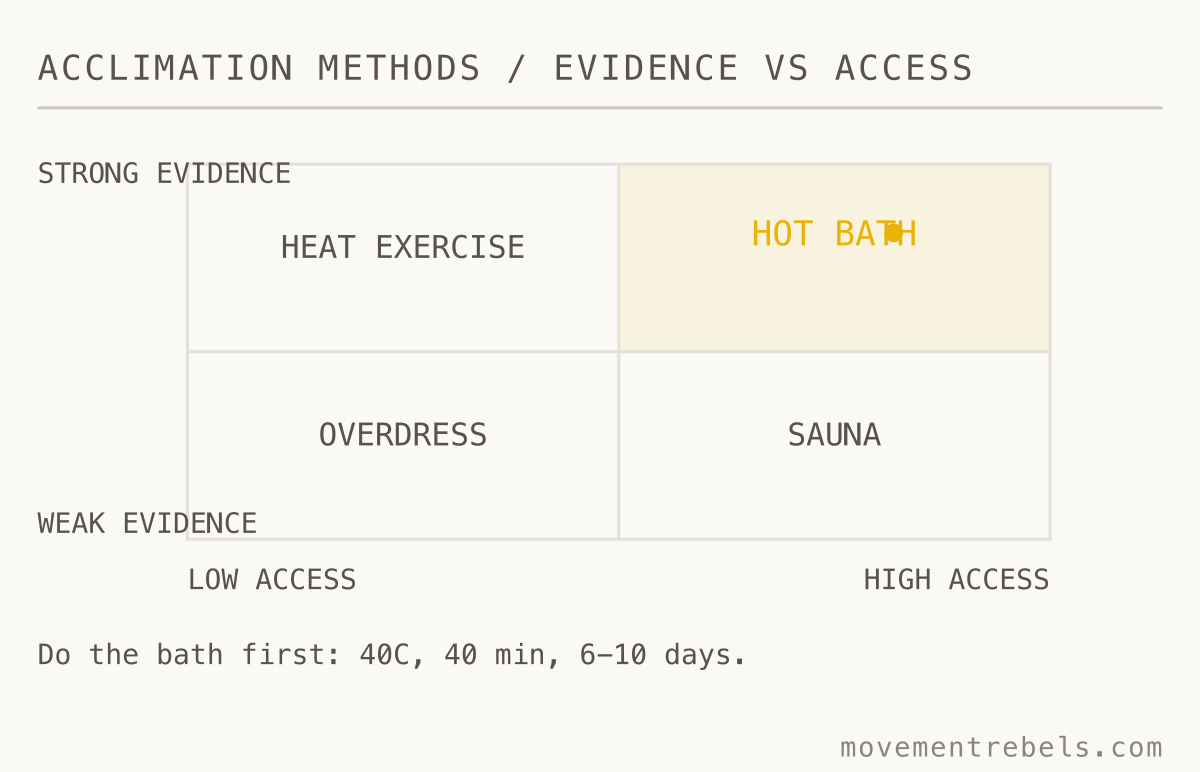
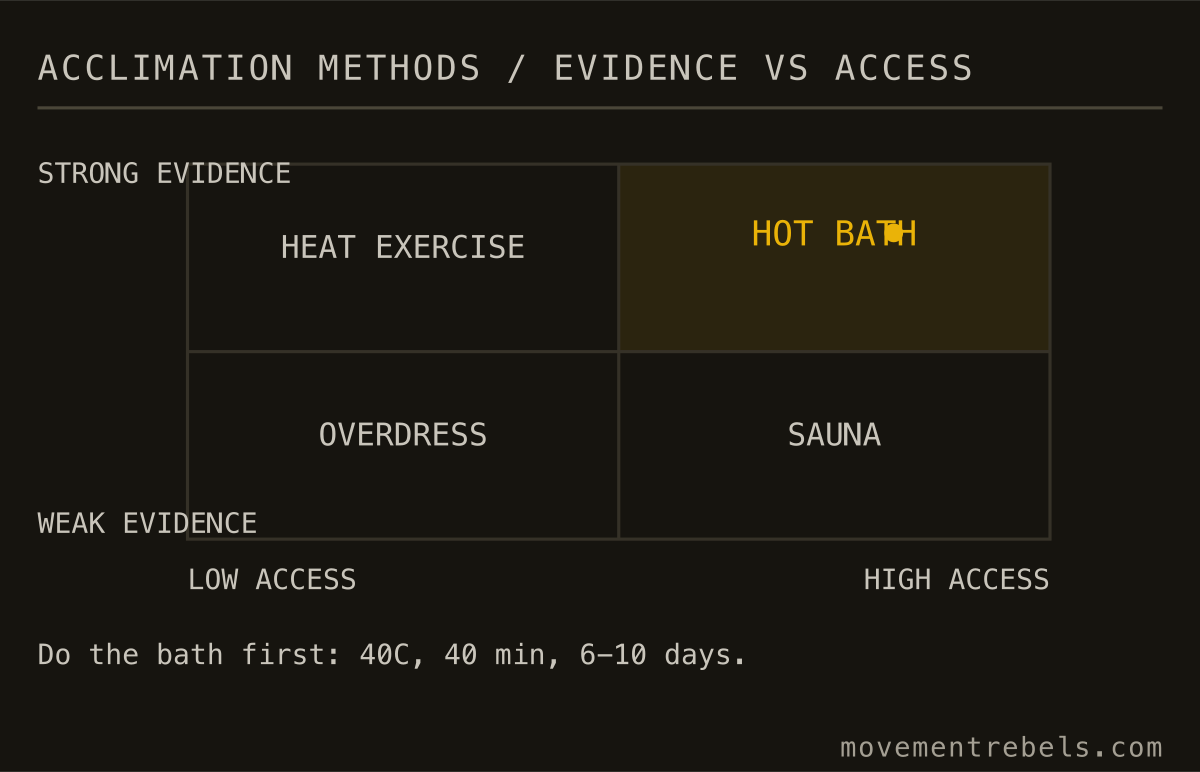
| Method | Evidence strength | Accessibility | Notes |
|---|---|---|---|
| Post-exercise hot bath (40C, 40 min, 6-10 days) | Strong (RCT) | High (bathtub at home) | Adaptations retain for 2 weeks |
| Post-exercise sauna (90C, 45 min, 10 sessions) | Moderate (elite athletes) | High (most Nordic athletes) | Partial adaptation; cardiovascular signal clear |
| Exercise in heat (30-40C chamber, 8-14 sessions) | Strong (gold standard) | Low (requires climate access) | Full adaptation suite |
| Overdressing during normal training | Weak (RCT showed no benefit) | High | Not recommended as primary strategy |
movementrebels.com
How Movement Rebels handles this
When you log a target race in a hot climate and your athlete profile includes your training location, the coach can flag the thermal gap. If you are based in Stockholm and racing in Seville in eight weeks, you can note this in your athlete profile and the weekly brief will address preparation.
The coach builds a heat acclimation block into your taper: typically a 10-session post-exercise hot bath or sauna protocol starting in the second week of taper, matched to your daily training schedule. On days with a hard session, the heat protocol is scheduled after, not before. On easy days with a 40-minute jog, the 40-minute hot bath follows. The total daily time cost is 40-45 minutes, and it displaces no training.
The coach reads your HRV and resting heart rate from Apple Health (native on the iOS app) or Garmin synced data. If recovery signals drop sharply during the acclimation block, it will suggest shortening or skipping a heat session rather than a training session. Adaptations accumulate across the full block. One missed session does not undo the protocol.
Your Garmin workout file from each session is read back automatically. The clearest sign the adaptation is landing is a lower heart rate at race pace after 10 sessions compared to before the block started.
For the race itself, the coach sets realistic expectations in the pre-race brief: pacing in heat should be conservative early, the body's cooling system manages debt poorly when it is already behind, and no amount of acclimation replaces sensible pacing in the first 30 minutes of a hot race.
Pricing
Movement Rebels is one app for training, coaching, fueling, and recovery. A 7-day free trial covers the full surface, including adaptive plan-gen, the weekly coach brief, race preparation planning, and all recovery tools. No card on the trial. After the trial, Pro+ is $20 per month for unlimited coaching.
One app instead of five.
Strength, endurance, recovery, fueling, planning, and your AI coach. All under a 7-day free trial. No card.
Start 7-day trialHow to Taper: Arrive Fresh Without Losing Fitness
Cut volume 40-60%, keep intensity, and you peak. The evidence is clear. Most athletes get it wrong by resting too much, not too li
HRV-Guided Training: Read the Signal, Skip the Noise
One low HRV night tells you almost nothing. The 7-day-vs-28-day trend tells you nearly everything. Here is what the evidence actua
Carbohydrate Timing for Athletes: Fueling Around Long Sessions
How many grams of carbohydrate and when: 1 to 4 g/kg before training, 30 to 90 g per hour through long sessions, and the 4 hour re
Hydration Tracking for Athletes: The Overhydration Risk Nobody Talks About
Most hydration guides warn about dehydration. This one covers both sides: 2% body mass loss impairs performance, but over-drinking