How to Taper: Arrive Fresh Without Losing Fitness
Rest. That is the instinct before a big race, and the logic behind it runs clean enough, since more rest means more energy and more energy means a better result. It feels right. It is mostly wrong.
A taper removes fatigue without removing fitness. Two different things. Confusing them is the mistake that costs athletes the performance they spent months building.
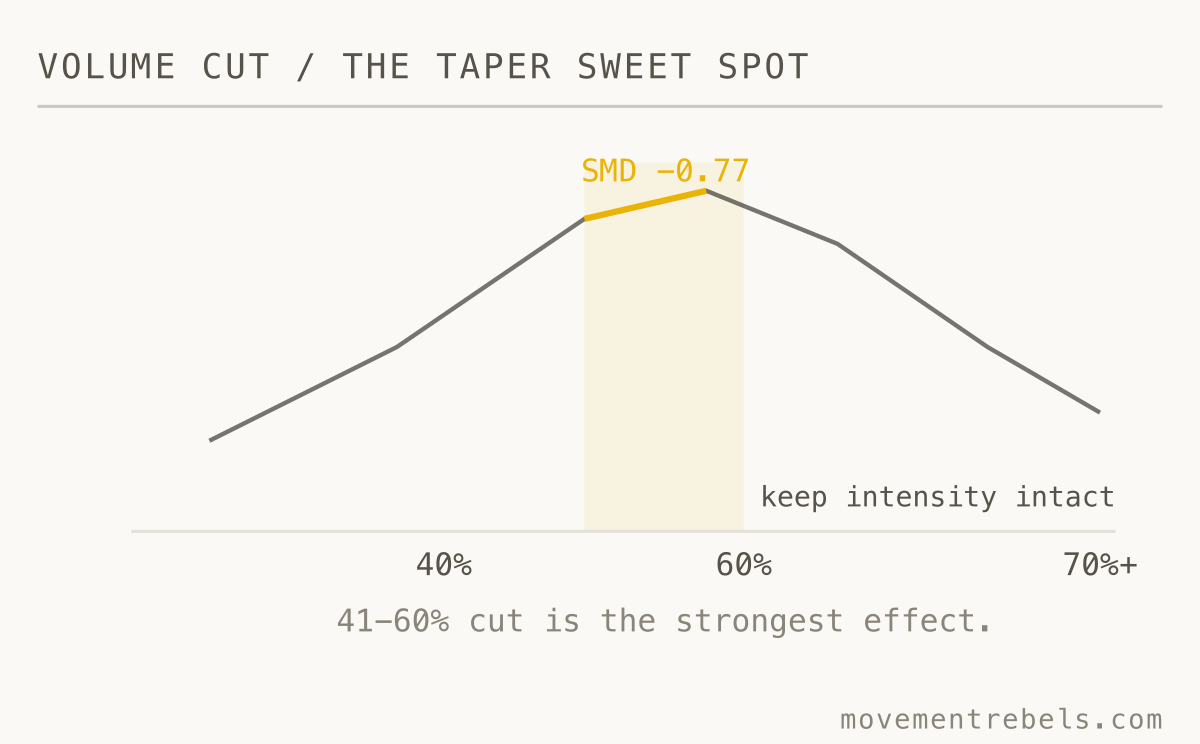
Cut training volume by 40-60% over one to three weeks, hold intensity fully intact, and time-trial performance improves significantly, while dropping the intensity too makes the whole benefit vanish. Across controlled trials on endurance athletes the conclusion reads that clean: maintain intensity, reduce volume sharply, perform better. Flip it. Keep volume moderate, cut the hard efforts, and you get nothing.
Most "rest weeks" cut both. That is the problem.
What a taper actually does to your body
Different clocks. Fitness and fatigue are both adaptations to training load, but fitness accumulates over months, while fatigue builds over days and weeks and then clears far faster than fitness ever does. The taper exploits that asymmetry, so pull back the load and fatigue drains in 5-10 days while fitness stays largely intact, because detraining takes weeks to show meaningful effects.
During a well-executed taper glycogen stores top off, neuromuscular function sharpens (force production, rate of force development, efficiency), plasma volume expands slightly, and inflammatory markers from heavy training clear. More rest gives you none of that. It happens when you keep doing hard work and stop doing so much of it.
VO2max and movement economy do not move. A well-cited 2023 systematic review and meta-analysis found no significant effect on either, which tells you where the performance improvement comes from: fatigue removal and neuromuscular sharpening, not a sudden aerobic upgrade. So do not expect a taper to build fitness you never trained, since all it does is reveal the fitness that was hidden under fatigue, and if the training was not there, no taper fixes it.
It also explains overtapering. An athlete anxious about the race, or sold too completely on the rest narrative, cuts so far back that race day arrives with flat, heavy legs. The nervous system needs to fire. Muscle fibers need recent recruitment. Two weeks with no hard efforts leaves you undertrained for the effort you are about to ask your body to perform.
The numbers: how much to cut, and for how long
Volume carries the clearest evidence. The same meta-analysis found reductions of 41-60% produced the strongest effects (SMD = -0.77), while 40% or less was not sufficient and anything past 60% trended toward diminishing returns. Below 40%, not enough fatigue clears. Above 60%, fitness starts eroding faster than fatigue does.
Duration: 8-21 days, with 8-14 days producing the largest effect sizes. Sprint-distance race, or a shorter strength competition? Lean short. For a marathon, half-Ironman, or full Ironman, 14-21 days fits better, because the accumulated fatigue load is larger and takes longer to clear, and Periodization for recreational athletes covers how to build the training block that earns a meaningful taper in the first place.
Strength athletes sit on a slightly different curve. A 2020 review on powerlifting peaking found volume reductions of 30-50% over 1-2 weeks beat larger reductions, and that holding intensity at or above 85% of 1RM was essential. Per-lift improvements across the reviewed studies: back squat 1.7-9.5%, bench press 1.4-6.4%, deadlift 3.8-4.8%. Short training cessation of 2-7 days can work too, though cessation beyond 14 days may begin to produce performance decrements. Same rule, different shape. Stop the volume, keep the heavy work.
Taper shape: step vs. exponential
Two shapes dominate the literature. A step taper drops volume abruptly to the target on day one and holds it there, while an exponential taper reduces volume gradually across the taper period and hits its lowest point in the final few days. Both work. The exponential model holds a marginal edge in most studies, likely because it avoids the abrupt shift that can feel disorienting in the first days of a step taper.
In practice the difference matters less than the volume target, and if you are sloppy about the reduction (training "felt fine so I added a little extra"), the shape is irrelevant. Precision on the volume cut is the one non-negotiable.
Frequency stays. Dropping a session per week is a common taper mistake, and the nervous system still needs the priming signal that training frequency provides. Keep the sessions. Shorten them, keep the hard intervals inside each one, and let total duration fall.
The pre-taper matters as much as the taper itself
A taper does not work in isolation. Research on competitive swimmers found a meaningful difference between athletes entering the taper in an acute fatigue state and those entering in a non-functional overreached state: the overreached group declined during the taper (-0.49%), the acute fatigue group improved (+1.80%). Deeply overtrained going in does not buy a bigger bounce. It buys a worse result. So the final block of training before the taper should accumulate productive load, not damage.
Ease off two weeks before the taper, then taper for two more, and you have tapered for four weeks and over-rested. The taper needs a loaded spring to release. That is why training stress score tracking earns its place across a full block, since it makes visible whether you built the load you intend to taper from, or whether you have been deloading unintentionally for weeks.
One honest caveat to all of this. Functional overreaching, the planned short-term dip into heavy fatigue, is productive, while non-functional overreaching, the kind that arrives with sleep disruption, appetite loss, persistent soreness, and mood changes, is not. Productive fatigue, not damage. Overtraining signs are worth reading before any major taper block.

Sport-specific adjustments
Running tapers land in the 2-week range with intensity at or near race pace, and the cut shows up as fewer miles per day, shorter long runs, trimmed easy days. Not fewer hard sessions.
Cycling runs similar, with slightly more room to hold volume because impact stress is lower. Ride duration drops. Ride intensity and the number of hard intervals do not.
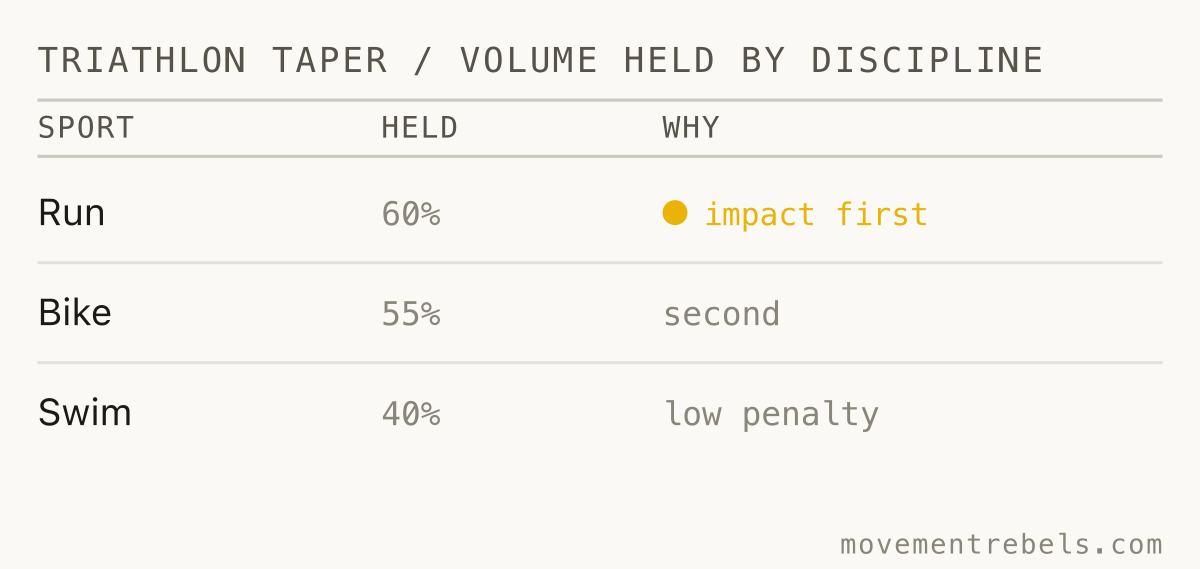
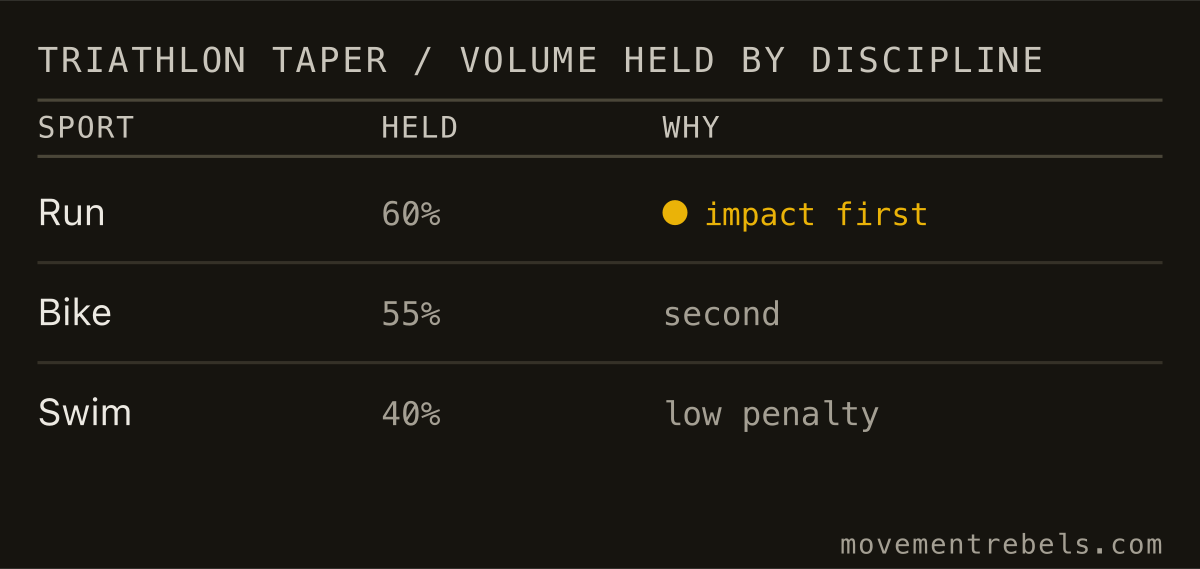
Triathlon is trickier, three disciplines interacting at once. The conventional approach cuts swim volume most aggressively (lowest injury risk from maintaining it, but also the lowest fatigue penalty from cutting), cycling second, running last, because running impact accumulates fastest. A 14-day Ironman taper might hold running volume at 60% of peak, cycling at 55%, swim at 40%. Read the full sport-specific load balance instead of applying one generic cut across all three.
For strength sports the 1-2 week window with heavy loads is standard. The last training session sits 4-7 days out, not 1-2, and plenty of lifters go too heavy too close to competition and pile up soreness and neural fatigue they cannot clear in 48 hours.
The tapering mistakes to avoid
Replacing hard sessions with easy ones. The most common error, and it feels responsible right up until race day, when the performance gains are gone. Keep the threshold work, the intervals, the race-pace efforts. Cut duration, not intensity.
Adding recovery modalities you have never used. Taper week is the wrong week for a first ice bath, a first massage, a first pair of compression boots. Novel recovery stimuli are stressors. HRV-guided training during a taper should show morning HRV rising or holding steady as fatigue clears, and a new intervention that disrupts sleep or leaves you sore is noise in that signal.
Panicking at taper blues. Around days 4-6 many athletes feel heavy and slower than expected. Normal. Legs that felt sharp at race pace two weeks ago feel flat at the same pace now, and the explanation is physiological, plasma volume expanding, glycogen stores refilling, the nervous system adjusting to a lower training stimulus. It resolves by race day. Do not rescue it with an extra hard session.
Changing nutrition. Carbohydrate loading in the 24-48 hours before a long event (over 90 minutes) is evidence-backed, and rebuilding your whole diet for taper week is not. Carbs stay up. Training volume drops, caloric need does not drop proportionally.
Tapering for the wrong race. Not every event deserves a three-week taper. A B-race or the weekly group ride does not warrant cutting training by 50% for a fortnight. Scale the taper to the event. A short deload and sharpening week covers most non-priority events, the full taper stays reserved for A-events, and conflating the two leaves you with broken training blocks and accumulated over-rest across a season. When to deload carries the framework for how to tier races and build around them.
Reading your body during the taper
A taper is one of the clearest windows for reading your own data, and morning resting heart rate should trend down or stay flat. HRV up or stable. Sleep quality often improves as training load drops. If resting HR climbs while HRV drops through the taper, something is off: illness, life stress, or a load that was never cut as far as planned.
Morning resting heart rate over the final two weeks before a race can catch a brewing illness days before symptoms show, and an athlete who spots a suppressed recovery signal four days out still has options, from adjusting race-day pacing to pushing hydration to sleeping more. Race morning, there are none.
Garmin's acute training load and HRV status give a reasonable proxy for what a lab would measure. Directional, not precise. What you want is the direction, load falling and recovery rising. Apple Health on iOS consolidates that picture from multiple devices writing to HealthKit, including sleep from devices like Apple Watch.
How Movement Rebels handles this
The coach reads your full training block, the weeks of load that precede the taper included, and builds the taper window against what you accumulated rather than a generic template, with event type, duration and training history all shaping the prescription.
Put the race in the calendar and the coach works backward from race day: find the final build week, set the volume cut for each discipline, hold the race-pace and high-intensity sessions intact, place the last hard session at the right distance out. Want to map the numbers yourself first? This taper calculator that builds your week-by-week volume drop turns your peak volume and taper length into a session plan. Structured sessions push to your Garmin watch, so each taper session is defined before you start it instead of decided in the moment.
Through the taper, the coach reads Garmin data and Apple Health signals back after each session. Volume landed where it was supposed to? Intensity held? HRV up or suppressed? A taper week where the athlete drifted 30% over the prescribed volume does not produce the expected fatigue clearance, and the coach flags it instead of assuming the plan executed cleanly. That is the link to adaptive training plans, because in the final weeks the adaptation that matters is the one based on what happened, not what was planned.
Nutrition rides the same loop. The coach watches for under-fueled tapers, the common error where an athlete cuts food intake alongside training volume and shows up on race day glycogen-depleted. Carbs stay up as training load drops. The final 24-48 hours before an event over 90 minutes gets a specific refuel target.
Post-race, the debrief lands in the coach chat: how the race felt against projection, whether the taper landed right or wrong, what to change for the next event. That conversation feeds the next taper prescription.
Pricing
Movement Rebels covers the full training arc, build, peak, taper, race, recover, and the 7-day free trial covers that entire surface. After the trial, Pro+ is $20/month for unlimited coaching, taper planning, race-day prep and post-race debrief included. No card on the trial.
One app instead of five.
Strength, endurance, recovery, fueling, planning, and your AI coach. All under a 7-day free trial. No card.
Start 7-day trialPeriodization for Recreational Athletes: Which Model, and How Much You Need
Linear, block, undulating: the honest evidence on which periodization model recreational athletes actually need, and what the rese
When to Deload: Reading the Signals Right
The 4-week deload rule is a template, not a law. Here are the actual physiological signals that tell you when your body is asking
HRV-Guided Training: Read the Signal, Skip the Noise
One low HRV night tells you almost nothing. The 7-day-vs-28-day trend tells you nearly everything. Here is what the evidence actua
Overtraining Signs: The Ones Worth Watching
True overtraining syndrome is rarer than you think, has no reliable biomarker, and is almost never what recreational athletes have