HRV-Guided Training: Read the Signal, Skip the Noise
Here is the honest version: the evidence for HRV-guided training is real but modest. A 2021 systematic review with meta-analysis found that HRV-guided approaches beat predefined training for preserving parasympathetic tone, but could not confirm a statistically significant advantage for VO2max or race performance. The effect consistently pointed in the right direction. It just was not as dramatic as the wearable industry needs it to be to sell subscriptions.
That is not a reason to ignore HRV. It is a reason to use it correctly. The metric works as a trend signal read against your own rolling baseline. It fails as a morning badge that tells you to skip sessions. Most apps give you the badge. This guide explains the trend.
What HRV is actually measuring
HRV is the variation in time between consecutive heartbeats, expressed most usefully as rMSSD, the root mean square of successive differences. Measured overnight while your nervous system settles, it reflects the balance between your parasympathetic system (rest-and-recover) and sympathetic tone (fight-or-flight, stress response).
Higher variability means parasympathetic dominance. Lower variability means stress, cumulative fatigue, or disrupted recovery. The thing that moves the dial is not any single session but the accumulated load: hard training stacked on poor sleep stacked on under-fueling stacked on work stress. A single hard workout does not crash a healthy athlete's overnight rMSSD. Three weeks of overreaching does. That distinction is the entire basis for using HRV in training decisions.
Two other things matter for interpretation. First, rMSSD is preferred over other HRV metrics for day-to-day monitoring because it reflects vagal tone and resists confounding from changes in breathing rate, which matters when sessions and life alter respiratory patterns. Second, absolute rMSSD numbers are meaningless across individuals. A number that is excellent for one person is poor for another. What matters is your number against your number.
Why a single reading is nearly useless
Nightly rMSSD has high day-to-day noise. Hydration, the sleep stage your device happened to capture, room temperature, a late meal, sensor contact quality, and position during measurement all shift the reading 10-20% without anything being physiologically wrong. A single evening of alcohol reduces rMSSD during the first hours of sleep by roughly 2-13 ms depending on dose, as a Finnish population study of over 12,000 recording days confirmed. One glass, one bad number. Not a signal about your fitness or readiness for a hard session.
This is why readiness badges that flash red after one rough night cause more bad training decisions than they prevent. Skip a planned quality session on a single red number and you have thrown away an adaptation stimulus for no real reason. Ignore a fortnight of declining trend because yesterday happened to be green and you have missed the actual signal the metric is designed to catch.
Wearable accuracy adds another layer of caution: optical sensors on wrists introduce measurement artifacts that can meaningfully inflate error compared to chest-strap ECG recordings. The trend approach is partly how you escape that noise. Artifact-driven outliers average out across seven days in a way they never can in a single reading.
The fix: two windows, one comparison
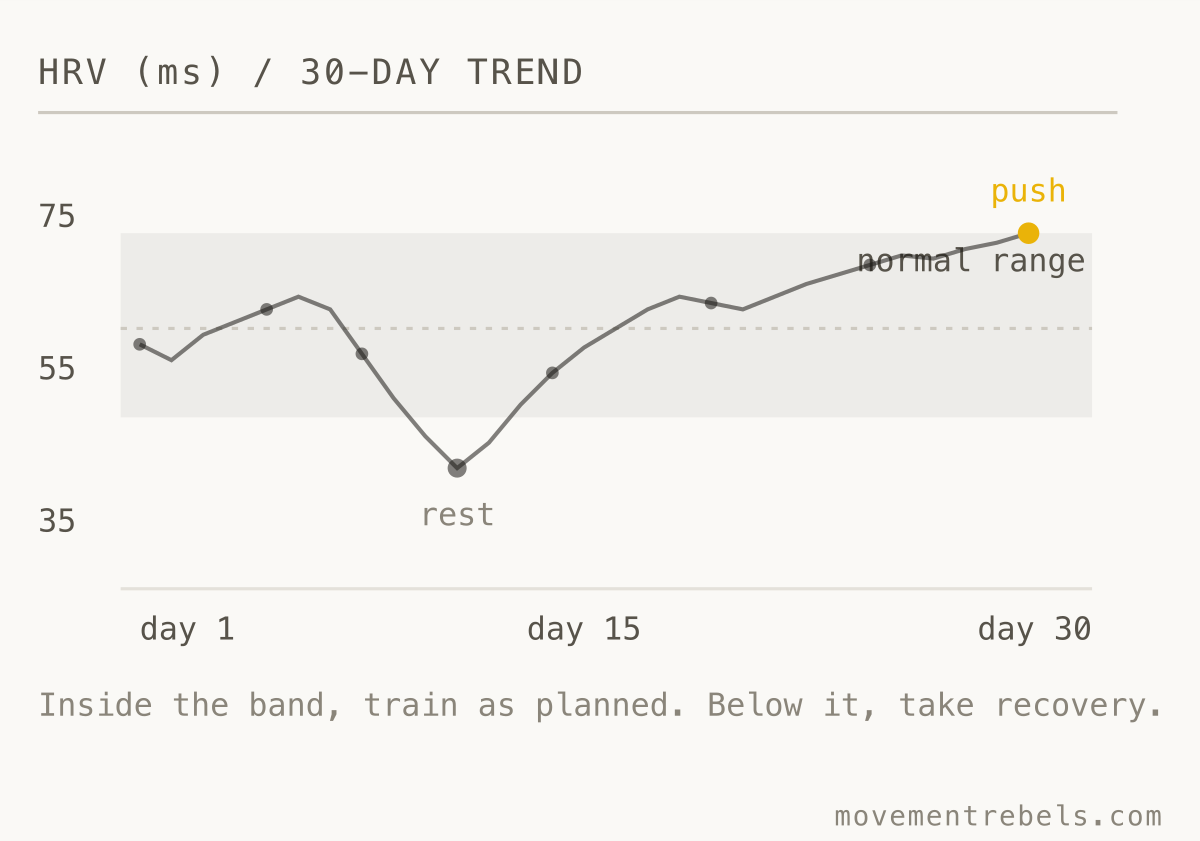
The robust approach, consistent across the applied HRV literature, is to hold two rolling averages and compare them:
- A 7-day rolling average of nightly rMSSD. This is your current state.
- A 28-day rolling average. This is your normal.
When your 7-day average sits at or above your 28-day average, your recovery is tracking as expected and today's planned session runs. When the 7-day drifts roughly 5-10% or more below the 28-day, that gap is a trend worth acting on. One night below baseline is weather. Fourteen days below baseline is climate.
A 2020 meta-analysis on HRV and VO2max improvements found that amateur-level athletes gained the most from HRV-guided training, with effect sizes roughly double those seen in elite athletes. The interpretation: elites already train with precise periodization and coach oversight. Recreational athletes have more to gain from a systematic readiness-check because their defaults are less structured. If you are training 6-10 hours a week without a coach, HRV trend-reading is likely your highest-leverage recovery tool.
This pairs directly with what the resting-heart-rate trend line shows on a longer horizon. Resting HR rising while HRV trend falls is a paired signal that deserves a plan adjustment. Either one alone is weaker evidence.
What actually moves rMSSD down
Understanding confounders helps you interpret the trend honestly rather than panicking every Monday after a social weekend:
- Cumulative training load above your current adaptation ceiling
- Consecutive nights of short or fragmented sleep (see sleep and training performance for the mechanism)
- Alcohol, dose-dependently and acutely, as noted above
- Illness, even pre-symptomatic
- Significant caloric deficit sustained over multiple days
- High psychological stress
- Heat exposure or jet lag
A single stressor rarely matters. The pattern of stressors stacking without recovery days between them is what bends the 7-day curve. Read the trend in that context. If rMSSD is down and you know you had three late nights, one glass of wine per night, and a travel day, you have explained the number. If rMSSD is down and you have done nothing different, that unexplained drop is the signal worth acting on.
How to act on the trend, not the number
Three tiers of response, based on where your 7d sits relative to your 28d:
At or above baseline. Today's session runs as prescribed. No adjustment.
Moderately suppressed (5-10% below baseline). Pull intensity before volume. A planned threshold run becomes an easy zone 2 run at the same duration. A heavy strength session becomes a technique day at 60-70% of working weight. The session stays in your week. The stimulus pattern continues. The load lands softer. See zone 2 training for why easy days have to be truly easy rather than moderate.
Deeply suppressed (10%+ below, multiple days, with elevated resting HR and poor sleep score). True recovery day. Walk, breathwork, NSDR, mobility. The next quality session shifts forward one to two days so you actually absorb the work you have already done. Repeated deep suppression lasting more than a week without an obvious acute cause is the threshold that warrants a formal deload, covered in when to deload.
The logic is not complicated. What most apps get wrong is giving you a red badge and leaving the decision to you, rather than mapping the signal to a specific session change.
What the evidence does not support
A few claims circulate in the wearable space that are worth addressing directly.
"Your HRV number tells you if you are overtraining." Not precisely. HRV suppression correlates with accumulated fatigue, but overtraining syndrome is a clinical diagnosis with many markers beyond HRV. Suppressed HRV is a reason to recover and monitor. It is not a diagnosis. For the full picture on what overtraining evidence actually shows, see overtraining signs.
"Higher HRV means you are fitter." Not across individuals. Absolute rMSSD is highly individual and influenced by age, genetics, and measurement conditions. A masters athlete with a lifelong aerobic base may have a modest absolute rMSSD and still be in excellent shape. What training improves is your own baseline, measured against itself over months. If you want the fitness ceiling that sits behind those readiness signals, you can estimate your VO2 max from a Cooper test.
"HRV-guided training produces meaningfully better fitness gains." Modest at best. The 2021 systematic review found that effects consistently favored HRV-guided training but did not reach statistical significance for VO2max or performance. The honest case for using HRV is not that it unlocks superior gains. It is that it reduces the chance of digging a recovery hole you cannot climb out of in time for the sessions that matter.
What you can do without a wearable
HRV is one input among several. The morning subjective check-in (energy, mood, muscle soreness, motivation) has its own predictive validity, particularly when you are honest with it rather than aspirational. Resting heart rate measured manually before you get out of bed follows similar trend logic, and you can calculate your heart rate zones with the Karvonen resting-HR method from that same morning number. Sleep duration and quality are arguably larger levers than HRV itself.
A coach who knows you slept five hours, is aware you have logged below your calorie target for three days, and sees your recent training load has a complete picture. The number adds precision. It does not replace context. Hybrid athletes and those chasing concurrent strength and endurance are especially prone to under-recovering between sessions, and for that population the multivariate view, HRV plus sleep plus load plus nutrition, is more informative than any single metric.
Breathwork and NSDR are the tools most directly shown to move overnight rMSSD in the right direction. Five minutes of slow, controlled breathing shifts autonomic balance toward parasympathetic dominance acutely. Twenty minutes of NSDR lowers arousal and improves subsequent sleep quality. They are not passive recovery. They are active inputs to the same system HRV is reading.
How Movement Rebels handles this
Garmin and Apple Health are the two live data pipes. Garmin pushes overnight HRV directly to the coach via the native OAuth integration. Apple Health is the native iOS path: grant HealthKit permission in the MR iOS app and the coach reads whatever nightly HRV your device has already computed and written to Health. Oura exports sleep, HRV, and resting HR to Apple Health, so those metrics flow through. WHOOP does not write its recovery or strain scores to Apple Health, so MR cannot read WHOOP scores directly. If you train with WHOOP, bring the context to the coach chat.
The coach builds 7-day and 28-day rolling baselines from your history, starting from your first week of data. It does not show you a readiness badge. It uses the trend to modify the day's session before you see it. A planned interval session on a suppressed trend day becomes a zone 2 session. A heavy squat day becomes a technique day. The session stays in your calendar so your week has the right shape. The load adjusts so you do not dig a hole.
The coach also reads recent training load, your sleep data and your subjective check-in together. A single suppressed HRV number that lines up with two nights of short sleep is a clearer call than either signal alone. It cannot see your fuel log, so if you are eating at a deficit, write that into Notes for your coach and the same numbers get read against it. That is the difference between a wearable that shows you data and a coaching layer that uses the data.
For a broader look at how wearable data translates into actual training decisions versus metric overwhelm, the data-driven athlete guide covers where signal density helps and where it creates noise.
Pricing
Movement Rebels is one app for the full picture: strength, endurance, hybrid, planning, coaching, fueling, recovery, tracking. A 7-day free trial covers the entire surface. After the trial, Pro+ is $20/month for unlimited coaching. No card on the trial.
One app instead of five.
Strength, endurance, recovery, fueling, planning, and your AI coach. All under a 7-day free trial. No card.
Start 7-day trialWhen to Deload: Reading the Signals Right
The 4-week deload rule is a template, not a law. Here are the actual physiological signals that tell you when your body is asking
Overtraining Signs: The Ones Worth Watching
True overtraining syndrome is rarer than you think, has no reliable biomarker, and is almost never what recreational athletes have
Sleep and Training Performance: The Lever Nobody Respects
Sleep outperforms every supplement, wearable, and recovery tool you own. Here's the honest evidence, what actually trashes it, and
Resting Heart Rate Trends: The 28-Day Line
One morning's RHR is mostly noise. Your wearable's sensor can swing 5 bpm on a good night. The 28-day rolling mean is where the si