Hydration Tracking for Athletes: The Overhydration Risk Nobody Talks About
Every hydration guide on the internet tells you the same story: drink more, dehydration kills performance, carry a bigger water bottle. That story is half right. The half that gets left out is that over-drinking kills people.
Exercise-associated hyponatremia, the sodium dilution condition that results from drinking more fluid than you lose, kills marathon runners and ultramarathon athletes every year. Between 5% and 70% of endurance athletes across events develop some degree of hyponatremia, depending on the sport and conditions. The athletes most at risk are not the ones who forget their water bottle. They are the ones who follow "drink proactively" advice too literally, hour after hour, in an event where their sweat rate does not keep pace with their fluid intake.
The honest version of hydration advice is not "drink more." It is: know your sweat rate, drink to roughly offset it, and keep sodium in the picture for anything over 60 to 75 minutes. That is a more complicated sentence, which is exactly why the simpler but incomplete version keeps circulating.
The 2% threshold is real, but the direction matters
The research consensus is clear that losing more than 2% of body mass through sweat impairs aerobic performance in most conditions. The mechanisms are well established: plasma volume drops, cardiovascular strain rises, thermoregulation gets harder, and perceived effort climbs at a given power output.
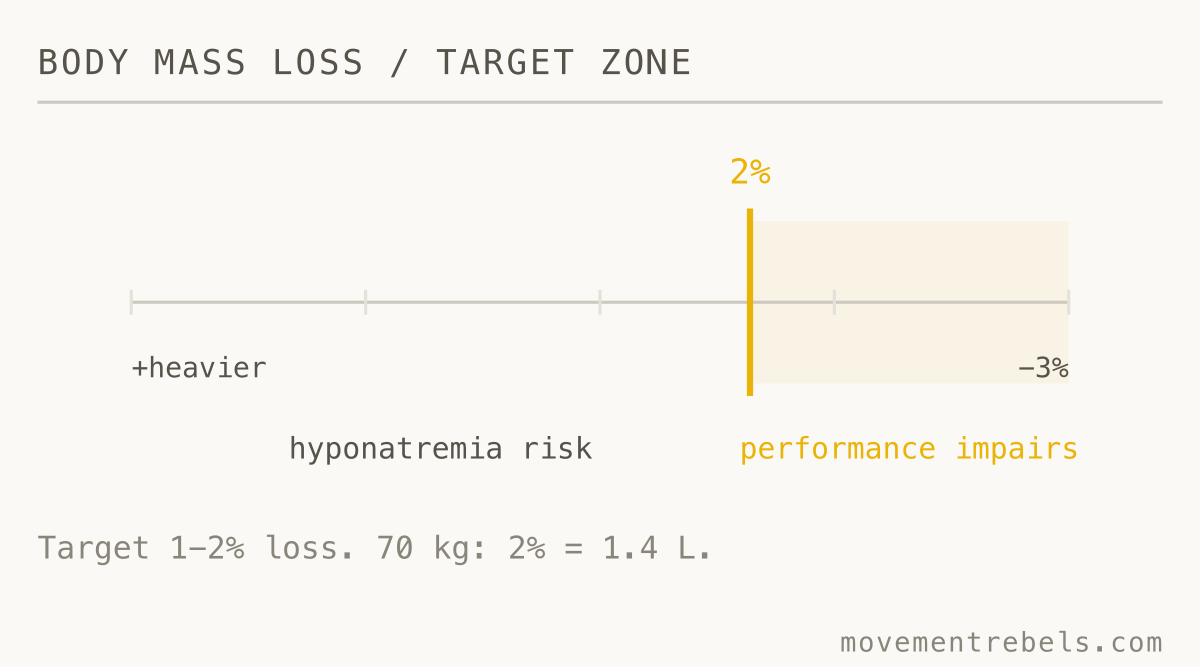
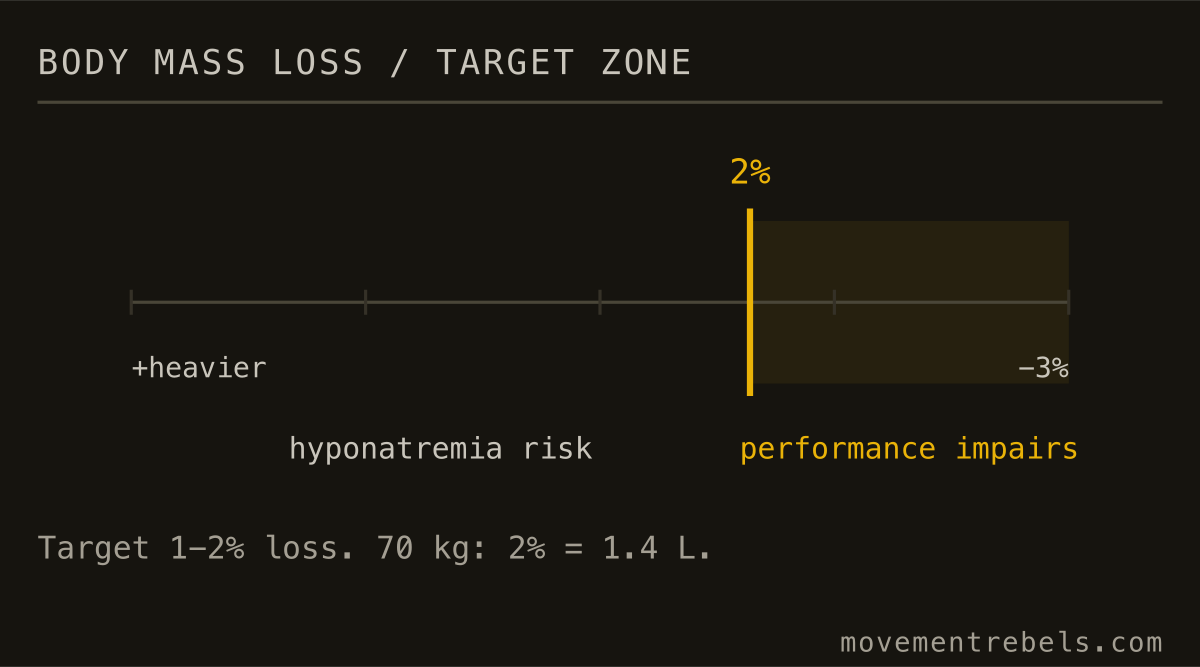
For a 70 kg athlete, 2% is 1.4 kg of fluid, roughly 1.4 liters. Losing that in a hot two-hour session without drinking anything is easy. Losing it in a cool 45-minute run is unlikely.
The takeaway is not to eliminate all dehydration. It is to stay within a reasonable window: not so dehydrated that performance tanks, not so over-hydrated that sodium concentration drops. The target zone is roughly 1% to 2% body mass loss by the end of a training session. Finishing a long ride 1 kg lighter than you started is normal and fine. Finishing it the same weight as you started, or heavier, is a warning sign.
Your sweat rate is not average, and averages will mislead you
Published normative data show sweat rates typically ranging from 0.5 to approximately 2.0 liters per hour across athletes, with rare outliers above 3.0 liters per hour in extreme heat and intensity. The variation is driven by body size, fitness level, heat acclimatization, exercise intensity, and ambient temperature. The "500 to 1000 ml per hour" figure that appears in most guides is a population average that may be substantially wrong for any given person.
The same is true for sweat sodium. Local sweat sodium concentration ranges from roughly 10 to 90 mmol per liter among individuals. Factors include heat acclimatization status and exercise intensity. Research broadly finds that dietary sodium intake over the preceding one to two weeks can shift sweat sodium concentration measurably in either direction. Some athletes lose 2,000 mg of sodium per liter of sweat. Others lose a third of that. Telling everyone to take the same electrolyte tab is as imprecise as telling everyone to drink the same volume.
The practical fix is a sweat test, and it takes 30 minutes of your life. Weigh yourself naked before a one-hour session where you do not drink anything. Weigh yourself again at the end. Every kilogram of weight loss represents approximately one liter of sweat. Do this once in cool conditions and once in warm conditions and you have your personal range. A pinch of salt on your shirt after a summer run tells you something about your sweat sodium. A white residue outline tells you more.
This individual variation is why wide ranges show up consistently across the sweat research: you are not a fixed machine. Your hydration needs shift with your diet, your training load, and the weather.
When "drink to thirst" works and when it does not
The thirst-first camp has legitimate ground to stand on. For sessions under 60 minutes in moderate weather, the evidence generally supports that drinking to thirst keeps most athletes within an acceptable hydration window. Thirst triggers around 1% to 2% dehydration, which is roughly where the 2% performance threshold sits. For shorter efforts, the alarm goes off just in time.
Past 90 minutes, or in heat, the math changes. People drinking ad libitum during prolonged endurance events typically consume only about half their fluid losses, according to the same body of research. Thirst lags too far behind sweat rate in sustained heat. You can reach 3% dehydrated before the signal is loud enough to act on, and by then perceived effort is already elevated and power output is dropping.
Long sessions need a schedule, not a reaction. A few sips every 15 minutes during anything over an hour is a simple default that prevents the thirst lag from compounding. That is not "drink to a plan regardless of your body." It is a structured reminder that accounts for the known lag in thirst response.
Dawn training is a specific trap. After 8 hours without fluid, even without training you are mildly dehydrated. A 60-minute fasted morning run adds to that deficit before breakfast arrives. Pre-loading 400 to 500 ml with a pinch of salt before you walk out the door is one of the highest-return hydration habits an athlete can build. The salt matters: plain water before exercise can suppress thirst further and delay gastric emptying.
Sodium: the variable the supplement aisle exploits and undersells simultaneously
Sodium is both over-marketed (every sports drink brand leans on electrolytes) and under-dosed in practice. Below 60 to 75 minutes of moderate training, water alone is adequate. Past that, sodium matters for two reasons: it drives the desire to keep drinking, and it maintains the osmotic gradient that helps your intestines absorb fluid.
For sessions over 90 minutes, target 300 to 700 mg of sodium per hour alongside your fluid. That range is wide because the right target depends on your sweat sodium concentration, which most athletes do not know precisely. If you cramp late in long events, sodium is a more likely culprit than magnesium or potassium, despite what the supplement aisle emphasizes.
For ultra-distance events, the sodium calculation flips from "are you getting enough?" to "are you getting too much water relative to your sodium intake?" The athletes who develop hyponatremia in ultramarathons are typically not salty sweaters who forgot electrolytes. They are athletes who drank aggressively at every aid station because they followed "stay ahead of thirst" advice in an event long enough for that strategy to accumulate a sodium-diluting water overload.
The practical output: know your event duration. Under 90 minutes, water and food are fine. 90 minutes to three hours, electrolyte tabs or a salty solution. Beyond three hours, the sodium per hour number matters more than the fluid volume, and you should not be topping off a full bottle at every aid station regardless of whether you are thirsty. For a specific event, our race nutrition planner for fluid and sodium sets the per-hour targets to drink and salt against.
The baseline before training exists
Resting hydration scales with bodyweight. The research-grounded working number is 30 to 40 ml of total fluid per kilogram per day before training is added. At 35 ml per kg, a 70 kg athlete needs 2.45 liters of total fluid, and roughly 20% comes from food, so the drinkable target is around 2 liters before they touch a training session. Our daily water intake calculator runs that bodyweight math for you.
This baseline matters because dehydration entering a session compounds. Hitting your daily baseline on rest days means you start every training session with normal plasma volume. Falling 500 ml short every day across a week means your resting heart rate creeps up, your HRV trends down, and your perceived effort at a given power climbs before the session even starts. This kind of chronic mild dehydration is invisible in a single day and visible in a month of data.
For the relationship between resting heart rate trends and hydration, see resting heart rate trends. Chronic dehydration is one of the cleaner explanations for unexplained resting HR drift in athletes who are otherwise training and sleeping well.
How Movement Rebels handles hydration
Rebel Fuel is the intake log inside Movement Rebels. Hydration sits alongside calories, macros, and supplements. You log fluid in cups or milliliters, and the coach reads the running daily total against your bodyweight-scaled baseline plus the sweat estimate from any completed training sessions pulled through Garmin Connect or Apple Health on iOS.
The cross-domain layer is where this becomes useful beyond a simple counter. If you logged a hot two-hour ride at noon through Garmin and your fluid intake is sitting at 1.4 liters by 6 PM, the coach can flag it in your morning brief: you are tracking 1.8 liters short of target, your readiness may print yellow tomorrow, and tomorrow's intervals may shift to easier aerobic work if you do not catch up tonight. That is not theoretical. The coach reads your training calendar and your wearable data together. Rebel Fuel is your own log and stays out of what it sees.
Photo-based meal logging through Snap Meal captures food-side hydration: soups, fruit, smoothies, and similar sources contribute to your daily total without manual counting. Electrolyte intake goes into the supplement tracker. On hot training days the coach can prompt a pre-session sodium plan based on the duration and conditions of what is on the calendar.
For athletes using Apple Health on iOS, sleep and HRV data flows into the coaching layer, and the coach reads those signals alongside your fluid intake to catch dehydration patterns across days rather than session by session. See HRV-guided training for how that readiness picture works in practice.
The cross-domain picture also matters for fueling. Dehydration and under-fueling often co-occur: a day of low calorie intake tends to be a day of low fluid intake. If you are tracking macros and calories in Rebel Fuel alongside hydration, the coach can flag both signals when they drop together before a hard day. For the full fueling picture around training sessions, see fueling around long sessions.
Pricing
Movement Rebels is one app for training, coaching, fueling, recovery, and tracking. A 7-day free trial covers the entire surface, including Rebel Fuel. After the trial, Pro+ is $20/month for unlimited coaching. No card on the trial.
Sweat Rate Calculator
Find your hourly fluid loss from a simple weigh-in.
One app instead of five.
Strength, endurance, recovery, fueling, planning, and your AI coach. All under a 7-day free trial. No card.
Start 7-day trialSnap Meal: Photo Calorie Tracking Without the Tedium
Photo calorie tracking lands at 80-90% accuracy for simple plates and lower for sauced dishes. Here is what that actually means fo
Macros for Body Recomposition: The Numbers That Work
Simultaneous fat loss and muscle gain is real but slow. Here's the honest protein math, the deficit window, how training status ch
Carbohydrate Timing for Athletes: Fueling Around Long Sessions
How many grams of carbohydrate and when: 1 to 4 g/kg before training, 30 to 90 g per hour through long sessions, and the 4 hour re
HRV-Guided Training: Read the Signal, Skip the Noise
One low HRV night tells you almost nothing. The 7-day-vs-28-day trend tells you nearly everything. Here is what the evidence actua