Indoor Rowing Technique: The Drive, the Recovery, and What Costs You Watts
The monitor on a rowing machine counts one thing. How hard you accelerate the flywheel on each drive. An early arm pull, legs that fire before the handle moves, none of it reaches the chain, so when the erg feels slow the first suspect is the order you move in. Here is that order, the flywheel setting, the four leaks that cost the most, and what the machine does to a tired back.
The stroke in order: legs, back, arms, then the reverse
Four checkpoints. Every stroke has them, and Concept2's technique page describes them the way every coach teaches them.
- The catch. Arms straight. Shoulders level and in front of the hips with the upper body leaning forward from the hips, and the shins vertical, never past it.
- The drive. Legs first. Seat and handle leave together while the back holds its angle, and with the legs most of the way down the hips open and the trunk swings through vertical before the arms draw last, straight to below the ribs.
- The finish. Legs flat, a slight layback held by the core, the handle light below the ribs, wrists flat, shoulders low.
- The recovery. The drive run backwards. Hands away until the arms are straight, body pivots forward from the hips, and only once the hands have cleared the knees do the knees bend and the seat slide forward, slowing as it arrives.
Coaches shorten it to "legs, back, arms; arms, back, legs". Timing gets talked about as 2:1, where one second on the drive buys two on the recovery, and most of what goes wrong on an erg is one of those sequences overlapping itself.
The stroke at a glance
The numbers column is the target, the last column the fault that appears at that point in the stroke, and the power shares come from on-water crews and will not be identical on a fixed erg. The order holds.
| Checkpoint | What moves | What stays put | Numbers to hit | The leak that shows here |
|---|---|---|---|---|
| Catch | Nothing yet. You arrive, you do not lunge | Arms straight, shoulders in front of the hips | Shins vertical, never past it | Over-reaching, lunging at the catch |
| Drive, first half | Legs press; seat and handle leave together | Arms long, body angle held | Legs deliver about 45% of stroke power | Shooting the slide |
| Drive, second half | Hips open, trunk swings through vertical | Arms long until the back is past vertical | Trunk about 32% | Opening the back too early |
| Finish | Arms draw the handle in below the ribs | Legs flat, slight layback | Arms about 23%; wrists flat | Early arm break, shrugged shoulders |
| Recovery, hands away | Arms extend until straight | Body and seat | Hands leave at the speed they came in | Knees bend before the hands clear them |
| Recovery, body over | Trunk pivots forward from the hips | Legs straight until the hands pass the knees | Catch angle set here, not at the front | Late rock-over, then a lunge |
| Recovery, slide | Seat travels forward, slowing as it arrives | Body angle, arm length | Twice as long as the drive (1:2); technique work under 22 spm | Rushing the slide |
| Flywheel | Damper lever sets how fast the wheel slows | Your effort sets the watts, not the lever | Damper 3-5; drag factor 120-135 for most; 90 or less at 1, 200 or more at 10 | Damper 10 "for strength" |
movementrebels.com
Where the watts come from
Valery Kleshnev's on-water measurements at the Australian Institute of Sport put the legs at about 45% of total rowing power, the trunk at 32% and the arms at 23%, so the biggest muscles do the biggest job, and only if the handle is still connected to them when they fire. Break the arms early and the smallest 23% carries the load meant for the 45%. Shoot the slide and the 45% moves the seat without moving the handle.
Concept2's guidance for the PM5 force curve is a broad arch without sharp peaks or wobbles, because the area under it is your result for the stroke. A bump is a break in the sequence. ErgData calls it disjointed application of force, and the shape names the fault: a curve that spikes early and sags is an arm pull, a dip in the middle is legs that finished before the back arrived.
Then the maths. Flywheel speed becomes watts through a cube, watts = 2.80 divided by pace cubed with pace in seconds per metre, so Concept2's example of 2:05 per 500 m is about 179 W, and a leak that costs 3% of your watts shows as about 1% on the pace readout. Watts are the currency for technique. The split is for pacing, covered in Erg Splits Explained, and the erg calculator converts between the two.
Damper setting versus drag factor
The damper is the lever on the flywheel housing, numbered 1 to 10, and it sets how fast the wheel slows between strokes, and nothing about how hard the workout is. Concept2 compares it to bike gearing: intensity comes from how hard you use your legs, back and arms, wherever the lever sits. The number that matters is the drag factor. Measured every stroke from the wheel's deceleration, it can read differently on two machines at damper 5, because air temperature, altitude and lint in the housing all move it.
- The recommendation. Start at 3-5. Go lower as technique improves. Settings of 6 and up are, in Concept2's words, hard to sustain with proper technique before you start compensating, and most coaches land in the 3 to 5 band with long pieces toward the low end.
- The numbers. About 90 or less at damper 1 on a new RowErg, 200 or more at 10, and a dusty gym erg at 5 can read like a clean one at 7. Check the drag factor on any unfamiliar machine.
- What the fast people use. Caryn Davies, an Olympic champion, calls 120-135 the normal range and rows at about 125, a damper of around 4 on her machine, while Eric Murray did everything at 130 and Gevvie Stone at 112. Nobody is at 200.
- Why 10 costs watts. Heavy drag makes the catch feel like a deadlift and the drive slow and grindy, more load through the back, fewer strokes held in sequence, and since the readout is corrected for drag a high setting buys nothing. Concept2's own guidance is blunt: there's no advantage of one damper over another for all athletes in all workouts. Set 120-130. Let the legs decide how hard it is.
Shooting the slide and the early arm break
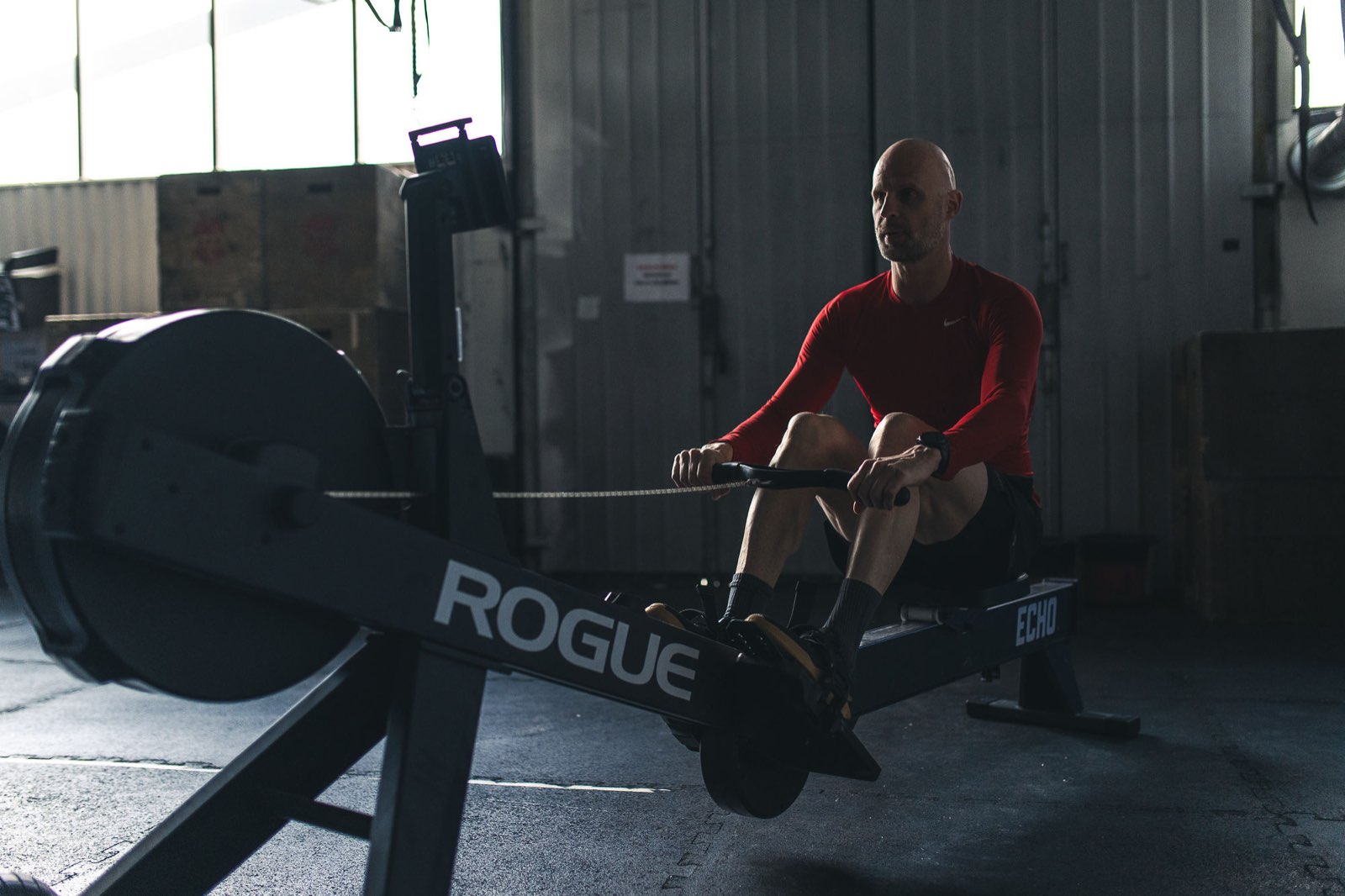
Shooting the slide is the seat moving before the handle. The legs push, the knees go flat, the handle is still at the catch, and the back yanks it the rest of the way, so the legs' 45% never reached the chain and the trunk now does its job plus theirs, from a rounded position. Concept2's cue is the whole fix: the handle and the seat move together on every stroke.
- The fix. Legs-only rowing: arms straight, body angle set, press with the legs while nothing above the hips changes, so the handle travels exactly as far as the seat. 20 strokes. Then legs plus body swing, then the full stroke, the reverse pick drill, all of it under 22 strokes per minute, because slowing the stroke teaches transitions the muscles then keep at higher rates.
The early arm break is the reverse: the elbows bend in the first half of the drive, before the legs have finished. Concept2's own list names this exact fault "Bending Arms Too Early", and the fix is what they say everywhere else: initiate the stroke with the legs, not the arms. The arms are 23% of the power. The weakest link. Bend them early and the biceps take a load meant for the quads, the shoulders shrug, and the force curve spikes early and dies.
- The fix. Straight-arm rowing at 18-20 strokes per minute, elbows locked until the handle passes the knees, then the draw, with a one-second pause added at hands-away so the arms re-learn straight before every catch.
- The grip. Fingers wrapped, thumbs underneath, wrists flat. An overgrip pulls the forearms in early; a relaxed hook keeps the arms as connectors, not engines.
Over-reaching at the catch and rushing the slide
The recovery is where the next stroke gets built, so both of these get blamed on the drive.
Over-reaching is going past the catch. Shins tip past vertical, heels come high, the knees drift over the toes and the pelvis tucks so the lower back rounds, and the first part of the drive is then spent unfolding the spine. Concept2's cue is to prepare the position early instead of lunging for it. In a 2021 systematic review, rowers without back pain reached the catch with a neutral or anterior pelvic rotation, while rowers with pain showed more posterior pelvic rotation there, the tucked position over-reaching produces.
- The fix. Set the body angle by the time the hands pass the knees, then slide into a position that is already built, then shorten the slide a couple of centimetres and feel the legs connect at the front. Heels may lift. The shins do not tip.
Rushing the slide is the recovery taking as long as the drive, or less. At 1:1 the seat arrives fast and the body unprepared, so the catch becomes a lunge and the rate climbs without the watts following, while at 1:2 the seat slows on the way forward and the catch is placed. Count "one" on the drive, "two, three" on the recovery.
- The knees. Hands clear the knees before the knees bend. Break them early and the handle has to lift over them: a bump in the hand path, a bump in the force curve.
Low back pain: what the erg does to a tired spine
Low back pain is rowing's signature injury, and the ergometer loads the lower back harder than the boat does, so the technique argument doubles as an injury argument.
- How common. A 2025 meta-analysis found the prevalence of rowing-related low back pain in cohort studies ran from 52.6% to 57%, and the one risk factor that reached significance was a history of low back pain, at 2.65 times the odds.
- The erg specifically. A 2023 scoping review links stationary ergometer use to onset and flare-ups, with many papers putting the threshold at more than 30 minutes per session. Split long steady pieces into blocks with a standing break.
- What fatigue does to the catch. In 16 school rowers, lumbar flexion rose significantly through an ergometer trial while the erector spinae showed the signature of fatigue. In 19 elite men, maximum lumbar flexion climbed 4.4 degrees on the erg across a step test, against 1.3 degrees in a single scull, and an hour on an erg produced more lumbar range of motion than the same hour in a rowing tank.
A tired rower stops hinging at the hips and starts folding at the lumbar spine: the catch rounds, the pelvis tucks, and the last 20 minutes of a long piece get rowed in the position the back-pain group shows. Three rules follow. Hinge from the hips and keep the chest tall into the catch, so the lean is a pelvis rolling forward and not a spine curling. Watch the catch in the last third of any long piece. When it rounds, stop or drop the rate. Keep the drag factor sane, because a setting near 200 loads the back on every stroke.
How much erg to do in a week is the 2k Erg Training Plan guide, the intensities are in Erg Training Zones, and if the erg is one tool inside a lifting week the hybrid athlete guide covers the balance.
How Movement Rebels fits
The erg hides the cost of bad technique. The split still moves when you pull with your arms. Movement Rebels makes the cost visible over weeks. Connect your Concept2 logbook (see the Concept2 integration guide) and every erg session lands in your log with split, average watts and stroke rate, next to your Garmin or Apple Health heart rate, HRV and sleep, your logged lifts, and the morning check-in where you score soreness from 1 to 10. Score low-back soreness a 7 the morning after a 60-minute piece that came the day after deadlifts, and the coach writing your Sunday plan has the erg session, the lift and the soreness in one view: it keeps the next erg piece short and moves the hinge work off the day before it. Write "low back rounds late in long pieces" in the notes for your coach. It gets read every time the week is planned. Concept2 and your AI coach covers how erg data becomes a week; once the sequence is clean, the 2K erg pacing guide is where the watts go to work.
Legs, back, arms. Arms, back, legs. Drag factor between 120 and 130, rate under 22, and the handle leaves with the seat.
One app instead of five.
Strength, endurance, recovery, fueling, planning, and your AI coach. All under a 7-day free trial. No card.
Start 7-day trial2K Erg Pacing: How to Execute Without Blowing Up at 1500m
How to pace a 2000m rowing ergometer test: energy systems, pacing phases, split calculations, and the mental strategy to crush you
Concept2 and Your AI Coach: Turn Erg Data Into Training
Connect your Concept2 Logbook and every RowErg, SkiErg, and BikeErg session syncs into Movement Rebels with split, watts, and stro
Connect Concept2 to Movement Rebels
Sync your Concept2 Logbook to Movement Rebels. RowErg, BikeErg and SkiErg sessions flow in automatically. The coach reads your spl
Hybrid Athlete Training: Concurrent Done Right
The interference effect is real but smaller than you think, and the rules for avoiding it are simpler than the hype suggests. Here