AI Fitness: The Difference Between a Generated Workout and a Coach
Type a goal into any of the new AI fitness tools and a workout comes back in seconds. It will look fine. It might be good. And a good workout, on its own, is a much smaller thing than being coached, for reasons that have nothing to do with how well the workout was written.
Random workouts work, for a while
Start with the concession, because the rest of the argument depends on it. If you have not trained much, almost any program works, as long as it gets you training two or three times a week. The first few months of lifting or running produce gains on nearly any sensible plan, because the stimulus is new. Untrained lifters gain something like 40% on their lifts in that window. Elite ones fight for 2%. Coaches call it the novice effect, and it is one of the better-established findings in the field.
A plan you follow beats a better plan you abandon. For most people the whole game is showing up three or four times a week for years, and the design of any single session sits a long way down the list of what decides the outcome. Training three times a week instead of twice moves the result about twice as much as choosing the right program structure does. If you are trying to stay consistent through a busy life, a tool that hands you a session in ten seconds removes a real barrier, and that counts.
So if a generator gets you off the sofa, use it. The question this guide is about starts later, somewhere around month four to six, when the easy gains slow and the workouts stop stacking into anything you can point at.
What AI fitness mostly means right now
Two different things get sold under the label, and they deserve different verdicts.
The first is the AI workout generator: a form, a prompt and a language model. You enter your goal, your equipment and how long you have, the model writes a session, and some of them put a timer and a library of exercise videos on top so it feels like an app rather than a chat window. Under the hood it is one call: describe the person, get a workout back. The free one-shot generators work this way. Each request starts blank.
Nothing is wrong with that. It is a fair use of a language model, and the sessions it writes are often better than what a beginner would pull off a forum, with sane exercise selection and reps that make sense for the stated goal.
The second kind keeps a log, and this is where the usual complaint about AI fitness falls over. The serious training apps remember what you did, and they progress you. Fitbod estimates your one-rep max from the sets you log and writes 100 lb into 105 next time, and it models recovery per muscle so it does not hand you the same tissue two days running. Dr. Muscle updates the program after every completed set and backs the load off when your estimated max drops. Alpha Progression tells you the next set's weight, reps and reps in reserve from your own log. The same holds for most of what a search returns: WorkoutGen keeps your sets behind a free account, Planfit logs every set, rep and weight and calculates the next one, FitnessAI sells progressive overload as the product. The exception is the tool with no account at all, and Arvo is straight about theirs, calling its free generator a static plan you follow manually. Even the chat window has caught up. ChatGPT has kept memory across conversations on by default since the middle of 2025, so type that you did legs yesterday and it still knows next week.
The old line, that an AI cannot see yesterday or add weight to the bar, is dead. Say it about a good app and anyone who has opened one knows you have not. Fitbod alone sinks it. The gap is somewhere else, and it is narrower than the marketing on either side suggests.
The two things almost none of them have
Fourteen AI training products were checked against five questions for this guide, and most of them passed memory and progression without breaking stride. Two findings held up.
Almost none of them take a date. Not the generators a search puts in front of you, and not the strength apps you might already pay for. WorkoutGen, Planfit, FitnessAI, Arvo, Fitbod, Dr. Muscle, Alpha Progression, Tonal, Peloton IQ, Tempo, Zing and Freeletics: none of them ask when your event is. They ask what you want, stronger or leaner, and progress you toward it with no end, which is a fine answer for someone with no date and a poor one for someone with a HYROX in eleven weeks. JuggernautAI is the single exception. It takes a powerlifting meet date and builds hypertrophy, strength and peaking blocks that end on it, and it does that well. It is also powerlifting only, so it has nothing for a marathoner or someone with an ultra in October. The endurance side has had dates for years, Runna and TrainerRoad both take a race date and taper to it, and Garmin Coach does the same free on a Garmin watch.
No product was found with both a date and a watch that changes today's session. JuggernautAI has the date, and asks you to type your readiness into a form. Peloton IQ reads Garmin Connect, Fitbit and Apple Health and adjusts what it suggests, and has no date, only a category like "get stronger". Each half exists. Six weeks out from a meet with a suppressed HRV this morning is a situation neither can see in full, because one knows the calendar and the other knows the body.
That is the whole gap. A date that shapes the weeks backward, and a watch that changes today's session. Separately, both are on the market. Together, they were not found. It is the difference between an adaptive training plan and a good log with a progression rule.
What a good app does with it, against what a coach does
The row-by-row version. The middle column is what the better AI training apps do, and most of it is good engineering. The third column is what the Movement Rebels coach has in front of it when it writes a session, and every item on it comes from a synced watch, a logged lift or a check-in you tapped in the morning.
| What decides today's session | What a good AI training app does with it | What a coach with a date and a watch does differently | What that changes in practice |
|---|---|---|---|
| Yesterday | Logs it, and a recovery model or a spacing rule keeps the same muscles from coming up twice | Reads the last 14 activities with duration, distance, average heart rate, power or pace, plus the calendar 7 days back, lifts and runs in one window | The Tuesday ride counts against Thursday's squats, not only the last leg day |
| Last week's load | Estimates your max from the logged sets and adds to the bar | Logged lifts and PRs, per-lap power on rides, per-km splits on runs, and Training Effect from the watch | Progression is decided with the whole week's work in view, not one lift's history |
| How you slept | Some ask in a form before the session; a few read a wearable | The morning check-in (sleep, soreness, mood, energy on 1-10) plus synced HRV, resting heart rate and sleep, read by the morning brief | The brief says whether today holds or moves, before you ask |
| The next 7 days | Shows the next session in the progression | Calendar Intel 7 days ahead: what is planned, which day, how many minutes | Thursday's tempo does not land on the day you already have a heavy lift |
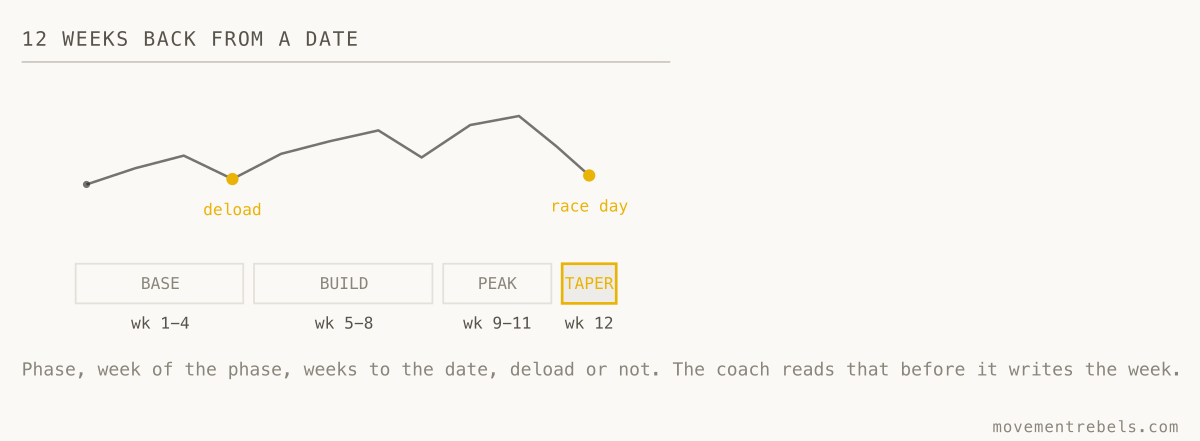
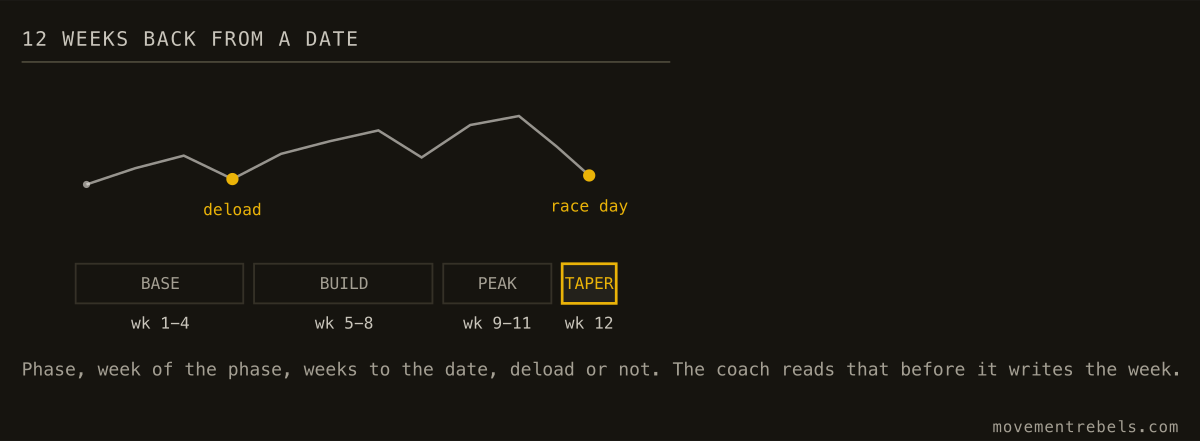
| The date | Strength apps almost never ask. Endurance apps take a race date and taper to it | A dated goal, and the arc built back from it: which phase, which week of the phase, how many weeks out, whether this one is a deload | Nine weeks out reads differently from three, and the week is written for that |
| A knee that flares | No field for it. Some endurance apps have a temporary I am not feeling great toggle | The note you wrote once, read verbatim into every brief, plus athlete memory carrying old injuries between blocks | You write it once. It is still true in March, and the rebuilt week respects it |
| How you responded last time | The log holds every set and the trend line through them | Athlete memory built from earlier blocks and earlier conversations, plus the note you left on the activity | Hard days spaced wider for the athlete who crashed after three in a row last block |
| What the session cost | Marked done; a few read the wearable summary | Training Effect and share of time by zone from the synced activity, read in the post-activity analysis | An "easy" run that came in at threshold heart rate gets flagged, and the next easy day is protected |
movementrebels.com
Most of the middle column is good engineering. The third column is what changes when the same log sits next to a watch and a program with an end.
Novelty is not a training effect
An AI workout generator's best feature is variety. Every day is a new session, which feels like progress because it never gets boring. Adaptation comes from repeating a stimulus and nudging it. Change the exercise every session and the specific lifts you care about stop improving, because a heavy single is a skill and skills need reps. You also lose the baseline. Nothing repeats, so there is no number to beat next week. Muscle size is more forgiving here, and rotating exercises within a movement pattern is fine. It is the lift you want to add weight to that punishes constant change.
Ask a different question than "was today's workout good". Is there a progression at all, a line you could plot where the load or the pace in month six sits above month one? A year of generated sessions gives you 150 workouts and a shrug when someone asks what got better. A year of tracked ones gives you a number you can name. The squat you can load to the kilo, the 10K split you can compare to March. The training was never the hard part. Knowing whether it worked is.
This is exactly what the good apps fixed: they repeat the lift and they keep the number, which is why the case against them has to be about the date and the watch.
Sustainability is the same question wearing different clothes. The generator has no view of your total weekly volume, so it cannot tell you that this week has one hard session too many. That is how enthusiastic people end up flat a couple of months in, then quietly stop. A training volume calculator gives you a ceiling to work under by hand, and a coach that sees the whole week applies it for you without being asked. That is the sustainable part.
What coached training looks like week to week
Here is what changes once the log sits next to a watch and a program with an end, described as it runs in Movement Rebels.
On Sunday the coach writes the week. It reads your last 14 synced activities, the lifts you logged, your readiness check-ins and where you sit in the active program, then lays the sessions on the calendar so the hard ones sit apart and the strength work does not land on top of the intervals. Each morning a short brief reads last night's HRV, resting heart rate and sleep against the plan and says whether today holds or moves.
When a run or ride syncs from Garmin or Apple Health, the coach reads it lap by lap and posts what it saw: the heart rate that drifted over the back half of the long run, the tempo that came in twenty seconds per kilometer hot. Tell it in chat to move Thursday to Friday. Done. With auto push on, the session lands on your Garmin, which is the part the Garmin integration handles.
None of that is a smarter workout. Each session on its own might look much like one a good app would write. The difference is that the sessions know about each other and about the watch, and the longer you use it the more they know, which is how the coach learns from your data over a season rather than re-deriving you from a form.
How to tell the two apart before you pay
You will not find this on a pricing page. Five checks, all of them fast.
- Look for a number that came from you. "Squat 3x5 at 82.5 kg" means it has your history. "Squat 3x5 moderate" means it has a template. The good apps pass this inside the first week. A one-shot generator never will, and you can run your own numbers through a 1RM calculator to see what it should have known.
- Does it connect to your watch, and does the watch change anything? Garmin or Apple Health, at minimum. Then the harder question: does a short night move today's session, or does the sync only decorate the log? Two mornings will tell you. Which metrics deserve how much trust is its own topic, covered in AI coach accuracy by metric.
- Look for a date. If there is nowhere to enter a race or a test date, there is no target, and the progression runs with no end. Most strength apps fail it.
- Look for a week, not a day. If you can only see today's session, nothing is managing the load across the seven days around it. Periodization for recreational athletes covers how the week, and the block around the week, shape what you get out of a training year.
- Ask it what changed and why. After a hard ride or a short night, a coach can tell you what it moved and what it read to decide that. A progression rule can only tell you the next number.
A product that passes the first check is a good training app, and worth paying for. A product that passes all five is coaching you, whatever it calls itself. The best AI fitness app for you is the one that passes and that you will open on a Tuesday in February.
How Movement Rebels fits
One app instead of five.
Strength, endurance, recovery, fueling, planning, and your AI coach. All under a 7-day free trial. No card.
Start 7-day trialHow the AI Coach Learns From Your Data: Periodization, Adaptation, and Feedback Loops
Adaptive is the most abused word in fitness apps. Here is what learning from your data means in practice: three feedback loops, re
AI Coach vs Personal Trainer: Where Each One Wins
A personal trainer costs $60-100 per hour and sees you once a week. An AI coach reads every workout for a fraction of the price. W
Adaptive Training Plans: How the Plan Adjusts to You
Adaptive training is real science with honest limitations. What peer-reviewed research says about autoregulation and HRV-guided pl
Garmin AI Coach: What Your Watch Knows vs. What a Coach Needs to Know
Garmin's built-in coaching balances run and ride load using its own metrics. An AI coach reading the same data programs everything