AI Coach vs Personal Trainer: Where Each One Wins
The honest version of this comparison is messier than the marketing on either side wants it to be.
Research on AI coaching has been accumulating over the past few years. A randomized controlled trial following participants over ten months found that an AI coaching chatbot matched human coaches at goal attainment by the final follow-up, though participants were undergraduate business students pursuing personal development goals rather than athletic performance targets. Studies probing the therapeutic relationship between participants and AI coaches suggest the gap in perceived connection is smaller than most people assume, though the research is early and uses mostly simulated or text-based AI systems rather than the kind of multimodal, data-integrated coaching that exists today. Both kinds of studies carry real limitations: constrained populations, self-reported outcomes, short windows. But they point at something the fitness industry does not like saying plainly: for goal-setting and habit formation, an AI coaching system is closer to a human coach than most trainers will admit.
That does not mean they are interchangeable. It means the question "which is better" is the wrong question. The right question is: better at what?
Where a human personal trainer wins
There are three jobs where a good in-person PT is still the better tool.
Form coaching on technical lifts. A snatch, a clean, a heavy squat under fatigue. Eyes on the bar in real time, hands on the hips to cue depth, voice in the room telling you to brace three seconds before you break. No AI tool watches you lift in three dimensions and intervenes at rep four when your knees cave. If you are learning the Olympic lifts or chasing a double-bodyweight squat, find a coach in your gym and pay them for the hour. That specific hour is irreplaceable.
Race-day and competition presence. Standing in the transition zone at your first triathlon, in the warmup pen at a powerlifting meet, in the start corral at a marathon. A human coach who knows you, talked you through taper week, and is physically present on that day is worth real money once a year. That presence is not a coaching feature. It is a human feature.
Reading the room before you say anything. A good PT notices you walked in flat today before you open your mouth. They scale the session on the fly because your eyes look tired. AI coaching reads your data, and that is a different and powerful signal. But data is what happened after the fact. A human in the room reads what is happening now.
If those three jobs are your bottleneck, hire a human for them. The argument below is not that you should not.
Where an AI coach wins, and the evidence is clear
Outside those three jobs, the comparison shifts fast.
Breadth of domain. Almost no human PT covers strength plus endurance plus nutrition plus recovery competently. They specialize because the depth required is genuine. A strength coach who prescribes your half-marathon block is improvising. A running coach who programs your deadlift progression is guessing. The Movement Rebels coach is trained across all of it: hypertrophy, powerlifting peaking, Olympic lift progressions, calisthenics, marathon and ultra prep, triathlon brick logic, Hyrox pacing, masters-specific load management, female-cycle-aware periodization. One voice, all domains.
Availability and frequency. Your PT is unavailable at 5:47am when your HRV has tanked and you want to know whether to swap the tempo run for easy aerobic work. The MR coach answers in seconds, with your last 14 activities already loaded. You can ask at midnight, at the airport, between meetings. There is no booking window. Research on digital health coaching broadly finds that engagement frequency and coaching outcomes move together, and availability is a key driver of how often people actually engage. An AI coach you can reach at any hour removes the scheduling friction that erodes that frequency.
Data density per conversation. This is the thing nobody talks about. A human PT meets you twice a week for one hour. They see your bar speed and whatever you remember to tell them. The MR coach reads your Garmin sync from yesterday, your Apple Health sleep data from last night, your body comp trend from the last 30 days, and your last six readiness check-ins, every single time you ask a question. The context window a human coach carries after a one-hour session cannot compete with that, not because human coaches are not skilled, but because there is not enough time in a session to brief them fully. The wearable data sitting unread in your fitness apps is where most of the signal lives, and a human trainer rarely sees it. Acting on it can be as simple as running a heart rate training zone calculator so your own resting and max HR set the bands you train in.
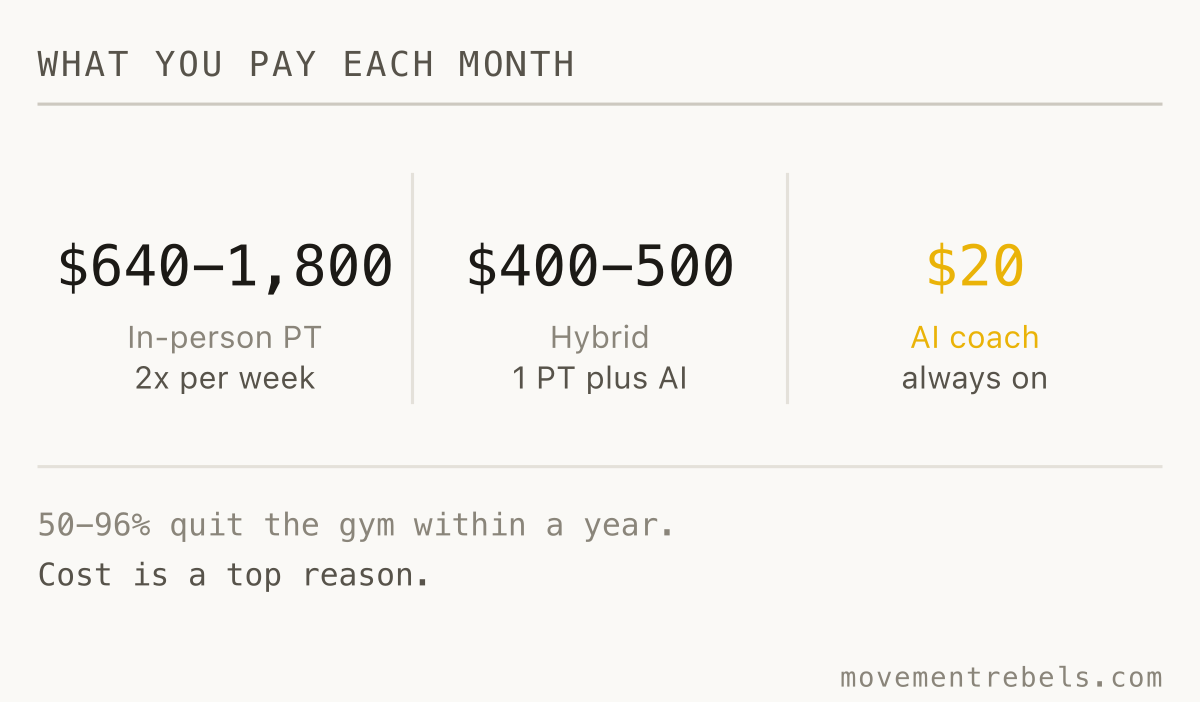
Cost and dropout. A good PT at two sessions per week runs $640 to $1,800 a month depending on city. Gym membership dropout is high across the board, with multiple studies placing year-one attrition well above 50% in most markets, and cost is consistently cited among the top reasons. The maths on sustained engagement at $1,000+ a month is poor for most people. An always-on AI coach at $20 a month has a very different dropout profile.
The accountability question, answered honestly
People ask: "But will an AI hold me accountable the way a human does?"
The honest answer is differently, and for many people more sustainably.
A human PT creates accountability through a paid appointment. Miss it and you eat the cancellation fee. That mechanism works until you cancel the subscription entirely, which most people do. The PT-as-accountability model has a known failure mode: it works right up until life gets busy, money gets tight, or the commute to the gym stops fitting the schedule. Then adherence collapses fast.
The MR coach creates accountability through your data. Skip three sessions in a row and the morning brief opens with it, not as a guilt trip but as a planning adjustment. Under-eat by 600 kcal for three days and the coach reads your logs and raises it before you do. Stop logging entirely and the weekly brief notices the gap. It is not a guilt machine. It is a mirror that keeps running whether you show up or not.
For building an adaptive training plan that actually bends around your real life rather than an idealized schedule, that kind of persistent low-cost accountability has an edge over a twice-weekly session that disappears when the budget shrinks.
The thing neither side will say
Here is the finding the AI fitness marketing ignores, and the PT industry also ignores, because it cuts both ways.
The evidence on AI coaching is mostly from goal-setting and behavior-change studies, not from athletic development. Telling a student to study more, telling a person to walk more, helping someone hit a weight-loss goal: those domains show the parity results cited above. What the research does not yet tell us clearly is whether an AI coach delivers better sport-specific training adaptations over a full season than a good human endurance or strength coach would.
The comparison is actually: AI coach versus average human coach. Not versus the elite coach with 20 years of athlete data. The elite coach wins on nuance and intuition built from thousands of athletes. The average coach, who learned a program template and delivers it to everyone, may not. That is the more honest bracket.
And the data-driven gap matters here too. Most athletes are sitting on months of HRV, sleep, and training load data that nobody has ever synthesized into a plan. Even a single field test you run today adds to that picture, and a free VO2 max calculator from a field test is a concrete data point you can generate in an afternoon. An AI coach that reads HRV trends and adjusts training load accordingly is doing something very few human coaches do, not because they lack the skill, but because they never see the data in the first place.
How to choose
Pick the human if: you are learning technical barbell movements from scratch, you have a competition in the next 12 weeks and want someone physically present, you have the budget and schedule, you know you need eyes-on accountability to show up.
Pick the AI coach if: your training spans more than one discipline, you train at odd hours, you want a plan that adjusts to your recovery data without a conversation, your wearable has been running for months and nobody is reading it, your budget is under $50 a month.
Run both if you can. They do not conflict. Use a human PT once a week for form and the MR coach for everything else: planning, nutrition, recovery, cross-discipline programming, and the 11pm question about whether to deload next week. That stack runs about $400 to $500 a month and covers far more ground than three PT sessions a week alone ever could.
How Movement Rebels handles this
The MR coach reads completed workouts from Garmin Connect (native integration, live) and Apple Health on iOS (live, reads HRV, sleep, resting HR, and workouts). Structured sessions push back to your Garmin watch with HR and pace targets set as on-device alerts. After each session the coach writes a summary back to the Strava activity description, so your Strava log gets annotated automatically; Strava is an output destination, not a data source the AI reads from. The Garmin integration means your watch becomes an output device, not just a logging device.
Nutrition, snap meal photo logging, breathwork, cold exposure, and HRV-guided readiness all live in the same app. The coach reads all of it before every reply, so the context is already there when you ask. For more on what that data flow looks like end to end, see Apple Health AI coach.
Pricing
Seven days of full access on the free trial, no card required. After the trial, Pro+ is $20 a month for unlimited coaching. The morning and weekly briefs stay free after the trial ends.
One app instead of five.
Strength, endurance, recovery, fueling, planning, and your AI coach. All under a 7-day free trial. No card.
Start 7-day trialAI Coach vs TrainingPeaks: Automation, Community, and Cost Compared
TrainingPeaks analyzes your training. It does not coach you. Here is where the platform wins, where an AI coach takes over, and wh
AI Coaching for Runners: Pace, HR, Power, and Form Feedback
What an AI running coach does with your pace, heart rate, and power data, how adaptive plans respond to real weeks, and where watc
AI Coaching for Female Athletes: Cycle Tracking, Periodization, and Hormonal Variation
How AI coaches adapt to female physiology: cycle tracking, hormonal periodization, real-time readiness, and the data that powers i
Garmin AI Coach: What Your Watch Knows vs. What a Coach Needs to Know
Garmin's built-in coaching balances run and ride load using its own metrics. An AI coach reading the same data programs everything