Periodization for Recreational Athletes: Which Model, and How Much You Need
Periodization advice was written for Soviet Olympic sprinters in the 1960s. Your calendar looks nothing like theirs. So before picking a model, here is the honest version: the research comparing different periodization approaches shows no clear winner on outcomes. Linear and undulating programs produce similar strength and body composition results when volume is matched. What matters more than which model you pick is whether you build in enough variation to avoid stagnation, enough planned recovery to let adaptation express itself, and enough flexibility to keep showing up when life randomizes your week.
That is the part most guides skip. They spend three thousand words comparing block versus conjugate for an athlete training 5 hours a week, when the real leverage is somewhere simpler.
This guide covers what periodization actually solves, how the three main models differ, how to pick based on your goal and hours, and what "good enough" looks like for a busy recreational athlete.
What periodization actually solves
Periodization is the deliberate variation of training stress over time to drive adaptation while preventing stagnation and managing cumulative fatigue. Without any structure, two things happen reliably. First, you plateau, because a repeated stimulus stops being novel and the adaptation curve flattens. Second, fatigue accumulates faster than fitness, because every week looks like a hard week and there is no recovery built in.
The physiological mechanism is well established. Training stress raises both fitness and fatigue simultaneously, but fatigue decays faster than fitness does. A planned reduction in volume or intensity, whether you call it a deload, a taper, or a low week, lets fatigue drop while the fitness adaptation you built lingers. That window, the gap between fatigue dropping and fitness following it, is when performance actually expresses itself. Skip the recovery and you never fully feel what you earned.
The 2015 systematic review on periodization for inactive adults found that all major periodization models improved health and fitness outcomes versus no training, but only two of the 21 studies in the review directly compared periodized to non-periodized training. That is a thin evidence base for the strong claims made about one model versus another. What the literature is clear on: some structure beats none, and built-in variation beats monotony.
For recreational athletes the question is rarely "should I periodize?" but "which model fits 6 hours a week with two kids and a desk job, and can I actually stick to it?"
Linear periodization: simple, predictable, still works
Linear periodization moves progressively from high volume and lower intensity toward lower volume and higher intensity over a block, typically 8-16 weeks, ending at a peak event or testing week.
A runner training for a half marathon might spend weeks 1-4 building aerobic base with zone 2 work, weeks 5-8 adding tempo and threshold work, weeks 9-12 sharpening with race-pace intervals and shorter long runs, then tapering. A strength athlete might run 5x5 at moderate load for a month, shift to 4x4 heavier, then 3x3 heavier, then test a one-rep max.
Linear works well for:
- Beginners, where any novel stimulus drives adaptation and simplicity reduces friction
- Single-peak goals with a known date: a race, a meet, a big event
- Athletes training 4-7 hours a week who cannot manage multiple competing qualities at once
It struggles when you want to maintain multiple qualities simultaneously (you lose strength while peaking endurance; you lose endurance while peaking strength) or when life forces you to skip weeks and breaks the progression. The longer the block, the harder a missed week hits the math.
Block periodization: stack the adaptations sequentially
Block periodization concentrates one or two training qualities at a time in 2-4 week focused blocks, then rotates. The logic draws on Vladimir Issurin's review of block periodization versus traditional training theory: after a focused aerobic block, aerobic adaptations persist for several weeks even after you shift focus to strength or speed. After a hypertrophy block, that base lingers during a power block. You stack adaptations in sequence rather than chasing them all at once, which is why the block order matters.
A typical hybrid-athlete structure: accumulation block (high volume, lower intensity, build work capacity), transmutation block (sport-specific intensity, lower volume), realization block (peak intensity, low volume, taper into testing or competition). The total cycle often runs 12-16 weeks.
Block works well for:
- Hybrid athletes (CrossFit, Hyrox, military prep, triathlon) who need multiple physical qualities
- Athletes with two annual peaks, a spring event and an autumn event, who can build a distinct block cycle for each
- Anyone training 6-12 hours a week with the discipline to commit to one priority per block
The trap: abandoning a block early because you "feel slow today" pulls the rug out from under the next block's stack. Block periodization rewards consistency more than the other models do. If your schedule is unpredictable, block might be the wrong shape for your life.
Undulating and conjugate: rotate qualities within the week
Undulating periodization (daily or weekly variations in intensity and volume) and the conjugate approach (Westside-derived, rotating which quality gets the maximum effort) both train multiple qualities every week rather than concentrating them in sequential blocks.
A weekly undulating example: heavy lower on Monday, upper hypertrophy on Wednesday, dynamic lower on Friday, tempo run on Saturday. The intensities rotate; the qualities stay live. A simple recreational version: one hard strength session, one hard interval session, one long easy aerobic session, all within the same week.
The 2026 Frontiers meta-analysis comparing linear and undulating programs across 704 participants found the two approaches broadly equivalent for strength, body composition, and metabolic markers. Undulating showed an edge for short-term body composition goals, particularly in populations targeting weight loss; linear appeared more appropriate for long-term weight loss outcomes. Neither dominated across the board.
What undulating does offer recreational athletes is flexibility. When your Thursday interval session has to become a Wednesday easy run because the kids are sick, an undulating week absorbs that substitution better than a rigid linear block does. The evidence broadly supports the principle that flexible nonlinear approaches, where athletes can adjust session order based on daily readiness while keeping total weekly load structured, tend to support consistent training over time. Adherence is the variable that beats model selection every time on a long enough timeline.
Undulating and conjugate approaches underperform when you have a specific performance peak and need to channel everything at it. For event-specific peaking, block or linear typically wins because the concentration of stimulus is higher.

How to pick based on your goal and hours
The decision is simpler than the models suggest.
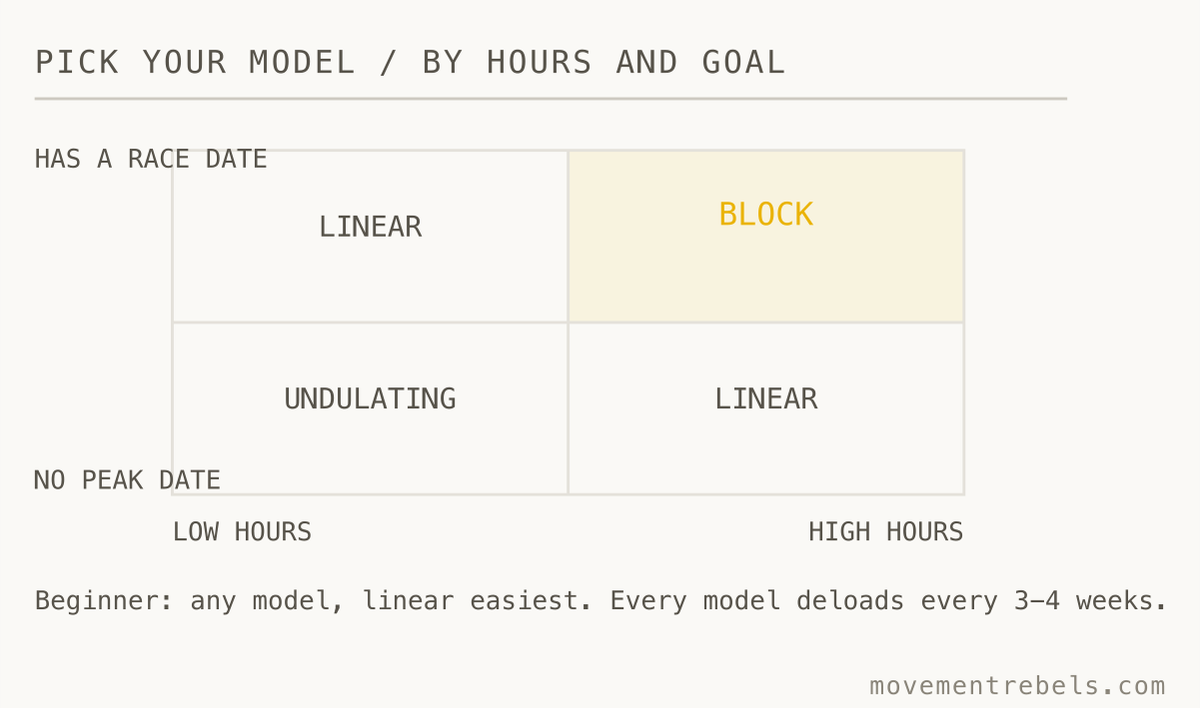
You have a race, meet, or event date. Use linear or block. Linear is simpler; block is better if you need multiple qualities for the event.
You train 3-6 hours a week with no fixed peak. Undulating or flexible nonlinear is more realistic. The sessions vary enough to prevent stagnation. Life disruption is absorbed more gracefully.
You are a beginner. Any model works. Linear is easiest to follow. The bigger priority is building the habit, hitting your sessions, and adding load progressively. The label matters less than the execution.
You are a hybrid athlete with 8-12 hours a week. Block is worth the discipline cost. The stacking logic pays off when you have the volume to fully load each block.
One thing every model has in common: they all build in recovery. If you take nothing else from periodization theory, take this: plan a lower-volume week every 3-4 weeks, not when you feel like it, but on the calendar. A weekly volume planner with 10% progression and a deload week maps that block shape for you so the low week lands on schedule. That is the minimum effective dose of periodization for most recreational athletes, and it is what the research most consistently supports. If you want to set that dose against your own numbers, a training volume calculator with MEV, MAV and MRV bands shows where your weekly load sits between minimum and maximum recoverable. An editorial in the programming and periodization literature notes that session supervision, exercise selection, and volume matching are often overlooked confounding variables that impact strength and hypertrophy adaptations, a useful reminder that the model label matters less than how the sessions are actually run.
The adherence problem no model can solve
Here is the conflict that expert sources do not resolve cleanly: rigid periodization models were designed for athletes with coaches, single sports, and training as their job. Applied to a recreational athlete with 5 unpredictable hours a week and competing demands, the model can become a source of guilt rather than structure.
The practical principle the evidence points toward: letting athletes adjust which session they tackle based on how they feel, while keeping total weekly load structured, tends to support both performance and consistency better than fixed daily sequences that cannot bend. The structure that gets done beats the optimal structure that gets abandoned.
A missed week inside a linear block is not a disaster. A missed month because the model felt too rigid to survive real life is. This is the practical case for adaptive planning over any fixed template.
How Movement Rebels handles this
Most apps periodize one thing. Strength apps periodize strength. Running apps periodize running. Hybrid athletes get no coherent model at all. The real problem most recreational athletes face is not "which model" but "which model can actually read my life."
The Movement Rebels coach picks a starting model based on your goal, training hours, and experience during onboarding. A first-time marathoner gets a linear aerobic build. A returning hybrid athlete gets a block structure with concurrent strength. A lifter training around endurance gets an undulating approach that keeps both qualities live.
Then the plan flexes week to week. Garmin data and Apple Health (native on the iOS app) feed actual training load and sleep into the coach's read. Your readiness check-ins and Rebel Fuel log add context. If you finished last week in a caloric deficit three days running and HRV is suppressed, the coach scales the upcoming volume rather than pushing the block forward on paper. If you nailed the week and HRV is trending up, load increases. The model provides the shape; the data adjusts the dosing.
This matters because the failure mode for recreational periodization is almost always adherence, not model selection. Flexible adjustment based on how your body actually responded does more for long-term progress than rigidly executing the theoretically optimal block sequence.
Recovery tools sit in the same app: breathwork, NSDR, and HRV-guided readiness. Biohack history and training timeline live together, not in separate apps, so the coach sees the full picture before prescribing the next week.
Native iOS and Android. Garmin connects natively. Apple Health connects natively on iOS. Strava syncs both ways.
Pricing
7-day free trial, full access, no card. After the trial, Pro+ is $20/month for unlimited coach chat, plan generation, deep workout analysis, and snap-meal logging. One app instead of five.
One app instead of five.
Strength, endurance, recovery, fueling, planning, and your AI coach. All under a 7-day free trial. No card.
Start 7-day trialAdaptive Training Plans: How the Plan Adjusts to You
Adaptive training is real science with honest limitations. What peer-reviewed research says about autoregulation and HRV-guided pl
When to Deload: Reading the Signals Right
The 4-week deload rule is a template, not a law. Here are the actual physiological signals that tell you when your body is asking
Hybrid Athlete Training: Concurrent Done Right
The interference effect is real but smaller than you think, and the rules for avoiding it are simpler than the hype suggests. Here
HRV-Guided Training: Read the Signal, Skip the Noise
One low HRV night tells you almost nothing. The 7-day-vs-28-day trend tells you nearly everything. Here is what the evidence actua