Adaptive Training Plans: How the Plan Adjusts to You
The pitch is compelling: a plan that reads your body, rewrites itself each week, and is never the static PDF that ignores how badly you slept on Wednesday. The honest version is a bit more complicated, and it is worth getting right before you trust one with your training.
Adaptive training is real, peer-reviewed science. It is also partially overhyped by the app industry that benefits from selling it. This guide walks through what the research says autoregulation actually does, where its effects are modest, and what conditions have to exist for an adaptive plan to be worth anything at all.
What "adaptive" means, and what it doesn't
The academic term is autoregulation: adjusting training variables in real time based on athlete feedback or objective signals rather than following a fixed pre-written prescription. Two main forms show up in the literature:
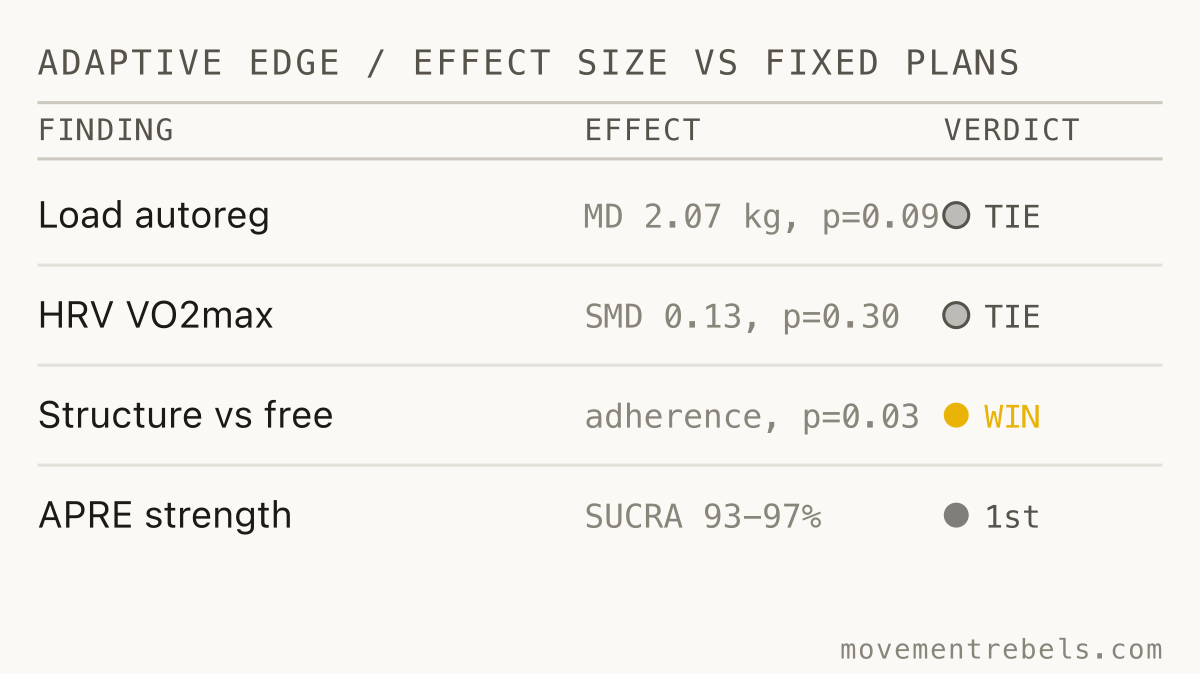
- Load autoregulation. Prescribed intensity flexes session to session based on readiness signals. Reps-in-reserve (RIR) rating, rate of perceived exertion (RPE), or velocity-based thresholds replace a fixed percentage of 1RM. A 2022 systematic review and meta-analysis in Sports Medicine - Open covering 15 studies found autoregulated load prescription did not significantly outperform percentage-based training for strength (MD 2.07 kg, p = 0.09), but did show that volume autoregulation via lower velocity loss thresholds (25% or less) outperformed higher thresholds for maximal strength gains.
- HRV-guided training. Whether to go hard or easy on a given day is decided by morning heart rate variability rather than the calendar. The research broadly finds that HRV-guided training, when it outperforms a well-designed fixed plan, does so by a small margin that often falls short of statistical significance. The practical takeaway: HRV guidance works best as one signal among several, not as a standalone decision engine.
Neither finding means adaptive approaches are useless. They mean adaptive approaches work when the underlying plan is already sound, when the signals feeding the adaptation are real data and not noise, and when the athlete actually uses them across enough weeks for the effect to accumulate. The athlete who compares "adaptive AI plan" against "I wing it each week" is not running the same experiment the research ran.
Where the real evidence is strongest
The most robust finding cuts across all camps: structure beats no structure for adherence. Studies comparing periodized training against unstructured free training consistently find higher motivation, lower dropout, and better outcomes in the structured groups. Reverse periodization and traditional periodization both outperform unstructured training on adherence metrics, and among the structured approaches, reverse periodization tends to score highest overall on motivation measures. The mechanism is simple: knowing what comes next, and why, sustains compliance. A rigid plan that gets followed is more useful than an adaptive plan that gets ignored.
The second robust finding: the bigger the deviation between what the plan prescribes and what the athlete can actually do, the more those deviations compound. Research by Connor, Beato, and O'Neill (2022) modeled this mathematically: small session-by-session deviations accumulate over a training cycle into significant drift from the intended physiological goal. An adaptive system that resets the trajectory each week beats a static plan because it closes that drift before it becomes a week of junk mileage chasing a prescription that no longer fits.
The third finding, specific to strength training: a 2025 network meta-analysis in the Journal of Exercise Science and Fitness covering 19 randomized controlled trials found that autoregulatory progressive resistance exercise (APRE) ranked first for strength improvement in both back squat and bench press (SUCRA 93.0% and 97.1% respectively). The practical interpretation: letting the rep count flex based on that day's output, rather than locking in a fixed set-rep scheme, is the most evidence-backed form of strength autoregulation.
The honest counter-argument
The strongest skeptic case runs like this: the studies on HRV-guided training used relatively short interventions (eight weeks or less in most cases), making it hard to detect cumulative benefits. Autoregulation in the strength literature benefits trained athletes more than beginners, who adapt to almost anything. And for endurance athletes under eight hours per week, the more tractable problem is often not "is my periodization adaptive?" but "am I actually executing the easy days easy and the hard days hard?" See Zone 2 Training for why intensity discipline beats intensity sophistication at most recreational training volumes.
The economist lens adds one more honest note: adaptive training plans are a compelling product story. Apps that update your plan dynamically feel premium. The gear sold around this: HRV monitors, readiness rings, lactate meters, and $30/month subscriptions. Some of that is real, useful signal. Some of it is the premium feel of the interface more than the value of the adaptation itself. The signal worth having is the one that changes a decision. If your HRV is down 8% from baseline and you would have done a threshold session anyway, but the app flags it and you shift to an easy day, that flag earned its place. If you ignore every flag, you paid for a dashboard.

What makes an adaptive plan actually work
Given all that, here are the conditions that separate "adaptive" delivering real value from "adaptive" as a marketing word:
Real readiness signals, not a single proxy. HRV alone is too noisy on short timescales to drive high-confidence decisions. The systems with the best track record layer HRV with resting heart rate trend, sleep, subjective mood, and performance output (are your paces at a given HR drifting?). See HRV-Guided Training for the full signal picture. Resting heart rate trends over 28-day windows give the steadiest background signal.
A goal the plan holds constant. Adaptation serves a target. "Sub-3:30 marathon on October 5" gives the system a periodization scaffold. "Get fitter" gives it nothing. The key sessions (race-specific work, peak intensity blocks) should be locked; what flexes is the surrounding volume and intensity distribution.
Enough weeks to see the effect. The research that shows HRV-guided training catching up to and occasionally surpassing fixed plans is the research that ran 12 weeks or longer. Eight weeks is borderline. Four weeks of "adaptive" is mostly noise.
Consistent logging. Adaptation requires data. A training plan that reads your body reads whatever you give it. The athlete who logs strength sessions, recovery tools, and nutrition creates a much richer feedback loop than the one who only pipes in Garmin HR data. Periodization for Recreational Athletes covers which variables matter most for different training volumes.
Deload timing on demand, not on a calendar. Standard programs schedule a deload every fourth week. Your physiology does not run on a four-week calendar. When to Deload covers the signals that actually predict when recovery weeks earn their place, versus when you are inserting them by convention and missing training opportunity. If you want a starting block to flex against, a weekly volume planner with built-in deload lays out the progression and low week you can then adjust on demand.
The weekly loop that actually works
The architecture of an effective adaptive cycle is not complicated:
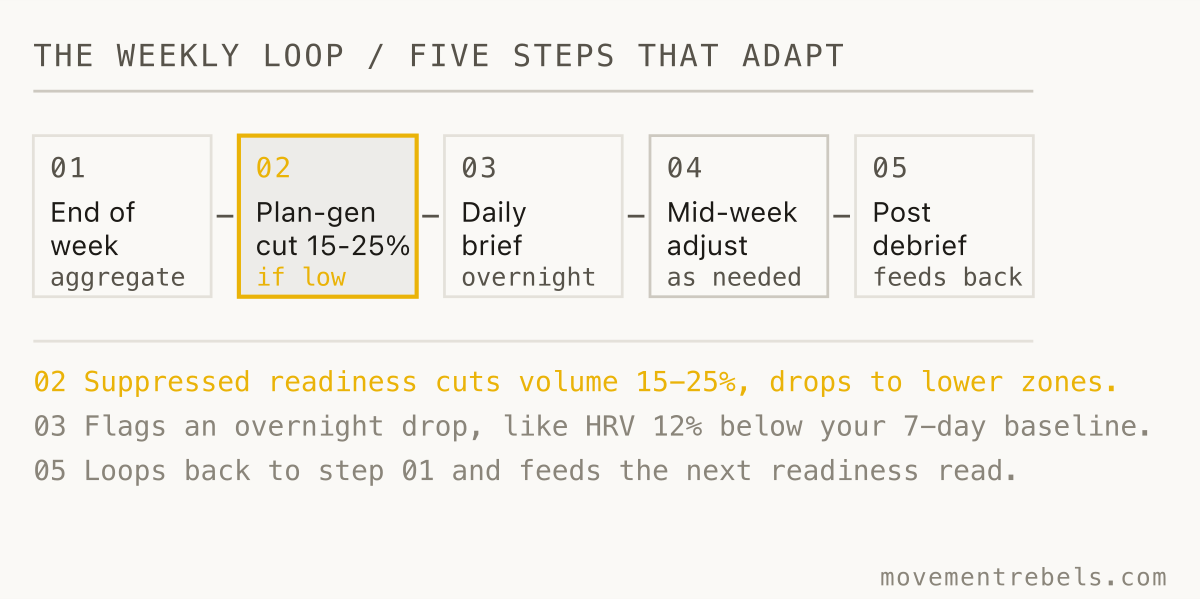
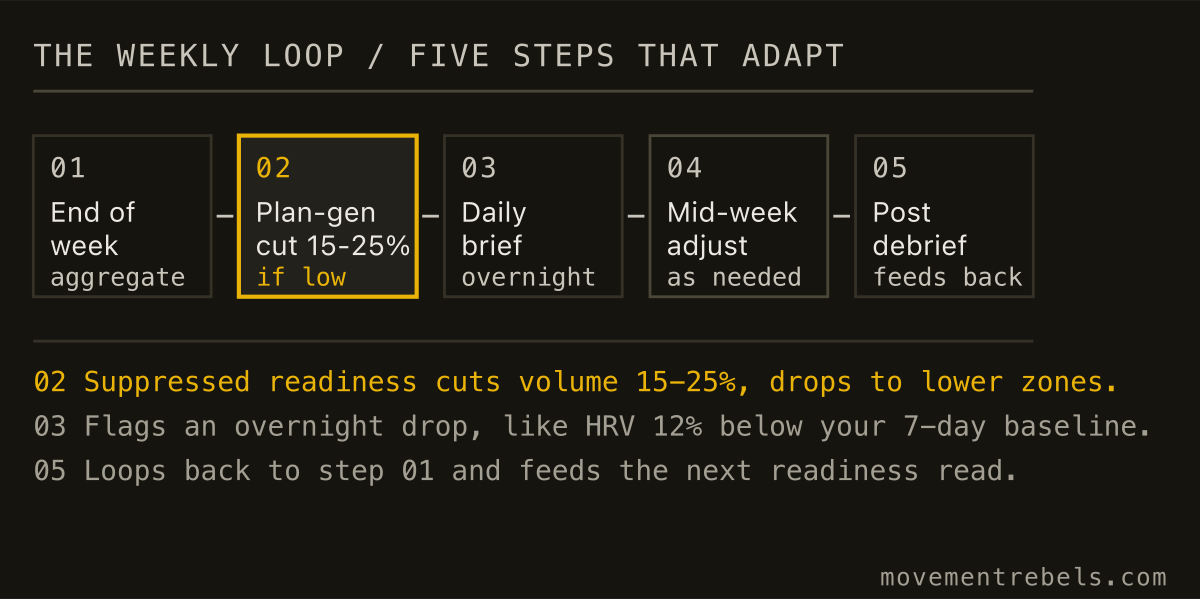
- End of week. Aggregate readiness signals: HRV trend across the week, sleep average, session completion rate, subjective RPE vs. prescription, any flags from strength sessions (missed reps, pace deviation at target HR).
- Weekly plan generation. Adjust next week's volume and intensity based on those signals. Hold the goal and the key session structure constant. If readiness is suppressed, reduce total volume 15-25% and push intensity toward lower zones. If readiness is high and the athlete is ahead of projection, advance the loading.
- Daily brief. Flag any overnight readiness drop before the day's session. Give the athlete an honest read: "HRV 12% below your 7-day baseline this morning. Today's threshold session is not the best use of this day. Here are two options."
- Mid-week adjustment. Life intervenes: travel, illness, a long workday. The plan re-routes around those constraints without discarding the week's training target.
- Post-session debrief. Close the loop. Session execution feeds the next readiness assessment.
This is not novel architecture. It is how every good human coach has always worked. The technology makes it available at scale and at the frequency good coaching requires.
How Movement Rebels handles this
The adaptive loop is the default product behavior, not a paid tier.
Onboarding captures your goal, training history, available hours, disciplines, and equipment. The first plan generates immediately. Wearable sync kicks in as soon as you connect Garmin (which pushes structured sessions directly to your watch, readable in the native Garmin integration), or Apple Health on iOS (which pulls HRV, sleep, resting heart rate, and workouts from any device that writes to HealthKit). Strava is live: completed activities from Garmin or Apple Health appear in your Strava feed automatically, and the coach writes a session summary back to your Strava description. Strava data itself does not feed the coach as an AI input. No other platform connects directly; if your device writes to Apple Health, that data reaches the coach through that path.
Every Sunday the coach generates the next week. Before writing a single session, it reads the last 14 activities, your strength log, nutrition logs from Rebel Fuel, recovery tools used (breathwork, NSDR, cold exposure), and the conversation history it has been building with you across every chat. The weekly brief arrives Monday: what happened, why the week is structured as it is, and what to watch for.
Mid-week, if something changes, you tell the coach in chat. The rest of the week re-plans. No extra credit charge. The overtraining signals guide explains exactly what the coach watches for before it recommends backing off a block entirely.
Unlike generic templates, this system has every discipline in the same loop. Strength volume from Tuesday feeds the endurance prescription for Thursday. A bad sleep week triggers a volume drop across all sessions, not just the running. Fueling signals from Rebel Fuel feed the same plan-gen that touches your lifting days. Hybrid athlete training requires that cross-domain accounting. Isolated single-sport apps cannot do it.
Pricing
A 7-day free trial covers the entire surface: adaptive plan-gen, weekly brief, daily brief, chat, post-workout debriefs, Rebel Fuel, and every recovery tool. No card on the trial. After the trial, Pro+ at $20/month keeps everything running, including unlimited plan regenerations.
One app instead of five.
Strength, endurance, recovery, fueling, planning, and your AI coach. All under a 7-day free trial. No card.
Start 7-day trialHRV-Guided Training: Read the Signal, Skip the Noise
One low HRV night tells you almost nothing. The 7-day-vs-28-day trend tells you nearly everything. Here is what the evidence actua
When to Deload: Reading the Signals Right
The 4-week deload rule is a template, not a law. Here are the actual physiological signals that tell you when your body is asking
Periodization for Recreational Athletes: Which Model, and How Much You Need
Linear, block, undulating: the honest evidence on which periodization model recreational athletes actually need, and what the rese
Overtraining Signs: The Ones Worth Watching
True overtraining syndrome is rarer than you think, has no reliable biomarker, and is almost never what recreational athletes have