Snap Meal: Photo Calorie Tracking Without the Tedium
The nutrition tracking industry has a dirty secret: a perfectly weighed, 99-percent-accurate food log that you abandon after eleven days is worth exactly zero. A "good enough" photo estimate you sustain for six months is what actually moves body composition and performance. Photo calorie tracking is not marketed on that logic. It should be.
This guide covers what the research actually says about AI photo accuracy, where the method breaks down, and how Snap Meal inside Movement Rebels is different from dropping a number into a calorie app that does nothing else with it.
Why the weigh-and-scan habit fails
The problem with conventional food logging is not the concept. It is the cost-per-entry in time and friction.
Weigh the chicken. Find the right chicken in the database (pan-seared? baked? generic poultry?). Remember the olive oil you cooked it in. Guess the tablespoon of butter. Scan the yogurt barcode. Search for the brand of sourdough your partner bought, find three versions with different kcal counts, pick the nearest one. Do that six times a day, every day, for months.
Research on self-reported dietary instruments consistently finds systematic underreporting of energy intake averaging 16 to 30 percent across populations, and a disproportionate fall-off for the hardest meals: the restaurant lunch, the post-training handful of trail mix, the social dinner where weighing anything would be socially bizarre. That is not a failure of willpower. It is rational behavior in response to a tool with unreasonable friction.
The athlete who needs nutrition data most is also the most likely to skip logging because they are tired after training.
What photo AI estimation actually gets right
Point your phone at a plate and the AI does three things in sequence: identify the food items, estimate each portion volume from visual cues (plate diameter as a scale reference, depth of the pile, utensil size, visible area), and convert volume estimates to mass-per-macronutrient using a food composition database.
Each step has its own error budget. The limiting step is almost always the second one: volume estimation, not food recognition.
A 2023 systematic review in Annals of Medicine covering 52 peer-reviewed studies found that AI estimation of calorie content from food images ranged from roughly 62 to 99 percent accurate depending on dish complexity, with average relative errors landing between 0.10 and 38.3 percent for energy and 0.09 to 33 percent for volume. The wide range is the story: single visible items (a chicken breast, a banana) sit at the high end; complex mixed bowls and sauced dishes sit at the low end.
A randomized crossover trial published in JMIR in 2022 compared AI image-assisted tracking against a validated web-based 24-hour recall across 136 participants over four consecutive days. Mean energy difference between methods: -32 kcal per day, not statistically significant. The AI tool scored 77 out of 100 on the System Usability Scale versus 53 for the conventional recall. No significant difference in carbohydrate, protein, or fat estimates. The practical conclusion: photo-based AI tracking matches a validated dietary recall method on energy and macros, while being far easier to use.
A smartphone portion estimation study on PMC showed that trained users reached average absolute errors of 16.65 percent for large-portion foods, but 47.60 percent for small-volume items. Small portions are the hardest thing to estimate by eye. This is not an AI limitation specifically; it is a human visual perception limitation that affects all estimation methods.
Honest accuracy by plate type
Rather than one headline number, here is what the evidence supports:
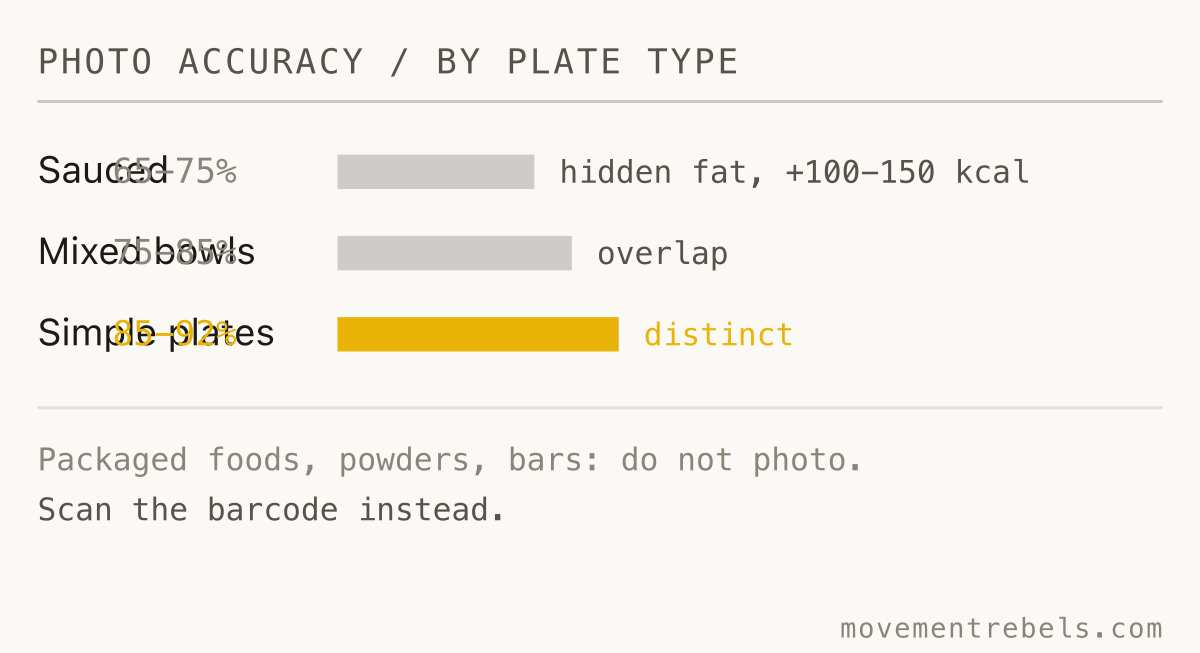
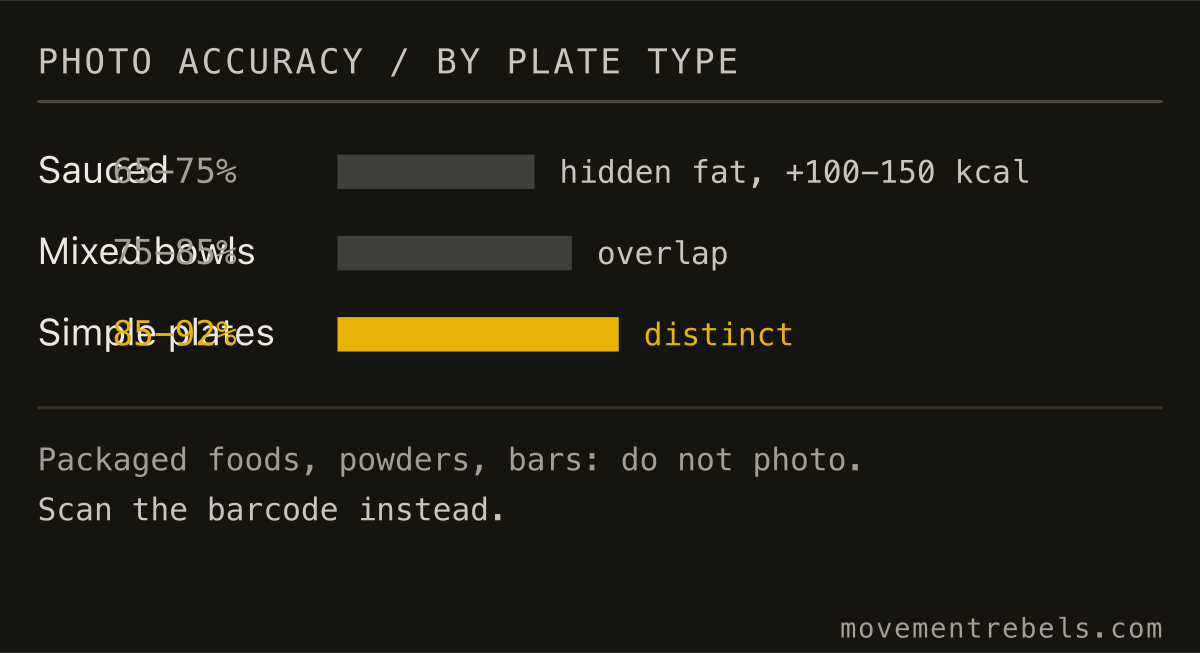
Simple plates with visible, distinct components (a protein, a starch, a vegetable): 85 to 92 percent of a weighed reference on total kcal. Protein is the best-estimated macro because protein sources are usually visually separable and have predictable density.
Mixed bowls, composite dishes, grain bowls: 75 to 85 percent. Multiple overlapping ingredients compound the volume estimation error.
Sauced and hidden-fat dishes (stews, curries, pasta with cream sauce, anything where fat is stirred in): 65 to 75 percent, sometimes lower. The model cannot see the half-cup of cream in the sauce or the four tablespoons of oil absorbed by the eggplant.
Packaged foods, powders, protein bars: do not photo-estimate these. A barcode or a quick manual entry is faster and more accurate. Save Snap Meal for real plates.
The right comparison is not photo estimation versus a lab-grade weighed log. It is photo estimation versus what you would actually do otherwise, which for most athletes on most days is nothing, or a rough mental note that is 25 to 40 percent off by default.
Where portion estimation trips up, and how to fix it
The key insight from the PMC portion-size research is that volume estimation breaks down when there is no reliable scale reference in the frame. Most modern photo-AI tools use the plate rim as a scale reference, which works well with standard 25 to 28 cm dinner plates and fails with deep bowls, take-out containers, and odd-shaped dishes.
Three habits that sharpen accuracy without adding friction:
- Use a standard plate. Bowl meals are harder to estimate than flat-plate meals. If you cook at home, the same plate every time removes one variable.
- Edit the protein number first. Protein is what most athletes underestimate. After the estimate appears, take two seconds to adjust the protein source if it looks off. Macros recompute instantly.
- Flag sauced meals. If you know there is hidden fat (cream, butter, oil absorbed in cooking), add 100 to 150 kcal manually as "cooking fat." It takes four seconds and closes 70 percent of the hidden-fat gap.
None of this is obsessive. It is the same judgment any experienced cook uses when eyeballing a plate.
The part calorie apps miss: what happens after you log
Dropping a number into a standalone calorie app gives you a daily total and a bar chart that no one reads. Snap Meal feeds a different machine.
When you log through Rebel Fuel, the entry is timestamped and integrated into the coach's picture of your training week alongside Garmin activity data, Apple Health recovery metrics, and your strength and endurance sessions. A few practical examples of what that cross-domain read looks like:
Logging only helps once you know what to log against, and our macro calculator to set your daily targets gives you the calorie and macro numbers to aim for. If you have been averaging 550 kcal under your intake target for three consecutive days before a heavy strength block, the coach scales Wednesday's volume down with a note explaining the call. It is not a generic warning; it is a specific adjustment derived from your logged data.
If your protein is sitting at 1.1 g per kg while you are running a modest cut, the coach flags it in the morning brief before you notice it yourself. Getting this right is one of the highest-leverage variables in body recomposition, and a calorie app sitting in isolation cannot connect those dots.
If you snap a 1,300 kcal plate two hours before a long endurance session, the coach reads the timestamp, the macro split, and the session type together. The fueling guidance for the session changes accordingly. That is the kind of context that matters in fueling around long training sessions.
If your Rebel Fuel data shows consistent low-carb intake across the week and your HRV is trending down, the coach connects both signals rather than treating them as separate readouts. Neither data stream means much alone.
Pair it with the rest of Rebel Fuel
Snap Meal handles cooked plates. The rest of Rebel Fuel handles what a photo cannot see.
The hydration log is a one-tap entry for water and electrolytes. The coach pulls this directly into endurance session briefs for heat and long-session protocols.
The macro estimate tool covers the non-photo case: type a description of what you ate and get the same structured macro output back at 1 credit. Useful when a photo is impractical (a liquid breakfast, a batch-cooked meal you already know).
The fasting timer gives the coach your eating window. If you eat until 10pm, the coach stops scheduling fasted long runs at 6am.
Supplement tracking logs creatine, magnesium, omega-3, and whatever your stack includes. If you raise cramping or sleep quality with the coach, the supplement context is already in the record.
None of this requires manual bridging. It all writes to the same Rebel Fuel log that the coach reads continuously.
How Movement Rebels uses your food data
The coach does not treat Rebel Fuel as a separate nutrition layer. Calorie and macro data from Snap Meal feeds the same weekly plan generation and daily brief production that your training load and recovery data feed.
Weekly plan generation does not read your Rebel Fuel history. The log is for you. A week of under-fueling shows up as lower volume prescriptions and explicit refuel notes before hard days. A well-fueled week with adequate protein gets normal or progressive loading. See how this fits into macros for body recomposition if you are managing a cut or bulk alongside your training.
The morning brief surfaces nutrition flags without you asking. Under-recovered and under-fueled read very similarly to the coach, which is the point: they often are the same problem at root, and the data from both streams is what separates the right call from a guess.
This integration matters more at higher training loads. If you are stacking strength and endurance work as a hybrid athlete, the fueling precision needed to recover across disciplines is the part most athletes get wrong. Photo tracking lowers the barrier to getting that data in consistently.
Pricing
Snap Meal costs 2 credits per photo. The macro estimate tool costs 1 credit. On the 7-day free trial you have full access to the entire app with a 100-credit weekly ceiling that covers normal logging volume without issue. After the trial, Pro+ is $20 per month for 250 credits monthly and unlimited coaching. No card required on the trial. No separate nutrition subscription, no premium meal database, no tiered upsell.
One app instead of five.
Strength, endurance, recovery, fueling, planning, and your AI coach. All under a 7-day free trial. No card.
Start 7-day trialMacros for Body Recomposition: The Numbers That Work
Simultaneous fat loss and muscle gain is real but slow. Here's the honest protein math, the deficit window, how training status ch
Carbohydrate Timing for Athletes: Fueling Around Long Sessions
How many grams of carbohydrate and when: 1 to 4 g/kg before training, 30 to 90 g per hour through long sessions, and the 4 hour re
Hydration Tracking for Athletes: The Overhydration Risk Nobody Talks About
Most hydration guides warn about dehydration. This one covers both sides: 2% body mass loss impairs performance, but over-drinking
Body Recomposition Tracking: Why The Scale Lies
The scale is the worst tool for tracking recomposition. Here's the honest five-signal stack that actually shows progress, what the