Resting Heart Rate Trends: The 28-Day Line
Here is the part no wearable app will put in its marketing copy: the sensor on your watch can swing 5 beats per minute on a perfectly normal night, and a solid 20-week training block will drop your resting heart rate by roughly 2 to 3 beats on average. That gap matters. If you are panicking over a 4-beat overnight spike, you may be reacting to sensor noise, not physiology. The answer is not to ignore resting heart rate. It is to stop reading single days and start reading the 28-day line instead.
What Resting Heart Rate Actually Measures
Resting heart rate (RHR) is the number of times your heart beats per minute at full rest, ideally captured during the lowest point of overnight sleep when your autonomic nervous system is as quiet as it gets. In that narrow window, it is a genuine window into cardiovascular adaptation. A heart that has learned to pump more blood per beat through months of aerobic training does not need to beat as often at rest.
The physiology is real. The measurement is not as clean as the apps suggest.
A 2020 PLOS ONE study of 92,457 Fitbit users across nearly 33 million daily readings found that most people have a median weekly RHR fluctuation of only 3 bpm, but 20 percent of participants experienced at least one week with swings of 10 bpm or more. Those swings were not training signals. They were driven by sleep duration, seasonal patterns (RHR peaks in January, bottoms in July), and normal intraindividual noise. The same study showed that while people differ enormously from each other (40 to 109 bpm range across the population), each individual stays remarkably stable around their own baseline. That is the key insight: deviation from your own rolling mean is the signal, not the absolute number.
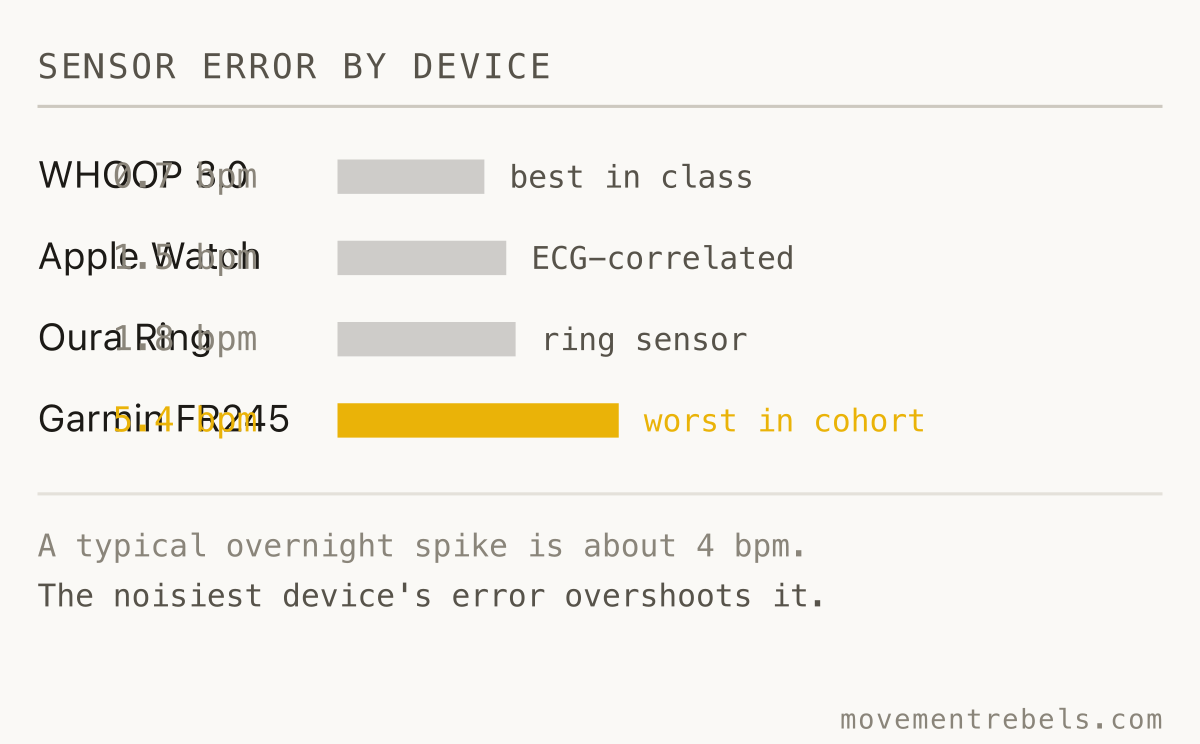
Then there is the sensor itself. A 2022 wearable validation study found mean absolute errors ranging from 0.7 bpm (WHOOP 3.0, best in class) to 5.4 bpm (Garmin Forerunner 245, worst in that cohort). Apple Watch sat at 1.5 bpm error with excellent ECG correlation; Oura Ring at 1.8 bpm. The implication is uncomfortable: if you are using a mid-range Garmin and your RHR "jumped" 4 bpm overnight, that difference may sit entirely within sensor measurement uncertainty. More recent Garmin hardware has improved, but the lesson holds. A single-day number from an optical wrist sensor is not a precision instrument. A 28-day trend smooths over that error.
The 28-Day Line and the 7-Day Line
The framework is two rolling averages stacked against each other.
The 28-day mean is your personal baseline. It moves slowly. It reflects genuine cardiovascular adaptation. If it has drifted from 58 to 54 over three months of consistent training, your aerobic system is absorbing the work. This is the number worth caring about. Paired with a rising fitness level, it is the quiet proof that the boring zone 2 sessions you have been grinding are doing their job.
The 7-day mean is your current state. It responds to the week you just had: training load, sleep, illness, travel, alcohol, a bad stretch at work. When the 7-day line climbs 3 to 5 beats above the 28-day baseline and holds there for several days, something is loading your system. When it sits at or below the 28-day line, you are recovered and the green light is on for hard sessions. The same resting number does double duty for prescription: you can turn your resting heart rate into personalised training zones so the hard days land at the right intensity.
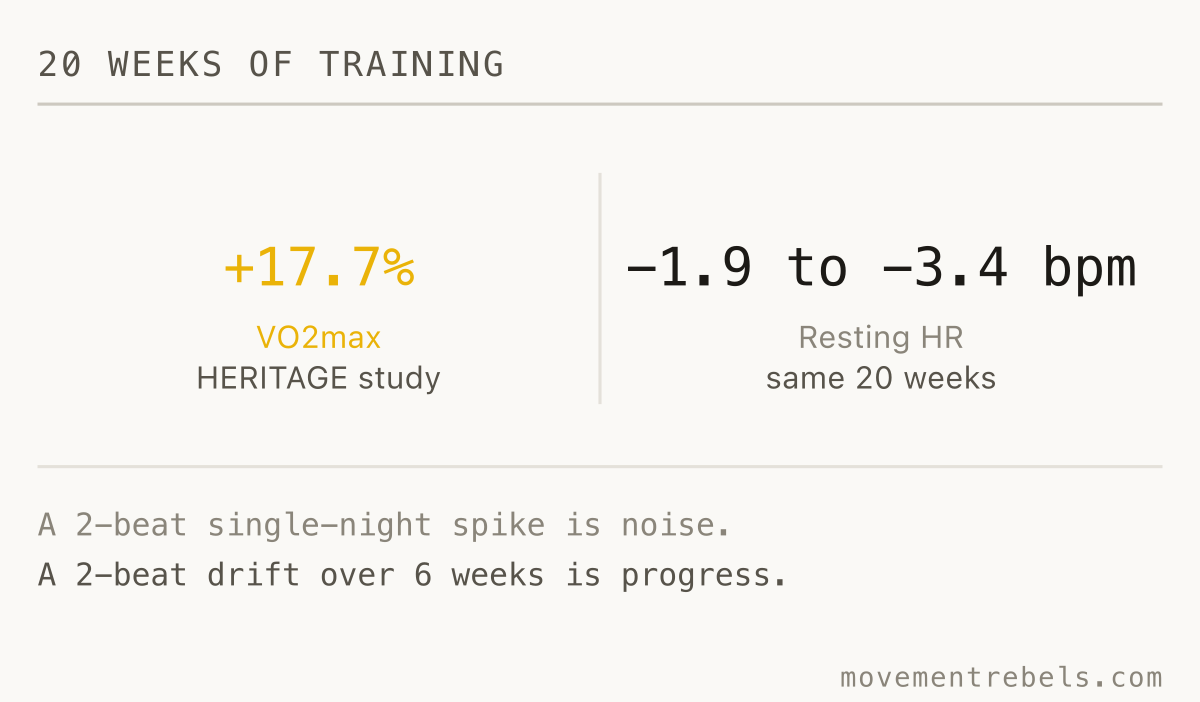
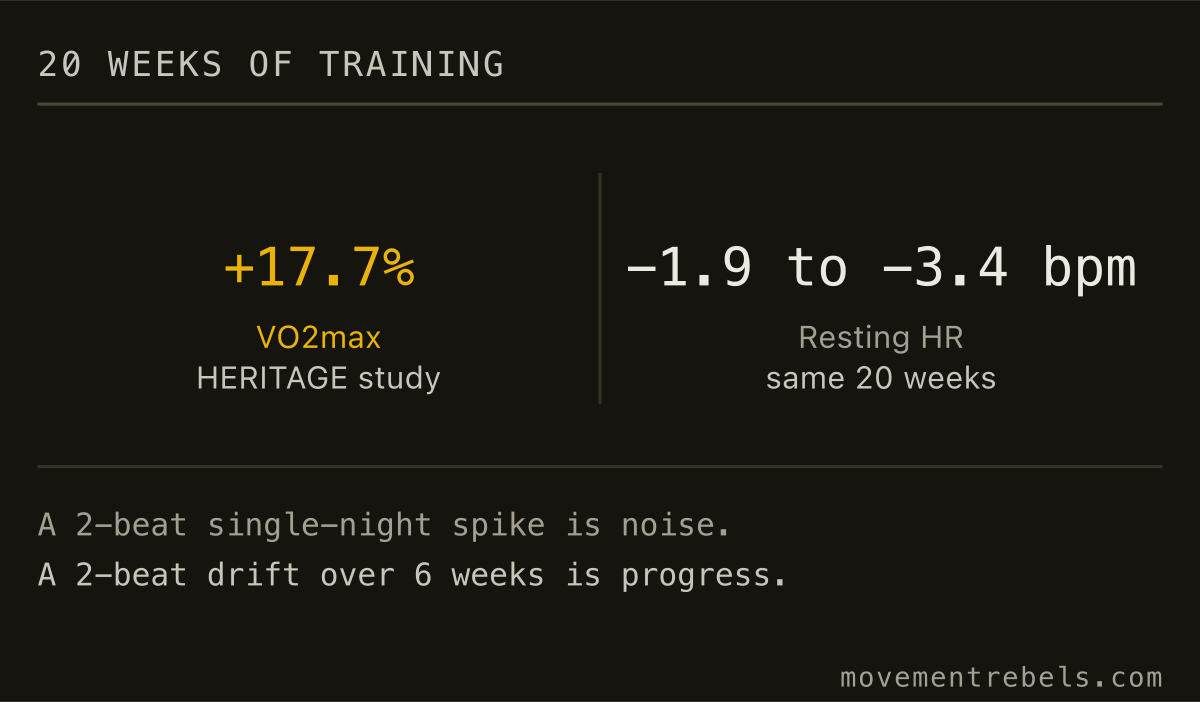
The HERITAGE Study provides useful calibration here. After 20 weeks of structured endurance training, VO2max improved by an average of 17.7 percent, but resting heart rate dropped only 1.9 to 3.4 bpm. Adaptation is real; it is also slow and modest in absolute terms. A 2-beat downward drift in your 28-day line over six weeks of consistent training is meaningful progress. A 2-beat single-night spike is almost certainly noise.
Why the 7-Day Line Rises: The Four Causes
When the 7-day mean climbs above baseline and holds, the cause is almost always one of four things, or a combination.
Training load not yet absorbed. A hard week with insufficient sleep between sessions is the most common cause for athletes. The autonomic nervous system has not returned to parasympathetic dominance. This is not a problem if you catch it early and adjust the next few days before it compounds. It becomes a problem if you push through and add another hard week on top of it.
Illness, often before symptoms appear. This is the one that earns the "early warning" reputation. The immune response elevates sympathetic tone before you feel unwell. Research on wearable data during the Covid-19 pandemic found that RHR elevation preceded self-reported symptoms in a measurable proportion of cases. A large-scale analysis of free-living longitudinal data found that illness drove a roughly 6 percent heart rate increase alongside a 10 percent HRV drop, both classified as large effects. If your 7-day line is climbing and you have no obvious training or lifestyle explanation, take that seriously. It is not the moment to grind a threshold session to prove you are fine.
Alcohol. A 2025 prospective study on nocturnal RHR using smartwatch data found a statistically significant 3 bpm increase in nighttime heart rate during alcohol exposure, from 63.6 to 66.6 bpm, returning to baseline after cessation. For athletes who drink occasionally, this is the single most reliable explainer for a Monday spike. It is not a moral argument. It is a 3-beat tax on your recovery window that lasts roughly 24 to 48 hours.
Non-training life stress. Heat, travel across time zones, sleep debt, and psychological stress all raise sympathetic nervous system activity and push RHR up. These are not things your watch can distinguish from training stress. That is why logging the context matters.
Falling Baseline: Adaptation, Not Magic
The 28-day line ticking down by a beat or two over a training block is one of the most underrated signals in endurance training. It means stroke volume is increasing, parasympathetic tone is rising, and the same submaximal output is costing your heart fewer beats. This shows up months before it shows up in race results.
The honest caveat from the HERITAGE data is important here: the drop is modest. A highly trained athlete will have a low RHR, but a low RHR alone does not make you a highly trained athlete. Professional cyclists can reach resting rates in the high 30s, but plenty of recreational athletes with RHRs in the low 50s outperform peers with RHRs in the high 40s because adaptation runs through many channels simultaneously. RHR is a useful trend marker, not a fitness ranking.
A falling 28-day baseline does tell the coach something actionable: the system is adapting and can probably handle a slight progression in load. The inverse, a flat or rising 28-day line across six or more weeks of consistent training, is a signal that recovery quality, fueling, or sleep is limiting adaptation. More training volume is unlikely to help. See overtraining signs for where the pattern goes if you ignore it.

RHR Inside the Recovery Stack
RHR is one instrument in the orchestra. The coach reads it alongside HRV (HRV-guided training), sleep duration and quality (sleep and training), subjective readiness, and cumulative training load. A single elevated RHR with stable HRV and good sleep is probably noise. Three signals stacking in the same direction is a different conversation.
Fueling enters the picture more than most athletes expect. Consistent caloric restriction raises resting heart rate. If your 7-day line is creeping up and your meal log shows repeated 400 to 600 kcal deficits on training days, the coach will name that connection. Dehydration follows the same pattern. An underfueled, dehydrated athlete looks overtrained in the RHR data even when their training load is perfectly reasonable.
The fitness data overwhelm problem is real here. Reading RHR in isolation without the rest of the stack produces exactly the kind of false alarms that make people distrust their wearables. Context is not optional.
What Wearable Data Reaches Movement Rebels
How your RHR data arrives depends on your device.
Garmin users: the coach reads your completed activities and health metrics directly through the native Garmin integration. Resting HR is part of what flows in automatically after each sync.
iOS app users: the native iOS app reads Apple Health directly, which is where Oura Ring data lands. Oura exports sleep metrics, HRV, and resting HR to Apple Health, so if you wear an Oura the coach picks those up through that path. There is no direct Oura integration and no separate API connection required.
For context on how these devices compare in terms of what each one measures and feeds to Apple Health, WHOOP vs Oura vs Garmin covers the honest differences. One note on WHOOP: it does not export its proprietary recovery or strain scores to Apple Health, so those specific scores do not reach the Movement Rebels coach. Heart rate data from WHOOP's Apple Health export may be available depending on your WHOOP settings, but the recovery and strain metrics stay inside the WHOOP ecosystem.
How Movement Rebels Uses This
The 7-day and 28-day RHR lines feed the morning brief, the weekly briefing, and the always-on coach chat. When the 7-day climbs above baseline and holds, the coach reads the full stack before recommending anything. It does not treat a single elevated morning as a verdict.
If RHR is up and HRV is down and sleep was short, the coach adjusts the plan: shorter session, lower intensity, or an outright rest day. If RHR is up but HRV is steady and sleep was good, it is more likely to flag the cause as alcohol or ambient heat and keep the planned session.
If the 7-day line has been elevated for five or more days with no obvious explanation, the coach asks in chat. You answer in a sentence. The rest of the week adapts. This is the gap between a data platform and a coaching layer. A dashboard shows you the numbers. A coach tells you what to do with them and changes the plan when the numbers shift.
The 28-day falling baseline gets surfaced in the morning brief when it moves. That is also the moment the adaptive weekly plan reads the improved recovery capacity and nudges load upward rather than holding flat indefinitely.
Pricing
Movement Rebels is one app for strength, endurance, planning, coaching, fueling, and recovery. The 7-day free trial is full access to all of it, no card required. After the trial, Pro+ is $20 per month for unlimited coaching.
One app instead of five.
Strength, endurance, recovery, fueling, planning, and your AI coach. All under a 7-day free trial. No card.
Start 7-day trialHRV-Guided Training: Read the Signal, Skip the Noise
One low HRV night tells you almost nothing. The 7-day-vs-28-day trend tells you nearly everything. Here is what the evidence actua
Sleep and Training Performance: The Lever Nobody Respects
Sleep outperforms every supplement, wearable, and recovery tool you own. Here's the honest evidence, what actually trashes it, and
When to Deload: Reading the Signals Right
The 4-week deload rule is a template, not a law. Here are the actual physiological signals that tell you when your body is asking
Overtraining Signs: The Ones Worth Watching
True overtraining syndrome is rarer than you think, has no reliable biomarker, and is almost never what recreational athletes have