Macros for Body Recomposition: The Numbers That Work
Body recomposition, losing fat and gaining muscle at the same time, is real. The evidence for it is solid. It is also slower than almost every guide on the internet implies, and whether it works at all depends heavily on how long you have been training. Most content skips that part. This guide does not.
If you are new to structured strength work, returning after a break, or carrying extra body fat, recomp is your most efficient path. If you have two or three solid years of progressive training behind you and are already fairly lean, the honest answer is that recomp is marginal and a traditional cut or bulk will produce better results per unit of time. Research on trained athletes documents the phenomenon while being clear that the effect size shrinks sharply with training age.
That is the part most guides skip. Know which camp you are in before you set the macros.
What Body Recomposition Actually Is
Recomp is simultaneous fat loss and muscle accretion. The scale barely moves. Body composition shifts under it: less fat, more lean mass, better performance. Progress shows up in how clothes fit, how strength numbers trend, and how body composition measurements move over months, not in weekly weigh-ins.
The mechanism is not magic. During a small calorie deficit, fat tissue provides the energy substrate for daily function. A sufficient protein intake and a progressive training stimulus keep muscle protein synthesis elevated enough to build or maintain muscle despite that deficit. The two processes run in parallel, which is why both the macro split and the training stimulus matter equally. Either without the other is just a diet.
The Deficit: 10-15% Below Maintenance, Not More
A small deficit is not a compromise. For recomp it is the only configuration that works.
A large deficit, 25-30% below maintenance, shuts down the building side of the equation. Recovery suffers, strength output drops, sleep quality degrades, and the muscle you wanted to add never appears. You end up lighter but the composition has not shifted much.
The window that works is roughly 10-15% below maintenance. For most people that is 200-400 calories per day below the number that holds body weight stable. Small enough that recovery stays functional. Large enough that fat comes off over weeks. Our calorie deficit calculator for a safe rate of loss sets the daily number and checks the rate.
Find maintenance honestly first. Weigh yourself every morning for 7-10 days, log every meal, and read the average calorie intake when weight is stable. Our TDEE calculator for your maintenance calories gets you in the right neighbourhood. Your own logged data gets you the actual number. Rebel Fuel's daily logging makes this baseline phase the necessary but unglamorous first step.
Protein: 1.6 to 2.2 g/kg, and Why the Range Matters
Protein is the macro that decides whether recomp works or whether you are just losing weight.
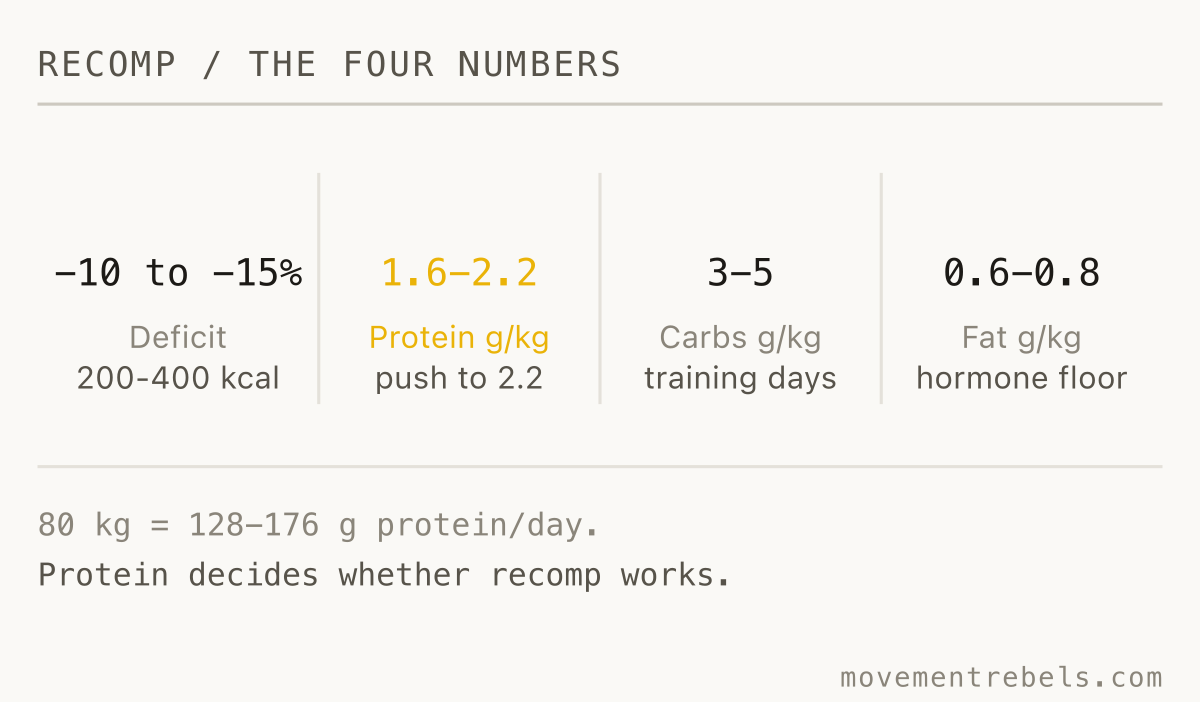
The most-cited evidence base here is Morton et al.'s 2018 meta-analysis of 49 studies and 1,863 participants, published in the British Journal of Sports Medicine. The analysis identified a breakpoint around 1.62 g per kilogram of body weight per day, with a 95% confidence interval of 1.03 to 2.20 g/kg/day. Note that the segmental regression did not reach statistical significance (p=0.079), so the upper end of that interval reflects genuine uncertainty, not a hard ceiling. The practical takeaway most coaches land on from this paper is a working range of 1.6 to 2.2 g/kg. The International Society of Sports Nutrition's position stand on protein and exercise recommends 1.4 to 2.0 g/kg/day for most exercising individuals, which partially overlaps with that range but starts and ends lower.
One complication: some recomp-specific research suggests that during a caloric deficit, protein targets at the high end of the range or slightly above it may provide additional lean mass protection. Studies with trained athletes consuming very high protein alongside heavy resistance training have found greater fat loss without sacrificing muscle, even when total calories were higher. The mechanism is partly the thermic effect of protein (it costs more to digest) and partly improved muscle protein synthesis signalling during recovery.
Practical take: aim for 1.6 to 2.2 g/kg as the floor and ceiling for most people. If your deficit is aggressive relative to your training load, moving toward 2.2 is the conservative choice. Go much above 2.5 g/kg and you are spending money and stomach capacity on protein that does not translate to additional benefit in most people.
For an 80 kg athlete, that is 128 to 176 g per day. For a 65 kg athlete, 104 to 143 g. Our protein intake calculator to set your daily grams does this math from your bodyweight. Hit that floor every day, not as a weekly average. The body does not store protein the way it stores glycogen. A high-protein Thursday does not compensate for a low-protein Tuesday.
Spread intake across 3 to 5 meals of 30 to 50 g each. The snap meal photo tool in Rebel Fuel estimates protein from a single photo when you do not have time to weigh every ingredient.
Carbs and Fat: Flexible, But Not Arbitrary
Once protein is fixed and total calories are set, carbs and fat split what remains. There is no single correct ratio. There is a correct ratio for your training load.
If you are doing heavy strength work and zone 2 or interval cardio on top, carbs should take the larger share. Heavy compound lifts and high-intensity intervals run on glycogen. Cutting carbs too aggressively while doing both is the fastest way to collapse a recomp. Aim for 3 to 5 g/kg carbs on training days, with a modest reduction on true rest days. Fat fills whatever is left over, with a floor of around 0.6 to 0.8 g/kg for hormone production and fat-soluble vitamin absorption.
If your programme is low-volume strength only, with no high-intensity cardio, you have more room to reduce carbs and raise fat. But lower carbs for a recomp still means 2 to 3 g/kg, not near-zero. Ketogenic diets and recomp coexist poorly unless you are keto-adapted and your strength work is well below maximal intensity.
Carb cycling, eating more carbs on training days and fewer on rest days, is a legitimate tool for managing this. Rebel Fuel's training-day versus rest-day macro targets handle the split automatically once your activity is logged.

The Training Stimulus: Why Macros Are Half the Equation
Hitting the right macros without a training stimulus is a diet, not a recomp. The macros create the conditions. Progressive resistance training is what tells your body to build something with the protein you are eating.
Two to four strength sessions per week, built around compound movements, with at least one variable trending up over time (load, reps per set, total weekly volume, or density), is the minimum viable training stimulus for recomp. This is also why recomp fails most often: people eat correctly and do cardio, without ever creating a progressive overload in the gym.
Movement Rebels' strength logger and exercise codex track weekly volume and intensity. The coach reads your training log. It does not read your Rebel Fuel data, so put the target you are eating to in Notes for your coach. If top-set strength has dropped 5% over three weeks while protein average sits below 1.4 g/kg and your deficit has exceeded 400 calories on multiple days, the coach flags it directly in chat before you have finished the mesocycle.
The same principle applies when you stack endurance work on top of strength. Running high volume of zone 2 sessions alongside heavy lifting inside a 15% deficit is recoverable if managed correctly. Stack zone 2 plus intervals plus strength plus a steep deficit and the coach will identify the under-recovery loop and adjust training load before the accumulation shows up as a performance crash.
The Trained-Versus-Novice Reality
Most recomp content quietly assumes a beginner, because that is where results are most dramatic and most visible. The research is clear on this: training status, initial body fat percentage, and nutritional consistency all influence how much recomp is possible. Novices have the most room to run. Trained athletes have less.
For a trained athlete with 18 months or more of consistent progressive overload:
- Muscle accretion in a deficit is slow. Measured in tenths of a kilogram per month, not the kilogram-scale gains a beginner can achieve. Our FFMI calculator to see your muscle ceiling shows how close you already sit to the natural limit.
- The margin for error shrinks. Protein has to stay high, the deficit has to stay moderate, and training has to stay progressive. Any one variable slipping kills the small positive balance.
- At this level, a deliberate 3 to 4 month lean bulk followed by a cut often produces better body composition improvement per year than perpetual recomp.
That is not a reason to avoid recomp. It is a reason to calibrate your expectations honestly and measure body composition with something more sensitive than scale weight.
Adherence Over Optimization
The macro split that works is the one you execute for 12 weeks in a row. An optimal plan you abandon on day 22 loses to a good-enough plan you sustain for three months. Build meals you will actually eat, prep on a consistent schedule, and log every day, including the days the numbers are bad.
Rebel Fuel's weekly average view is designed for this. The coach reads weekly averages, not single-day numbers. A high-calorie Saturday inside an otherwise disciplined week does not derail the cycle. Hydration matters too: dehydration mimics hunger and degrades training quality. Log water daily and let the app surface the pattern if it is consistently low.
How Movement Rebels Handles This
Rebel Fuel sets your protein floor, calorie target, and carb/fat split from your training load and goal. The snap meal photo tool logs entries in seconds when you do not want to weigh every ingredient. Body comp tracking holds your weight, waist, and optional progress photos so the trend is visible across months, not obscured by day-to-day noise.
The coach chat reads the full picture: your Rebel Fuel macros, your strength training log, your Garmin data, and your Apple Health activity from the native iOS app. When the deficit and training load conflict, the coach identifies it and adjusts the prescription. When protein has slipped below the floor for multiple days, the coach says so before the muscle loss shows up in your numbers.
One app for the macros, the training, the recovery read, and the coach who pulls them into a coherent plan.
Pricing
Movement Rebels is one app for the full picture: strength, endurance, hybrid, planning, coaching, fueling, recovery, tracking. A 7-day free trial covers the entire surface. After the trial, Pro+ is $20/month for unlimited coaching. No card on the trial.
Macro Calculator
Calories and macro targets for your goal.
One app instead of five.
Strength, endurance, recovery, fueling, planning, and your AI coach. All under a 7-day free trial. No card.
Start 7-day trialBody Recomposition Tracking: Why The Scale Lies
The scale is the worst tool for tracking recomposition. Here's the honest five-signal stack that actually shows progress, what the
Snap Meal: Photo Calorie Tracking Without the Tedium
Photo calorie tracking lands at 80-90% accuracy for simple plates and lower for sauced dishes. Here is what that actually means fo
Hydration Tracking for Athletes: The Overhydration Risk Nobody Talks About
Most hydration guides warn about dehydration. This one covers both sides: 2% body mass loss impairs performance, but over-drinking
Carbohydrate Timing for Athletes: Fueling Around Long Sessions
How many grams of carbohydrate and when: 1 to 4 g/kg before training, 30 to 90 g per hour through long sessions, and the 4 hour re