Open Water Swimming: Sighting and Swimming Straight
The pool teaches you to swim straight. Open water teaches you everything the pool hid: no black line, no wall to push off, chop that breaks your rhythm, cold that makes your chest lock up, and a hundred arms in the start. A pool swimmer's first open-water swim often ends in panic, and it has nothing to do with whether they can swim: the rules they learned stop applying the moment the bottom drops out of sight. So this covers the transition. Sighting without wrecking your stroke, holding a line with no line to hold, managing the cold, and the practice progression that builds the confidence to race.
Never swim open water alone
One rule sits above every skill on this page: never practice open water or cold-water swimming alone, because cold shock can incapacitate a strong swimmer in seconds and panic drowns people who swim fine in a pool with a lifeguard on the deck. Bring a buddy whose eyes are on you, swim at a lifeguarded or supervised venue, or stay close to a coach or a safety kayak. Bright cap. Tow a brightly colored float so boats and spotters can pick you out of the water, check the temperature before you get in, and treat anything below 15C with real caution. Start acclimating where you can stand up. None of the speed below is worth drowning for.
Why open water is a different sport
Pool and open water are not the same discipline. You know how to put one arm in front of the other, and that is the part that carries over: what you don't know is how to keep doing it with no reference line, no wall to push off, and nothing to see when you look down.
The shifts that matter most:
- No line to follow. The black line is your autopilot. It's gone. Look up and navigate constantly, or you swim an extra 50 meters in 1.5 km without ever noticing it happened.
- Chop breaks your rhythm. Waves bend stroke timing, and the swimmer who fights the water instead of flowing with it burns effort that buys nothing.
- Sighting burns energy. Lifting your head breaks streamline and interrupts stroke rhythm, and you do it every 4-6 strokes for 1.5 km.
- Cold is sudden and total. The first 30 seconds trigger a powerful physiological response: uncontrollable breathing, chest tightness. Pool water is 28°C. Open water is 14-18°C, and your nervous system registers that gap long before your brain has an opinion about it.
- You're surrounded. The start is a washing machine of elbows, feet and bodies, and staying calm inside it with 50+ swimmers packed into the same 100 meters is a skill like any other. You learn it by rehearsing it.
Pool fitness gets you there. Open-water skill keeps you there without falling apart.
Sighting without wrecking your stroke
Sighting is the one open-water movement you have to practice, because done badly it burns energy, breaks your rhythm and steers you off course. Done well it costs almost nothing.
Most pool swimmers lift the entire head to look, and the body line collapses behind it. Think crocodile eye. Eyes clear the surface. Nose and mouth stay in the water.
The technique:
- Sight every 4-6 strokes, not every stroke. Too frequent and you're braking constantly. Too sparse and you veer. Find the rhythm that fits you in the pool first: mark the deck with cones, sight to a fixed object on every fourth or sixth stroke, and repeat it until you have stopped thinking about it at all. Test your sighting pace with the swim CSS tool to dial in your stroke rhythm.
- Lift your eyes only. On the breath cycle, instead of turning your head all the way, lift the chin enough to see over the water. Eyes out, nose in. Breathe, sight, back to bilateral rhythm. One motion.
- Pick a fixed landmark on shore, not a buoy. Buoys move with waves and current. A building, a tree or a distinctive flag on shore does not, so that is your sighting target, and the buoy line is there to confirm you're at the right spot rather than to steer by.
- Sight when you breathe on a preferred side. Breathe right, sight right, every 4-6 strokes, so seeing where you're going becomes part of normal breathing instead of an extra move you have to remember. Good sighting costs almost nothing. Poor sighting costs you 50-100 meters. Train it in a pool for two weeks before you go near open water: cone on the deck, sight every 4-6 strokes, until it is automatic.
Why you veer and how to swim straight
Every swimmer veers without a line. Most never find out. You believe you're holding one direction while chop, current and stroke asymmetry push you sideways without announcing it, and across a 1.5 km swim that deviation adds 50-100 meters to your day. A mass start makes it worse, because now you're also reacting to the bodies around you, compensating for drafts, riding waves that shove you left and right. Veering is normal. Catching it early is the skill.
The causes:
- Bilateral breathing catches it. Unilateral breathers build stroke asymmetry because the breathing side gets stronger, and over 1.5 km that adds up to 50-100 meters of veer. Breathe both sides and you can't favor one. Straighter line, more speed on the weak side.
- Closed-eye pool test. Swim 25 meters with your eyes closed, opening every 4 strokes to check, and watch where you end up: most swimmers drift 1-2 meters off line. That tells you which way the asymmetry pulls, and you correct it in open water by balancing catch and exit.
- Catch and exit balance. Strong right catch, weak left, and you veer left. Listen to your hand entry: quiet and crisp on both sides, or you've found the asymmetry. Film it, or have a coach watch.
Straight swimming separates racing athletes from recreational swimmers. Spend two weeks on it.
Drafting and the energy math
Drafting is legal in triathlon. It is also the biggest advantage available to you without changing your fitness: swim behind someone and the metabolic cost of holding the same pace drops, with most research on drafting finding roughly 5-10% reduction in oxygen demand, which over an Olympic-distance swim is real time you carry into the bike and run.
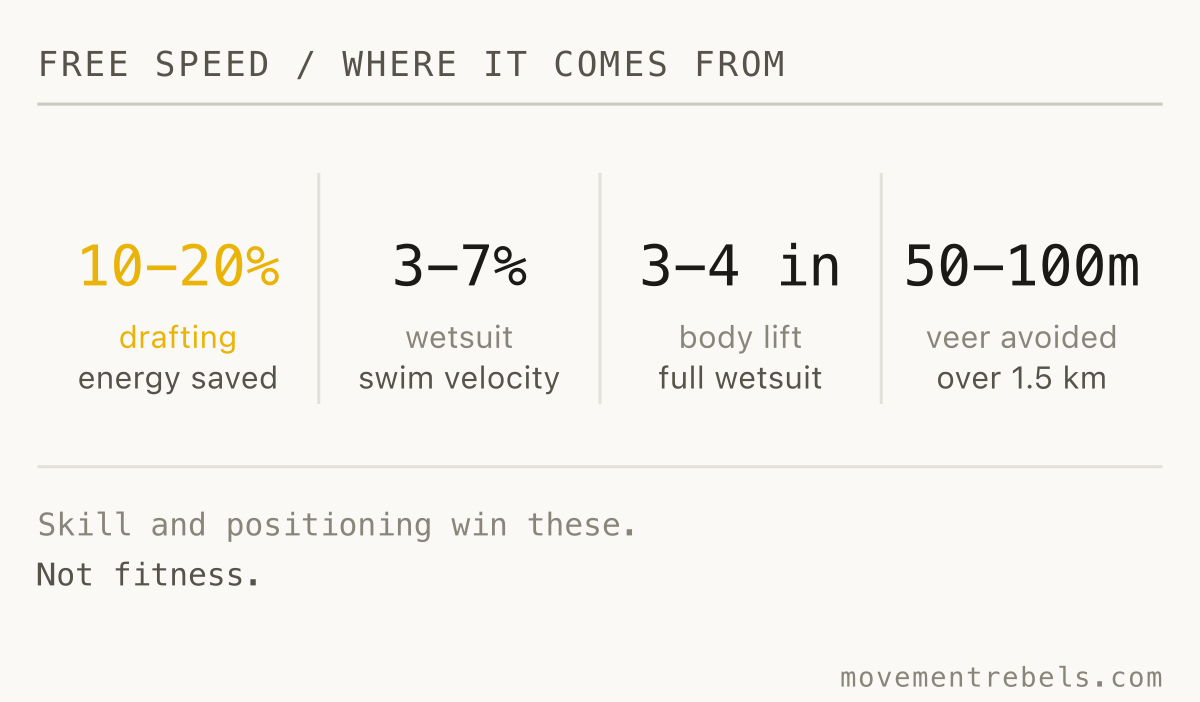
The physics is plain. The swimmer in front leaves a wake, and sitting in it means pushing through water that has already been displaced for you. Passive drag drops roughly 20% at the optimal position, 0-50 cm behind the lead swimmer, which is why the same pace suddenly feels cheaper. The pool never teaches you this. Compare your pool swim pace with what you hold in open water with and without a draft, and you have a number for your true race advantage.
Where to sit:
- On the feet (direct behind). Biggest saving, worst seat in the house. You're in the wash, you will get kicked, and the risk runs from swallowing water off their kick to a jammed ankle. Take it when you're confident both of you are sighting well and on course.
- On the hip (side position). Saves a little less than the feet and hands you back visibility and control: you see the lead swimmer, you're out of the kick, and you can break away the second they veer. This is the practical racing position. Plant yourself on the hip and match their rhythm.
Draft only from someone swimming straight and sighting well. In the first 200 meters most of the field is disoriented, so check the line before you tuck in. If the person you've attached to veers, break off and find another set of feet, because a few seconds hunting a better draft beats 100 meters spent following someone else's mistake. The triathlon splits calculator shows where you stand against the field, and where a drafting partner is worth the most.
Managing cold and panic
Cold shock hits the moment you enter the water (typically 14-18°C in most open-water venues): signals flood the nervous system, breathing turns rapid and hard to control, the chest tightens. Panic here and you're done. The water wins before the race starts.
This is physiology, not weakness. Unacclimatized swimmers hyperventilate, get dizzy, feel like no air is going in at all, and the body will happily try to gasp-breathe underwater.
You beat it through acclimation:
- Acclimate before you race, never alone. Over four to six cold-water sessions the cold-shock response settles for most swimmers, though it is individual and does not carry fully between water temperatures. The first swim is chaos. By the fourth or fifth, many people have their breathing under control inside the first minute. Treat that as risk reduction rather than a guarantee, and keep a spotter even once it starts to feel easy.
- Control the breathing immediately. The gasp is involuntary. Hyperventilation is not. On entry, take three slow deep breaths, full inhale and full exhale, and after 30-60 seconds the breathing settles. The first 100 meters is survival, not pace. Keep it easy.
- Roll to backstroke to reset. Panic building, breathing spiraling: flip to backstroke for 4-6 strokes. Backstroke is the reset button. Horizontal, stable, in control, breathing into the sky instead of into waves, and after 30 seconds of it most swimmers feel grounded enough to flip back to freestyle. Ironman athletes do this. It works.
Cold is not optional. Acclimate to it and plan for it, because ignoring it means it owns the first 500 meters of your race.
Wetsuit buoyancy and positioning
A full-length wetsuit lifts the hips and legs toward a more horizontal position. Frontal drag falls with them. Research finds swim velocity improvements ranging broadly depending on body composition, swim distance and pace: swimmers who sit low in the water tend to gain the most, while naturally buoyant swimmers see smaller or negligible improvements.
The start strategy:
- Seed yourself conservatively. The start is a collision. If you're unsure of your speed or your confidence, start outside the main clump and let the herd sort itself out over the first 100-200 meters, because you catch up once the field spreads and panicking inside the pack costs more time than starting wide ever will.
- Adjust your position for the suit's buoyancy. Hips riding too high in the suit: drop them slightly and lift your head a touch until the angle feels right.
- Account for the suit in your training. Trained most of the year in a swimsuit? Switch to the race wetsuit 3-4 weeks before competition and train in it. The stroke feels different: easier high in the water, potentially buoyancy-limited on the chest and core, and your sighting rhythm might shift 1 position shorter (sight every 5 instead of every 6). By race day the suit is old news.
A practice progression before your first open-water race
Fitness comes from the pool. Skill comes from the water you'll race in. New to racing? The first triathlon training plan walks through the full progression, and experienced triathletes can slot this straight into the build phase of brick workout training. Start on the deck and work outward:
- Weeks 1-2: Pool sighting drills. Mark a target on the deck. Swim 200m sighting every 4-6 strokes, twice a week, and add the closed-eye work on top: 25m with eyes closed, check the veer, repeat 4 times.
- Weeks 3-4: Flat open water. 400m in calm conditions, race wetsuit on. Sighting, bilateral breathing, staying calm. Not a race. A test.
- Week 5: Buoy-marked loop. 1-km loop with buoys and other swimmers if you can get them, testing cold response, sighting frequency and pace. You'll be 20-30 sec slower per 100m than pool pace. Normal.
- Weeks 6-7: Race simulation. Actual race course, same time and temperature, same start conditions, full distance or 80% of it. Nail this and you're ready.
Follow the progression. Skip steps and you'll learn them at race start.
How Movement Rebels fits
The hard part is not pool fitness. It is knowing whether today in the water is a day to push or a day to dial back. The Movement Rebels AI coach reads your Apple Health data and your Garmin swim metrics (pace, heart rate, perceived exertion) alongside your run and strength work. It sees the hard interval session you did yesterday and the 5 km easy run you did this morning, it sees your HRV is low, and the open-water session comes back as easy-pace drills and technique work: sighting drills, bilateral breathing, drafting practice. No race-effort intervals. You keep accumulating skill without stacking recovery debt into race week.
One app instead of five.
Strength, endurance, recovery, fueling, planning, and your AI coach. All under a 7-day free trial. No card.
Start 7-day trialYour First Triathlon: A Sustainable Training Week
A doable first-triathlon training week across swim, bike and run on 3-5 sessions. Pick a sprint, build consistency, master the bri
Brick Workouts for Triathletes: When and Why to Do Them
Bricks train one thing: the 679-meter sluggish zone after dismount. What peer-reviewed evidence says about the mechanism, how long
Ironman Training With AI
Most age-groupers don't fail on race day because of fitness. They fail because no plan watched their nutrition, sleep, and recover
AI Triathlon Coach: Three Sports, One Load
Most triathlon apps optimize three separate plans. An AI triathlon coach treats them as one load budget, detects your real limiter