AI Triathlon Coach: Three Sports, One Load
Here is the thing most triathlon apps get wrong: they are not triathlon apps. They are three single-sport apps with a shared calendar. A swim plan, a bike plan, a run plan, loosely bolted together, each optimized independently of the others. When your long ride Saturday eats into your long run Sunday, the app does not know. When your strength session Monday is too close to Tuesday's VO2 intervals, the app does not know. When you slept 5h 40m and your HRV dropped 14ms, the app definitely does not know.
The training problem in triathlon is not complexity. It is integration. Everything draws from one recovery account, and no single sport should be planned in isolation from the others. If you want to see how pacing maps across all three legs and the transitions, this triathlon split calculator for sprint to Ironman lays out the splits side by side.
The limiter most age-group athletes get wrong
Ask a triathlete which discipline is holding them back and they will usually guess. They guess the one they like least, or the one they trained least recently. The data tells a different story.
A 2025 study analyzing nearly 700,000 IRONMAN age-group race records found that cycling and running were by far the strongest predictors of overall finish time, with correlation coefficients of r = 0.88-0.90 for both, significantly outpacing swimming. The implication for training: most age-group athletes who obsess over shaving 5 minutes off their 3.8km swim could move their finish time more by targeting the bike or run. Swim fitness matters enough to not be a liability on race day, but it rarely decides your result the way the bike and run do.
The subtler limiter that almost no training app addresses is fueling. If your power and pace split looks fine for the first 90 minutes and then falls apart, that is often a carbohydrate problem dressed up as a fitness problem. Research on relative energy deficiency in endurance athletes broadly finds that low energy availability accumulates during heavy training periods and compounds fatigue in the sessions that follow. The fourth discipline is real.
One load, not three
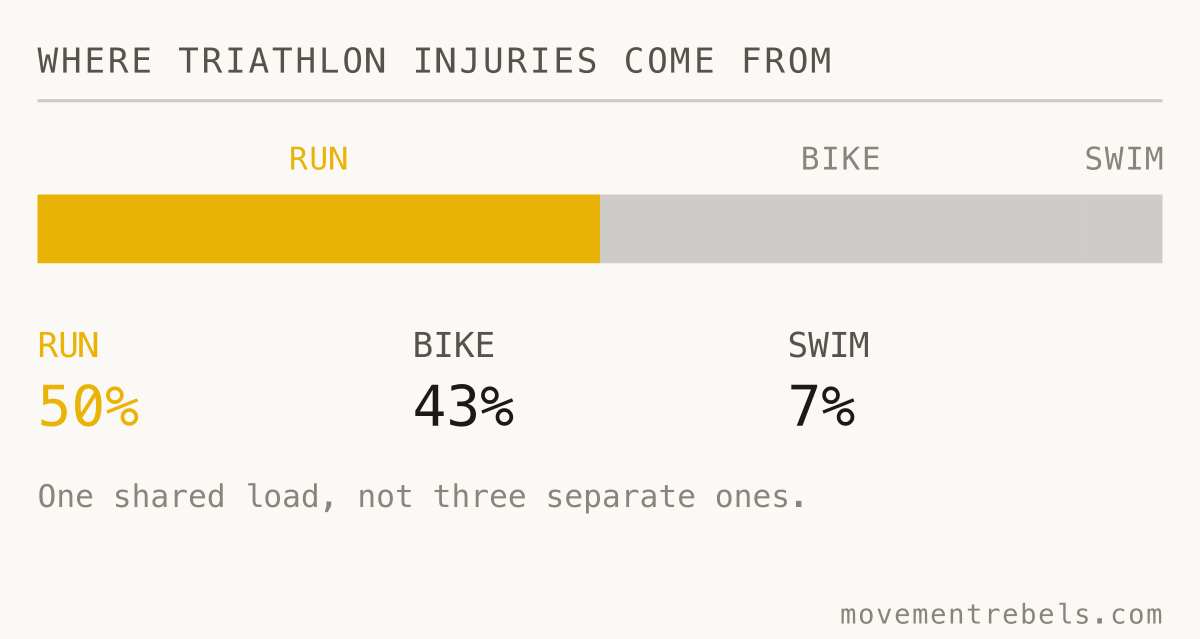
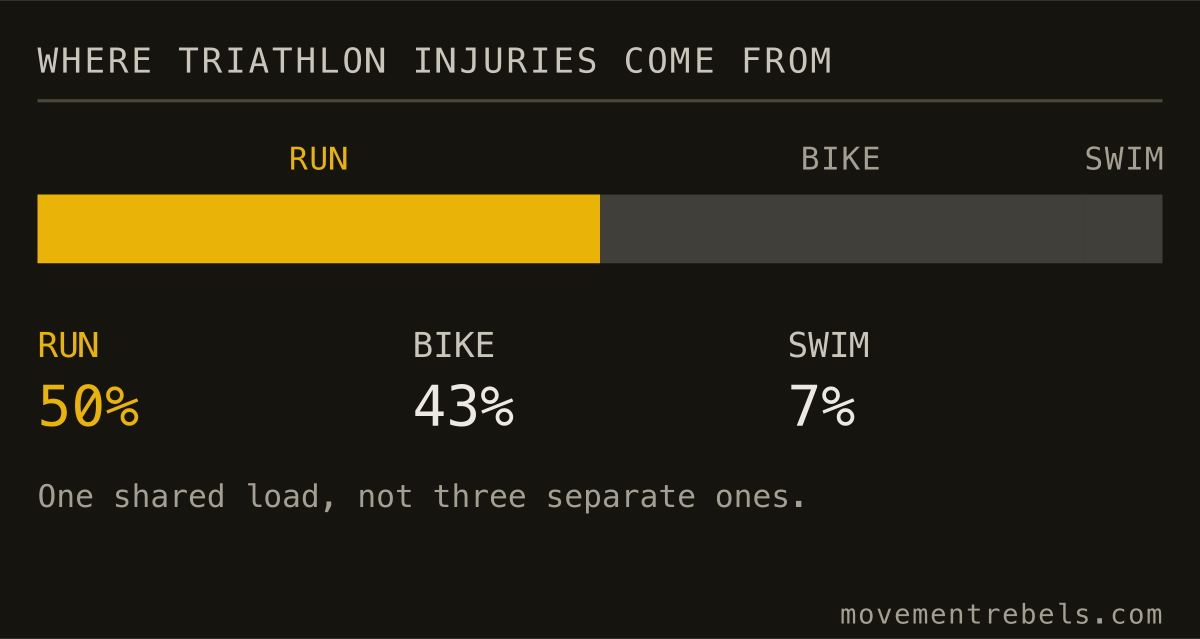
The honest constraint at the center of triathlon training: fatigue does not respect discipline boundaries. One shared budget means one shared number, and the Training Stress Score to size your weekly load budget is how you put a figure on the whole week across all three sports. A literature review on triathlon training found that running accounts for roughly 50% of training injuries, cycling another 43%, with swimming contributing the remaining 7%. The run is the injurious sport; the bike delivers the largest training load by volume; the swim is technically demanding but often underestimated as a recovery cost. Planning any one of them without accounting for the other two is how athletes arrive at key sessions already depleted.
Strength training is part of the same load equation. The research on concurrent training broadly shows that periodized strength work improves endurance performance and can reduce injury risk, provided sessions are separated by enough time for the acute fatigue to clear. The question is not whether to do strength. It is where in the week to put it so it does not collide with the sessions that matter most.
This is the problem a coach holds in their head. It is also the problem the Movement Rebels coach handles as a single model, not three separate ones.
How periodization actually works across three sports
Classic multisport periodization structures a build in discrete mesocycles: base (aerobic volume, form work, low intensity), build (sport-specific load, threshold and race-pace work), peak (reduced volume, sharper quality sessions), taper, and race week. Load increments stay under 10% per week to manage injury risk. Recovery weeks, usually every fourth week by default, pull earlier when monitoring signals say so.
What makes triathlon periodization harder than single-sport training is that you are running three of these curves simultaneously, and they interact. A heavy running block increases injury risk just as you want to push bike volume. A strength-heavy mesocycle blunts VO2 gains in both cycling and running if the timing is off. An Ironman taper is 2-3 weeks of declining volume that has to be coordinated across all three sports and the strength block underneath, not just "run less this week."
The research distinction between polarized and pyramidal intensity distribution matters here too. Elite endurance athletes generally spend the large majority of their training time at low intensity, with a smaller proportion at high intensity. Most research places that low-intensity fraction around 75-80% of total sessions. For athletes training under 8 hours a week, a strictly polarized copy is usually not the right model. Volume-adjusted intensity distribution is the honest version. See periodization for recreational athletes for a clear breakdown of which model fits which training context.
Limiter detection from your actual data
The Movement Rebels coach uses your Garmin power, pace, and heart-rate streams across all three sports, plus your race-distance target, to surface the discipline most likely to move your finish time.
Bike-limited: your run off the bike falls apart before the 30-minute mark, but your standalone run paces are solid. Build the bike and start doing brick workouts with intent. The transition stress is real and trainable.
Run-limited: your standalone 10k pace is well off what your aerobic engine should support. Run frequency and durability work goes up, often at the expense of a second bike session, not a third.
Swim-limited as a race-day risk: your CSS pace and form sessions are inconsistent. Frequency matters more than yardage here. Getting out of the water slightly faster is rarely the return on investment that athletes expect, but arriving without wrecking your shoulders is.
Fueling-limited: your splits hold through 90 minutes and then fall apart. This is a nutrition and pacing problem, not a fitness ceiling. The coach will tell you that directly, and the in-app fuel log gives it the data to diagnose it.
You can also ask the coach directly: "what's my limiter for Kalmar?" It will answer with the data it used, not a 400-word equivocation.
Adaptive regeneration every week
The plan is not a static PDF. Every week the coach regenerates the next 7 days from the last 7 days of completed sessions across all three sports, your Garmin training status and recovery time, your readiness check-in and HRV trend, your fuel log for the same period, and your biohack history (breathwork, NSDR, cold exposure, sleep all factor into the recovery picture).
A heavy long bike Saturday automatically softens Sunday's long run. A strength lower-body session Monday does not collide with a Tuesday VO2 bike at the wrong intensity. A bad-sleep stretch produces a downshift across all three sports, not just the discipline you happened to open the app for.
HRV-guided training is the sharpest real-time signal in the regeneration model. When your HRV trend drops for three consecutive days, recovery weeks pull forward. When it is stable despite high load, the plan holds. For the mechanics of how the regeneration engine works across plan types, the adaptive training plan guide goes into the detail.
Sprint and Olympic builds run roughly 12 weeks. Half-iron sits at 16. Ironman is 20 weeks plus taper. The Ironman guide covers the full-distance structure in depth, including the taper calibration that most athletes get wrong by starting too late or cutting too aggressively. A taper calculator to arrive fresh on race day builds the volume drop into race week so you can see the curve before you commit to it.

Fueling as a training variable
Fueling is treated as a fourth discipline, not an afterthought. Snap Meal lets you log a plate with a photo. The macro estimator handles the meals you cannot weigh. Hydration and the fasting timer live in the same app, so a race-week carb load is not a separate spreadsheet.
In peak week the coach will tell you directly: back volume off 30%, push carbohydrates to the upper end of your target range, hold caffeine constant. If your fuel log shows you have been 600 kcal under target three days running in a hard build week, it will flag it before the next quality session, not after. For athletes doing long sessions in the 3-5 hour range, the difference between arriving fueled and arriving glycogen-depleted is the difference between a training stimulus and a junk session.
Wearables and the activity loop
Garmin is the native integration for triathlon. Structured swim, bike, and run workouts push directly to your Garmin watch. Activities flow back into Movement Rebels automatically and feed the next plan regeneration. For a clear picture of what your watch actually knows versus what a coaching layer adds on top, the Garmin AI coach guide covers that gap directly.
On iOS, the native app reads Apple Health. If your device writes to Apple Health, that data flows in: HRV, resting heart rate, sleep, and completed workouts. Oura exports sleep, HRV, and resting HR to Apple Health, so Movement Rebels picks those up via that route. WHOOP does not export its recovery or strain scores to Apple Health, so WHOOP-specific scores are not available. If you use a WHOOP, you bring that context to the coach in conversation and it factors that in.
Strava is a live read and write integration. Your activities sync in automatically. After a session, the coach writes a rich summary back to your Strava activity description, so your long ride in the Strava feed has useful context underneath it. The coach does not analyze your Strava activity data as an AI input. Strava is the social layer; Movement Rebels is the coaching layer.
One honest note: Movement Rebels has a feed, crews, follows and high fives, but it does not replace Strava's reach. No segments, and far fewer athletes on it. The training value lives in Movement Rebels. The social layer stays in Strava.
What a good AI coaching answer looks like, and where the ceiling is
A 2025 pilot study on AI-generated training plans found that most experienced coaches could distinguish AI-generated plans from human-written ones, though the minority who could not identified the AI plan as better suited for the athlete due to its clarity and conciseness. The researchers concluded that AI plans offer a cost-effective route to structured training for recreational athletes who would otherwise train without any plan.
The ceiling is also real. A good human coach watching an athlete's gait in week 14 of an Ironman build catches things no data stream does yet. Form degradation under fatigue, compensatory patterns that precede a stress fracture, the look in someone's eyes when they are cooked. AI coaching is the highest-leverage tool most age-group athletes currently have access to, not because it is unlimited, but because a qualified human triathlon coach costs $200-400 a month and the data they receive between sessions is thin. The AI version reads your actual files continuously.
The honest position: use the coach as your primary training architecture. Use a human coach for race-week logistics, form work in the pool, and anything that requires someone to watch you move.
How Movement Rebels handles this
One app. Swim, bike, run plans that draw from one load budget. Strength blocks timed to not wreck key sessions. Rebel Fuel and hydration in the same place. Breathwork, NSDR, and readiness on the recovery side. Adaptive weekly regeneration from real data. Garmin native, Apple Health native, Strava native. Sprint through Ironman.
Pricing
Movement Rebels is one app for the full picture: strength, endurance, hybrid, planning, coaching, fueling, recovery, tracking. A 7-day free trial covers the entire surface. After the trial, Pro+ is $20/month for unlimited coaching. No card on the trial.
One app instead of five.
Strength, endurance, recovery, fueling, planning, and your AI coach. All under a 7-day free trial. No card.
Start 7-day trialAI Coach vs TrainingPeaks: Automation, Community, and Cost Compared
TrainingPeaks analyzes your training. It does not coach you. Here is where the platform wins, where an AI coach takes over, and wh
Brick Workouts for Triathletes: When and Why to Do Them
Bricks train one thing: the 679-meter sluggish zone after dismount. What peer-reviewed evidence says about the mechanism, how long
Ironman Training With AI
Most age-groupers don't fail on race day because of fitness. They fail because no plan watched their nutrition, sleep, and recover
HRV-Guided Training: Read the Signal, Skip the Noise
One low HRV night tells you almost nothing. The 7-day-vs-28-day trend tells you nearly everything. Here is what the evidence actua