When to Deload: Reading the Signals Right
The most uncomfortable finding in deload research is not that deloads are useless. It is that a 2023 Delphi consensus of leading strength scientists achieved 100% agreement on something most coaches still ignore: a deload should be both pre-planned AND autoregulatory. Calendar first, signals always. Not one or the other.
That means the popular rigid "every fourth week" schedule and the hipster "I only deload when I feel broken" approach are both half-right and half-wrong. The athletes who recover well do both: they schedule a rough deload window, then let the actual signals in that window decide whether to pull it early, extend it, or skip it entirely because their body is running fine.
This guide covers what those signals actually are, how to read them together rather than in isolation, and why the subjective ones outperform the wearable data more often than anyone wants to admit.
The 4-Week Rule: A Template, Not a Law
The three-weeks-loading, one-week-deloading mesocycle became popular because it is easy to program and roughly tracks how a moderately trained athlete accumulates fatigue under moderate volume. The problem is the word "moderately." Your nervous system, connective tissue, and hormonal recovery speed do not average out.
A week with two travel days, poor sleep from a sick kid, and a skipped lunch is not the same training stimulus as a week where you slept eight hours and ate well, even if the sets and reps look identical on paper. The inputs differed. The recovery cost differed. The spreadsheet does not know this.
The other failure is the reverse: athletes who feel strong in week four and deload anyway, giving up a good progression window because the calendar said so. Both errors compound across a season. Deload too often and you leave adaptation on the table. Deload too rarely and you blow up the block that follows. Part of getting the timing right is knowing how much you have actually accumulated, so it helps to check weekly hard sets against MEV, MAV and MRV bands before you decide a week is too much.
The research on periodization for recreational athletes shows that most non-elite athletes are not training at volumes where rigid deload schedules are especially meaningful anyway. The schedule exists as a rough backstop, not a precision tool. If you want that backstop laid out concretely, you can plan a 4-week block with a built-in deload week and then let the signals below decide whether to honor it.
Signal 1: HRV Trend (Not the Daily Number)
Heart rate variability is the most useful non-invasive proxy for autonomic recovery. The trap is reading it daily. A single bad HRV morning tells you almost nothing. A two-week downward trend, with rolling 7-day values consistently sitting below your 60-day baseline, means your parasympathetic system is not keeping pace with your training load.
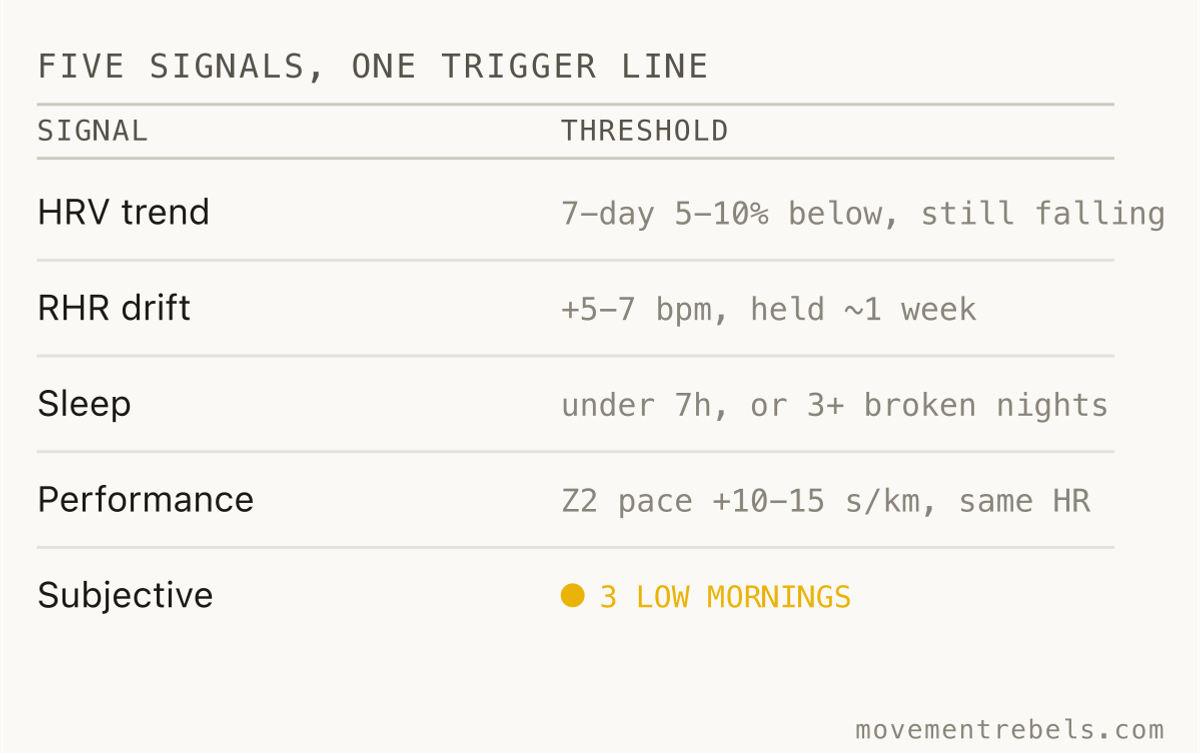
Look for a rolling 7-day average that has dropped 5-10% below your personal baseline and is still moving down. If that drop lands during a block where you pushed intensity or added volume, that is your first deload signal. If HRV is suppressed but trending upward week over week, you are likely in mid-adaptation rather than headed toward non-functional overreaching.
The evidence broadly shows that combining HRV with subjective well-being scores produces better training outcomes than HRV alone. Single-marker decisions miss too much context. The trend plus at least one other signal is the minimum threshold.
For more on reading HRV without becoming ruled by the daily number, see HRV-guided training.
Signal 2: Resting Heart Rate Drift
Resting heart rate is the slower-moving companion to HRV. A morning RHR that climbs 5-7 beats above your personal baseline and holds there for a week is one of the most consistent signs of accumulated fatigue, particularly when your sleep duration has not changed. It typically shows up before performance drops become obvious in training.
Research on athletes under intensified training has found that nocturnal heart rate combined with subjective readiness and a running-power index showed 85% or greater positive and negative predictive value for distinguishing overreached from adapting athletes. That combination also detected the divergence well before most athletes would have flagged it themselves, often within the first week or two of an overload block.
Garmin's all-day and overnight HR sampling picks this up natively. The Movement Rebels coach reads both HRV and RHR from Garmin or Apple Health (HealthKit, native on the iOS app) without any manual export. Your RHR trend is part of the readiness picture the coach sees before writing next week's plan.
For a closer look at what a meaningful RHR shift looks like across weeks, see resting heart rate trends.
Signal 3: Sleep Duration and Quality
If you are consistently sleeping under seven hours during a heavy training block, the deload conversation is largely over: your body is already managing recovery debt. Sleep is where protein synthesis peaks, growth hormone is released, and the nervous system resets. None of that happens on six hours.
Beyond total duration, watch for fragmentation. Waking at 3-4am wired, or feeling unrefreshed after what looks like a full night, both correlate with elevated overnight cortisol. That cortisol elevation is a downstream marker of accumulated stress, training and otherwise, outrunning recovery capacity.
The research is direct: sleep loss accelerates the path from acute fatigue to non-functional overreaching. The evidence on sleep and training performance consistently shows that even two to three nights of reduced sleep during a high-load week meaningfully impair power output, reaction time, and psychological readiness. If sleep has been compromised for three or more nights during a heavy block, you already have two deload signals before you check anything else.
Signal 4: Performance Plateau or Regression Under Equal Effort
This is the signal most athletes notice first, and the one they tend to weigh incorrectly. One bad training session is not a deload indicator. Three weeks of every working set feeling harder than the same weight felt last block is.
For strength work: watch bar speed on top sets, your own RPE log, and your back-off set tolerance. If sets you were completing comfortably are now stalling on the final reps with perceived effort clearly higher, the nervous system is flagging something the load sheet is not capturing. Research on competitive strength athletes finds that energy and fatigue management are the primary reasons athletes deload; performance stagnation and soreness are additional secondary triggers that often determine the exact timing.
For endurance work: pace at a given heart rate is the cleanest read. If your zone 2 pace has slowed 10-15 seconds per kilometer at the same HR over two to three weeks, and your training volume has not increased, your system is running depleted. This is different from a single bad session. The trend across sessions is the signal. For what zone 2 effort should actually feel like at different states of freshness, see zone 2 training.
Hybrid athletes face a compounding version of this: strength fatigue and endurance fatigue interact in ways a single-sport log does not capture well. The hybrid athlete approach requires watching both RPE trends together rather than treating them as separate ledgers.

Signal 5: The Subjective Markers Nobody Takes Seriously
Mood, motivation, appetite, joint stiffness on the stairs, libido, general irritability. Athletes dismiss these because they feel unscientific. The research disagrees sharply.
Most evidence in this area consistently finds that subjective self-reported measures outperform objective measures for monitoring training load response. Subjective wellness scores tend to be more sensitive to training load changes than blood biomarkers, heart rate measures, and hormonal panels, with strong negative associations between subjective stress and sustained performance.
The research on athletes under overload conditions also consistently shows that subjective readiness to train ranks among the most sensitive markers of increased training load, outperforming HRV and resting HR in many studies. When you feel like you do not want to train, and that feeling is new relative to your baseline, that is data. It is not weakness. It is one of the most reliable early signals the literature can offer.
Three consecutive mornings of low energy, poor mood, and high soreness, stacked on top of a drifting HRV or elevated RHR, is effectively a deload week already happening without the volume cut to go with it.
What the Research Actually Recommends for the Deload Itself
Sports science consensus does not agree on a rigid formula, but the pattern is clear: reduce volume through fewer sets or fewer reps, keep intensity (load on the bar or pace) relatively preserved on key lifts, and target approximately seven days. Frequency can also drop slightly. The goal is to let the nervous system reset without losing the neuromuscular "groove" of the movements.
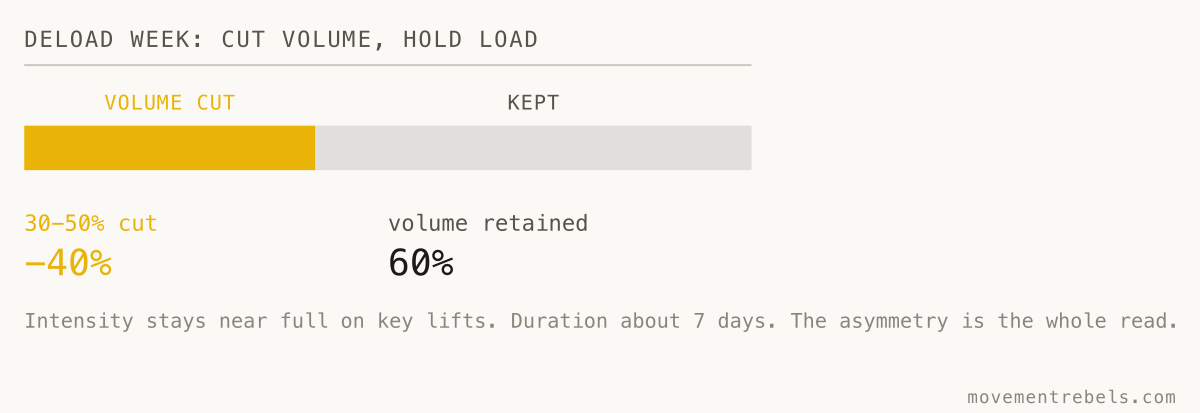
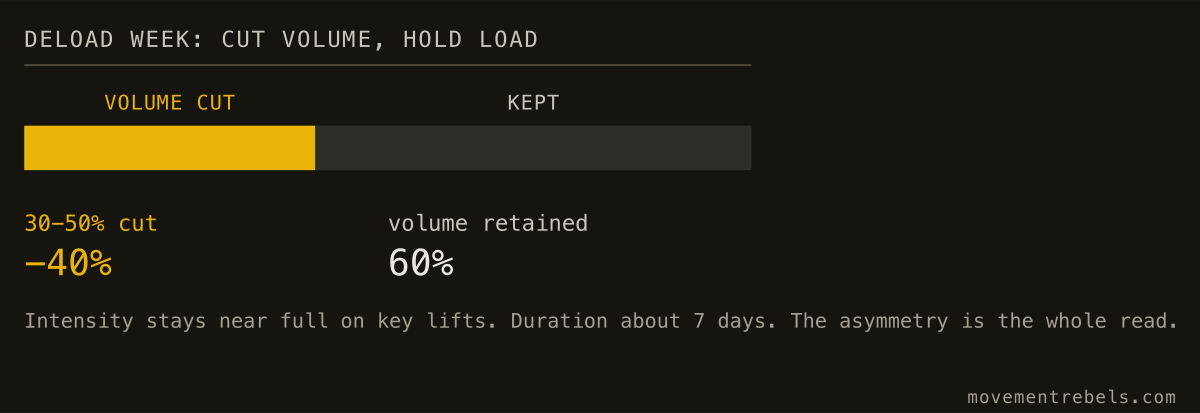
Volume reductions of 30-50% are most commonly cited in practice. The same step-down math drives a race week, so if you are heading into a competition you can map a week-by-week taper down from peak volume instead of guessing the cut. The research does not support extreme rest weeks where athletes do nothing: aerobic fitness markers can begin declining within two weeks of full rest, and strength losses take longer and vary by training status. A deload done right is not about stopping, it is about reducing the systemic load long enough for parasympathetic recovery to catch up.
Fueling during the deload matters more than most guides address. Cutting calories because you are "not training as hard" while trying to facilitate recovery is counterproductive. The body rebuilds tissue during this window. Protein stays high. Total intake stays near maintenance or slightly above if you have been in a deficit during the loading block. See fueling around long sessions for the underlying rationale on why under-fueling a recovery period extends it rather than shortens it.
The Blind Spot: Accumulated Life Load
Here is what almost every deload guide skips. The signals above respond to training stress. Your recovery budget is not drawn from training alone. Work pressure, disrupted sleep from a crying infant, travel across time zones, relationship stress, financial anxiety: all of these draw from the same parasympathetic recovery pool that training draws from.
An athlete with a moderate training block but a brutal week at work and three bad nights of sleep may need a deload more urgently than an athlete who trained harder but lived quietly. The HRV trend and the subjective markers will show it. The RPE log may not. A calendar schedule will definitely miss it.
This is the genuine advantage of multi-signal monitoring over any single metric: life stress shows up in HRV suppression, subjective mood scores, and sleep fragmentation before it shows up anywhere else. If you are reading those signals honestly, the deload call is rarely a surprise.
How Movement Rebels Handles This
The coach does not run a fixed four-week timer. It watches five streams in parallel: HRV trend (from Garmin or Apple Health), RHR drift, sleep duration, rolling RPE averages across strength sessions, and pace-at-HR trends on endurance days. When three of those diverge from your personal baseline in the same week, the adaptive plan shifts the following week toward a recovery focus: typically a 40-50% volume reduction, key lifts preserved at maintained load, an extra rest day inserted.
Garmin connects natively: structured sessions push to the watch, completed activity files read back automatically. Apple Health connects natively in the iOS app, pulling HRV, resting HR, sleep, and workout data. Strava activities sync in, and the coach writes a summary back to each Strava activity description. No manual exports.
The coach also cross-references your Rebel Fuel log. If you have been 500-600 kcal under maintenance for several days during a heavy block, that registers as additional recovery debt, not "good discipline." The morning brief will flag the gap and set a refuel target to support the recovery window.
You can also log breathwork or NSDR sessions from the recovery tools. The coach reads them as active recovery credit in the readiness calculation. The point is a coherent picture, not isolated metrics.
Pricing
Movement Rebels covers strength, endurance, hybrid training, planning, coaching, fueling, recovery, and tracking in one app. A 7-day free trial covers the full feature set. After the trial, Pro+ is $20 per month for unlimited coaching. No card required for the trial.
One app instead of five.
Strength, endurance, recovery, fueling, planning, and your AI coach. All under a 7-day free trial. No card.
Start 7-day trialHRV-Guided Training: Read the Signal, Skip the Noise
One low HRV night tells you almost nothing. The 7-day-vs-28-day trend tells you nearly everything. Here is what the evidence actua
Overtraining Signs: The Ones Worth Watching
True overtraining syndrome is rarer than you think, has no reliable biomarker, and is almost never what recreational athletes have
Periodization for Recreational Athletes: Which Model, and How Much You Need
Linear, block, undulating: the honest evidence on which periodization model recreational athletes actually need, and what the rese
Sleep and Training Performance: The Lever Nobody Respects
Sleep outperforms every supplement, wearable, and recovery tool you own. Here's the honest evidence, what actually trashes it, and