Plyometrics for Endurance Athletes
Most endurance athletes skip plyometrics because they think jumps are for sprinters, or they try them once, get sore, and give up. Both miss the point. Plyometrics train the fast, reactive stiffness that saves energy on every foot strike. A runner or cyclist who can store and return elastic energy more efficiently holds the same pace at a lower heart rate. That is free speed. But plyometrics are also the easiest way to get hurt if you overdo them. The whole game is dose, progression, and quality. Get it right, and you access a return that heavy lifting alone cannot deliver.
What plyometrics train
When your foot hits the ground, your muscles and tendons absorb the impact and store energy like a spring. A fraction of a second later, they release that stored energy to propel you forward. This is the stretch-shortening cycle, and it is what makes running possible. A stiffer, more efficient stretch-shortening cycle means less metabolic cost to move at the same speed.
Plyometrics train this mechanism in a way that pure strength work does not. Heavy squats make you stronger. They teach the nervous system to recruit more muscle fibers. But they train the muscle in the concentric (shortening) phase, which is only half the story in running and cycling. Plyometrics force the eccentric (lengthening) and the rapid transition between them. They teach tendons to stiffen, increase elastic energy storage, and improve the rate of force development (how fast you can produce force). That speed of force production is what separates an efficient endurance stride from a slow, heavy one. This is why running cadence matters: athletes who can turn their legs over faster and maintain stiffness in the calf and Achilles need fewer ground contacts to move the same distance, which saves energy.
Tendon stiffness matters more than raw muscle strength for economy in endurance athletes. A stiffer tendon stores elastic energy and returns it more completely, reducing the amount of muscular work required per stride. Runners with compliant (stretchy) Achilles tendons pay a metabolic penalty with every step. The stretch-shortening cycle works best when the tendon is prepped to do its job.
The economy evidence
The research on plyometrics and running economy is mixed, and the honest read is this: plyometrics done alone produce modest, speed-dependent gains, most consistently at easy endurance paces. The evidence suggests clearer benefits at lower running speeds, where energy conservation per stride matters most. Meta-analyses find only a trivial pooled effect for plyometrics in isolation, and individual studies show wide variation. Some studies find meaningful improvements in running economy; others find no benefit or even a worsening at higher speeds. The picture is far from uniform.
The bigger improvements show up when plyometrics are added on top of heavy strength work, not in place of it. The key factor in the better studies was ground contact time during the jumps. Recreational runners often spend too long in contact with the ground during plyometric work, which prevents the fast, stiff adaptation. The faster and more springy the movement, the better the result.
Plyometrics also work best when trained consistently for 10 weeks or more rather than in short bursts. One month of plyos, then nothing, doesn't stick. The tendon adaptation takes time. Compare that to heavy lifting alone: strength gains are slower to transfer to running economy than the specific stiffness plyometrics provide. Endurance athletes who add plyometrics to a strength routine generally see larger improvements in running economy than those who lift without the reactive-stiffness component.
Why dose is the whole game
This is where most runners and cyclists fail. Plyometrics create enormous eccentric loads. Landing from a basic two-foot jump sends several times your body weight through the calf and Achilles, with the exact force depending on jump height and landing mechanics. Single-leg landings and depth jumps push peak force considerably higher. Your connective tissue adapts to this, but it adapts slowly. Too much, too soon, and you get tendinopathy (sore Achilles), stress fractures in the tibia, or ankle sprains. Too little, and the adaptation never happens. The window is narrow.
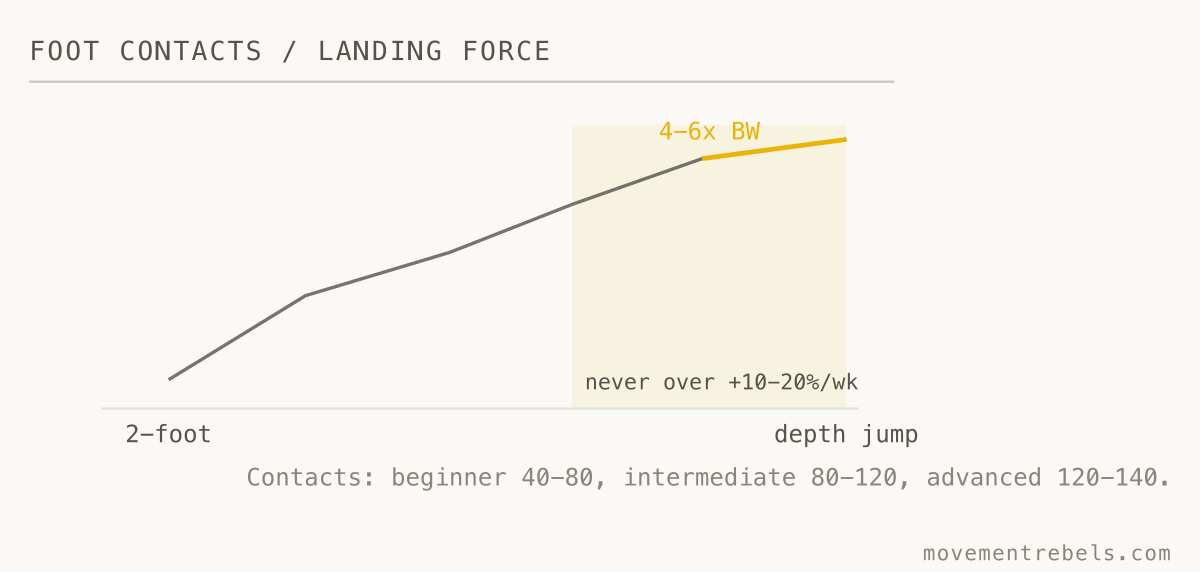
The research does not provide perfect guidelines for foot-contact volume, because it has never been clearly defined in the literature. But the consensus from coaching practice and the studies that do exist is this: beginners start with 40-80 contacts per session. Intermediate athletes can push to 80-120. Advanced athletes with years of plyometric training can handle 120-140. Each contact counts every landing. Twenty box jumps (20 contacts) is a different stress from 20 pogo hops (20 contacts), because intensity changes the load on the tissue.
Never train plyometrics to fatigue. The moment the movement gets slow, heavy, or loud, stop. That is when form breaks down and injury risk spikes. Quality over quantity is not a cliche in plyometrics; it is the law. A set of 8 explosive, quiet, springy double-leg hops is a set. A set of 12 sloppy, heavy, loud ones that tire you out is when your ankle rolls and your season ends.
The progression ladder
Start here and move up only when the lower level feels completely controlled and light.
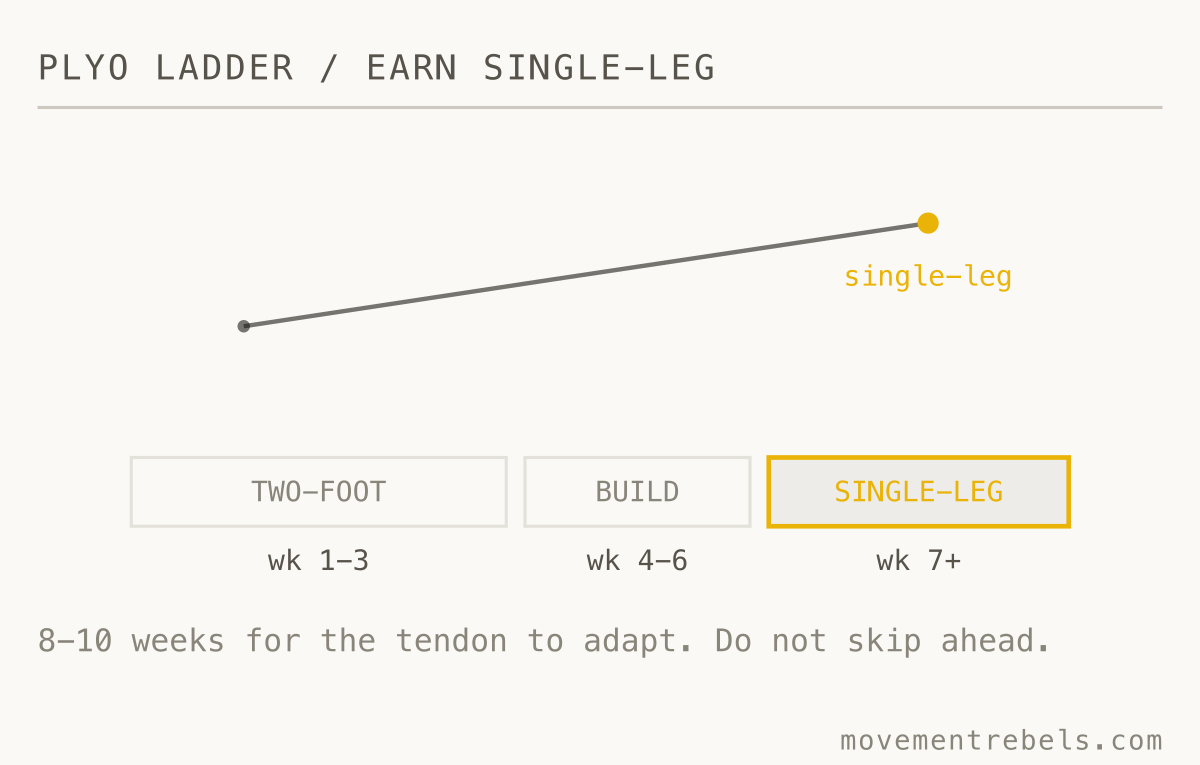
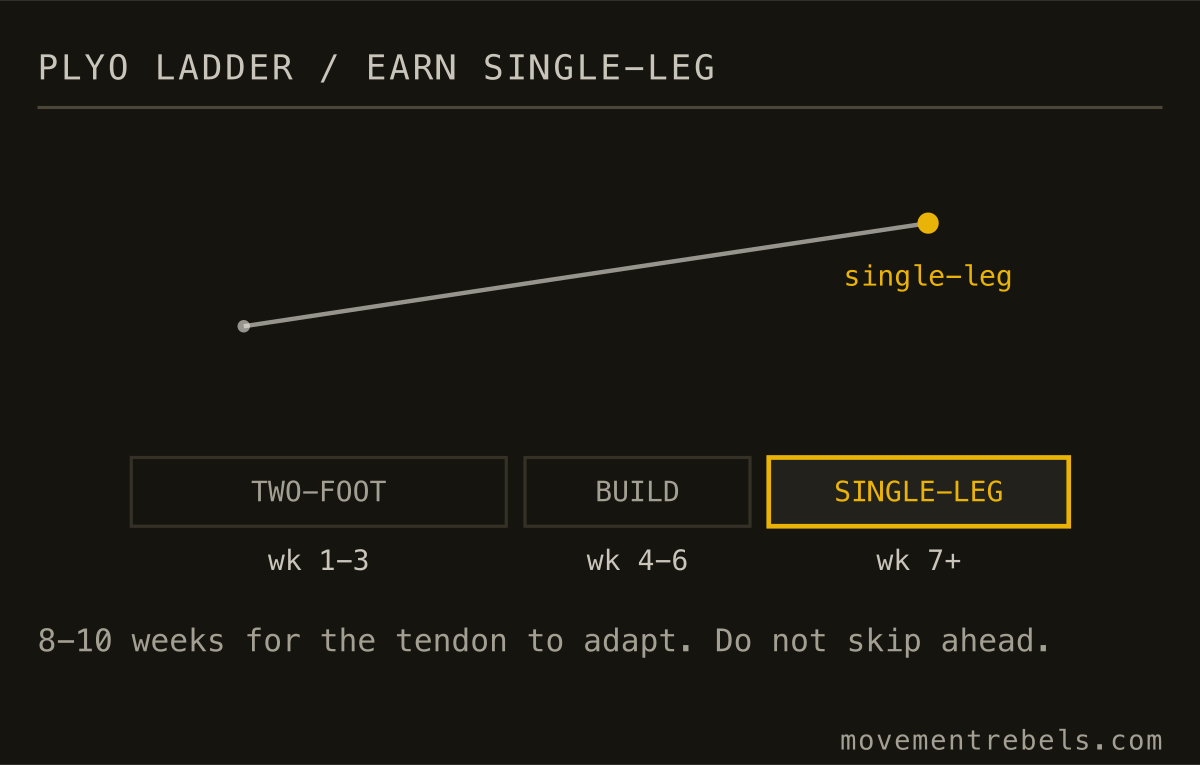
Phase 1: Low-intensity, two-foot basics (weeks 1-3)
- Pogo hops (small, rapid ankle bounces)
- Ankle hops (same movement, more explicit ankle focus)
- Low box jumps (12-18 inches, land soft, step down)
- Double-leg forward bounds (short, springy)
Perform 2-3 sets of 6-10 contacts. Rest 2-3 minutes between sets.
Phase 2: Building intensity, still two-foot (weeks 4-6)
- Medium box jumps (18-24 inches)
- Box jump plus hold (land, stick for 2 seconds, step down)
- Double-leg lateral bounds (side to side)
- Depth drops (step off a low box, land softly, stick, reset)
Perform 3 sets of 8-12 contacts. Increase volume by no more than 10-20% per week.
Phase 3: Single-leg and advanced (weeks 7+)
- Single-leg hops (one leg, same ground, rapid)
- Single-leg bounds (one leg, covering ground)
- Lateral single-leg hops (bounding side to side)
- Depth drops to single-leg landing (high skill, high reward)
Perform 3-4 sets of 6-8 contacts per leg. Total volume is still low because single-leg work is more demanding.
Do not rush this ladder. Many athletes skip to single-leg work after two weeks and hurt themselves. Take six to eight weeks on the basics. The adaptation in the tendon and the nervous system needs time.
Foot contact dosing
The practical framework is simple: low, moderate, or high volume based on experience and intensity.
- Low volume: 40-80 contacts per session. Start here. Two-foot basics only. Example: 3 sets of 6 pogo hops + 3 sets of 8 ankle hops + 3 sets of 10 low box jumps = 54 contacts total.
- Moderate volume: 80-120 contacts per session. Intermediate progression. Mix two-foot and introductory single-leg. Example: 4 sets of 8 double-leg hops + 3 sets of 6 single-leg hops per leg = 66 contacts.
- High volume: 120-140 contacts per session. Advanced athletes only, and only after weeks of building. Still quality over quantity. Never grind.
The volume increase between sessions should never exceed 10-20%. If you do 80 contacts in week 3, you can do 88-96 in week 4. Build gradually. Plyometric injuries are the result of sudden jumps in volume or intensity.
Where they fit in the week
Plyometrics are demanding on the nervous system and the connective tissue. Schedule them the right way or they will interfere with your running or cycling.
Do plyometrics fresh, before your main lifting session, or on a separate quality day. Never after a hard run or ride. Never on the same day as your heaviest strength work. If you are running intervals on Tuesday and want to lift heavy on Tuesday, do the intervals, rest a few hours, then do the strength work. Skip plyos that day. Save plyos for Thursday, when you have had 48-72 hours to recover from Tuesday's stress.
The ideal schedule looks like this:
- Tuesday: Intervals or tempo run + low-intensity strength (not heavy legs)
- Thursday: Easy run + plyometric session on fresh legs
- Saturday: Long run or long ride
- Sunday or Monday: Heavy strength session (squat, deadlift, calf raises)
Running intervals build aerobic power; plyometrics build the stiffness to express that power efficiently. A VO2 max training plan paired with plyometrics in the base phase creates a foundation where the aerobic capacity and the economy to use it both improve together.
Two plyometric sessions per week is the upper limit for most distance runners and cyclists. More than that taxes the Achilles and ankles beyond what they can adapt to. One per week is safer if you are new to it. Three per week is asking for overuse injury.
Track your total foot contacts for the week, not just per session. If you do 80 contacts on Thursday and 100 on Sunday, that is 180 for the week. Next week, aim for 180-215 (10-20% increase). Stay under 200-250 per week for intermediate athletes. Advanced athletes can push higher, but only after a full season of consistent work.
Common mistakes
The patterns that undo plyometric training are predictable. Avoid these:
- Plyos when you are fatigued. Tired plyometrics are sloppy plyometrics. You lose the speed and stiffness you are training for, and you invite injury. Always do them fresh.
- Mixing intensity without tracking it. Doing 100 ankle hops is not the same stress as 100 box jumps. Keep intensity consistent within a session. All low (pogo hops), or all moderate (box jumps), or mix carefully and count the total stress, not just the contact count.
- Increasing volume too fast. Adding 50 contacts week to week will hurt you. Increase by 10-20% max. Build patience.
- Training through pain in the Achilles or ankle. Soreness is normal. Sharp pain or swelling is not. Stop immediately and rest.
- Skipping the progression ladder. Single-leg work is advanced work. Start two-foot. Spend weeks on the basics. The foundation is where the adaptation happens.
- Doing plyos in the week before a key race. They are a stressor. Do your last plyometric session 7-10 days before the race. Taper volume in the final two weeks.
- Neglecting the calf and Achilles. Plyometrics stress these tissues hard. Do calf work in the gym (heavy, slow raises) on your strength days. This builds the tendon resilience needed to handle plyos.
How Movement Rebels fits
The Movement Rebels AI coach reads your training data (from Garmin or Apple Health on iOS), sees your running economy, your running cadence, and your readiness scores from HRV and sleep. It spots when you have the recovery capacity to add or increase plyometric work. When you are in a base-building phase with low racing stress, the coach builds plyometrics into the strength plan, placing them on days when you have had full recovery. When you enter race season, it scales plyos back to maintenance only and moves them away from your key workouts.
The coach also reads your weekly running load. If you spike your mileage, it throttles the plyometric volume to keep total stress from compounding. If you are recovering poorly or your VO2 max fitness is declining from fatigue, it pulls the plyos out and holds them until you have bounced back. A 40-contact plyometric session done when you are fresh is far more valuable than an 80-contact session done when you are already fried. Movement Rebels adapts the dose to your recovery reality, not a generic calendar.
Start with two to three weeks of low-intensity, two-foot basics. Be bored. Be patient. The tendon adaptation happens quietly, under the surface. Then progress incrementally. Plyometrics are one of the highest-return strength interventions for endurance, but only when the dose is right.
One app instead of five.
Strength, endurance, recovery, fueling, planning, and your AI coach. All under a 7-day free trial. No card.
Start 7-day trialStrength Training for Runners: Get Faster and Stay Healthy Without Bulking
How runners should lift to run faster and stay injury-free: the key lifts, heavy over high-rep, two sessions a week, plyometrics,
Running Cadence and Form: What Matters, and What Doesn't
Kill the 180-cadence myth. Overstriding is the real problem, and a modest cadence bump is the fix backed by evidence. Here is what
VO2 Max Intervals: The Sessions That Raise Your Ceiling
3-5 minute reps near 90-95% HRmax with near-full recovery are what the evidence actually supports for raising VO2max. Dose, work:r
Hill Training for Runners: Strength, Speed, and Economy
Hills are resistance training you can run. Short reps for power, sustained climbs for threshold, downhill for race skill. The hone