Running Cadence and Form: What Matters, and What Doesn't
The number 180 has done a lot of damage to a lot of runners. It appears in training books, coaching apps, GPS watch alerts, and forum arguments as if it were a physiological law. It is not. It was an observation. Jack Daniels counted arm swings at the 1984 Los Angeles Olympics and noticed that most elite runners, across all distances he observed from 800m through the marathon, hit 180 steps per minute or more. That is it. One man, one Olympics, one observation about runners traveling at sub-elite-for-us speeds under race conditions.
Modern research has refined the picture considerably, and the honest version is both simpler and more useful: the target cadence does not exist. The real problem is overstriding, and a modest bump in your personal cadence, around 5-10% above whatever you naturally run today, is one of the few form interventions with solid evidence behind it. Everything else in the running-form universe ranges from plausible to vigorously marketed noise.
This guide covers what overstriding actually does to tissue, what cadence adjustment achieves and why, where the rest of the form advice stands on evidence, and what to skip.
Why 180 Is Not Your Number
Daniels himself never said 180 was a target. He said he noticed elite runners were at or above it. Modern analysis shows why: cadence scales with speed. Most recreational runners approach 180 only when running around a 7:00 per mile pace or faster. At easy and moderate paces, a cadence of 160-170 is completely normal and not a problem.
A 2025 systematic review confirmed what practitioners already suspected: optimal cadence is individual and speed-dependent. Height, leg length, fitness, and pace all influence the cadence that is metabolically cheapest for a given person. Forcing a low-and-slow runner toward 180 at an easy training pace adds oxygen cost without adding benefit. Your body already knows roughly where it wants to be. Straying well outside that natural range tends to cost more energy, not less.
The cadence-watch market, GPS form metrics, and running-tech advertising have turned a loose coaching heuristic into a performance obsession. The only number that matters is your number, and even that matters less than the pattern beneath it.
The Real Problem: Overstriding
Overstriding is what actually earns the concern. It is a running pattern in which the foot lands in front of the body's center of mass, creating a braking force with every step. You can overstride at 165 spm or at 185 spm. Cadence is a proxy for overstriding, not a substitute measure for it.
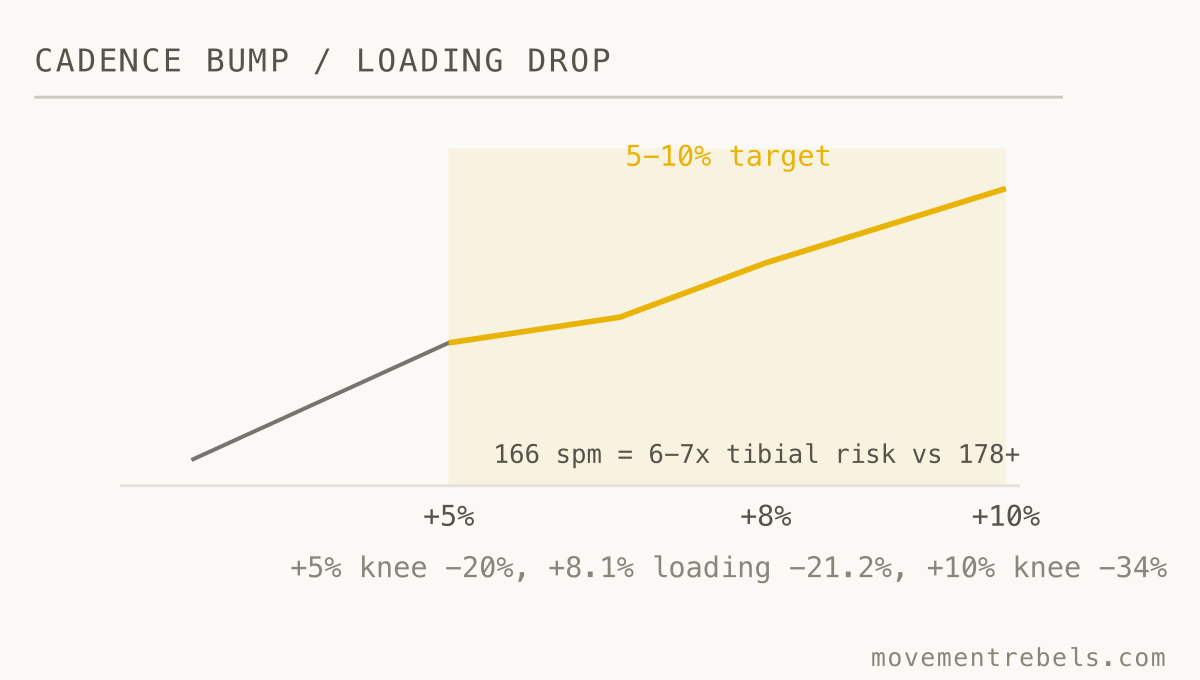
When the foot strikes ahead of center, the runner absorbs a braking impulse that has to be overcome before the next push-off. Tissue loading increases at the knee and hip in particular. Research on recreational runners consistently finds that a 5-10% step rate increase meaningfully reduces energy absorption at the knee and hip. The reductions are not rounding errors. They are large enough to matter for injury risk.
Studies measuring vertical loading rate, the variable most closely associated with tibial stress fractures, patellofemoral pain, and medial tibial stress syndrome, find that moderate cadence increases reduce it substantially without adding metabolic cost. That is a genuine win.
The mechanism is simple: a shorter stride lands the foot closer to your center of mass, reducing the braking impulse and the peak forces your bones and tendons absorb on each contact. You are not changing your running style dramatically. You are reducing an error pattern.
What a Modest Cadence Bump Actually Does
The evidence supports a specific, limited intervention: if your current cadence is below 165-170 at easy-to-moderate paces, a 5-10% increase is worth pursuing. Not a jump to 180. A 5-10% increase above your personal baseline.
That intervention produces real, measurable changes:
- Shorter stride length with the foot landing closer to the hips
- Less vertical oscillation, the up-and-down bounce that costs energy and increases landing impact
- Reduced braking impulse at foot strike
- Lower peak knee and hip loading rates
- No meaningful increase in oxygen cost at the new cadence if the change is gradual
The evidence here is consistent. Gait retraining studies in novice runners using real-time biofeedback to reduce vertical impact loading show substantial reductions in injury incidence over 12-month follow-up periods. Research on step rate and tibial injury risk finds that runners with very low cadences face roughly six times higher injury risk than those in the higher cadence range. The exact thresholds vary by study and testing speed, but the direction is clear and the effect size is large. The intervention is worth it for low-cadence runners.
For runners already in the 170-180 range at easy paces, chasing more cadence produces diminishing returns. The overstriding problem is already largely absent.
Where to Start: Measure First
Before adjusting anything, run at an easy conversational pace and count your steps for 30 seconds, then double it. Do this on a flat section at a pace you would call "comfortable." That is your baseline.
If you are at 160 or below, a 5-10% increase means targeting 168-176 at that pace. A running cadence calculator for stride length shows how that step-rate change shortens your stride at a given pace, so the target is a number you understand rather than a watch alert. Use a metronome app or a cadence-alert on your watch during one or two runs per week to build the pattern. Do not attempt to force the new cadence during every run immediately. Neuromuscular patterns take weeks to become automatic. Gradual exposure builds the adaptation. Forcing the change too fast changes your gait mechanics in ways you are not yet conditioned for, and that creates its own injury risk.
After four to six weeks of partial exposure, the new cadence tends to feel natural rather than effortful. At that point you can drop the metronome.
If you are already at 170 or above at easy paces, cadence is not your constraint. Save the effort for the sections below.
The Form Advice Worth Keeping (and Why)
Beyond cadence, the running-form world is full of cues that feel authoritative but rest on limited controlled evidence. Here is an honest account of what survives scrutiny.
Forward lean from the ankles, not the waist. A slight forward lean keeps your center of mass moving in the direction of travel rather than fighting against it. The evidence base is modest but the physics is coherent, and it does not require special training to implement.
Relaxed shoulders and hands. Tension in the upper body transfers to the trunk and disrupts the elastic recoil the running gait depends on. Every form coach agrees on this. The cue "hold a potato chip between your fingers without crushing it" is old and still useful.
Arms swinging forward-and-back, not across the body. Cross-body arm swing rotates the trunk and creates torque that has to be absorbed, wasting energy. The cue is easy to apply and has biomechanical logic behind it.
Foot strike type (heel vs. midfoot vs. forefoot). This is the most contested territory in recreational running advice. The scientific literature on foot strike and injury is mixed, and the evidence cuts in multiple directions. A large prospective study found no significant difference in overall injury rates between heel strikers and midfoot strikers at comparable training loads. Some research shows forefoot striking reduces certain impact transients while increasing Achilles tendon load, shifting rather than eliminating injury risk. The honest summary: foot strike matters less than where the foot lands relative to your center of mass. A midfoot strike under your hips beats a midfoot strike out in front of them.
Running drills (high knees, A-skips, bounding). Drills improve neuromuscular coordination and may reinforce better mechanics over time. The direct evidence that drilling alone transfers to faster times or lower injury rates is thin. Drills are useful as part of a warmup and as motor pattern work. They are not a shortcut to form transformation.
What Form Work Does Not Fix
Form coaching has real limits, and the industry undersells them.
It does not fix weak hip abductors, glutes, or single-leg stability problems. If your knee collapses inward on landing, you need hip and glute strength work, not a cadence cue. The cue can mask the problem briefly. Strengthening eliminates it. See hill training for runners for sessions that build the specific leg strength that underpins better mechanics.
It does not substitute for appropriate training load management. Most running injuries are overuse injuries, meaning too much load accumulated faster than tissues can adapt. The most common form problem is not a gait flaw but a too-aggressive ramp-up in weekly mileage. Fixing your arm swing while doubling your mileage in a month solves nothing.
It does not produce overnight change. Gait is a deeply ingrained motor pattern running at tens of thousands of repetitions per hour. Meaningful gait changes take weeks of deliberate, consistent exposure. Sessions where you consciously monitor form account for a fraction of your weekly running. The unconscious pattern reasserts itself quickly. Patience is the intervention.
The Gear and Economy Question
The running shoe industry has layered additional complexity onto the form debate. Carbon-plated super shoes shift the mechanics of the push-off phase in ways that measurably improve economy at race effort. The evidence is solid: multiple meta-analyses converge on mean economy improvements in the range of 2-3%, with variation depending on the runner and the shoe. They do not fix overstriding, and the economy improvement does not transfer uniformly across runners. For a full look at the evidence, see carbon-plated super shoes.
Minimalist shoe advocates argue that cushioned shoes permit worse mechanics by muting the sensory feedback that naturally corrects overstriding. The evidence is plausible but the practical outcome for most recreational runners switching to minimal shoes is calf and Achilles injury from the load shift, not better mechanics. Transition slowly or not at all if you have any history of lower-leg issues.
Reading Your Own Data
If you run with a Garmin, your device is already capturing cadence, vertical oscillation, vertical ratio, and ground contact time on every run. These metrics are worth understanding rather than chasing.
Vertical oscillation above 10-11 cm at easy pace is worth noting. It often correlates with overstriding and excess landing force. Reducing it through a small cadence increase is the right lever. Ground contact time trending long (above roughly 280-300ms at easy pace) can also signal a sluggish push-off or excessive fatigue. Neither number is a dial you should obsess over daily.
What matters is the trend across a training block, not the single-session number. A hard tempo day will spike ground contact time and drop cadence slightly. That is normal. A series of easy days where these numbers are deteriorating alongside rising resting heart rate is a fatigue signal worth investigating. Pair it with HRV-guided training to build a fuller picture of when your body is adapting versus accumulating damage. Garmin data also flows directly to the Garmin AI coach integration so the coach can spot form-fatigue patterns across weeks rather than expecting you to track them manually.
For context on what heart rate numbers from easy running reveal about aerobic capacity, marathon training with heart rate data covers the practical application across a full training block.
How Movement Rebels Handles This
The coach does not give you a cadence target. It reads your recent runs from Garmin Connect or Apple Health (native on the iOS app), identifies whether cadence is meaningfully below 170 at easy efforts, and prescribes a specific, incremental retraining protocol if it is. Structured sessions push directly to your Garmin watch with the appropriate cadence alert set, so you get real-time feedback during the run without thinking about it.
After the session, the coach reads the file back, grades cadence compliance, and checks whether the change is affecting vertical oscillation in the right direction. If you are already at a healthy cadence, the coach does not manufacture a form problem to fix. It focuses on the training variables that will actually move your fitness: intensity distribution, recovery load, long-run pacing, and fueling strategy.
When you log a run on days the form metrics look off (cadence dropped, oscillation spiked), the coach cross-references it with your recent training load and sleep data from Apple Health. Cadence degradation late in a long run often means the session was too long or too fast for the current fitness level, not that your form is broken. The coach distinguishes the two rather than treating every metric drift as a technique problem.
Pricing
Movement Rebels covers the full training picture: structured runs to your Garmin, post-session form analysis, recovery tracking, and the AI coach that connects them. A 7-day free trial covers everything. After the trial, Pro+ is $20/month for unlimited coaching. No card required on the trial.
Running Pace Calculator
Pace, speed, and splits from a distance and time.
One app instead of five.
Strength, endurance, recovery, fueling, planning, and your AI coach. All under a 7-day free trial. No card.
Start 7-day trialCore and Hip Strength for Runners
Late-race form collapses at the hips first. The stability work that holds your stride together: the muscles that matter, the exerc
Tempo Runs: Threshold Done Right
Tempo run physiology, honest pacing ranges, three session variants, and why the popular HR zone is wider than coaches admit. Build
Marathon Training With Heart Rate Data: The Honest Playbook
HR-based marathon training is powerful and misunderstood. The honest version: what cardiac drift means for race day, when pace bea
HRV-Guided Training: Read the Signal, Skip the Noise
One low HRV night tells you almost nothing. The 7-day-vs-28-day trend tells you nearly everything. Here is what the evidence actua