Hill Training for Runners: Strength, Speed, and Economy
The gym is optional. Hills are not.
That is the slightly uncomfortable truth buried under most hill training advice. A short, steep climb forces greater propulsive force, higher cadence, a forefoot-dominant strike, and a cardiac demand your flat easy runs never reach. A descent demands more from your quads in one minute than most runners accumulate in a week of flat running. That demand is also where most training plans are quiet, because downhill hurts two days later and coaches would rather avoid the complaint.
This guide does not avoid it. It covers what the research actually shows about uphill and downhill physiology, where the hype around hill training overshoots the evidence, and how to program each type without accumulating injury risk faster than fitness.
What hills actually do to your physiology
Research on graded running biomechanics and physiology consistently shows findings that are more nuanced than the usual "hills build strength" summary.
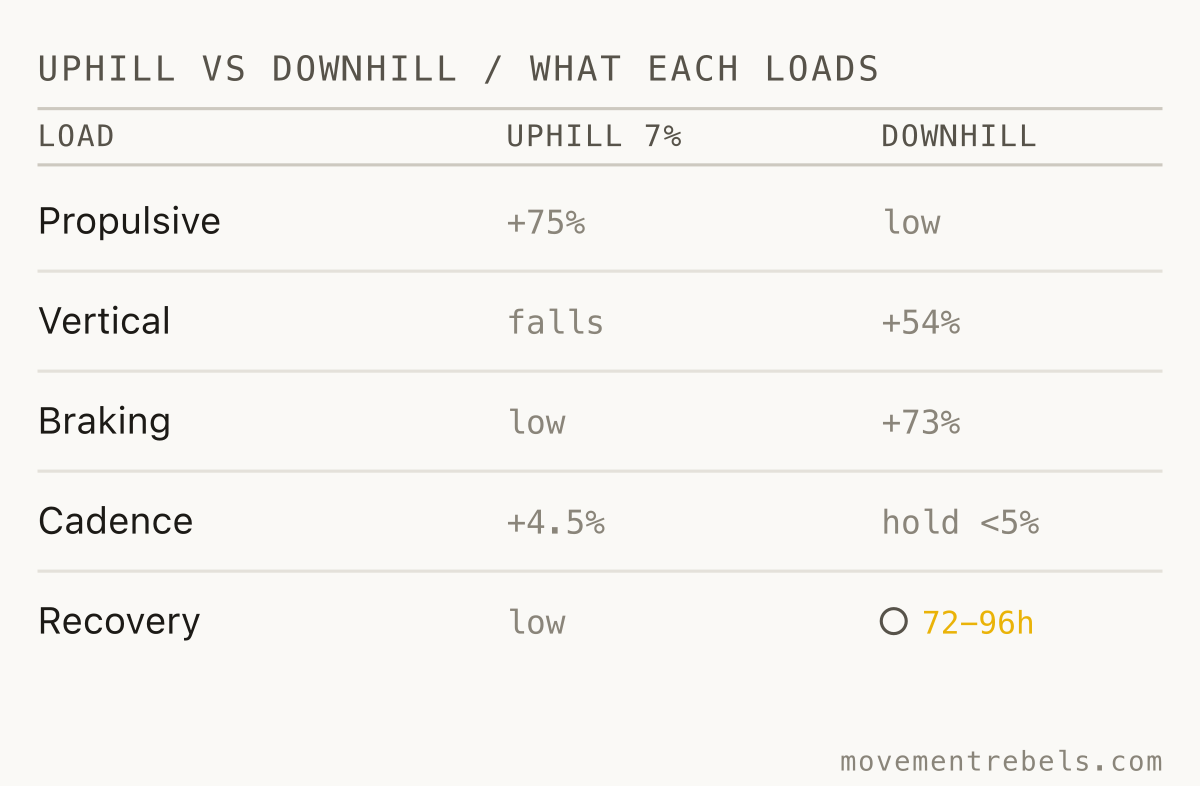
Uphill running increases cadence while stride length drops. Ground reaction forces shift: normal (vertical) forces fall, but propulsive forces rise substantially on steep grades. Your posterior chain and hip flexors are doing work on a hill that flat running simply does not load at the same intensity. That is genuine strength stimulus, not metaphor.
The catch is roughly linear: energy cost climbs proportionally with gradient. A long sustained climb at a moderate grade is closer to threshold work than easy aerobic running, regardless of pace. Your GPS pace looks slow; your body is working hard. If you follow pace targets on hills, your heart rate will tell a different story. A grade adjusted pace calculator for hill efforts converts that slow uphill pace into its flat equivalent, so you can compare effort honestly across climbs and flats.
Downhill running is a different physiological problem. Impact forces spike significantly, and braking forces increase even more steeply at negative grades. Research on muscle damage after downhill running consistently finds that maximal voluntary force is reduced for 24-72 hours post-session, creatine kinase markers spike markedly in the first 24 hours, and full recovery takes roughly 3-4 days.
Those are not numbers to treat as abstract. They mean a hard downhill session needs roughly 72-96 hours before you load the quads again with quality work. Most runners violate this without knowing it.
The honest caveat: which claims are solid and which are not
Hill training is surrounded by confident claims. Several of them are well-supported. Several are extrapolated further than the evidence warrants.
Well-supported:
- Hills increase propulsive force demands, which trains the same neuromuscular qualities as heavy lower-body strength work, without adding a separate gym session to an already full training week.
- Short hill sprints (8-12 seconds) improve peak force output and stride rate. Randomized controlled trial evidence shows that 8 weeks of twice-weekly uphill sessions at steep gradients (around 7.6%) produced meaningful improvements in maximal sprint velocity compared to controls, and outperformed shallower inclines on every measure.
- Downhill running is a specific and trainable skill. Runners who regularly train on descents adapt their braking mechanics and accumulate less damage from equal downhill exposure over time.
- Hills reduce soft-tissue impact compared to flat speed work at equivalent effort. Running a 10-second hill sprint at maximum effort carries far less injury risk than a 10-second flat sprint at maximum effort, because the incline reduces horizontal velocity and braking forces.
Overstated or unclear:
- "Hills replace the weight room entirely." They address some of the same qualities, particularly force production and single-leg strength. They do not replicate hip hinge strength, posterior chain loading at long muscle lengths, or the structural bone density benefits of heavy loading. Runners who use hills as a supplement to strength work are in a better position than those who replace it entirely. See hybrid athlete training for how to balance the two.
- "Any hill will do." Gradient matters. The RCT evidence above showed that shallow gradients (around 2.5%) produced minimal performance gains compared to steep ones. A rolling route with gentle undulation is not hill training in the meaningful sense, even if it feels hilly.
- "More hill work is always better." The dose-response flattens and then reverses. Sustained high volume on hills increases eccentric loading and injury risk, particularly to the IT band, patella, and calf complex. Trail runners consistently show higher injury rates per training hour than road runners, and cumulative hill loading is a likely contributor to that gap.
Three types of hill session, three different adaptations
Hills are not one stimulus. They are three distinct training tools depending on length, gradient, and intent. Mixing them randomly wastes the specificity.
Short hill reps: power and neuromuscular drive
Duration: 8-15 seconds per rep. Gradient: steep, 8-15%. Full recovery between reps (2-3 minutes). 6-10 reps per session.
This is speed development and neuromuscular conditioning, not aerobic work. The session is over before lactate accumulates. You are training force application and stride mechanics, and the steep incline forces the posture, knee drive, and forefoot contact that technical flat-speed drills try to teach artificially.
The RCT evidence supports steep gradients for this format. Shallow hills at this duration produce modest returns. Find the steepest hill that lets you sprint fully, not shuffle.
Recovery is deceptively easy. You will not feel much the day after a short-rep hill session because the metabolic cost is low. But the eccentric demand on the downhill jog-recovery is real. Jog recovery, do not sprint down.
Sustained hill climbs: threshold and aerobic economy
Duration: 60-180 seconds per rep. Gradient: moderate, 4-8%. Recovery: 2-3 minutes jogging. 4-8 reps.
This is your threshold and VO2 territory. The sustained demand at moderate grade forces a heart rate near your lactate threshold while the speed is controlled and the impact forces are lower than flat interval work. If you are not ready for track intervals or want a softer introduction to hard-effort running, sustained hill climbs are the entry point. See tempo runs for how to sequence this with flat threshold work across a training block.
The pacing discipline required here is also race-specific. Learning to control effort on an uphill, rather than hammering it and blowing up on the descent, directly transfers to road and trail racing. A running pace calculator helps you set the flat-ground reference paces these sustained climbs sit just under.
Long road or trail climbs: sustained aerobic loading
Duration: 8-30 minutes of continuous climbing. Gradient: 3-10%, variable. Used as part of a longer run, not as a standalone interval session.
This is volume and aerobic base on gradient, not intensity. The uphill section of a long run builds specific aerobic capacity for hilly races without the injury risk of sustained flat-speed work. For marathon and trail runners, it is the most underprogrammed hill format. It is also the one that will expose weaknesses in your aerobic engine most clearly.
Combine this with zone 2 training principles: sustain a heart rate you can hold in conversation, and walk the steep sections before your HR spikes too high to return. Walking is not failure. It is correct execution.
Downhill running as a skill, not an afterthought
Most running plans treat the descent as recovery from the climb. That is the wrong frame.
Downhill running is a skill with its own physiological demands, and most runners are undertrained at it. The braking phase of each footstrike on a descent is a high-load eccentric contraction. The muscle damage research shows how significant that demand is, even for runners who are otherwise well-conditioned.
The practical consequence is that runners who only occasionally encounter descents, such as those who train on flat routes and race a hilly course, are at higher risk of the quad failure and shuffling gait that marks the back half of hilly races.
How to train it:
- Introduce downhill running gradually, in 5-10 minute blocks added to longer runs, before building to dedicated descent repeats.
- Use a controlled forward lean and slightly shorter stride to reduce braking force. Reaching out with the foot in front of your center of mass is the mechanical error that creates the most impact loading.
- Allow cadence to rise slightly on descents, rather than lengthening stride. The evidence broadly supports maintaining cadence close to preferred values on negative grades as a way to minimize impulse loading.
- Separate hard descent sessions from other quality work by at least 3 days, given the 72-96 hour recovery window the muscle damage evidence supports.
For trail runners especially, downhill proficiency is often the differentiating skill in race performance. Road runners who train on flat terrain tend to lose more time on descents than climbs in hilly events, because the descending skill simply has not been trained.

How to program hills across a training block
Hill work sits in the intensity category alongside tempo runs and intervals. It is not easy aerobic filler, even when it looks like it on paper.
A simple framework for a runner training 4-5 days a week:
Base phase (8-12 weeks): One short-rep hill session per week (8-15 second reps, full recovery). Treat it as neuromuscular maintenance with low metabolic cost. Keep the other days truly easy. The emphasis is building aerobic volume, not quality work. This also serves as injury prevention because short hill reps at full effort on steep gradients produce lower impact stress than flat speed work.
Build phase (4-8 weeks): Shift one session per week to sustained hill climbs (60-120 seconds, moderate gradient). This is your hard day. Keep one easy day before it and one easy day after. The short-rep session can move to once every 10-14 days as a speed maintenance stimulus.
Race-specific phase (3-6 weeks): Integrate long road or trail climbs into your long run once every 10-14 days. Reduce short-rep work further. Add one or two controlled downhill blocks if your target race has significant descent. Manage HRV and resting heart rate closely in this phase. Accumulated hill load stacks fast, and the recovery demand is higher than flat interval work at equivalent duration. Watch the signals rather than following the plan rigidly when they go in the wrong direction.
Taper (2-3 weeks): Drop volume but keep one short-rep session per week. The neuromuscular stimulus refreshes quickly and the metabolic cost is low, so you can stay sharp without adding fatigue. See how to taper for the complete picture on preserving fitness through the taper window.
Gear: what actually matters and what does not
Carbon-plated shoes improve running economy on flat and moderate grades. The evidence on how that benefit behaves at steep uphill gradients or on descents is limited, and the general coaching consensus is to train in what you race in rather than trying to optimize around footwear-specific conditions. The practical takeaway: shoes matter less than gradient selection and session structure. Runners who buy carbon plates and keep doing the same shallow rolling loops are getting neither the shoe benefit nor the hill training benefit.
Trail-specific considerations for downhills: a wider-lugged outsole improves braking grip and reduces the compensation load that comes from slipping, which adds an unpredictable eccentric impulse on every questionable footstrike. This matters more than carbon plates for trail runners.
How Movement Rebels handles this
Hill sessions are programmed as structured workouts with explicit rep counts, gradient targets, and recovery intervals, pushed directly to your Garmin watch through the native integration. The watch file includes the target heart rate or effort zone for each climb, so you are not guessing whether you are in the right zone mid-rep.
After the session, the coach reads the completed activity back through Garmin Connect or Apple Health (native on the iOS app), checks time in target zone per rep, and grades execution. A sustained-climb session where you spiked past threshold on every rep and then needed extra recovery gets flagged, along with a note on why the pacing drifted and what to adjust next time.
Downhill recovery is tracked actively. Log a hard descent block, and the coach builds a 3-4 day buffer before the next quality session, based on what the muscle damage timeline actually requires rather than what the generic weekly template assumes. If your HRV or resting heart rate shows suppression in that window, the buffer extends automatically. The recovery data flows from Garmin or Apple Health without manual input.
The AI coach connects this to your broader training block. A runner who connects Garmin sees activity type, HR data, and pace per lap. Data from Apple Health flows in through the native iOS integration, picking up sleep, resting HR, and HRV from any device that exports there. Strava write-back posts a session summary to your activity description after each hill workout. The coach uses Garmin and Apple Health data for coaching decisions. It does not pull from Strava as a data input.
For runners building toward a hilly road race or trail event, the coach sequences hill work within the broader periodization structure: short reps in base, sustained climbs in build, descents in race-specific prep, controlled reduction in taper. Each block builds on the last without overlapping quality demands. If you are curious how the coach adapts your plan week to week based on actual performance data, adaptive training plans covers the logic.
Pricing
Movement Rebels is one app for the full picture: endurance coaching, structured workouts to Garmin, recovery tracking, fueling, and the AI coach that connects them. A 7-day free trial covers everything. After the trial, Pro+ is $20/month for unlimited coaching. No card required on the trial.
One app instead of five.
Strength, endurance, recovery, fueling, planning, and your AI coach. All under a 7-day free trial. No card.
Start 7-day trial5K and 10K Training: A Weekly Plan to Race Faster
A specific 5K and 10K training plan: easy volume, one VO2max session, one threshold session, a long run, sample workouts with pace
Core and Hip Strength for Runners
Late-race form collapses at the hips first. The stability work that holds your stride together: the muscles that matter, the exerc
Tempo Runs: Threshold Done Right
Tempo run physiology, honest pacing ranges, three session variants, and why the popular HR zone is wider than coaches admit. Build
VO2 Max Intervals: The Sessions That Raise Your Ceiling
3-5 minute reps near 90-95% HRmax with near-full recovery are what the evidence actually supports for raising VO2max. Dose, work:r