Strength Training for Runners: Get Faster and Stay Healthy Without Bulking
Most runners who avoid the gym do it for one reason: they think lifting makes you slow and heavy. Done right, it does the opposite. Lift heavy twice a week, keep the reps low, and you get a stiffer stride, a stronger pushoff, and tendons that hold up to the mileage you keep putting through them. What to lift, how to fit it around your running, which mistakes cost runners their best races: that's the rest of this guide.
Why runners should lift (and why it won't make you bulky)
The fear of bulking is misplaced. Visible muscle mass takes high training volume, a calorie surplus and months of dedicated hypertrophy work, and none of that describes a runner doing 2 strength sessions a week on top of 40-60 km of running. You burn too much. The rep scheme you should be using doesn't drive size either, so the mass that would slow you down never turns up.
What you get instead:
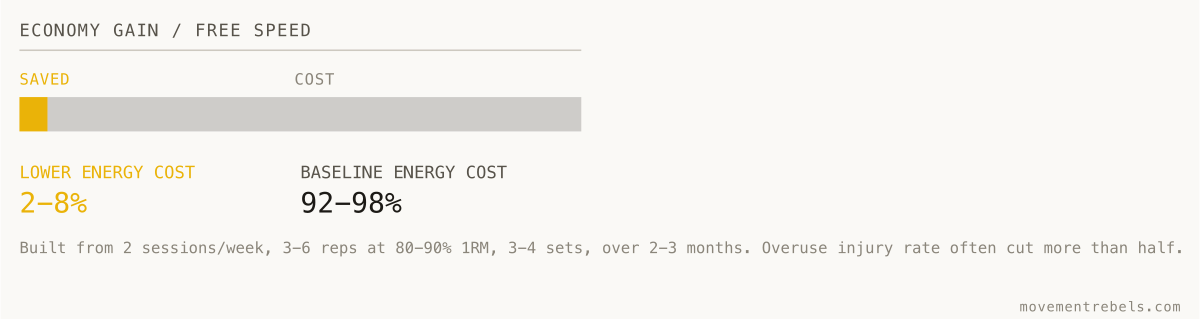
- Better running economy. Stronger, stiffer muscles and tendons store and return more elastic energy every time your foot hits the ground, and the research broadly finds that 2-3 months of heavy strength work improves running economy in trained runners, though individual studies vary widely on how much. Same pace, lower heart rate. Free speed, and your lungs pay nothing for it.
- Injury resistance. Most running injuries are overload injuries: the tissue can't absorb the force you keep putting through it, and stronger glutes, hamstrings and calves raise that ceiling. The evidence for strength training reducing overuse injuries in game-sport athletes is strong, and most coaches and sports medicine practitioners extend that logic to runners, while the picture in endurance runners specifically is less settled. The tissue-resilience argument holds regardless.
- A stronger finish. When form falls apart in the last few kilometers it goes at the hips and core first, and strength is what holds your posture together on the stretch where everything else is tired.
The target is more force into the ground in less time. Then you leave the gym.
Lift heavy, low reps, not high-rep circuits
This is where most runners go wrong. Bodyweight circuits, light dumbbell complexes, endless core work at high reps, all of it picked because it feels "athletic" and safe, and every bit of it building the local muscular endurance running already gave you. For speed? Close to nothing.
The adaptation you want is neuromuscular, teaching the nervous system to recruit more muscle fibers faster, and heavy loads with low reps are what get you there.
- Reps: 3-6 per set for the main lifts.
- Load: 80-90% of your one-rep max, or a weight where the last rep is hard but clean. A 1RM calculator to set heavy lift percentages turns a recent set into those percentages, and an RPE calculator to gauge how heavy to go reads effort on the days the bar feels different from what the math promised. Once you know your numbers, see how your main lifts rank against strength standards.
- Sets: 3-4 working sets per main lift.
- Rest: 2-3 minutes between sets. You're recovering the nervous system, not chasing a burn.
Low volume is the point. Soreness stays low, mass gain stays low, you walk out strong instead of wrecked, and if you finish a session barely able to make it to the car you lifted like a bodybuilder. New to heavy lifting? A warm-up set calculator to ramp into heavy lifts safely builds the on-ramp so you reach your working weight ready instead of cold.
Lift with intent. Even at heavy loads, drive the bar up as fast as you can control it, because the speed of intent is what trains power.
The lifts that matter
The list is short. Five movement patterns cover what a runner needs, and your two weekly sessions get built out of them.
- Squat (back or front). The base of lower-body strength. 3-5 sets of 3-5 reps. Front squats sit easier on a cranky lower back.
- Deadlift or hip hinge (Romanian deadlift, trap-bar deadlift). Trains the posterior chain, glutes and hamstrings, the engines of your stride, and the trap bar is the most runner-friendly version of the lift at 3-4 sets of 3-5 reps.
- Single-leg work (Bulgarian split squat, step-up, single-leg RDL). Running is a single-leg sport. You never push off both feet at once, so the left-right imbalances that cause injury get found here and fixed here. 3 sets of 6-8 per leg.
- Calf raises (straight-leg and bent-knee). The calf and Achilles are the most underloaded, most injured tissues in runners, and heavy slow work is what builds Achilles tendon stiffness and resilience: 3-4 sets of 6-10, with a 3-second lower. Do both the straight-leg (gastrocnemius) and bent-knee (soleus) versions.
- Hip and core (hip thrust, side plank, Pallof press, single-leg glute bridge). Anti-rotation and hip stability. Keep it focused. A few hard sets beat 20 minutes of floor exercises.
Skip the machines that lock you into a fixed path and isolate one muscle, because free-weight, compound, single-leg movements return the most for the time you spend. And when you're working in kilos and plates, a plate calculator for loading the barbell saves the mental math on which plates hit your target weight per side.
Two sessions a week and how to fit them around running
Two strength sessions a week is the sweet spot for most runners. One maintains. Three crowds out running recovery for most people, and the hard part was never the lifting anyway, it's the scheduling, because running and lifting draw from the same recovery budget. A training volume calculator to cap lifting sets against run load keeps total weekly sets inside what your mileage leaves room to recover from.
The rule: stack hard with hard, and protect your easy days. Put the strength session on the same day as a hard run (intervals, tempo, or your long run), a few hours after it or that evening, and your easy days stay easy while the day after gives you a full recovery day. Put a heavy leg session on an easy day instead and that easy day becomes a hard day, which leaves you no recovery anywhere in the week.
A sample week for a runner doing 5 runs:
- Monday: Easy run. No lifting.
- Tuesday: Intervals (hard run) + strength session A, same day.
- Wednesday: Easy run or rest. No lifting.
- Thursday: Tempo run + strength session B, same day. See the tempo run guide for pacing.
- Friday: Rest.
- Saturday: Long run.
- Sunday: Easy run or full rest.
Schedule reality sometimes forces both into one slot, and when it does you run first if the run is a quality one, because legs pre-fatigued by heavy lifting change your form and raise injury risk. The endurance session is the priority. Strength supports it.
Split them across the day and leave at least 6 hours between the hard run and the lift. Never a heavy lower-body session in the 24-48 hours before a key race or the hardest workout of your week.

Plyometrics in small doses
Plyometrics (jumps, bounds, hops) train the fast, reactive stiffness that carries almost directly over to running, and they're also the quickest way to hurt yourself if you overdo them. Seasoning, not a meal.
- Start with low-intensity, two-foot work: pogo hops, low box jumps, ankle hops. 2-3 sets of 6-10 contacts.
- Build toward single-leg bounds and depth drops only once the basics feel controlled.
- Keep total foot contacts low when you start: standard strength and conditioning guidelines recommend roughly 80-100 contacts per session for beginners, so stay on the conservative side until two-foot landings feel easy and build from there. Never grind them to fatigue.
- Do them fresh, before the strength work or on a separate quality day, because tired plyometrics are sloppy plyometrics and sloppy is where ankles roll.
- Quality over quantity. Each contact should be quiet, springy, fast off the ground. The moment they turn heavy and loud, stop.
A small dose, done well and repeated week after week, builds the reactive strength heavy lifting alone misses.
Periodize strength across the season
Strength isn't a year-round constant. It rises as your running intensity falls and falls as your running intensity climbs, because run volume and gym volume can't both peak at once, so match the strength phase to your race calendar the same way you match your running. New to periodization? Start with periodization for recreational athletes.
- Base / off-season: Build here. 2-3 sessions a week at the heaviest loads of the year, running intensity down, which is why most of your strength gains land in this phase instead of the ones where racing is competing for recovery.
- Build phase: Drop to 2 sessions. Running intensity is climbing and strength volume comes down to make room for it. Loads stay heavy. Cut sets, not weight.
- Race / peak phase: Maintenance only. One short heavy session a week holds the strength you built, which means 2-3 sets of your main lifts, low reps, in and out. You're protecting gains here, not chasing them.
- Taper / race week: Last heavy lift 7-10 days before the race, then nothing demanding beyond a few light, fast movements to stay sharp, because heavy legs three days out is a mistake you'll feel on the start line.
Cut strength entirely for a week or more and you lose the economy and durability you worked for, where one session a week keeps the bank from emptying. And when fatigue piles up across a block, a deload week applies to your lifting as much as your running.
Common mistakes
The errors that undo a runner's strength work are predictable. Avoid these:
- Lifting to failure the day before a key run. The big one. Grind out a max set and your legs are flat for 48 hours, so stop a rep or two short of failure, always, and keep heavy work out of the 1-2 days before a quality session or race.
- High-rep circuits instead of heavy lifts. Covered above. You already have endurance. Lift heavy.
- Skipping single-leg and calf work. Least fun, most protective. The imbalances and weak Achilles they fix are exactly what sideline runners.
- Adding strength on top of full mileage with no adjustment. Add 2 lifting sessions and something gives. Pull run volume back slightly for the first few weeks so total stress doesn't spike, and watch for the signs of overtraining if you stay flat more than a few days.
- Doing strength on easy days. It kills the point of an easy day and leaves you with no real recovery. Hard with hard.
- Quitting in race season. Runners drop the gym when racing gets serious, then wonder why their late-race form collapses. Hold one maintenance session.
- Coming back too fast after time off. Away from lifting or running for a while? Ramp the load back gradually. Returning to training after injury has the framework.
How Movement Rebels fits
Knowing you should lift is the easy part. Fitting it around your running without digging a recovery hole is the work. The Movement Rebels AI coach reads your Garmin and Apple Health data, sees your real runs and your real recovery, and builds the week so your heavy lifts land on hard days and your easy days stay easy. Flat week, bad night of sleep? It pulls the strength volume back instead of stacking stress on top of stress, and it moves with the season, base through race week, so the strength work supports your running instead of competing with it.
Start with one base phase done right: heavy, twice a week, low reps. Then hold one maintenance session through race season. Your splits and your knees will both thank you.
One app instead of five.
Strength, endurance, recovery, fueling, planning, and your AI coach. All under a 7-day free trial. No card.
Start 7-day trialTissue Capacity: The Training Quality Runners Never Measure
Your tendons and bones adapt far slower than your aerobic engine. Here is how to build tissue capacity so a fitness peak does not
Why Runners Should Deadlift
Runners who skip the deadlift leave speed and durability on the table. Why the posterior chain drives your stride, which variant t
Periodization for Recreational Athletes: Which Model, and How Much You Need
Linear, block, undulating: the honest evidence on which periodization model recreational athletes actually need, and what the rese
Returning to Training After Injury: Slower Than You Think, Faster Than You Fear
The 10% rule is not science. Tendons recover three times slower than muscle. Here is what the evidence actually says about coming