VO2 Max Intervals: The Sessions That Raise Your Ceiling
Most people do these sessions wrong in one of two directions. They go too hard and too short, hammering 30-second sprints until they collapse, accumulating almost no time at high aerobic output. Or they go moderately hard and too long, turning VO2max work into a glorified tempo run that never actually reaches the stimulus needed. Both feel brutal. Neither moves the needle much.
The research is fairly consistent on what actually works: sustained reps of 3-5 minutes close to 90-95% of maximum heart rate, with recoveries long enough to almost fully restore aerobic capacity before the next rep. That combination keeps you at the critical threshold long enough per session for cardiac and muscular adaptations to stack. Everything else, the Tabatas, the 30-30s, the "just go as hard as you can" fartleks, has its place, but that place is not "training the aerobic ceiling."
This guide covers what the peer-reviewed evidence says about protocol design, dose, weekly frequency, and the common mistakes that reduce these sessions from a ceiling-raiser to expensive fatigue.
Why VO2max is the target
VO2max, your maximal oxygen uptake in mL per kilogram per minute, is the single strongest predictor of endurance performance across sports and one of the strongest independent predictors of long-term health outcomes. It sits at the intersection of cardiac output (how much blood the heart pumps) and peripheral extraction (how much oxygen working muscles pull from that blood). Raise either, and the ceiling goes up.
The aerobic base work covered in Zone 2 training builds the bottom of the aerobic pyramid: mitochondrial density, fat oxidation, capillary network. VO2max intervals target the top of the pyramid: stroke volume, cardiac output at peak intensity, and the ability to sustain near-maximal aerobic power. You need both. Neither replaces the other.
The practical ceiling: if your VO2max is 45 mL/kg/min, no amount of race-pace discipline pushes your half-marathon time below the physiological limit that number imposes. Raise the ceiling, and every other training adaptation has more room to work. A race time predictor to track your ceiling gains lets you watch those gains land across distances as the block progresses.
What the evidence actually says about protocol design
The most-studied protocol in this space is the Norwegian 4x4: four 4-minute reps at 90-95% HRmax, separated by 3 minutes of active recovery at roughly 60-70% HRmax. The foundational trial by Helgerud and colleagues compared this protocol against three lower-intensity training methods matched for total work and frequency. Eight weeks of 4x4 three times per week improved VO2max by approximately 7% in moderately trained subjects. The long slow distance group, by contrast, did not improve VO2max. Lactate threshold and stroke volume both followed the same direction as VO2max in the higher-intensity group.
That research is now nearly 20 years old, but nothing in the literature since has overturned its central finding. More recent work has refined the edges.
A 2023 randomized controlled trial put 48 well-trained men through 8 weeks of either: HIIT (4x4 minutes at roughly 95% maximal aerobic speed), short-recovery sprint intervals (8x20 seconds at 150% MAS), or long-recovery sprint intervals (10x30 seconds at 175% MAS). HIIT improved VO2max by 6.5%. The sprint interval groups improved by 3.3% and not significantly, respectively. The mechanism the authors named: "aerobic intensity, accumulated time spent above 90% VO2max, and not overall intensity, seems paramount for enhancing VO2max." The HIIT protocol accumulated roughly 7 minutes per session above that threshold. One sprint protocol accumulated roughly 1.5 minutes above it. The other sprint protocol accumulated approximately zero minutes above 90% VO2max. Higher absolute speed, far less aerobic ceiling stimulus.
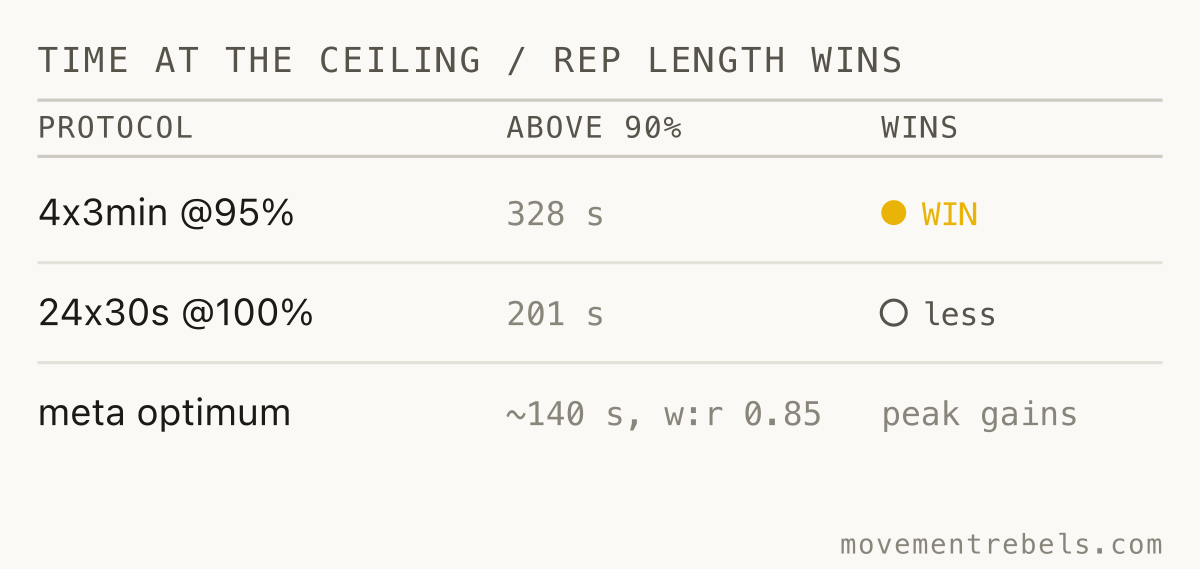
A 2025 study in Frontiers in Sports and Active Living confirmed the same mechanism from a different angle. Twelve trained middle-distance runners completed 4x3-minute reps at 95% vVO2max versus 24x30-second reps at 100% vVO2max, both with 1:1 work-rest ratios and equal total work duration of 12 minutes per protocol. The 3-minute reps produced roughly 328 seconds above 90% VO2max per session. The 30-second sprints produced roughly 201 seconds, despite higher absolute speed. The authors concluded that traditional long intervals remain superior for time at the target zone, even when the shorter intervals feel more intense.
The broader literature points to a dose-response curve that peaks around rep durations of 2-4 minutes with near-full recovery. That is directionally consistent across multiple reviews: moderate rep length, close to complete recovery, and repeated exposure to the ceiling zone are what drive adaptation.
The unified message: what matters is time near the ceiling, not time above a speed number. Going faster shortens the reps (or shortens what you can repeat) and paradoxically reduces the aerobic stimulus.
The work:rest question
The temptation is to cut rest so the session feels "hard enough." It usually makes it worse.
During the recovery between VO2max reps, the goal is to restore aerobic capacity close to baseline so the next rep can reach the same ceiling. Too short, and rep 3 becomes a lactate-poisoned shuffle that never gets near 90% VO2max. Too long, and you are doing isolated bursts instead of a connected aerobic session.
Active recovery at 60-70% HRmax (easy jogging or soft pedaling) beats passive rest. It clears lactate faster without draining the aerobic system. Three minutes active recovery between 4-minute reps is the most consistently replicated protocol. Some well-trained athletes can use a 1:1 ratio (4 minutes work, 4 minutes recovery) with equivalent or better results. Athletes earlier in their development often need longer recovery, closer to 1:1.5 or even 1:2, before they can execute the reps cleanly.
The test: if your HR drops below roughly 70% HRmax before the next rep and you complete all reps without significant pace drop, recovery duration is calibrated. If you start rep 3 with a HR already at 80%+ and your pace falls off, extend rest next session.
Weekly frequency and the dose question
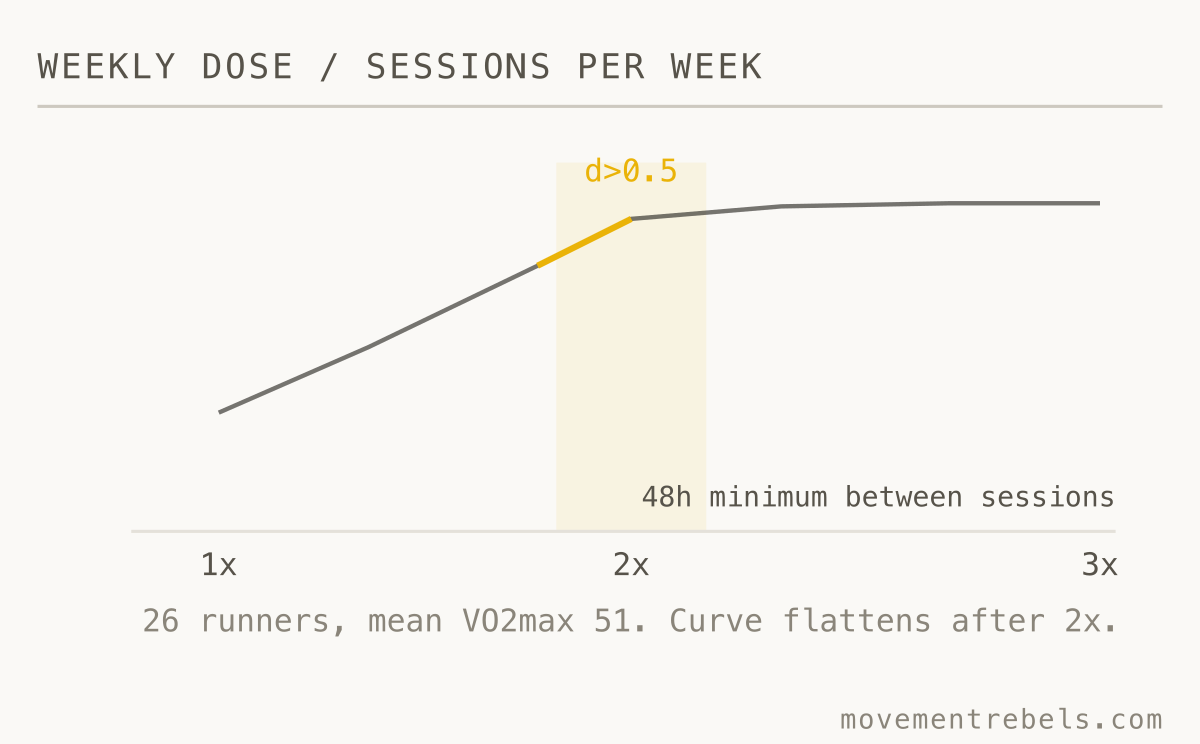
A 2025 exploratory study in Physiological Reports randomized 26 recreational runners (mean VO2max 51 mL/kg/min) into once-weekly, twice-weekly, and three-times-weekly 4x4 HIIT groups over a 6-week training period. All groups improved. The three-times-weekly group showed the clearest VO2max effect size (d above 0.5). The twice-weekly group showed meaningful gains for time to exhaustion. No clear additional benefit emerged from jumping from twice to three times weekly. The practical recommendation from the authors: 2 sessions per week as the efficient ceiling, with 3 as an option only when recovery is well managed.
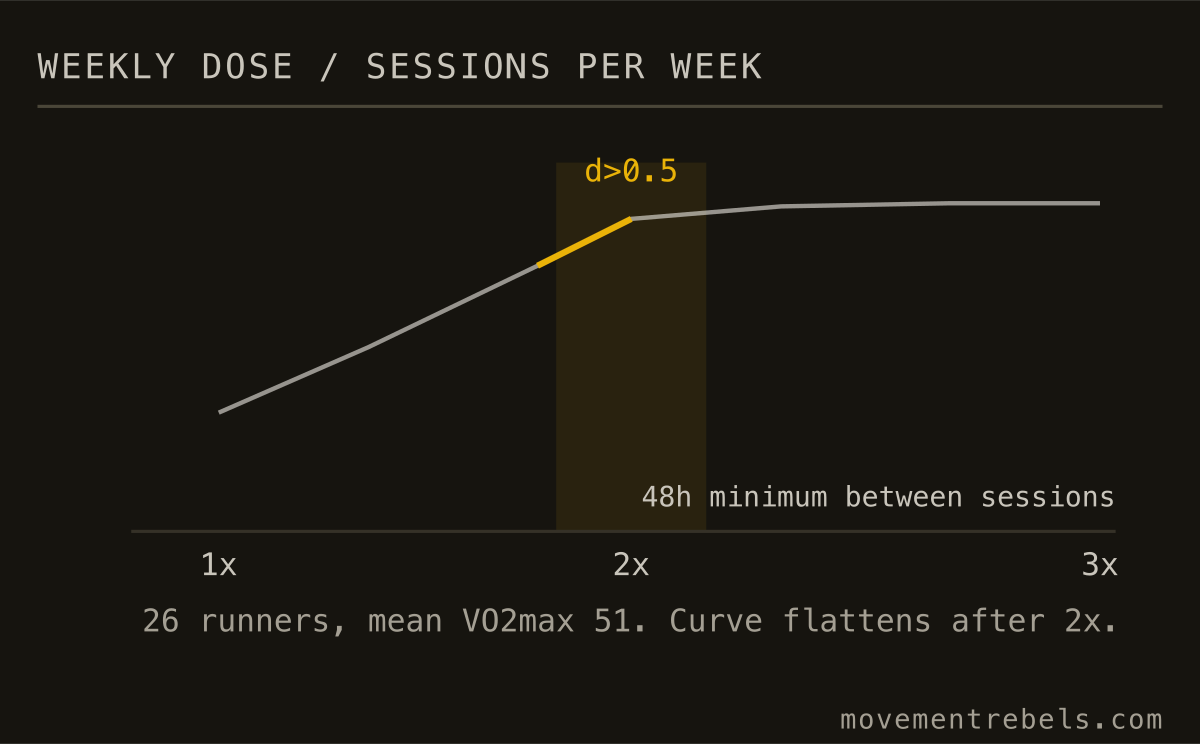
The caveat worth stating: these were recreational runners, not elite athletes doing 15-20 hours per week. The elite literature generally supports polarized distribution, where 80% of training stays easy and 20% goes hard. Two VO2max sessions per week on a 10-hour training week is a very different dose than two sessions on a 4-hour week. At lower weekly volumes, two hard sessions represent a larger proportion of total stress. Managing that balance is covered in periodization for recreational athletes.
A sensible baseline for most athletes: one VO2max session per week during base phases, two per week in a targeted VO2max block lasting 6-10 weeks, then back to one (or none) in the final weeks before a goal event. The ceiling you raise takes time to express in performance; peaking too close to competition on interval-heavy training leaves athletes fatigued at the line.
Why most people go too hard
The cultural model for hard training is suffering. If it does not feel like you are dying, it was not hard enough. VO2max intervals violate that model: they should feel very hard, but controllable. The last minute of each rep should require real mental focus, but pace should not collapse.
Sprint intervals feel worse. Going all-out for 30 seconds, gasping, is a viscerally satisfying session. It is also, by the evidence above, a weaker VO2max stimulus. The anaerobic contribution rises sharply above vVO2max, which means you are tapping the glycolytic engine rather than the aerobic ceiling. More suffering, less ceiling-raising.
The check: can you complete rep 4 at the same pace as rep 1? If rep 4 is 10-15% slower, you went out too hard. The session still had value, but it was not a VO2max session. It was an over-reach that will delay recovery and eat into the rest of the week's training.

Why most people also go too short
The flip side is the athlete who tacks 6x1-minute reps onto a run and calls it interval training. One minute at high intensity leaves you below 90% VO2max for most of the rep, because it takes 2-3 minutes of hard effort for oxygen uptake to fully climb to match the demand. The Frontiers data showed it clearly: the same work:rest ratio, equal total work duration, but 30-second reps produced roughly 40% less time above the aerobic ceiling than 3-minute reps. The first minute is warm-up for the actual stimulus.
This is the physiological explanation for why the canonical protocol specifies 4 minutes, not 2. The last 90-120 seconds of each rep, when VO2 has plateaued at or near max, is where the adaptation lives.
Common errors in session design
Starting reps too fast. Aim to reach 90% HRmax around the 90-second mark, not the 10-second mark. Sprinting the opening 30 seconds exhausts capacity before the aerobic system has fully ramped up.
Confusing HR ceiling with speed. 90-95% HRmax on a hot day, at altitude, or at the end of a heavy week will be a slower pace than normal. The percentage target, not the pace, is the prescription.
Under-recovering between sessions. VO2max intervals impose significant neuromuscular and cardiovascular stress. Most athletes need at least 48 hours between sessions. Stacking one on top of a previous incomplete recovery produces accumulation, not adaptation. HRV-guided training is particularly useful here: a depressed HRV the morning after a VO2max session is a clear signal that the second planned hard session that week should shift or soften. Resting heart rate trends across a training block are the other useful long-term signal.
Doing them year-round. VO2max intervals are a specific development tool, not a base. Running two hard sessions per week for 52 weeks without periodization leads to stagnation and often injury. Build the aerobic base first, use intervals in blocks, then let the fitness express in competition before repeating the cycle.
Neglecting tempo work. VO2max intervals and tempo runs serve different systems. Tempo work builds lactate threshold, the pace you can sustain for 30-60 minutes. VO2max work raises the absolute ceiling. Both matter for racing. Running only intervals without tempo runs produces athletes who are aerobically capable but who cannot sustain a hard pace for long.
A session you can run next week
This is a direct implementation of the 4x4 protocol, adapted for a runner:
Warmup. 10-15 minutes easy running, then 4-5 strides of 20 seconds at roughly 5K pace. Heart rate should be at 65-70% HRmax by the time you start rep 1.
Main set. 4 reps of 4 minutes at a pace that puts you at 90-95% HRmax by the 90-second mark and keeps you there. Active recovery jog for 3 minutes between reps at roughly 60-65% HRmax. If you want a starting pace instead of guessing, a VDOT calculator for your interval and repetition paces gives you the rep target off a recent race result.
Cooldown. 10 minutes easy.
Total session time: roughly 55 minutes. Total time at ceiling: roughly 7-8 minutes if executed correctly. That is the entire productive stimulus.
For cyclists, the identical structure applies using power: 90-95% of peak aerobic power (roughly 105-115% of FTP for most athletes) for the reps, easy pedaling for recovery.
For time-crunched athletes, 3 reps instead of 4 is a legitimate option in a short week. 2 reps is barely worth the warmup cost for VO2max purposes: the fatigue is real, the stimulus is not enough.
How Movement Rebels handles this
The coach places VO2max sessions inside a periodized structure, not as a standalone habit. The plan distinguishes between base phases (mostly Zone 2, one hard session per week maximum), development phases (two VO2max sessions per week when the base is established and recovery is holding), and peak phases (intensity drops back, freshness takes over).
When a session is written, it pushes directly to your Garmin watch through the native integration: rep duration, target HR zone, recovery duration, rep count, all visible on the watch face. No pace translation needed. The watch alerts if you exceed the HR ceiling on rep 1 (which protects rep 4). After the session, the file comes back through Garmin or Apple Health on iOS, and the coach reads the execution: time in zone, HR profile across reps, pace consistency. A rep-by-rep analysis arrives in the coach chat thread, usually within a few minutes of the activity syncing.
If the data shows you went out too fast on rep 1 (HR spiked to 98% before the 90-second mark, pace dropped 8% by rep 4), the coach flags it and adjusts next week's rep duration or target pace band. If the data shows you are handling two sessions per week cleanly across three weeks, the rep count or total session count may step up. The adaptation is real-time, not a fixed 8-week template.
Recovery data shapes the schedule, too. Garmin HRV status and sleep stages sync natively. If your device writes HRV or sleep data to Apple Health, that reaches the coach through that path as well. Overtraining signs are something the coach watches for before scheduling back-to-back hard weeks, and the deload decision factors in how the VO2max block has landed across the previous 3-4 weeks.
Fueling matters for this type of session. VO2max reps are carbohydrate-dependent at high intensity. Doing them fasted or in a glycogen-depleted state produces lower output, shorter time at ceiling, and more perceived suffering per unit of adaptation. The practical fueling side of training around hard sessions is in fueling around long training sessions.
Pricing
Movement Rebels covers structured interval programming, adaptive periodization, wearable integration, fueling, and recovery in one place. A 7-day free trial opens the full surface. After the trial, Pro+ is $20/month for unlimited coaching. No card on the trial.
VO2 Max Calculator
Estimate your VO2 max from a 12-minute run test.
One app instead of five.
Strength, endurance, recovery, fueling, planning, and your AI coach. All under a 7-day free trial. No card.
Start 7-day trialZone 2 Training: When It Works, When It's a Waste
Zone 2 is real, old, and oversold. Here's the honest version: when low-intensity volume is your highest-leverage work, when it isn
Periodization for Recreational Athletes: Which Model, and How Much You Need
Linear, block, undulating: the honest evidence on which periodization model recreational athletes actually need, and what the rese
HRV-Guided Training: Read the Signal, Skip the Noise
One low HRV night tells you almost nothing. The 7-day-vs-28-day trend tells you nearly everything. Here is what the evidence actua
Tempo Runs: Threshold Done Right
Tempo run physiology, honest pacing ranges, three session variants, and why the popular HR zone is wider than coaches admit. Build