Protein for Endurance and Hybrid Athletes: How Much, When, and Why
Most endurance athletes eat too little protein. Not their fault. The number they were handed, 0.8 g/kg, is the RDA: set to prevent deficiency in someone who does not train, and it falls apart the moment you start running six hours a week or stack lifting on top of riding. This guide gives you a daily target you can defend, a way to split it across the day, and the timing that matters around hard sessions and sleep.
Why endurance athletes need more than the RDA
Protein is not a lifter-only concern. Run, ride or swim for any real volume and you damage muscle protein, and you oxidise a small but meaningful amount of amino acids for fuel, especially when glycogen runs low late in a long session. Repair runs on dietary protein. So does adaptation. Under-eat it and you recover slower, lose lean mass over a hard block, and blunt the training response you paid for in sweat.
Two things drive the higher requirement:
- Repair. Eccentric loading from downhill running, the pounding of long efforts, the muscle tension from strength work: all of it creates damage that protein rebuilds.
- Adaptation. Mitochondrial density, capillary growth and enzyme synthesis are protein-dependent, which means amino acids build the endurance adaptations you want, not the aerobic stimulus alone.
Hybrid athletes carry both demands at once, asking the same body to build aerobic machinery while it holds or grows strength, which is a higher total protein bill than either sport alone. In a deficit the bill goes up again.
A daily target you can defend
For trained athletes the broadly supported range is 1.6 to 2.2 grams of protein per kilogram of bodyweight per day, and where you land inside it depends on your situation and the training you do. Roughly double to nearly triple the RDA.
Use these anchors:
- 1.2 to 1.6 g/kg covers pure endurance athletes at moderate volume, and research on endurance-only training generally puts adequate protein in this band, with 1.6 g/kg at the top end for elite loads.
- 1.6 g/kg is the floor for hybrid or concurrent training, strength stacked onto endurance, and below it you leave adaptation on the table.
- 1.8 to 2.0 g/kg suits high-volume blocks and hybrid training, anyone carrying aerobic and strength demands at once.
- 2.0 to 2.2 g/kg is the zone for a calorie deficit, heavy training loads and masters athletes. More on those below.
Worked example. A 70 kg athlete at 1.8 g/kg needs 126 g of protein a day; the same athlete pushing 2.2 g/kg in a cut needs 154 g, and our protein intake calculator for the 1.6-2.2 g/kg range runs both ends off your bodyweight. That gap is one extra meal. It also decides whether you hold muscle or bleed it.
A few practical notes:
- Use lean bodyweight if you carry significant excess fat. Most lean athletes can use total bodyweight and keep it simple, but if your body fat is high, scale the target to a leaner estimate so you do not overshoot.
- Going above 2.2 g/kg rarely adds anything for weight-stable athletes. Healthy kidneys handle it fine, but at maintenance the return flattens, and in an aggressive deficit some evidence supports going modestly higher, around 2.3 to 2.4 g/kg, to protect lean mass. Spend any appetite left on carbohydrate to fuel the work.
- More carbohydrate does not replace protein, and protein does not replace carbohydrate. Bonking on long days is a fueling problem, covered in fueling around long sessions.
Spread it across the day, not into one big dinner
The daily total matters most. How you distribute it decides how much of that protein ends up rebuilding muscle, because synthesis responds to the dose in a meal and the body can only ramp it so high per sitting, so a single large hit at dinner wastes part of what you ate. To place that protein inside your full daily calories, fat and carbs, our macro calculator to fit protein into your day sets the surrounding targets.
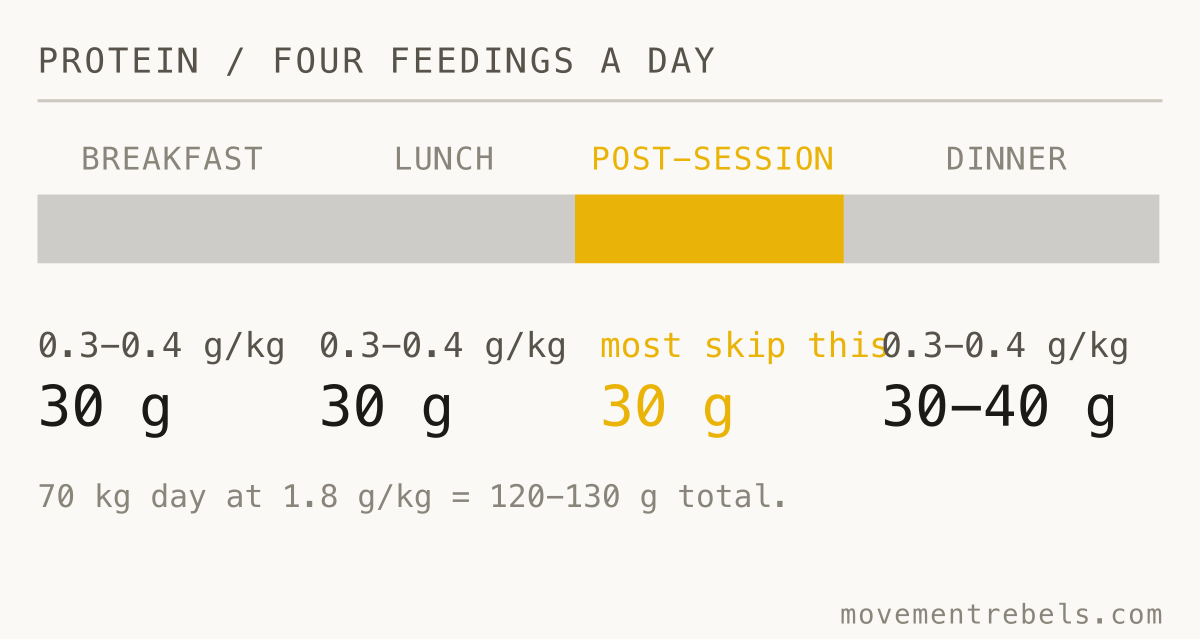
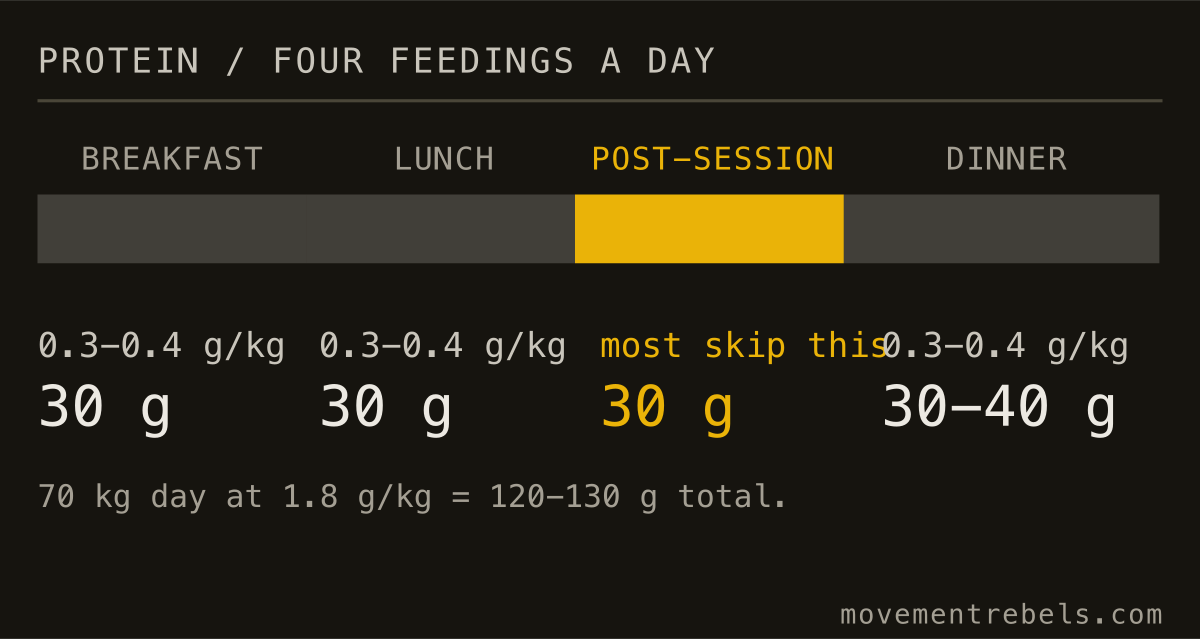
The target per meal is 0.3 to 0.4 g/kg, eaten across roughly four meals.
For the 70 kg athlete that is about 25 to 30 g of protein per meal, four times a day. Laid out:
- Breakfast: 30 g. Eggs, Greek yoghurt, or a shake if you train early and cannot stomach solid food.
- Lunch: 30 g. A palm-and-a-half of chicken, fish, or a legume-and-grain combo.
- Post-session or mid-afternoon: 30 g. The one most people skip or shortchange.
- Dinner: 30 to 40 g. Often the easiest to hit, so do not let it become the only one.
That is 120 to 130 g. Right on a 1.8 g/kg target, and four feedings of 0.3 to 0.4 g/kg each keep muscle protein synthesis high through the day rather than spiking once and flatlining for twenty hours, and if you train twice a day or carry a high training load, a fifth feeding helps.
Timing around sessions and before sleep
The "anabolic window" was oversold for years. Slam a shake inside thirty minutes or lose your gains, the story went, and it was never true: the window is wider than that, measured in hours, not minutes. What still matters:
- Post-session protein. 25 to 40 g of protein within a couple of hours of a hard or long effort, and if you trained fasted, or it has been more than three hours since you last ate, move faster and eat sooner. That depleted, damaged muscle is primed to use it.
- Pair it with carbohydrate after long or glycogen-depleting work. Protein rebuilds, carbohydrate refills. Off a three-hour ride you want both, not protein alone.
- Pre-sleep protein. 30 to 40 g of slower-digesting protein before bed, casein from cottage cheese or Greek yoghurt, or a protein-rich evening meal, supports overnight repair across the long fast of sleep, and it is one of the more reliable timing levers in a hard block.
Sleep is where most of the adaptation gets cemented. Feed protein into that window, protect the sleep itself, and both pay off; the recovery side is covered in sleep and training.

Quality and sources
Not all protein hits muscle protein synthesis the same way. Leucine is the driver, an essential amino acid that flips the synthesis switch. Animal proteins are leucine-dense and complete. Plant proteins generally sit lower in leucine and often come up short on one or two essential amino acids, so a plant-based athlete needs a bit more total protein and more deliberate combining across the day.
Practical sources, ranked by ease of hitting a 30 g dose:
- Animal: chicken, lean beef, fish, eggs, Greek yoghurt, cottage cheese, milk, where a 30 g dose is roughly 120 to 130 g of cooked chicken, or four eggs, or 250 g of Greek yoghurt.
- Plant: tofu, tempeh, lentils, beans, edamame, seitan. You will eat more volume per gram of protein, so plan portions accordingly.
- Supplements: whey or a plant blend, useful for the post-session dose or to top up a meal that fell short. Convenient protein, nothing more.
Eating plant-based, push your daily target toward the upper end of the range, closer to 2.0 g/kg, and put leucine-dense soy across your meals: edamame, tofu, tempeh. Lentils and beans carry useful volume but sit lower in leucine per serving, so pair them with a soy or grain-based source to reach a meaningful dose per meal. Whole food wins on satiety and micronutrients. Powder wins on convenience around training.
Protein in a deficit for body recomposition
In a calorie deficit protein stops being about adaptation alone and starts being about protection, because a body short on calories pulls from lean mass unless you give it a reason not to. Two things give it that reason. Enough protein, and a strength stimulus.
In a deficit:
- Push protein to 2.0 to 2.2 g/kg, and on aggressive cuts some evidence supports going a little higher still, around 2.3 to 2.4 g/kg. Higher than maintenance, on purpose. The deficit raises the requirement.
- Keep strength work in the program. Protein signals repair. Lifting tells the body which tissue to keep, and if you drop the lifting you lose muscle even with high protein.
- Stay patient with the rate. Aggressive deficits cost lean mass no matter how much protein you eat, and a slower cut holds more muscle.
That is body recomposition: fat off, muscle held or built, protein and training doing the protecting, and two guides go deeper on the full macro picture and the process, macros for body recomposition and body recomposition.
Masters athletes need more, not less
Past about 40 the body responds less to a given dose of protein. Anabolic resistance. The same 20 g that maxed out synthesis in a 25-year-old no longer does the job, and the muscle needs a bigger nudge before it answers.
The fix:
- Run the upper end of the range, 1.8 to 2.2 g/kg, even at maintenance.
- Raise the per-meal dose to 0.4 g/kg. For a 70 kg masters athlete that is about 35 g per meal, not 25, and the higher per-meal threshold matters more with age than the daily total.
- Protect the post-session and pre-sleep doses especially, the two feedings where the bigger stimulus does the most.
Strength training is non-negotiable here. It restores some of the lost sensitivity and fights age-related muscle loss directly, and the full picture of training as a masters athlete, recovery and load included, sits in masters athlete training.
Common mistakes
- Backloading the whole day's protein into dinner. You will hit your total and still waste half of it. Spread it.
- Treating a shake as the only post-session strategy. Fine in a pinch. Real meals do more, especially with carbohydrate after long efforts.
- Eating maintenance-level protein while cutting. A deficit is when you need more, not the same.
- Ignoring the per-meal floor as a masters athlete. A 25 g lunch no longer cuts it past 40. Make it 35.
- Counting protein and forgetting carbohydrate. Protein cannot fuel a long session. If you are crashing late, fix fueling first.
How Movement Rebels fits
Movement Rebels builds your training week from your real data. The AI coach reads your Garmin and Apple Health, sees which sessions you completed and how you recovered from them, and shapes the plan around that instead of a generic template. It moves week to week as your load and recovery move, so a heavy block gets handled differently from a deload, and nutrition guidance, protein targets included, sits inside the same picture the coach already holds of your training.
Pick your daily number from the range above, split it into four feedings, protect the post-session and pre-sleep doses, and push the total higher in a deficit or past 40. That is the system. The rest is hitting it on the days you would rather not cook.
One app instead of five.
Strength, endurance, recovery, fueling, planning, and your AI coach. All under a 7-day free trial. No card.
Start 7-day trialWhy Women and Men Fuel Differently: Macro Targets, Timing, and Iron
How women and men differ in fueling: carbohydrate and protein targets, menstrual cycle effects, iron needs, and the energy availab
GLP-1 and Training: Preserving Muscle Through Intensity, Volume, and Protein Timing
Preserve muscle on GLP-1 by adjusting training intensity and volume. A coach's guide to resistance protocols, cardio zones, and pr
Macros for Body Recomposition: The Numbers That Work
Simultaneous fat loss and muscle gain is real but slow. Here's the honest protein math, the deficit window, how training status ch
Body Recomposition Tracking: Why The Scale Lies
The scale is the worst tool for tracking recomposition. Here's the honest five-signal stack that actually shows progress, what the