Sleep and Training Performance: The Lever Nobody Respects
The recovery industry is worth billions because sleep is free and boring. Cold plunges, percussive guns, pneumatic boots, red light panels, magnesium cocktails: all of them exist partly because they feel like doing something. Sleep feels like doing nothing. That is the lie that costs athletes the most.
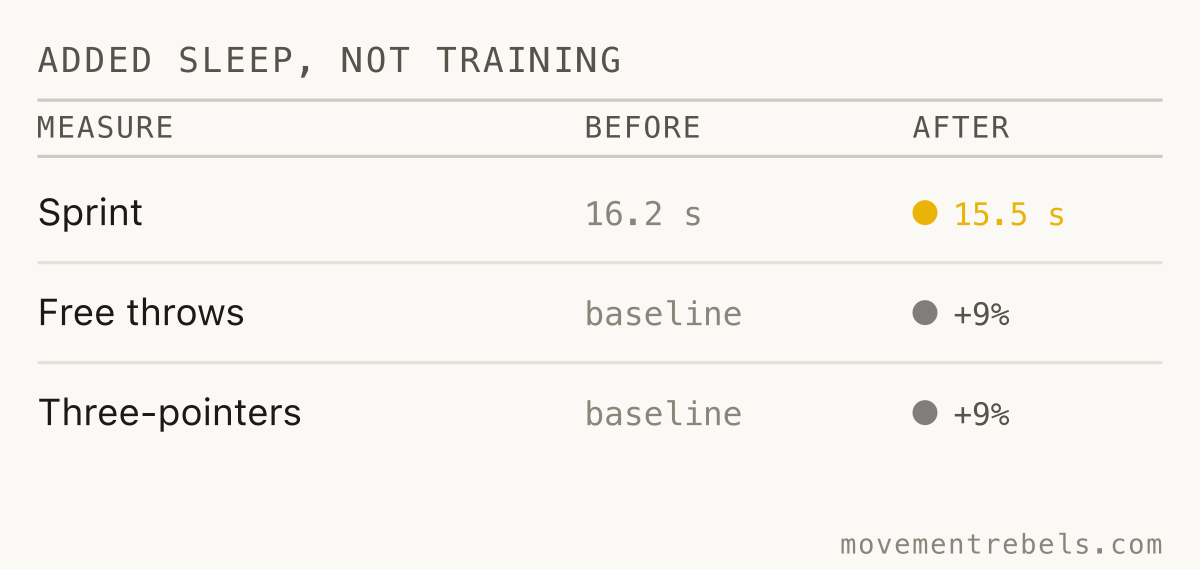
The evidence is blunt. Research consistently finds that sleep deprivation impairs skill control more than any other performance domain, followed by aerobic endurance, speed, and explosive power. Perceived exertion also spikes on bad-sleep days: the same workload feels harder, athletes pace down, and quality degrades across the session. Nothing in your recovery stack comes close to reversing those losses. More importantly, sleep extension actually produces gains. The Stanford basketball study remains one of the cleanest demonstrations: after five to seven weeks of extended sleep, sprint times dropped meaningfully and shooting accuracy improved, with free throw percentage rising by 9% and three-point percentage by 9.2%. Athletes added no training. They added sleep.
Most guides stop there and tell you to sleep more. This one goes further, because the honest picture is more complicated and more useful.
What sleep actually does for adaptation
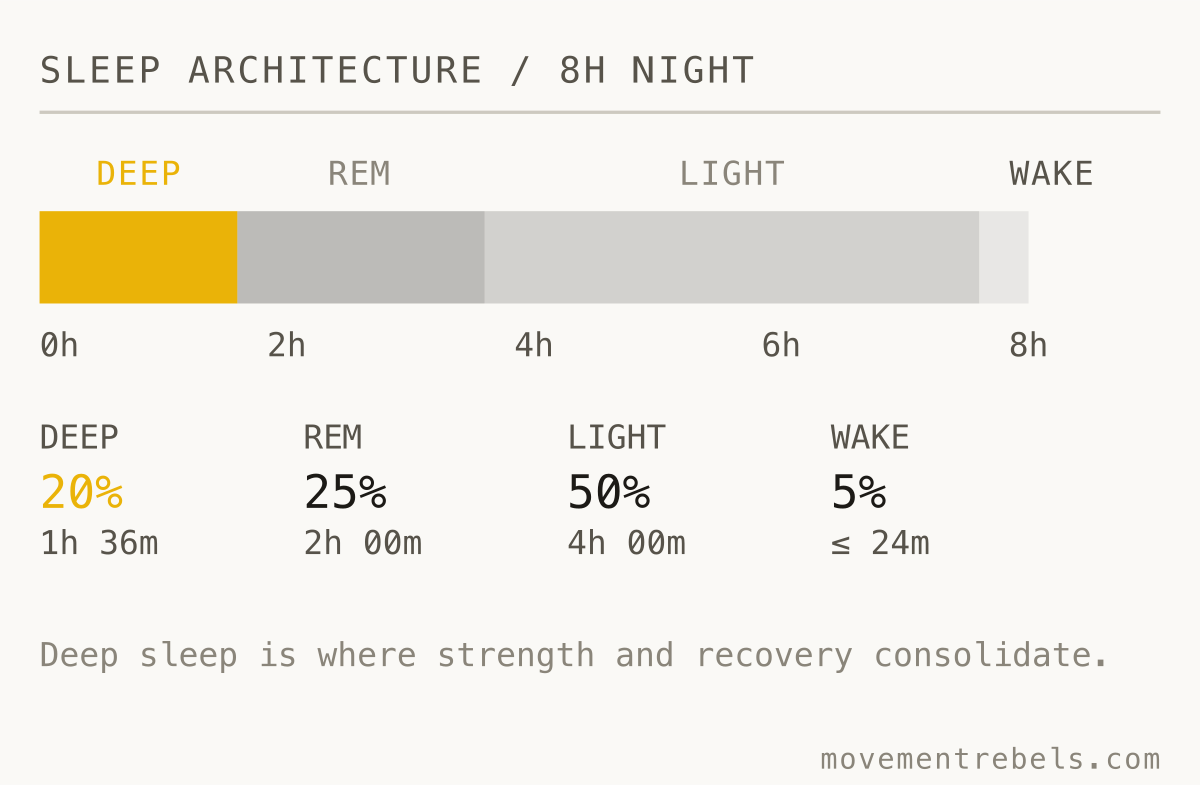
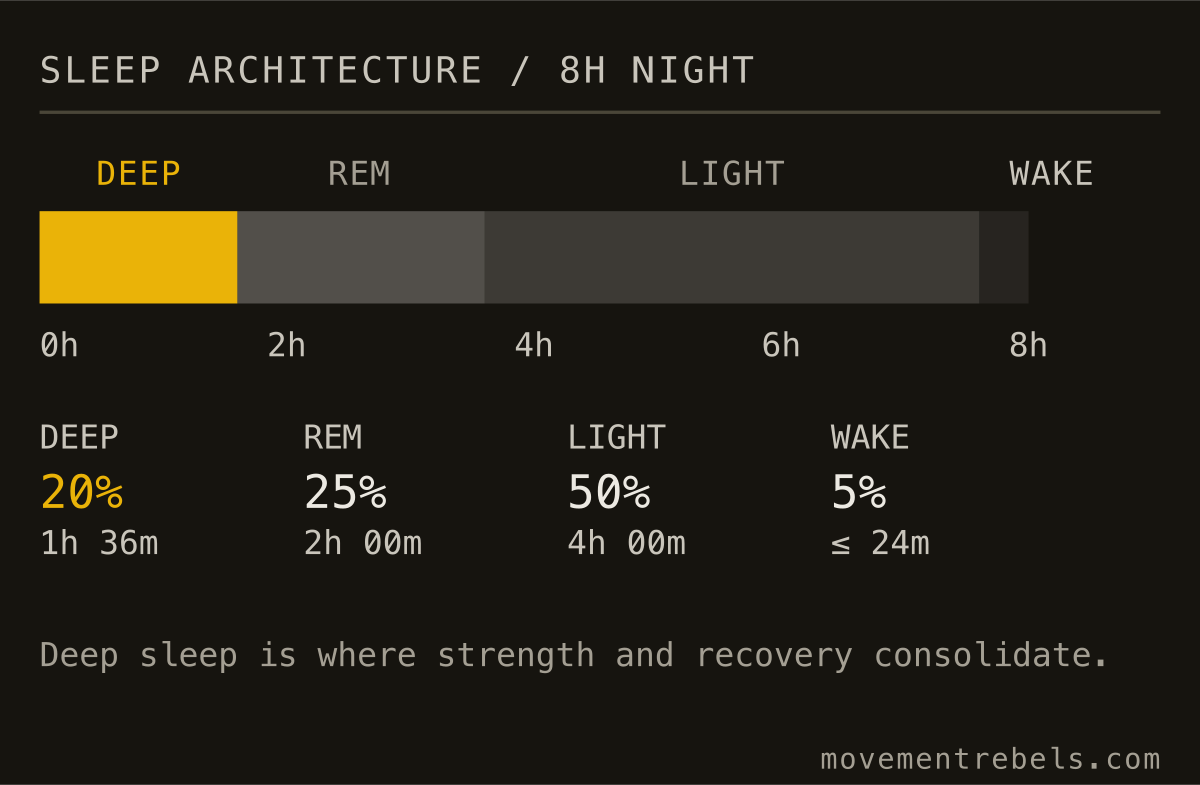
The workout is a stimulus. Sleep is where you collect the adaptation it triggered. Growth hormone pulses peak during the first slow-wave cycles, which is why consistently short sleep (below 6 hours) blunts hypertrophy and strength gains. REM sleep consolidates motor patterns, which is why skill-heavy sports suffer most: Olympic lifting, gymnastics, martial arts, technical running form. Research on sleep and athletic performance shows that performance timing is significantly modulated by chronotype. Evening-type athletes tend to peak in the evening; morning-type athletes tend to peak earlier. The "peaks in late afternoon" generalization does not apply universally, and scheduling competition preparation around individual chronotype matters more than a single rule.
Autonomic recovery runs in the same window. HRV rises during sleep as parasympathetic tone rebuilds. Resting heart rate drifts down. Inflammatory markers clear. The relationship between poor sleep, elevated cortisol, and suppressed HRV in athletes is well established: the markers are measurable the next morning on any wrist device. This is why HRV trends and resting heart rate patterns are among the most useful morning signals an athlete can track: they tell you what last night actually delivered.
The honest complication: quality beats duration for most athletes
Here is the part the "sleep more" guides omit. Duration is easier to measure than quality, so it dominates the conversation. But fragmented sleep, even at seven or eight hours total, can leave HRV suppressed and cortisol elevated in ways that four hours of clean uninterrupted sleep does not. For athletes managing busy lives, improving the quality of the hours they have is often a higher-return intervention than chasing more hours.
The distinction matters practically. A parent who cannot move bedtime earlier can meaningfully improve sleep architecture by cutting alcohol, finishing dinner earlier, and cooling the bedroom. A founder working late cannot manufacture more hours but can stop the 11pm caffeine and drop REM-suppressing alcohol. Quality work almost always yields faster results than duration work when schedule constraints are real.
What actually trashes sleep
Short list. Mostly boring. Almost universally ignored until the training metrics crater.
Alcohol. This is the most underestimated one. The research on alcohol and sleep is consistent at moderate-to-high doses: REM is suppressed during the first half of the night, followed by fragmented rebound in the second half. At lower doses the REM effect is less consistent, but the rebound fragmentation still degrades sleep architecture in many people. The net effect is that a glass of wine with dinner is not a free pass. You fall asleep faster and feel sedated early, but sleep quality erodes exactly when motor learning consolidation is most active. During a peak or race week, it is a hard no. See how alcohol affects your recovery data for the wearable picture.
Late hard training. A 9pm threshold session leaves you sympathetically activated at midnight. Resting heart rate is typically 8-12 bpm above baseline during the first few sleep cycles. The session was not free. You paid for it overnight.
Late caffeine. Caffeine half-life is 5-6 hours. A 3pm espresso still has roughly 35-50% of its caffeine active at 9pm, one half-life later. Getting down to 25% remaining takes closer to two full half-lives, around 1am. An afternoon pre-workout is often still partly active at midnight.
Big late meals. Digestion competes with parasympathetic recovery. A 600-calorie meal two hours before sleep measurably suppresses slow-wave depth in sensitive individuals. The 12-13 hour overnight fast that the in-app fasting timer enforces is partly about metabolic health, but it also tends to deepen sleep architecture when it shifts dinner earlier.
Inconsistent timing. This is the one most athletes underweight. Circadian biology rewards regularity more than raw duration. Sleeping 6.5 hours at the same time every night beats 8 hours with 90-minute weekend drift. The circadian phase mismatch from Friday-late-Saturday-in is real and it shows up in Monday's resting heart rate.
Sleep and overtraining: the signal you are already measuring
Overtraining and under-recovery rarely announce themselves loudly. They bleed in slowly through worsening sleep. An athlete pushing too hard for too long typically sees a cluster: HRV trending down over two weeks, resting heart rate elevated by 4-6 bpm above rolling baseline, sleep score declining even when hours are adequate. The sleep signal often appears before performance drops, which makes it the earliest useful flag in a monitoring stack. If your device shows the cluster, a deload is worth considering before the performance conversation happens. Sleep is rarely the only thing loading the system, so it helps to see how sleep debt stacks with training and life stress when you read the cluster.
What wearables actually measure
Every modern device reports a sleep score. They do not measure the same things, and the honest assessment matters.
Garmin uses heart rate, HRV, motion, and respiration to estimate sleep stages and outputs a Sleep Score (0-100). Solid for duration and disturbance detection. Sleep stage accuracy is consumer-grade, not polysomnography-grade, and Garmin itself says so in the documentation.
Apple Watch via Apple Health gives you duration, estimated stages, and respiratory rate through the native iOS sensor stack. The signal is clean enough for trend tracking. More useful across weeks than on any single night.
Oura uses finger-based PPG, which produces a cleaner heart rate signal than wrist optical sensors and generally yields better sleep stage estimation. Its Readiness score weights sleep heavily. If Oura exports its sleep, HRV, and resting heart rate to Apple Health, Movement Rebels reads those values through Apple Health on the iOS app. There is no direct Oura API integration in MR today.
WHOOP focuses on recovery and sleep debt quantification. It does not export its recovery or strain scores to Apple Health, so those specific metrics do not flow into MR. WHOOP sleep duration and session data may export to Apple Health depending on your settings.
The honest framing: your device measures sleep well enough to track trends, not diagnose disorders. A single bad score is noise. A week of declining scores is signal worth acting on.
How Movement Rebels handles your sleep data
Reading a number off a watch is not coaching. Adjusting the day around it is.
Garmin sleep data flows in through the native OAuth integration. Apple Health sleep, HRV, and resting heart rate flow in through the native HealthKit layer on the iOS app. Both update the morning brief automatically.
When the sleep score drops, the coach does not just flag it. It reads context: sleep score, HRV trend across the last 7 days, resting heart rate drift, what is scheduled today, whether you logged a late hard session yesterday that likely caused the bad night, and what your nutrition looked like. A planned threshold run on a 52 sleep score becomes a zone 2 session or moves to tomorrow. A heavy squat day becomes a technique or mobility session. The coach will suggest a 10-20 minute NSDR (yoga nidra-style deep rest) via the in-app breathwork timer as a partial afternoon recovery protocol: the evidence base for NSDR is moderate but real for reducing arousal and partially offsetting sleep deficit subjectively.
Three consecutive bad-sleep nights will surface a pattern flag rather than just a session adjustment. The coach will ask whether something structural is off: training timing, alcohol, late caffeine, work stress, under-fueling. Chronic mild sleep loss is where overtraining actually starts for most athletes, not from a single brutal week.
For athletes connected through Garmin, the adjusted session pushes to the watch the same way a normal session does. You do not have to manually edit anything. The plan adjusts overnight, the watch reflects it in the morning.
How to actually improve sleep quality
Two things move the needle faster than anything else: timing consistency and protecting the first 90 minutes of sleep.
Pick a bedtime within a 30-minute window, seven days a week including weekends. The circadian system rewards that regularity more than occasional long sleep. Treat the 60 minutes before sleep as work: dim lights, no screens, no difficult conversations, nothing cognitively activating. The hour before sleep shapes the first deep-sleep cycle more than the hour you fall asleep does.
Environmental basics that are well-established: cool room (16-18C), dark, quiet. These are not wellness influencer tips. They are thermal and photonic conditions that the circadian system uses to calibrate sleep depth.
If you cannot sleep more, improve the architecture:
- No alcohol within 3 hours of sleep (ideally more)
- No caffeine within 8 hours
- Finish the last substantial meal 2-3 hours before sleep
- The in-app breathwork timer has a wind-down protocol (extended exhale, roughly 6 breaths per minute) that drops sympathetic tone within 10 minutes
- The fasting timer enforces eating cutoffs, which indirectly protects sleep architecture
If you have nailed all of the above and still struggle with sleep quality, it is worth looking at training load distribution across the week. Many athletes who report poor sleep are training too hard too often, with no true recovery days. A periodization review often reveals the structural fix faster than any supplement or habit stack.
How Movement Rebels handles this
Garmin sleep data, Apple Health sleep and HRV, the morning brief that adjusts the plan, NSDR and breathwork timers, a fasting tool that enforces eating cutoffs, nutrition logging that flags the under-fueling that often shows up as fragmented sleep, and biohack history that shows what has actually worked for you over weeks. One app.
The coach does not treat sleep as a passive input. It treats it as the primary recovery variable and adjusts everything else around it.
Pricing
Movement Rebels is one app for strength, endurance, hybrid training, recovery, nutrition, and coaching. A 7-day free trial covers the entire surface. After the trial, Pro+ is $20/month for unlimited coaching. No card on the trial.
One app instead of five.
Strength, endurance, recovery, fueling, planning, and your AI coach. All under a 7-day free trial. No card.
Start 7-day trialNSDR (Yoga Nidra) for Athletes: A Complete Recovery Tool
How athletes use NSDR to recover faster, sleep better, and reduce stress between sessions: what the evidence supports, when to use
HRV-Guided Training: Read the Signal, Skip the Noise
One low HRV night tells you almost nothing. The 7-day-vs-28-day trend tells you nearly everything. Here is what the evidence actua
When to Deload: Reading the Signals Right
The 4-week deload rule is a template, not a law. Here are the actual physiological signals that tell you when your body is asking
Overtraining Signs: The Ones Worth Watching
True overtraining syndrome is rarer than you think, has no reliable biomarker, and is almost never what recreational athletes have