Masters Athlete Training After 40: What Holds You Back
Here is the part most guides skip: research on aging masters endurance athletes consistently finds that a large share of VO2max decline is explained by changes in training volume, not by the birthday. Athletes who maintained their volume showed a loss of only around 5-6% per decade. Those who cut volume substantially lost several times that. The gap is not aging. It is lifestyle drift wearing aging's clothes. You can estimate your VO2 max from a field test to see where you sit on that curve right now.
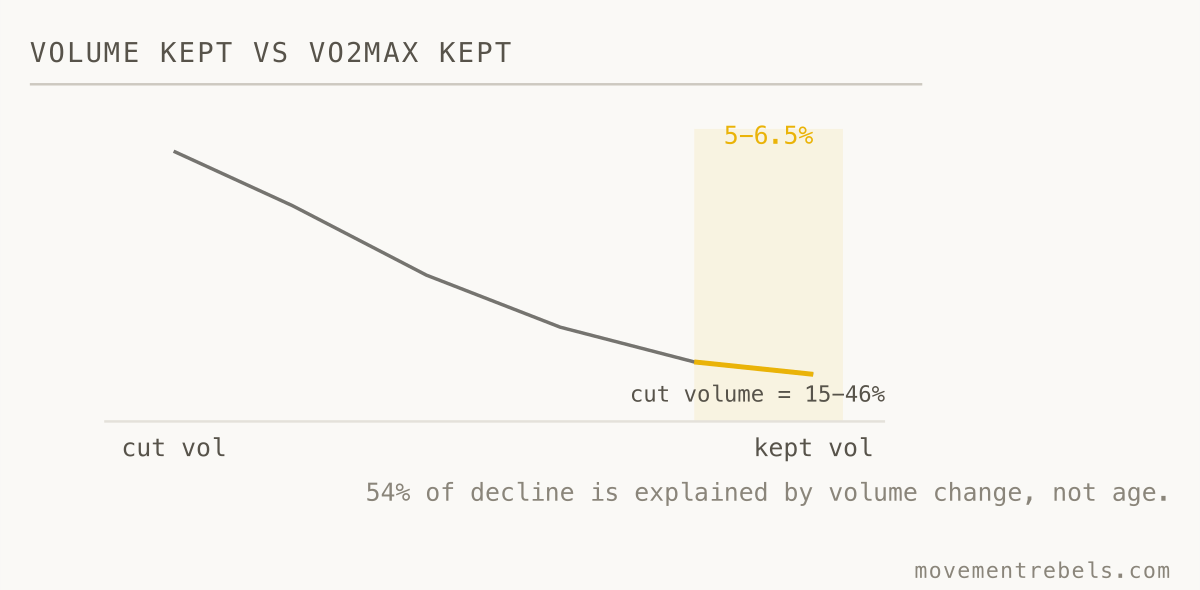
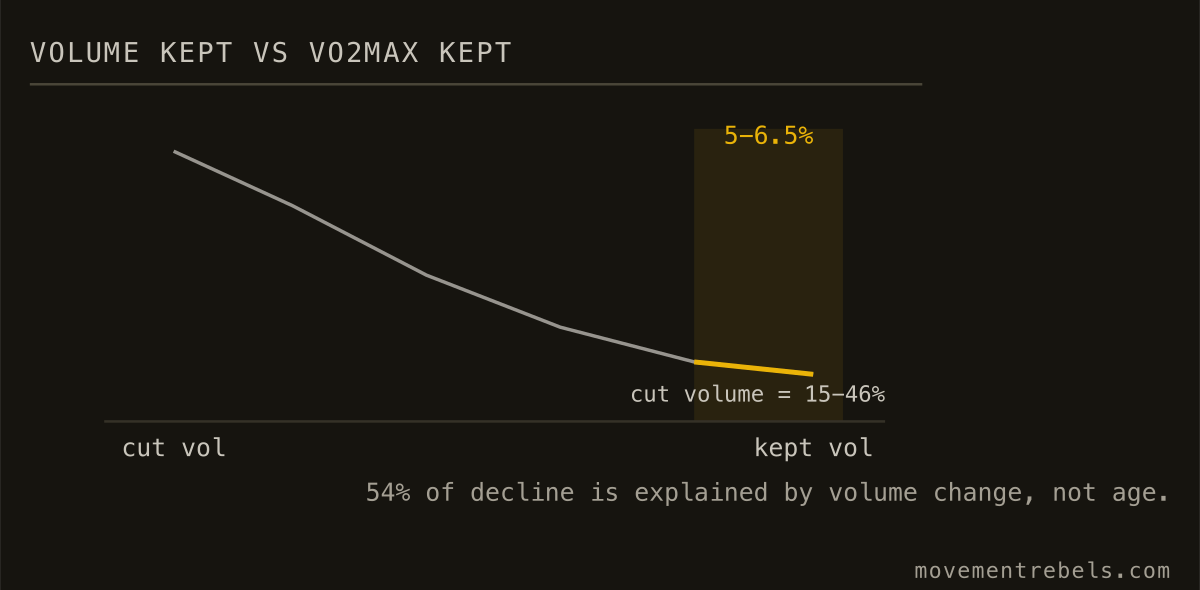
This matters because it reframes the whole conversation. The question is not "what do I do differently because I'm older?" The question is "how do I protect the things that actually drive fitness, specifically training volume, recovery quality, and protein, while the rest of life gets louder?"
This guide covers what the physiology actually changes, what the popular advice gets wrong, and how to program the week in a way that holds the curve.
What Changes After 40 (and What Doesn't)
Three things shift in specific, measurable ways.
Recovery time between hard sessions stretches. A 30-year-old can run threshold intervals on Monday, squat heavy on Tuesday, and hold a tempo session Wednesday without structural damage. At 45, that same three days leaves you flat by Friday and chasing a tendon by Sunday. Per-session intensity tolerance stays high. Masters athletes can still hit VO2 max intervals, pull 90% singles, and run race pace. The limit is on frequency of hard sessions per week, not on the intensity of any individual session. Two true high-quality sessions per week is the working model. Three is the ceiling. Four is where things break.
HRV and resting heart rate become better signals than they used to be. The evidence broadly shows that masters athletes tend to have lower baseline parasympathetic activity at rest compared to younger athletes. What research also finds is that acute recovery dynamics after individual sessions can look similar between age groups; the difference shows up more in the resting baseline than in how quickly HRV bounces back from a single effort. The practical implication: a suppressed morning HRV that you might have shrugged off at 28 is a more reliable warning flag at 45. The trend across 7-10 days tells a clearer story than any single reading. See HRV-guided training for how to read the signal without chasing daily noise.
Protein needs are real, though the popular framing overstates them. The widespread claim is that older muscle suffers from severe "anabolic resistance" requiring dramatically more protein. The current evidence pushes back on that narrative: active masters athletes, as opposed to sedentary older adults, do not show the same blunted muscle protein synthesis response. The practical target is 1.6-1.8 g/kg/day, distributed across 4-5 feedings. Per-meal dose scales with body weight; most research points to around 0.3-0.4 g/kg per meal as the target, which works out to roughly 20-40 g depending on how much you weigh. A protein intake calculator for masters athletes converts that ratio into a daily gram total for your bodyweight. This is modestly above general guidelines, not a complete restructuring of your diet. What is non-negotiable is the distribution. One protein-heavy dinner and two light meals does not trigger the same synthesis response as four evenly spaced feedings.
What does not change: training principles. Progressive overload still works. Zone 2 still builds the aerobic engine. Heavy compound lifts still produce strength and preserve bone density. The physiology of adaptation is not age-gated. The timeline is.
The Real Bottleneck: Volume and Recovery Architecture
Given that training volume decline explains most of the fitness loss, the programming priority is clear: protect volume by making recovery non-negotiable, not by reducing intensity.
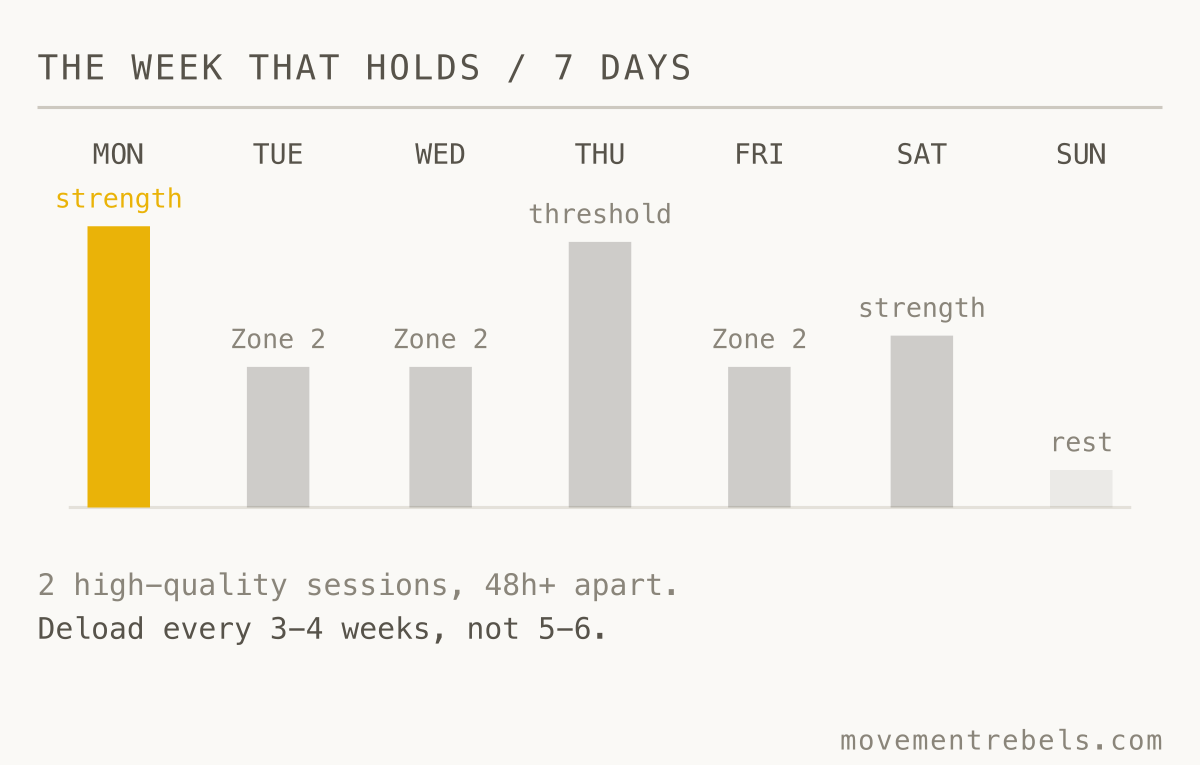
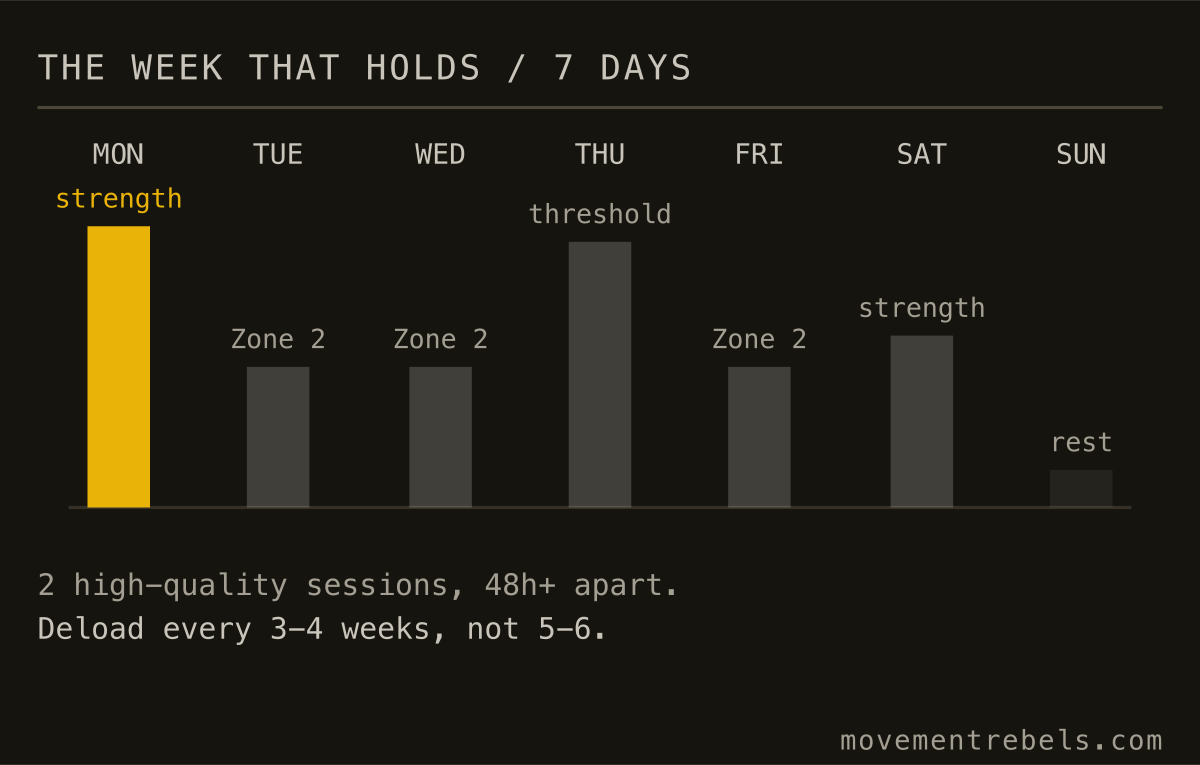
A week that holds the curve looks something like this:
- 2 high-quality sessions (one strength-focused, one threshold or VO2 interval session, separated by at least 48 hours)
- 2-3 Zone 2 sessions (truly easy aerobic, conversational pace, nose-breathing throughout)
- 1 full-body strength session at moderate intensity, focused on posterior chain and movement quality
- 1 true rest or active recovery day (walk, mobility, breathwork)
- Deload week every 3-4 weeks, not every 5-6
The deload cadence is where most masters athletes leave adaptation on the table. Younger athletes can push a 5-6 week block before deloading. At 45, the consolidation phase needs to come sooner. The deload is not lost training. It is when the adaptation from the previous block actually lands. See when to deload for a signal-based approach that uses resting heart rate trend and subjective fatigue rather than a fixed calendar date.
The Zone 2 base is the other underused lever. Most masters athletes drift into "gray zone" training: too hard to be aerobic base work, too easy to drive high-quality adaptation. If you have never run a watch with explicit heart rate zones, mapping your five heart rate training zones gives you the bpm ceilings that keep easy days honest, and the Zone 2 training guide covers when this work is your highest-leverage session and when it is not, depending on your weekly volume.
Strength Work: The Non-Negotiable
The single highest-leverage thing a masters endurance athlete can do is keep lifting. Not light weights for high reps. Actual resistance training with compound movements and progressive load.
The evidence on resistance training and aging consistently finds that two or more sessions per week with meaningful load preserves the adaptations that protect endurance performance: bone density, tendon resilience, late-race form, and the fast-twitch fiber recruitment that keeps power available when you need it. Two strength sessions per week is the minimum effective dose.
The "just do light weights because I'm older" instinct is the wrong adaptation. Heavy enough still matters. Sets in the 4-6 rep range, banked alongside hypertrophy work in the 8-12 range, send the nervous system the signal to keep recruiting. Dropping to high-rep isolation work full-time accelerates strength loss, not slows it.
For masters athletes also doing substantial endurance volume, the hybrid athlete training guide covers how to sequence strength and aerobic sessions across the week without one suppressing adaptation in the other.

Sleep: The Actual Performance Drug
Past 40, sleep debt shows up in measurable ways within 48 hours: suppressed HRV, elevated resting heart rate, reduced power output, increased perceived exertion at the same load. No supplement, breathwork session, or recovery modality offsets a 5-hour night. The sleep and training guide goes into the mechanisms, but the practical floor is 7-9 hours, consistently.
When sleep was short the night before a session, the honest adjustment is to shift the hard session to the next day and treat the current day as aerobic recovery. The data tells you. HRV trend is a reliable proxy for whether the nervous system is ready to produce quality work or whether you are grinding through a session that will accumulate fatigue without adaptation.
Fueling Around Hard Weeks
The protein targets above (1.6-1.8 g/kg/day, 0.3-0.4 g/kg per meal, 4-5 feedings) matter most during high-volume blocks and in the 24 hours after long or hard sessions. Protein timing around training has a real effect: post-exercise and pre-sleep feedings support muscle protein synthesis at the times the signal is strongest.
Carbohydrate is the other piece masters athletes chronically under-eat. Reduced glycogen from repeated under-fueling blunts the quality of every subsequent hard session. The fueling around long sessions guide covers the pre, during, and post-session strategies in detail.
How Movement Rebels Handles This
The coach reads your completed activity files through Garmin's native integration and through Apple Health on the iOS app, which captures HRV, resting heart rate, sleep duration, and workouts from any device that writes to Apple Health. When you log meals in Rebel Fuel, the coach sees your protein distribution across the day and flags patterns before they become deficits.
For a masters athlete, this concretely means: the weekly plan defaults to two hard sessions with aerobic volume filling the rest, schedules a deload every 3-4 weeks based on your actual training history rather than a fixed template, and watches the 7-10 day HRV trend for the multi-day suppression that means today's threshold session should become a Zone 2 run instead. If Rebel Fuel shows you have been short on protein three days running, the coach raises that before the next hard session.
When your Garmin pushes your structured workout to the watch, heart rate zones are set as alerts, not suggestions. Drift above the Zone 2 ceiling on an easy day and the watch buzzes. After the session, the coach reads the file back and grades it. Time-in-zone gets logged, and patterns across weeks inform how the following block is shaped.
The structured session logs go straight to your Strava activity description after each workout as a written summary, keeping your training record current without manual entry. The coach does not analyze Strava data as an AI input; Strava is the sync destination, not the data source.
You still get to lift heavy. You still get to PR at 50. The programming just respects the recovery cost and protects the volume that actually drives the result.
Pricing
One subscription, one app. Strength, endurance, hybrid, recovery, fueling, AI coach, and wearable integration in the same place. Seven days free, no card, full access.
After the trial, Pro+ is $20/month for unlimited coaching.
One app instead of five.
Strength, endurance, recovery, fueling, planning, and your AI coach. All under a 7-day free trial. No card.
Start 7-day trialTraining Consistency When Life Is Busy: How to Keep Moving Without a Perfect Schedule
How to stay consistent when work and family eat the week: your maintenance dose, protecting intensity over volume, and a triage or
Is Running Bad for Your Knees? What 50 Years of Research Shows
Recreational runners have less hip and knee arthritis than people who never run. Here is what 50 years of research found, and what
Return to Running After Injury: A Step-by-Step Plan That Does Not Rush the Tissue
How to return to running safely after injury without reinjury. Progressive phases, run-walk intervals, weekly mileage rules, and s
Training on GLP-1 Medication: Protect Muscle, Fuel Your Sessions
On semaglutide or tirzepatide? The honest athlete guide: the lean-mass risk in a steep deficit, why lifting and high protein are n