Body Recomposition Tracking: Why The Scale Lies
Body recomposition is the one goal in fitness where your most common tracking tool actively misleads you. The scale measures the sum of fat, muscle, water, bone, and whatever you had for dinner. When you are trying to lose fat and add muscle simultaneously, those variables can offset each other for weeks while your body quietly reshapes itself. You look different. You lift more. The number on the floor has not moved.
Most people quit right there.
This guide explains the honest science of why recomposition is harder than the internet suggests, who can actually expect it, and the five-signal tracking stack that catches progress when the scale refuses to.
What The Research Actually Says
Simultaneous fat loss and muscle gain is real. It is also narrower than fitness marketing implies.
A 2024 editorial in Frontiers in Nutrition surveying the current body of recomposition research confirmed that meaningful fat loss with concurrent muscle gain occurs across untrained, trained, and older populations. The research broadly points to high protein intake and consistent resistance training as the key facilitators. Recomposition can occur at maintenance calories or in a modest deficit. It is not a single locked protocol.
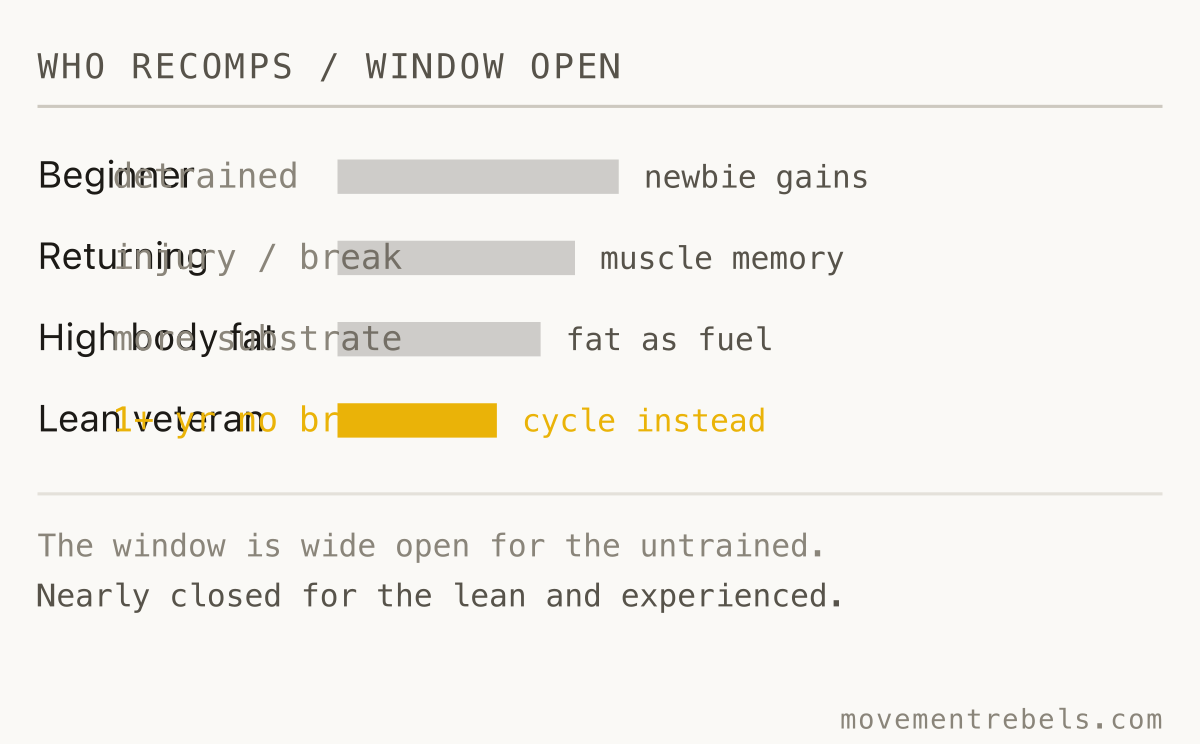
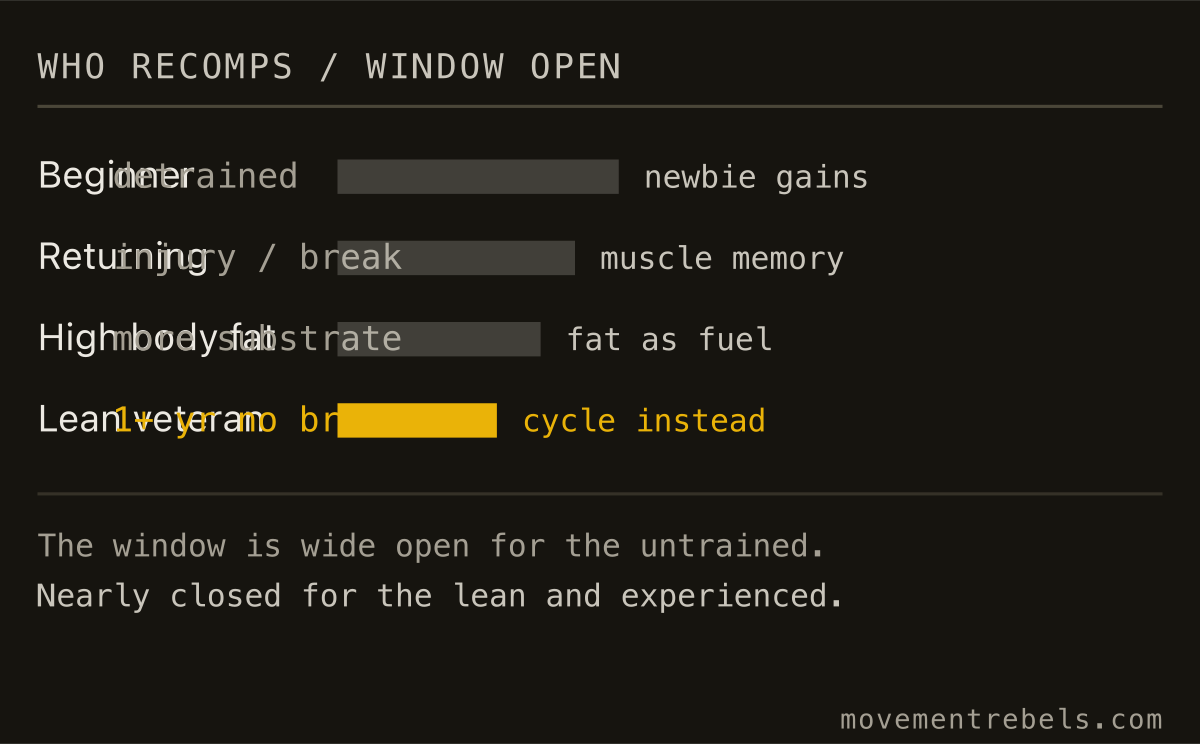
Recomposition is most reliable for beginners, athletes returning from a break, and people with higher starting body fat; for lean experienced lifters it is slow enough that deliberate bulk and cut phases usually serve better. The full breakdown of who can expect it, at what rate, and when to stop chasing it lives in Building Muscle While Losing Fat: Who Can Do It. This guide is about the other problem: how to see recomposition happening when it does.
Why The Scale Fails For Recomp
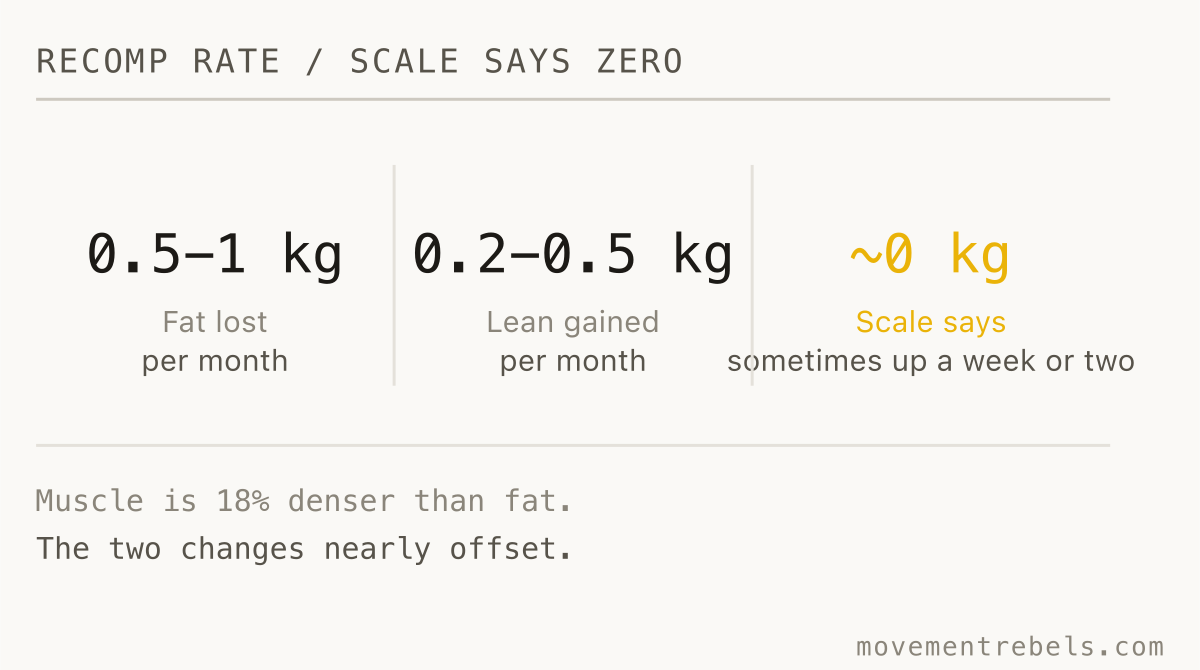
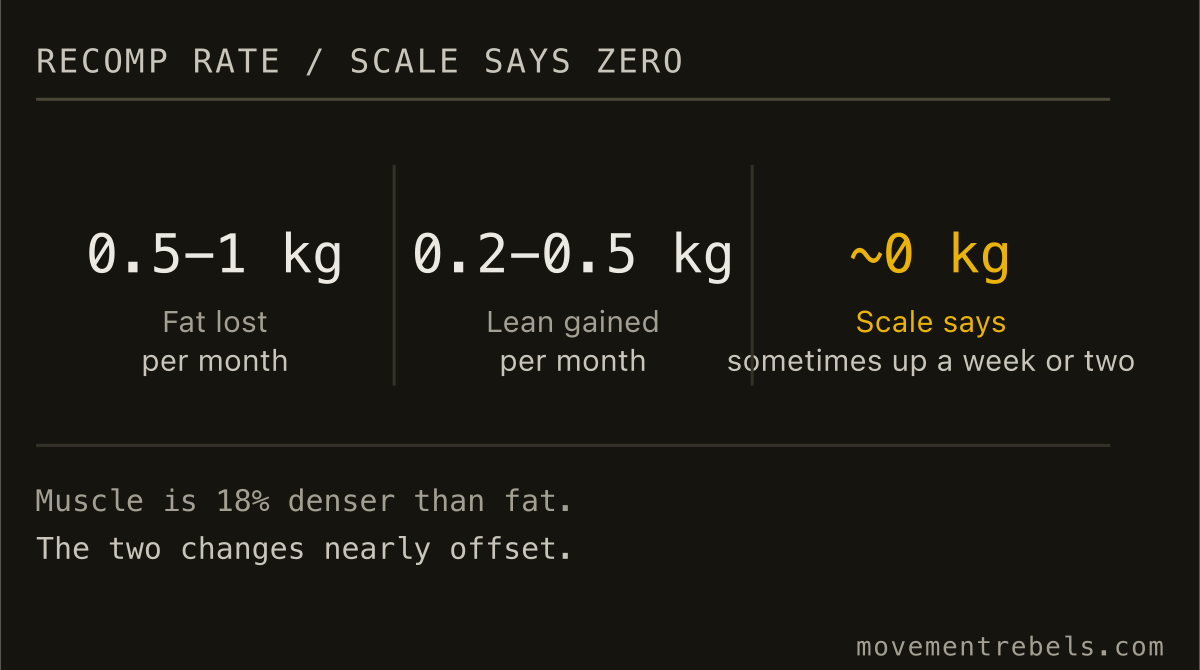
Muscle is roughly 18% denser than fat. One kilogram of muscle takes up significantly less space than one kilogram of fat. When you are gaining lean mass and losing fat at similar rates, the scale barely moves because the two are nearly offsetting.
On top of that, hard resistance training, especially legs, causes temporary fluid retention as your body repairs damaged tissue. You can train well, eat right, and wake up half a kilogram heavier for five days in a row, purely from inflammation and glycogen loading. If scale weight is your only signal, that five-day stretch looks like failure. It is the opposite.
A realistic recomposition rate for someone who qualifies for it: roughly 0.5 to 1 kg of fat per month lost, and 0.2 to 0.5 kg of lean mass per month gained. The net scale movement? Close to zero. Sometimes up for a week or two. You need a different instrument panel. A lean body mass calculator to track muscle, not scale weight gives you the number that should be climbing while total weight stalls.
The Five Signals That Actually Matter
No single signal here tells the full story. Together they triangulate it. All five feed into the Movement Rebels timeline so the coach can read the cross-pattern.
Body composition scan every 4 to 6 weeks. DEXA is the gold standard. If you want a fast estimate between scans, an FFMI calculator to see where you sit against the natural muscle ceiling gives you a sense of how much lean mass you are actually carrying, and a body fat calculator using the Navy tape method covers the fat side with nothing but a tape measure. A 2024 study in Frontiers in Nutrition on multi-frequency bioelectrical impedance found that InBody-class devices show excellent test-retest reliability (ICC above 0.99) but consistently underestimate body fat percentage by about 4% compared to DEXA. That does not make them useless. It means you pick one method, control the conditions (morning, fasted, post-bathroom, same hydration state), and track the trend, not the absolute number. The trend is what matters. Log it in MR so the coach has the history, not just today's reading.
Compound lift progression every training block. Squat, bench, deadlift, overhead press, weighted pull-up. Pick three. Adding weight to the bar or adding reps at the same load in a calorie deficit is evidence you are adding contractile tissue. It is the simplest muscle-gain signal available and requires no equipment beyond your training log. The strength logger in MR tracks these as named PRs and the coach references the trend when deciding whether to push or pull back volume.
Waist circumference, weekly. Research on anthropometric fat-loss tracking finds that waist-to-height ratio correlates strongly with fat mass, stronger than BMI among common at-home measurements. Measure at the midpoint between your lowest rib and the top of your hip bone, on a relaxed exhale, first thing in the morning. A 1.5 cm drop over a month with no scale change is a recomp win. Log it consistently and you will see the trend before the scale does.
Progress photos every two weeks. Same time of day, same lighting, same spot on the floor, same four poses: front relaxed, side relaxed, back relaxed, front flexed. Recomposition shows in photos six to eight weeks before it shows on the scale. Your brain adjusts to your reflection daily and misses the slow shift. Photos do not.
Protein adherence. This is the input, not the output, but it is the variable you actually control. The landmark meta-analysis on protein and muscle hypertrophy found the dose-response curve for lean mass gain plateaus around 1.62 g/kg of bodyweight per day. In a calorie deficit, many researchers argue for pushing toward 2.0 to 2.4 g/kg to offset the elevated muscle protein breakdown that comes with restricted energy. To set the deficit itself you need your maintenance number, and a TDEE calculator for your maintenance calories gives you that starting point, while a macro calculator for protein, fat and carb targets turns it into the daily numbers you actually eat to. If protein consistently falls short, recomp stalls regardless of training quality. The Snap Meal log and Rebel Fuel in MR track this daily. For a deeper look at how macros play out in a recomposition context, see Macros for Body Recomposition.
The Measurement Tool Industry Does Not Want You To Know
There is a profitable ecosystem around body composition tracking: DEXA clinics charging $50 to $150 per scan, InBody units sold to gyms that then charge per measurement, smart scales promising continuous tracking, body fat calipers, ultrasound probes.
None of these tools are wrong. But none of them are necessary weekly or even monthly for most people. Waist circumference, a training log, and weekly photos cost nothing and collectively tell you 80% of what a monthly DEXA tells you. The DEXA is useful for a baseline and a check every 8 to 12 weeks to confirm the direction. Spending money on weekly measurements creates precision theater: the noise in any single measurement (hydration state, time of day, whether you trained yesterday) dwarfs the signal of weekly fat change.
The contrarian point is this: the people who make progress in recomposition are usually not the ones with the most granular data. They are the ones who trained consistently, hit protein, slept adequately, and did not spiral when the scale stalled for two weeks.

Recovery Is Where Recomposition Breaks Down Silently
Recomposition is the body composition goal most sensitive to sleep and stress, because you are asking your body to do two opposing metabolic jobs simultaneously. Muscle protein synthesis requires recovery bandwidth. Chronic sleep debt, high cortisol, and low HRV suppress anabolic signaling and push the balance toward fat retention and muscle breakdown.
Apple Health data feeds into MR's readiness layer on iOS: HRV trends, sleep duration, and resting heart rate trends all inform what the coach prescribes. If HRV has been suppressed for three days and sleep is under six hours, the coach pulls back on hypertrophy volume and routes to a technique day or a recovery session instead. Running the training hard when the recovery signal is red does not accelerate recomposition. It delays it.
If you want to understand the HRV signal more deeply, HRV-guided training covers how to read the trend, and sleep and training performance makes the case for sleep as the highest-leverage recovery input available to a recomp athlete. They are also the two things most people track least carefully.
When To Stop Expecting Recomposition
This is the question most guides avoid. At some point, the recomposition window closes and you are better served by a deliberate phase change.
Signs the recomposition phase has stalled:
- Scale flat, waist flat, lifts flat for 6 or more weeks, with protein hitting target
- Sleep and HRV look fine, so you are not under-recovered
- You have been training consistently for over a year with no extended break
At that point, a deliberate surplus phase to add lean mass, followed by a modest cut, will outperform continuing to grind in the recomposition zone. The body becomes efficient at the deficit you have been running. Novelty, in the form of a calorie surplus and slightly higher volume, restarts adaptation. This is periodization applied to nutrition, and it works better for trained athletes than indefinite moderate-deficit recomp. If you want the full structure for cycling phases, periodization for recreational athletes covers the models and which one suits different training histories.
The hybrid athlete has an additional variable: adding endurance volume to a recomposition block accelerates fat loss but can interfere with muscle-building if the interference effect is not managed. Hybrid athlete training covers the concurrent-training literature and how to sequence strength and endurance sessions to minimize that interference.
How Movement Rebels Handles This
Inside MR, body comp logs, strength PRs, waist measurements, progress photo timestamps, Snap Meal logs, and sleep data all live on a single timeline. The coach reads across all five signals and adjusts the prescription accordingly.
A concrete example of what that looks like: you have held weight for three weeks, waist is down 1.2 cm, squat went from 5x3 at 100 kg to 5x3 at 105 kg, protein is hitting 185 g daily, but calories are 200 below target on training days. The coach reads that as recomposition working but the training stimulus being under-fueled. It adds 30 g of carbs to your pre-training meal and notes the adjustment. No template. No generic advice. The recommendation comes from reading your actual logged data.
Counter-example: scale flat, waist flat, lifts stalled, Apple Health showing HRV suppressed and sleep under six hours for a week, protein logged at 1.3 g/kg. The coach surfaces the recovery deficit in your morning brief before you spiral into thinking the plan is broken.
On iOS, Apple Health integration feeds sleep and HRV natively. Garmin pushes structured sessions to your watch and syncs the activity files back. Strava receives a post-session summary after each workout so your activity record stays current there, without that data feeding into the coach's analysis.
If you photograph meals rather than logging them manually, Snap Meal photo tracking covers how the photo-to-macro estimation works inside MR, and why consistency of method matters more than perfect accuracy for tracking adherence over a recomp block. For the fueling side of longer training sessions alongside a recomp goal, fueling around long sessions covers the carb timing that keeps the training quality up while keeping the calorie target intact.
Pricing
Movement Rebels is one app for strength, endurance, hybrid training, coaching, fueling, recovery tracking, and planning. A 7-day free trial covers the full product. After the trial, Pro+ is $20 per month for unlimited coaching. No card on the trial.
One app instead of five.
Strength, endurance, recovery, fueling, planning, and your AI coach. All under a 7-day free trial. No card.
Start 7-day trialMacros for Body Recomposition: The Numbers That Work
Simultaneous fat loss and muscle gain is real but slow. Here's the honest protein math, the deficit window, how training status ch
Hybrid Athlete Training: Concurrent Done Right
The interference effect is real but smaller than you think, and the rules for avoiding it are simpler than the hype suggests. Here
HRV-Guided Training: Read the Signal, Skip the Noise
One low HRV night tells you almost nothing. The 7-day-vs-28-day trend tells you nearly everything. Here is what the evidence actua
Snap Meal: Photo Calorie Tracking Without the Tedium
Photo calorie tracking lands at 80-90% accuracy for simple plates and lower for sauced dishes. Here is what that actually means fo