Strength Training for Endurance Athletes: Where to Start
Most endurance athletes skip the gym because they fear strength training steals from their sport. They think lifting legs means losing the ability to run or ride hard. Done right, it adds free speed and durability without sacrificing endurance. The key is understanding how to dose strength alongside your aerobic work, not avoiding it altogether.
Why endurance athletes need strength
Strength training improves your running economy and cycling efficiency: the oxygen and energy cost of holding a given pace or power drops. The gains come mostly from neuromuscular adaptations and stiffer tendons, not from added muscle mass. Runners call this running economy. Cyclists call it efficiency. Either way you hold the same pace for less effort.
Research on trained athletes backs this up. A meta-analysis of middle and long-distance runners found that high-load strength training improved running economy, with the benefit larger at faster speeds and in more highly trained athletes. On the bike, a controlled trial in cyclists found that adding twice-weekly strength training improved sustained cycling performance by single-digit percentages with no loss of aerobic capacity. Individual studies show smaller or larger effects, but the direction is consistent. These are not trivial gains for athletes already near their ceiling.
Beyond raw speed, strength builds durability. Most endurance injuries are overload injuries: the tissue cannot absorb the force you keep putting through it. Stronger glutes, hamstrings, quads, and calves raise that ceiling. The shoulder and upper back matter too, especially for swimmers. Strength is the difference between a season cut short by a stress fracture or an Achilles flare and a season where you stay healthy and peak when it matters. Strength gives you a late-race advantage when form falls apart at the hips and core first, the moment when aerobic fitness alone no longer carries you.
The interference effect, honestly
The honest question every endurance athlete asks: will lifting blunt my aerobic fitness? Yes, the interference effect is real. Stack heavy strength training on top of high-volume endurance work and they can blunt each other's adaptations. But recent research shows it is manageable, not a reason to avoid lifting.
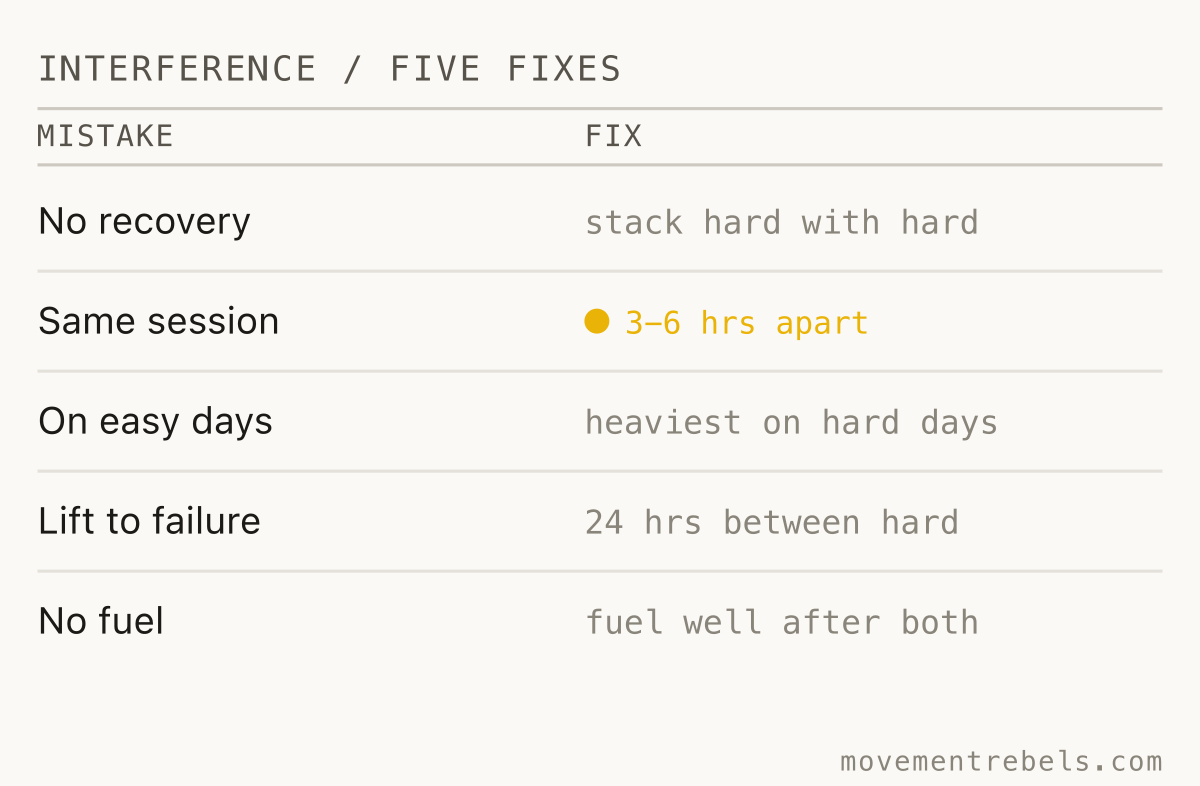
The interference effect is real only under specific conditions. It happens when:
- Your total endurance load is high and you bolt heavy lifting on top with no attention to recovery
- You combine strength and endurance in the same session with no separation
- You do strength work on genuinely easy days, turning them into hard days
- You lift to failure in the 24-48 hours before a key run or ride
- You fail to fuel adequately after concurrent sessions
The interference does not happen automatically. It depends on how you structure your week. When you separate strength and endurance by several hours or different days, the interference shrinks. The research on well-designed concurrent training shows you can improve both strength and aerobic fitness in the same training block. What fails is treating lifting as an afterthought bolted onto a full endurance schedule, done at random times and without attention to recovery.
The strongest evidence is clear: maintain 3-6 hours between a hard run or ride and your strength session when you stack them. Keep your heaviest lifting on your hard endurance days so easy days stay easy. Allow 24 hours between hard sessions when you can. Fuel well after both. Follow this, and concurrent training works. The evidence even suggests that a single endurance session per week shows almost no interference at all, which is relevant if you are training for a marathon or building massive cycling base.
The universal principles for endurance athletes
Heavy strength training means high load and low reps. This is the pattern that builds neuromuscular power without the bulk or the fatigue of hypertrophy training.
- Load: 80-90% of your one-rep max, or a weight where the last rep feels heavy but clean.
- Reps: 3-6 per set for your main lifts.
- Sets: 3-4 working sets per lift.
- Frequency: 2 sessions per week for most endurance athletes. One maintains the gains you build; three crowds out recovery for most people.
- Rest between sets: 2-3 minutes. You are recovering the nervous system, not chasing a pump.
- Speed of movement: Move the bar as fast as you can control it. The speed of intent is what trains power.
High load and low reps keep total volume low, so soreness and mass gain stay low. You leave the gym feeling strong, not wrecked. Use a one-rep max calculator to translate recent sets into the right percentages, and an RPE calculator to read effort when the bar feels different. To see where your lifts sit against strength standards, check your strength level.
The core lifts every endurance athlete needs
You do not need a long list. Five movement patterns cover what most endurance athletes need. Build your two weekly sessions from these.
- Squat (back or front). The base of lower-body strength. 3-5 sets of 3-5 reps. Front squats are easier on the lower back if yours is cranky.
- Hip hinge (deadlift, trap-bar deadlift, or Romanian deadlift). Trains the posterior chain: glutes and hamstrings, the engines of your stride or pedal stroke. Trap bar is the most accessible version for lifters new to the movement. 3-4 sets of 3-5 reps.
- Single-leg work (Bulgarian split squat, step-up, single-leg RDL). Your sport is single-leg: runners never push off both feet at once; cyclists never pedal with both legs symmetrically. Single-leg lifts find and fix the imbalances that cause injury. 3 sets of 6-8 per leg.
- Upper body pulling and pressing. For swimmers, pulling is non-negotiable (lat pulldown, rows, assisted pull-ups). Runners and cyclists can keep this lighter, but ignore the upper back at your own cost. Scapular strength prevents the shoulder and neck issues that come with forward posture. 3 sets of 5-8 reps.
- Hip and core stability (hip thrust, Pallof press, side plank, single-leg glute bridge). Keep this focused. A few hard sets beat 20 minutes of unfocused floor work.
Free-weight, compound, single-leg movements give the best return. Machines that lock you into a fixed path train one plane and miss the stabilizer muscles you need. When you are loading the barbell, a plate calculator saves the mental math on which plates hit your target weight.

Sport-specific tweaks
The foundation above applies across running, cycling, triathlon, and swimming. Sport-specific differences matter at the margins but should not override the main principles.
Runners: Add extra work for the ankle and calf beyond what the main lifts provide. The Achilles tendon is the most underloaded, most injured tissue in distance runners. Extra work matters here. 3-4 sets of 6-10 slow calf raises (3-second lower) in both straight-leg (gastrocnemius) and bent-knee (soleus) versions. This builds Achilles stiffness and resilience that carries through a season of high volume. Many runners skip this and regret it during taper when a minor Achilles irritation blooms into a real problem.
Cyclists: Put less emphasis on single-leg balance work and more on raw force production. The pedal stroke is symmetric and fluid, so single-leg work helps with imbalances but does not transfer to the bike as directly as it does for runners. Prioritize squat and hip hinge strength. Consider adding a bit of upper-body work too. Power transfer starts at the core and hips, not just the legs.
Swimmers: Upper-body pulling and shoulder stability are your highest priority. Lat strength and lat endurance matter for shoulder health and power throughout a set. Your shoulders are the limiting joint in swimming. Single-leg work is lower priority than upper-body integration and core stability. A strong back and stable shoulder is where swim speed lives.
Triathletes: Prioritize by your limiter. If you are a weak cyclist but a strong runner, load the lower-body work into your sessions. If your swim is the bottleneck, bias toward upper-body. If you are balanced, rotate the emphasis across the season so you do not let one discipline atrophy.
Fitting strength into your week
The hard part is not knowing you should lift. It is fitting lifting around endurance work without digging a recovery hole. The rule is simple: stack hard with hard, and protect your easy days.
Do your strength session on the same day as a hard run, ride, or swim, ideally several hours after or that evening. Keep your easy days genuinely easy. A heavy leg session on an easy day turns that day into a hard day, and now you have no recovery in the week at all.
A sample week for a runner doing 5 runs (the running-specific version goes deeper on the run side):
- Monday: Easy run. No lifting.
- Tuesday: Hard run (intervals or tempo) + strength session A, later that day (3+ hours apart).
- Wednesday: Easy run or rest. No lifting.
- Thursday: Hard run + strength session B, later that day.
- Friday: Rest.
- Saturday: Long run.
- Sunday: Easy run or full rest.
If you can only run after lifting, do the run first when it is a quality session. Running on legs pre-fatigued by heavy lifting changes your form and raises injury risk. Your endurance session is the priority; strength supports it.
Separate hard sessions by at least one full easy day. A training volume calculator helps you keep total weekly sets inside what your mileage leaves room to recover from. If you add 2 strength sessions on top of your usual volume, dial back your run or ride volume slightly in the first few weeks so total stress does not spike.
Periodize strength across your season
Strength is not a year-round constant. It rises and falls inversely with your race intensity. Base phase is when you build; race phase is when you maintain.
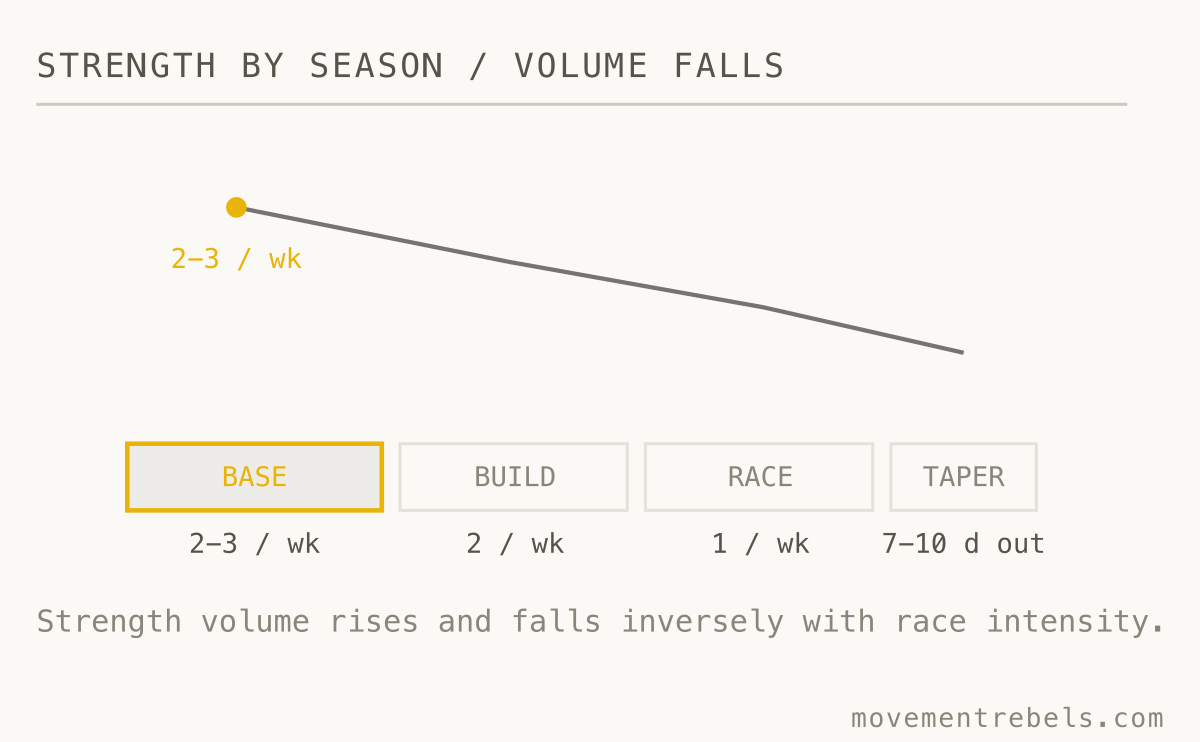
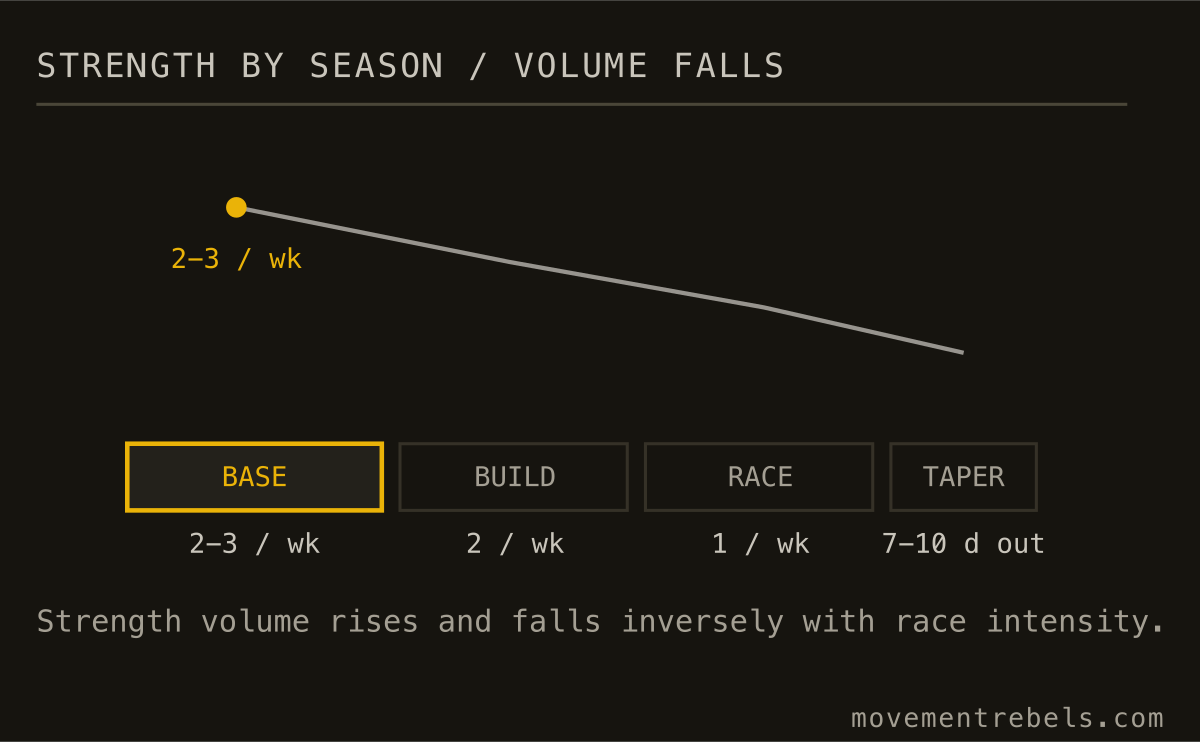
- Base / off-season: Build heavy. 2-3 sessions a week, the heaviest loads of the year, lower running or cycling intensity. Most of your strength gains happen here, when racing is not competing for recovery.
- Build phase: Drop to 2 sessions. Race intensity is climbing, so strength volume comes down to make room. Keep loads heavy but cut the number of sets.
- Race / peak phase: Maintenance only. One short, heavy session a week is enough to hold the strength you built. 2-3 sets of your main lifts, heavy, low reps, in and out.
- Taper / race week: Last heavy lift 7-10 days before the race, then nothing demanding.
Cut strength entirely for more than a week or two and you lose the economy and durability you worked for. A single session per week holds the gains. When fatigue piles up in a block, a deload week applies to lifting as much as to running or riding.
How Movement Rebels fits
The hard part is not knowing to lift. It is fitting strength work around endurance without stacking stress, and adapting when life or your body signals that something needs to change. The Movement Rebels AI coach reads your Garmin and Apple Health data, sees your real runs and rides and your recovery state, and builds the week so your heavy lifts land on hard days and your easy days stay genuinely easy. When you have a flat week, poor sleep, elevated resting heart rate, or a spike in training stress, it pulls the strength volume back instead of piling on more work. It adapts as your season moves from base to race week, so the strength work supports your endurance instead of competing with it. The coach understands that a deload week applies to both your running and your lifting, not one or the other. Load your runs and rides into the app, log your lifts in Rebel OS, and the coach layers them into one integrated plan that makes you faster and more durable. A simple Rebel Fuel log (even estimated) tells the coach whether you are fueling the hard work, which matters for managing concurrent training stress.
Start with one full base phase done right: heavy, twice a week, low reps, with at least 6 hours of separation between sessions on stacked days. You will feel stronger within 4-6 weeks and faster within 8-12. Hold a maintenance session through race season. Your speed and your durability will both thank you.
One app instead of five.
Strength, endurance, recovery, fueling, planning, and your AI coach. All under a 7-day free trial. No card.
Start 7-day trialWhy Runners Should Deadlift
Runners who skip the deadlift leave speed and durability on the table. Why the posterior chain drives your stride, which variant t
Strength Training for Runners: Get Faster and Stay Healthy Without Bulking
How runners should lift to run faster and stay injury-free: the key lifts, heavy over high-rep, two sessions a week, plyometrics,
Hybrid Athlete Training: Concurrent Done Right
The interference effect is real but smaller than you think, and the rules for avoiding it are simpler than the hype suggests. Here
Periodization for Recreational Athletes: Which Model, and How Much You Need
Linear, block, undulating: the honest evidence on which periodization model recreational athletes actually need, and what the rese