Caffeine for Endurance Athletes: Dose, Timing, and the Catch
Caffeine is one of the few ergogenic aids where the evidence actually holds up. Not in the "studies suggest" way that sports nutrition uses to sell everything from beet crystals to ashwagandha. In the "repeated, controlled trials, reviewed by multiple independent bodies, and accepted into position statements by both the ISSN and the IOC" way. That is a short list. Caffeine is on it.
The 2021 ISSN position stand on caffeine and exercise performance reviewed the full body of evidence and concluded that aerobic endurance is the exercise modality with the most consistent, moderate-to-large benefits from caffeine use. The 2018 IOC consensus statement on dietary supplements placed caffeine in its top tier: one of only a handful of supplements with good evidence of real performance benefits, alongside creatine, specific buffering agents, and nitrate. For the rest of that short list, see our rundown of evidence-backed supplements that work.
So the honest framing is not "does caffeine work?" It works. The interesting questions are: what dose actually matters, when to take it, what happens when you drink coffee every day, and what trade-offs you are accepting on gut health and sleep. Those are the parts that get glossed over.
What caffeine actually does
Caffeine's primary mechanism in endurance sport is adenosine receptor antagonism. Adenosine is the molecule that accumulates during prolonged effort and signals fatigue to the brain. Caffeine blocks those receptors, which reduces perceived exertion at the same power output and delays the subjective experience of fatigue. It also potentiates calcium release in muscle and increases catecholamine secretion (adrenaline). Early hypotheses proposed that caffeine also spares glycogen by increasing fat oxidation at submaximal intensities, but this mechanism is not well supported and is not considered primary. The main driver is adenosine antagonism reducing perceived exertion. The outcome on the bike or in a run is a meaningful reduction in how hard a given pace feels, and a delayed time to exhaustion. In time-trial format, consistent 2-4% performance improvements across studies. For endurance sport, that is not noise.
The dose that works: 3-6 mg/kg
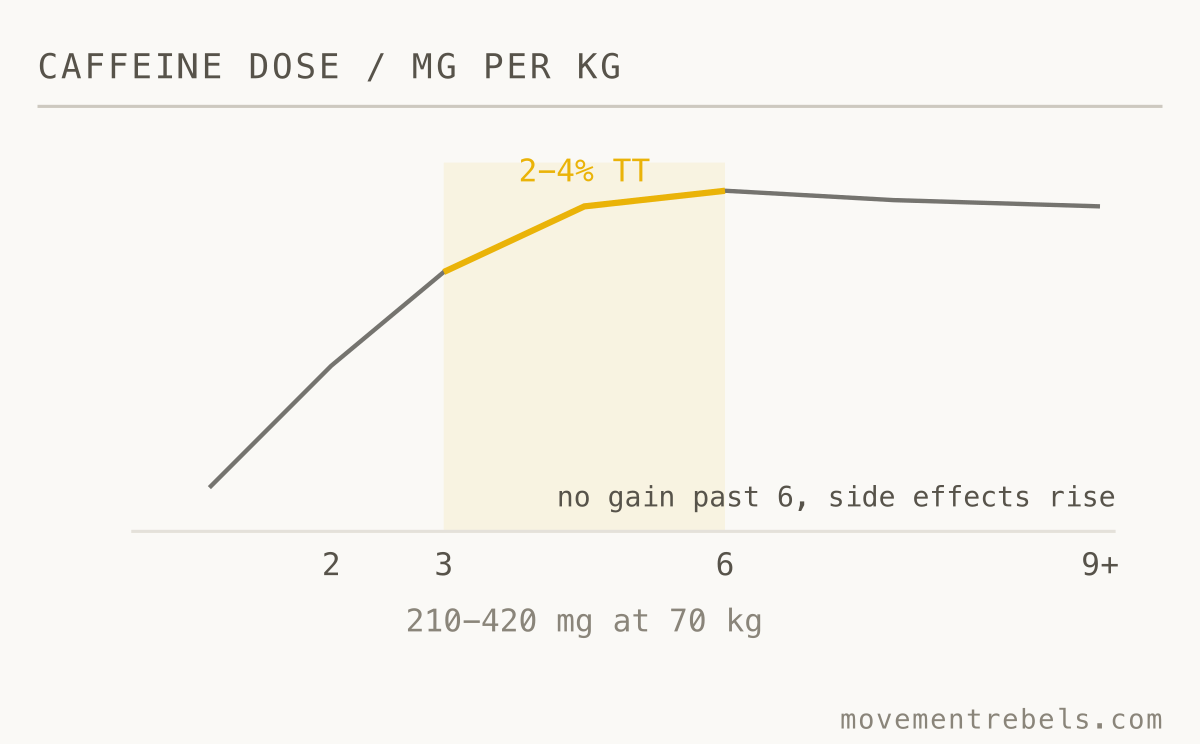
The ISSN position stand is explicit on dose: 3-6 mg/kg of body mass is the range with demonstrated ergogenic effect. Doses as low as 2 mg/kg may produce some benefit. Doses at 9 mg/kg and above do not improve performance further and substantially raise the incidence of side effects.
In real terms for a 70 kg athlete:
- Low end (2 mg/kg): 140 mg, roughly one strong espresso or a small pre-workout coffee
- Effective range (3-6 mg/kg): 210 to 420 mg, one to two large coffees or a purpose-dosed caffeine tablet
- High end to avoid (9 mg/kg+): 630 mg or more, the region where anxiety, heart palpitations, and gut issues multiply without adding speed
The research consistently shows the dose-response curve flattening well before the upper doses that the supplement industry puts in products. Chasing higher numbers with a proprietary blend is paying for side effects, not performance.
Timing: 45-60 minutes before effort
Caffeine peaks in plasma roughly 60 minutes after ingestion when taken in capsule or tablet form. The ISSN identifies 60 minutes before exercise as the most commonly studied timing. In practice, a 45-60 minute pre-effort window is reasonable based on general pharmacokinetics, though the research anchor is specifically around the 60-minute mark.
A few nuances:
- Caffeine gum absorbs through buccal mucosa much faster, with effects in 10-20 minutes. Useful for intra-race top-ups or when the start time is unpredictable.
- Coffee vs. pure caffeine: coffee introduces chlorogenic acids and other compounds that slow gastric emptying slightly, shifting the peak. The ergogenic effect is present but the timing is less predictable than tablets, which matters more for a race than a training session.
- Intra-workout caffeine is a real strategy for long events. Rather than loading all 3-6 mg/kg pre-start, some athletes split the dose: a moderate hit pre-start, then a small top-up via gel or gum at the 90-120 minute mark when glycogen and motivation both dip. One study found a low-dose caffeine hit toward the end of a race had comparable effects to a higher pre-race dose in that specific trial. The ISSN notes this as a potential strategy worth considering, though the 60-minute pre-exercise window remains the most validated approach across the broader evidence base.
For a training session with a fixed start time, simplicity wins: capsule or measured-dose tablet, 50-60 minutes before, consistent timing each time you use it so you learn your own response before relying on it in a race.
The habituation problem: honest version
Here is where the popular framing overclaims in both directions.
One camp says daily coffee drinkers get no ergogenic benefit from pre-race caffeine because they are fully habituated. The other camp says habituation is a myth and daily users respond identically to abstainers. Both are wrong, and the actual evidence is more useful than either position.
A 2019 opinion piece in Sports Medicine examining habitual caffeine use in athletes concluded that the ergogenic effect is blunted in habitual users, but not eliminated. Data from that work and related studies showed habitual consumers (above 300 mg/day) experienced smaller performance improvements than non-users at matched doses. Some research found a measurable reduction in work output after extended continuous supplementation at 3 mg/kg/day. But multiple other studies found no significant difference between habitual and non-habitual users when the dose was individualized rather than fixed.
The practical read: if you drink 3-4 coffees a day and want to use caffeine as a race tool, you probably still get a performance benefit, but the margin is smaller than for someone who rarely drinks coffee. The blunting is real, partial, and dose-dependent. Raising your pre-race dose above your typical daily intake is one way to exceed the habituation ceiling.
What about going caffeine-free in the week before a race to "reset" sensitivity? The same Sports Medicine commentary found that short-term pre-competition withdrawal produced headaches, fatigue, and irritability, with no measurable improvement in the subsequent caffeine ergogenic response compared to athletes who maintained their habitual intake. A few days of suffering to arrive at the start line with a headache and disrupted sleep is not a trade worth making. The withdrawal strategy appears to be folklore dressed in physiology clothing.
The gut trade-off
The gut is where caffeine can turn from performance tool to race-day liability, and this is where most caffeine guides stop short.
Caffeine has a direct stimulatory effect on GI motility. That is why morning coffee reliably triggers a bowel movement for many people. At race intensity, when gut blood flow is already reduced in favor of working muscles, the additive GI stimulation from caffeine can tip toward cramping, urgency, and distress. The evidence consistently shows GI symptom incidence rises with dose: at doses above 6 mg/kg, a meaningful proportion of athletes report GI problems during or after exercise, with delayed GI distress (hours post-race) also documented. At the lower end of the effective dose range (3 mg/kg), the incidence drops substantially, which is one practical reason to stay at the lower bound when GI sensitivity is a known issue for you.
More recently, research on caffeine and exercise-induced gut cell damage found that caffeine at 3 mg/kg before a cycling effort amplified intestinal epithelial cell injury, with effects modulated by the ADORA2A gene variant. Individuals with the high-sensitivity TT genotype showed roughly a 109% increase in gut cell damage markers with caffeine versus placebo, compared to 48% in low-sensitivity individuals. Genetics aside, the mechanism matters: caffeine reduces protective mucus layer secretion, increases intestinal fluid secretion under stress, and amplifies the exercise-induced reduction in gut blood flow.
Practical consequence: if you experience any GI distress during long training sessions or races, caffeine dose is a variable worth controlling before adding other nutritional complexity. Stay at the 3 mg/kg end of the range. Train the gut alongside training the aerobic system. See gut training for carb tolerance for how to systematically build GI resilience, since caffeine tolerance in the gut follows similar adaptation logic to carbohydrate transport. And for the pre-session nutrition window that interacts with caffeine timing, the full framework is in fueling around long training sessions.
The sleep trade-off
Caffeine has a half-life of approximately 5-6 hours in most people, though this varies with CYP1A2 genetic status (slow metabolizers can see half-lives extending to 9-10 hours). The practical implication: a 300 mg dose at 2pm still has 150 mg active at 8pm, and 75 mg at 2am for a slow metabolizer. That is not trivial. Research has shown that a 400 mg dose taken 6 hours before bedtime can meaningfully reduce total sleep time and increase wakefulness. The sleep disruption risk scales with dose, so afternoon and evening athletes carrying higher caffeine loads face a real trade-off.
For early-morning athletes, caffeine timing is mostly not a sleep problem. For afternoon or evening session athletes, the overlap with sleep pressure is real. The downstream cost of poor sleep on training quality and recovery is not trivial. Sleep is arguably the highest-leverage recovery tool available. Disrupting it for a 2-4% performance gain in a Tuesday threshold session is a poor trade.
Sleep and training performance covers why sleep quality cascades into HRV, resting heart rate, and training adaptation. HRV-guided training shows how the readiness signal the morning after a high-caffeine day can tell you whether you have actually recovered or are just running on sympathetic drive. The two signals interact: caffeine in the evening raises heart rate and blunts HRV, which next-morning HRV will flag as poor readiness regardless of how much sleep you logged.
Timing caffeine intake before 2pm when possible removes most of the sleep interference risk. Save higher doses for morning events and key training sessions. Keep evening training sessions either caffeine-free or at the lowest effective dose (2 mg/kg).
What good caffeine use looks like in practice
A few specific, evidence-based defaults:
- Dose: 3 mg/kg for training sessions and lower-priority races. 4-6 mg/kg for A-races where you want to access more of the ceiling.
- Format: Anhydrous caffeine capsules or tablets for precision. Coffee works but dose varies by brew, bean, and grind.
- Timing: 50-60 minutes before effort for capsules. 15-20 minutes for gum.
- Intra-race top-up: consider a 50-100 mg hit via gum or caffeinated gel at the 90-120 minute mark on events over 2 hours.
- Gut testing: practise your race-day caffeine protocol in training at the same dose, form, and timing before you commit to it in a race. GI tolerance is individual and trainable.
- Sleep cutoff: no caffeine after 2pm for athletes with normal sleep schedules. Adjust earlier for slow metabolizers or those with confirmed sleep disruption.
- Habituation: if you are a daily coffee drinker and want to maximize the competitive effect, dose slightly above your habitual intake. Do not attempt withdrawal in the week before a race.
One thing not worth chasing: tolerance-free caffeine cycling (using caffeine only on race days to "preserve" the effect). For most recreational endurance athletes training 6-12 hours a week, the practical return is small and the daily-life cost (no morning coffee) is high. The ergogenic effect is blunted with habituation but not gone, and 2-3% at a race still outweighs the quality-of-life trade.
How Movement Rebels handles this
The coach reads your training log from Garmin Connect and Apple Health, including session timing, duration, and intensity. When you log a long session or a race in the app and check in via the coach, it can factor performance drift, perceived effort, and session completion into its analysis. If you are consistently fading in the final third of long efforts, under-fueling and insufficient caffeine use are both hypotheses the coach can raise based on what you have logged.
The coach does not prescribe caffeine as a standalone recommendation outside your full nutrition and recovery context. That is the right call: caffeine sitting on top of chronic under-fueling (see fueling around long sessions), disrupted sleep, or high training stress produces a worse outcome than fixing those first. It will flag if your Apple Health or Garmin data shows elevated resting HR and suppressed HRV in the days following high-caffeine training blocks, which is the signal that the sleep cost is real and accumulating.
For athletes who connect Garmin, the coach pushes structured workouts to the watch with target HR or power zones. Knowing your zone targets makes the caffeine dose-response more interpretable: the same perceived effort at a higher power or pace, with HR matching target, is a clean signal that the dose worked. Log it. Repeat it.
The data-driven athlete guide covers how to read patterns across HRV, resting HR, and session quality in a way that makes caffeine experiments interpretable rather than anecdotal.
Safety note
The doses discussed in this guide (3-6 mg/kg) are within the ranges studied in healthy athletic populations and endorsed by the ISSN and IOC for sports use. Caffeine at very high doses (above 9 mg/kg) carries real risks: anxiety, cardiac arrhythmia, and severe GI distress. These doses are not needed for ergogenic benefit.
Individuals with cardiac arrhythmia, hypertension, anxiety disorders, or pregnancy should consult a physician before using caffeine as a performance aid. The ergogenic effects are real; so is the pharmacological activity at higher doses. This is not a supplement where more is better.
Pricing
Movement Rebels is one app for the full picture: endurance, strength, hybrid, planning, coaching, fueling, recovery, and tracking. A 7-day free trial covers the entire surface. After the trial, Pro+ is $20/month for unlimited coaching. No card on the trial.
One app instead of five.
Strength, endurance, recovery, fueling, planning, and your AI coach. All under a 7-day free trial. No card.
Start 7-day trialCarbohydrate Timing for Athletes: Fueling Around Long Sessions
How many grams of carbohydrate and when: 1 to 4 g/kg before training, 30 to 90 g per hour through long sessions, and the 4 hour re
Sleep and Training Performance: The Lever Nobody Respects
Sleep outperforms every supplement, wearable, and recovery tool you own. Here's the honest evidence, what actually trashes it, and
HRV-Guided Training: Read the Signal, Skip the Noise
One low HRV night tells you almost nothing. The 7-day-vs-28-day trend tells you nearly everything. Here is what the evidence actua
Gut Training: Build the Carb Tolerance Long Sessions Demand
Your gut is trainable. A progressive intra-workout carb protocol raises tolerance toward 90-120 g/hr over weeks. Here is the hones