Gut Training: Build the Carb Tolerance Long Sessions Demand
Most athletes who bonk at hour three do not have a pacing problem. They have a gut problem. Specifically, a gut that was never taught to absorb carbohydrates at the rate long efforts actually require.
The good news: the gut is trainable. This is not marketing language. It is a real physiological adaptation at the intestinal transporter level. The catch is that most athletes either do not know it applies to them, assume 90 g/hr is for professionals only, or try to hit aggressive intake targets on their first long ride and spend the back half managing nausea. None of those outcomes are necessary.
Here is what the evidence actually supports, what it does not, and how to build toward higher carbohydrate tolerance without sabotaging your training in the process.
Why Your Gut Becomes a Bottleneck
Carbohydrates do not absorb themselves into the bloodstream. They need transporters in the intestinal wall to carry them across. Glucose uses a transporter called SGLT1 (sodium-dependent glucose co-transporter 1). Fructose uses a separate one called GLUT5. Each transporter has a ceiling.
Glucose absorption via SGLT1 maxes out at roughly 60 g/hr under typical conditions. Push above that and the excess glucose sits in the gut, draws water in by osmosis, and the outcome is familiar to anyone who has gone too hard on gels: bloating, cramping, urgency, and a sudden interest in roadside bushes.
The key insight from research on intestinal transporter physiology is that SGLT1 density is not fixed. The transporter upregulates in response to consistent carbohydrate exposure. Animal studies show meaningful increases in SGLT1 transporter density with high-carbohydrate diets, with some effects appearing within a few days and larger increases observed over weeks. Human data is more limited and no direct human trials have confirmed the mechanism in vivo at the transporter level. But the functional outcome shows up clearly: athletes who regularly train with carbohydrates absorb more of them.
This is the same principle as any other physiological adaptation. Use the system consistently and it improves. Leave it idle and it stays at its baseline ceiling.
The Dual-Transporter Solution (and Where the Ratios Come From)
Adding fructose alongside glucose opens a second absorption lane, GLUT5, that operates independently of SGLT1. Research on glucose-fructose co-ingestion consistently shows that combining the two allows a higher proportion of ingested carbohydrate to be absorbed and oxidized compared with glucose alone. Part of what happens is that fructose oxidation partly substitutes for endogenous glycogen that would otherwise be burned. The net effect on total carbohydrate oxidation is more modest than the improvement in exogenous oxidation alone suggests, but the practical upshot is clear: a glucose-fructose blend lets you take in more carbohydrate per hour without the absorption bottleneck that hits when you push glucose above its transporter ceiling.
This is why the 2:1 glucose-to-fructose ratio became the standard recommendation for intakes at 60-90 g/hr. At that ratio, both transporters run near their respective ceilings without either being overwhelmed.
More recent research has probed whether going beyond 90 g/hr adds anything meaningful. Studies examining 120 g/hr intakes suggest exogenous carbohydrate oxidation can increase further at higher doses, but the performance case for 120 g/hr over 90 g/hr remains thin unless you are a highly trained athlete with a well-adapted gut. GI comfort at very high intakes varies considerably between individuals. Our carb loading calculator for daily carb grams converts per-hour figures into the daily and per-meal intake that keeps the tank topped up.
The honest summary: for most athletes training 8-16 hours a week, 60-90 g/hr with a glucose-fructose blend is the well-supported target. Pushing toward 120 g/hr is an advanced strategy with modest evidence of added benefit, and it requires a gut that has been progressively trained to handle it.
What the Evidence Actually Shows (and What It Does Not)
The practical case for gut training rests on a mix of strong mechanism data and thinner human trial data. It is worth being specific about the gap.
The mechanistic chain is solid: SGLT1 and GLUT5 transporter density increases with carbohydrate exposure, gastric emptying rate responds to training stimulus, and athletes who train with carbohydrates absorb more of them during exercise than athletes who do not.
The clinical trial base for specific gut-training protocols is narrower. A 2023 systematic review that screened over 300 studies found only a handful meeting rigorous inclusion criteria. Those studies found meaningful reductions in carbohydrate malabsorption and GI symptom frequency after gut-training interventions, but the findings came from different study designs using different protocols. No standardized gut-training protocol exists across the literature, most studies used male participants, and the mechanistic pathways in humans are not confirmed at the transporter level by direct measurement.
What this means practically: gut training is a real adaptation with genuine outcome data. It is not fringe. But the "do exactly X weeks at Y g/hr and you will achieve Z tolerance" precision you see in some coaching content is ahead of the evidence. The adaptation is real; the exact recipe is an educated approximation.
The Progressive Protocol: 6-12 Weeks to Higher Tolerance
With that caveat in place, here is a progressive approach grounded in what the better studies used.
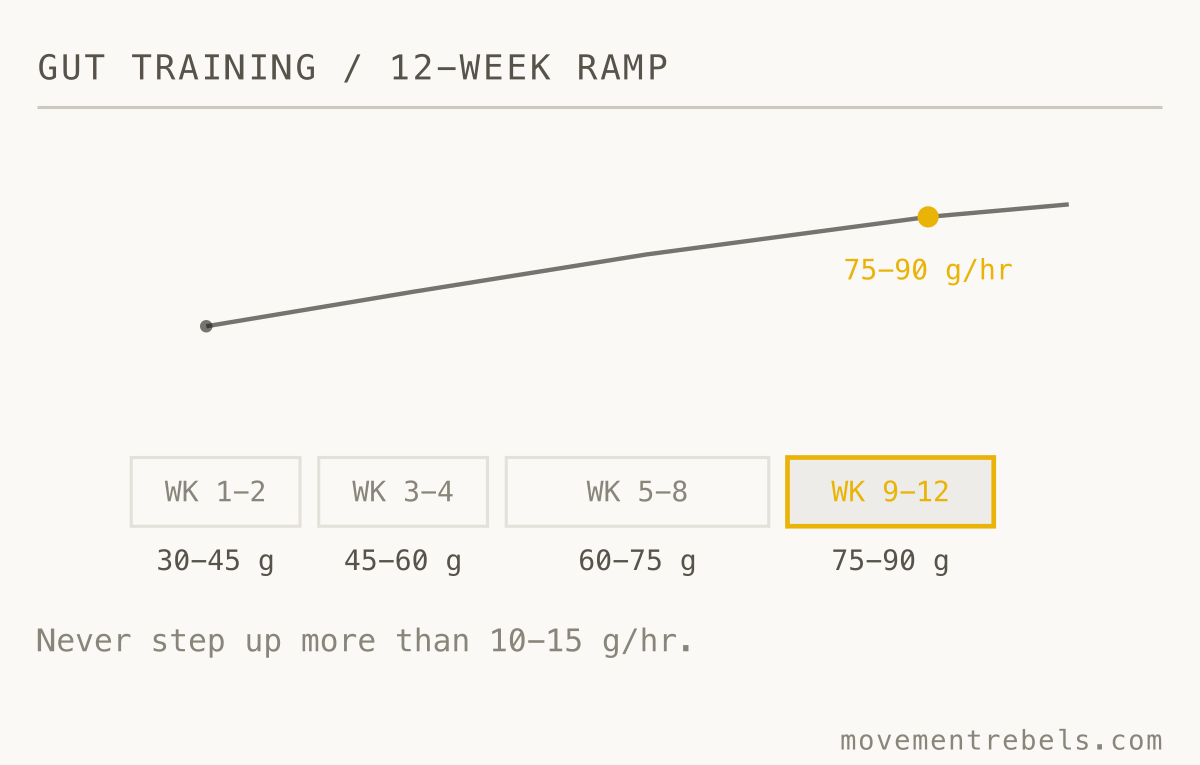
Weeks 1-2: Establish a consistent intra-workout carbohydrate habit on sessions over 60 minutes. Target 30-45 g/hr. For most athletes this means one gel and a bottle of sports drink per hour. The goal is not performance. It is teaching the gut to receive fuel during effort without protest.
Weeks 3-4: Step up to 45-60 g/hr. Introduce a glucose-fructose blend if you have not already. Sucrose works as well as separate monosaccharides per the available evidence, so a maltodextrin-fructose gel plus a glucose-based drink is fine. So is a sucrose-heavy sports drink. The specific product matters far less than the ratio and consistency.
Weeks 5-8: Step up to 60-75 g/hr. This is where many athletes start to notice whether their gut has adapted. Sessions at moderate zone 2 intensity are the best training ground: low enough intensity to keep gut blood flow reasonably high (intense exercise redirects blood away from the gut, which compounds absorption problems), long enough to accumulate meaningful practice reps.
Weeks 9-12: Step up toward 75-90 g/hr. This is the range where the dual-transporter ceiling sits for most trained athletes, and where the fueling framework for long sessions starts to feel intuitive rather than effortful. Some athletes with a well-adapted gut can eventually sustain 90-120 g/hr for very long efforts, typically Ironman-distance or ultra-endurance events. That outcome requires the full progressive base.
Two rules that apply at every step: never increase intake by more than 10-15 g/hr between blocks, and always practice new intake targets on lower-intensity sessions before testing them on a key workout. A bad GI experience on a recovery ride is inconvenient. A bad GI experience on race day is something else entirely. Our race nutrition planner to rehearse your fueling sets the per-hour numbers to practice against before the event.
The Intensity and Timing Variables People Miss
Gut tolerance at 60 g/hr on a zone 2 ride does not automatically mean you can tolerate 60 g/hr at 85% of threshold. Intense exercise reduces splanchnic blood flow (blood supply to the gut), which slows gastric emptying and amplifies distress risk. The relationship is approximately linear: the harder you go, the less fuel your gut can handle per hour.
This has two practical consequences. First, build your tolerance base at lower intensities and expect to tolerate somewhat less on race-pace efforts. Second, for events that mix intensities (triathlons, sportives, ultra races with climbs), plan your highest carbohydrate intake for the easier segments and back off during intense climbs or surges.
Timing within the session matters too. The first 30-45 minutes of a session is when the gut is most receptive. Starting fuel intake at minute 45 "because I don't need it yet" means you are already behind when glycogen starts to matter. The gut-training studies with the best outcomes fed athletes from early in the session, not halfway through.
Hydration interacts directly with carbohydrate absorption. Concentrated carbohydrate solutions slow gastric emptying. A gel chased with no fluid is a concentrated bolus sitting in the stomach longer than it needs to. The practical rule: take carbohydrate with fluid, and aim for carbohydrate concentrations of 6-8% in your drink bottles (roughly 60-80g per litre). See hydration tracking for athletes for the sweat-loss side of the equation.
The Supplement Economy Is Not Your Gut-Training Strategy
Sports gels, chews, and drinks with precise glucose-fructose ratios have genuine utility at the upper end of carbohydrate intake. They are compact, pre-measured, and designed to be consumed while moving. They are not necessary at 30-45 g/hr, and the price per gram of carbohydrate is substantially higher than real food equivalents.
Ripe banana halves, boiled salted potatoes, rice cakes, dates, and diluted juice all contain glucose and fructose. At lower intake targets they work fine during training, and they cost a fraction of purpose-built products. The sports nutrition industry profits from the perception that fueling requires specialized inputs. At 30-60 g/hr, it largely does not.
The case for commercial gels and drinks gets stronger above 75 g/hr, where the compact volume matters, and during events where logistics prevent carrying real food. That is a genuine use case. Just recognize where it starts, rather than defaulting to products for every training ride.
For long-haul endurance like Ironman training or trail and ultra racing, gut training is not optional. It is the difference between having a nutrition plan that works on race day and one that collapses at hour four of a seven-hour effort. Building it in training is the only way to arrive at the start line with a gut that can be relied on.
Common Mistakes That Reset the Clock
Three patterns undo gut-training progress faster than the adaptation builds it.
Training without carbs, then fueling on race day. Fasted training sessions have a legitimate place in some periodization models, but doing the majority of long sessions without intra-workout carbohydrate means the gut never gets practice reps. On race day the carbohydrate load is novel stimulus to an untrained system. The result is predictable.
Jumping to race-day targets without progression. Deciding in week two of gut training that you will hit 90 g/hr because you read it somewhere is the fastest route to GI distress during a key session. The progression exists for a reason. The gut adapts over weeks, not sessions.
Inconsistency between training blocks. Gut training adaptations, like other training adaptations, erode with detraining. An athlete who builds to 75 g/hr over eight weeks, then spends four weeks doing low-volume maintenance with minimal intra-workout fuel, will likely need to rebuild at least part of that base. Maintain the habit across the season, not just in the build phase. This connects to the broader periodization question covered in adaptive training plans.
How Movement Rebels Handles This
The coach builds a running nutrition context from your conversations. When you tell it what you took in on a long ride, how your gut responded, and what your targets are, that information feeds into its athlete memory and shapes subsequent coaching. You do not start from zero each session.
Planned sessions can include explicit fueling targets. Tell the coach you are in week four of gut training and aiming for 60 g/hr, and it will factor that into how it reads your session feedback. If you describe GI distress on a long effort, it can identify where intake timing or concentration likely went wrong and suggest adjustments for the next block.
Use Rebel Fuel to log pre-session and intra-session intake. That context is yours to share with the coach directly, and it will use it to give specific rather than generic guidance. This is the same principle covered in fueling around long sessions: the session window matters, but the week before it matters more.
Garmin Connect is live: structured sessions can push to your watch and completed activities sync back so the coach can read power, pace, and heart rate in context. Apple Health is live on the iOS app: HRV, resting heart rate, and sleep feed the coach's readiness picture. When training load shows accumulated fatigue, the coach adjusts the session target, including the fuel strategy, not just the watts or pace. Strava syncs too: completed activities appear in your feed and the coach writes a session summary back to the Strava description, though Strava data does not feed the coach's analysis directly.
Pricing
Movement Rebels is one app for the full picture: strength, endurance, hybrid, planning, coaching, fueling, recovery, tracking. A 7-day free trial covers the entire surface. After the trial, Pro+ is $20/month for unlimited coaching. No card on the trial.
One app instead of five.
Strength, endurance, recovery, fueling, planning, and your AI coach. All under a 7-day free trial. No card.
Start 7-day trialHow to Fuel a Marathon: Race-Day Nutrition From Start Line to Finish
Marathon fueling that holds up past 30K: carb loading numbers, race morning timing, carbs per hour, drinking to thirst, caffeine d
Carbohydrate Timing for Athletes: Fueling Around Long Sessions
How many grams of carbohydrate and when: 1 to 4 g/kg before training, 30 to 90 g per hour through long sessions, and the 4 hour re
Hydration Tracking for Athletes: The Overhydration Risk Nobody Talks About
Most hydration guides warn about dehydration. This one covers both sides: 2% body mass loss impairs performance, but over-drinking
Zone 2 Training: When It Works, When It's a Waste
Zone 2 is real, old, and oversold. Here's the honest version: when low-intensity volume is your highest-leverage work, when it isn