Evidence-Backed Supplements: The Short List That Works
The supplement industry's core business model is blurring the line between "might do something" and "does something measurable." Most products in the sports nutrition section exist in that blur. They have a plausible biological story, a sponsored athlete, and a before-and-after photo. What they do not have is a robust body of peer-reviewed trials showing meaningful performance gains in people who train like you do.
This guide names the short list that cleared the bar, explains what the evidence actually shows (including the caveats the label skips), and explains why the list is short. It draws on two of the most rigorous consensus documents in sports nutrition: the ISSN exercise and sports nutrition review and the IOC consensus statement on dietary supplements and the high-performance athlete. Both were written by researchers with no product to sell.
The IOC's summary: "Only a few [supplements], including caffeine, creatine, specific buffering agents and nitrate, have good evidence of benefits." The ISSN puts creatine monohydrate in its top category alongside caffeine. Everything else sits in a progressively weaker tier.
That is the honest starting point.
Why the List Is Short
The difficulty is not a lack of research. Thousands of trials have tested ergogenic aids. The problem is the filter. A supplement earns a place on this list only if:
- Multiple independent randomized controlled trials show a statistically significant, performance-relevant effect.
- The effect size is meaningful, not just detectable (a 0.3% improvement in a lab test is not the same as a 3% improvement in race time).
- The effect holds for trained athletes at realistic doses, not just in untrained subjects at extreme doses.
- The mechanism is understood and biologically coherent.
Most products fail step one. Many pass step one and fail step two. A few pass both and fail step three. The list below passed all four. Note: this guide covers performance supplements, not clinical micronutrient replacement (iron, B12, magnesium). Those are real clinical needs but a different conversation.
Creatine Monohydrate
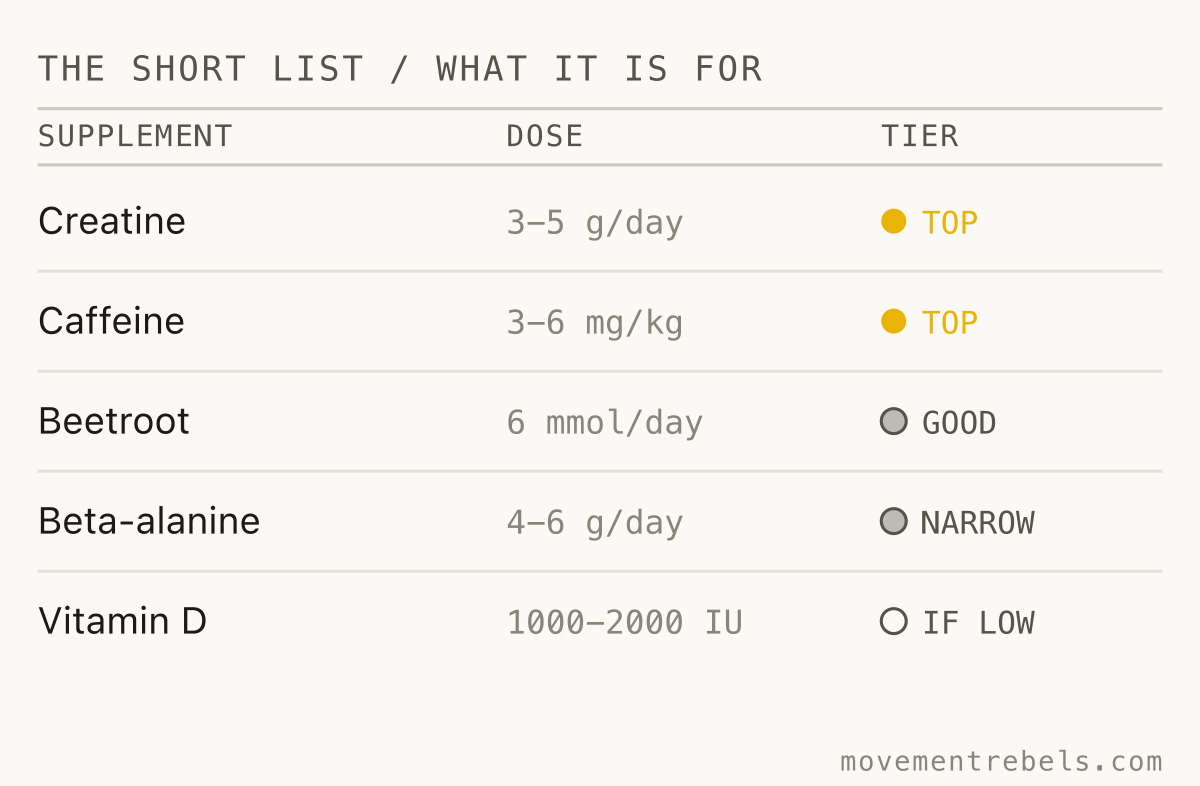
The most researched ergogenic supplement in sports science, with over 1,000 published studies. The ISSN's 2017 position stand on creatine concluded it is "the most effective ergogenic nutritional supplement currently available" for improving high-intensity exercise capacity and lean mass during training.
What it does: creatine saturates the phosphocreatine system, giving your muscles a larger buffer for explosive, short-duration efforts. The gains compound over weeks of training because you can do more total work per session. The evidence is strongest for:
- Repeated sprint bouts (combat sports, team sports, CrossFit-style intervals)
- Heavy resistance training (more reps at a given weight, better session-to-session recovery)
- Short maximal efforts under 30 seconds
What it does not do well: sustained endurance. If your sport is an unbroken 3-hour ride at zone 2, creatine is not your highest-leverage tool. The phosphocreatine system is nearly irrelevant at that intensity and duration.
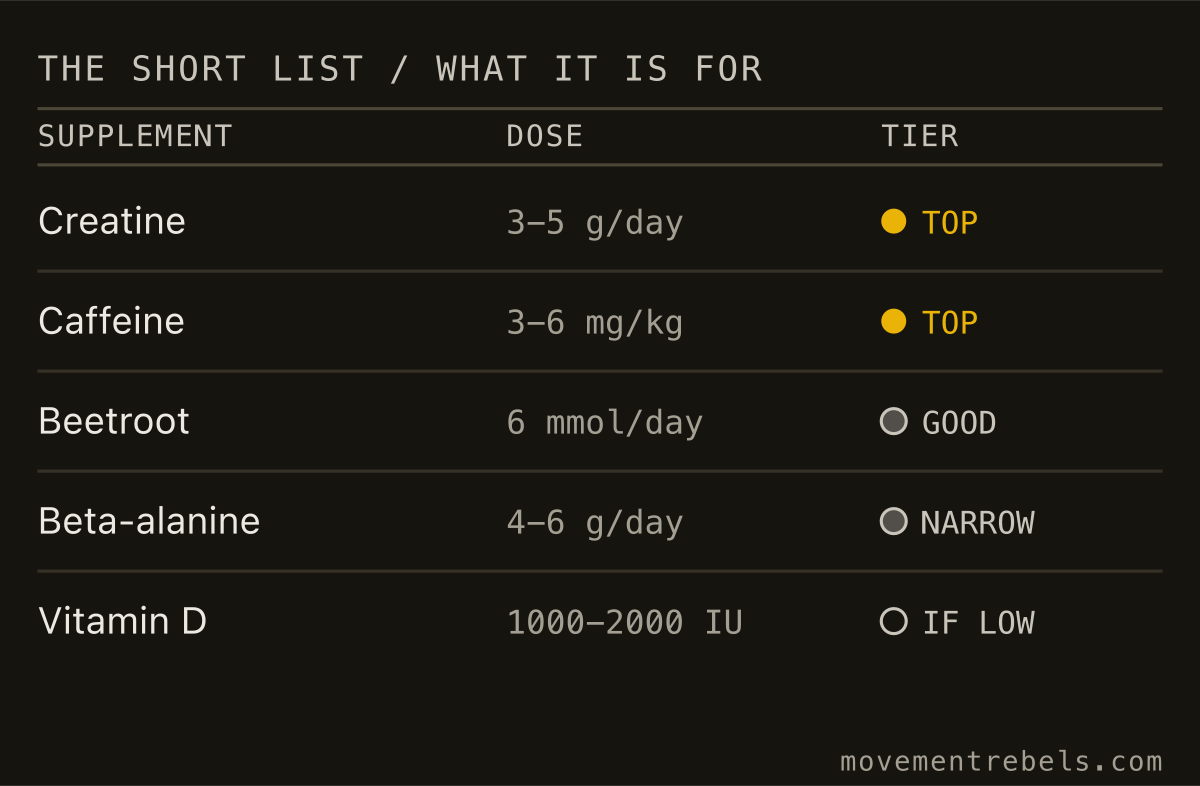
Dose: 3-5g per day of creatine monohydrate. A loading phase (20g per day for 5-7 days in divided doses) saturates muscle stores faster but is optional. Plain monohydrate is the form with the evidence base. Creatine HCl, buffered creatine, creatine ethyl ester: more expensive, less studied, no demonstrated superiority.
Safety: Short and long-term supplementation up to 30g per day for five years is considered safe in healthy individuals. The kidney-damage narrative has been repeatedly tested and not supported in people without pre-existing renal disease.
Caffeine
Not a controversy, a fact: caffeine improves endurance performance. The primary mechanism is adenosine receptor antagonism, which reduces perceived effort and delays fatigue. The effect size is real and consistent across decades of research. Fat oxidation at moderate intensity is sometimes listed as a secondary effect but is contested in the literature and is not considered a primary driver of caffeine's ergogenic benefit.
For full protocol detail including dose, timing, tolerance management, and what happens with habitual use, the caffeine for endurance guide covers it specifically. The short version: 3-6mg per kg of bodyweight, taken 45-60 minutes before effort, is the effective range. Lower doses (3mg/kg) work for most people and produce fewer side effects. Higher doses add diminishing returns and more jitteriness, GI upset, and sleep disruption.
The single most important point the marketing skips: caffeine's ergogenic effect is largely about returning you to your uncaffeinated baseline if you are a habitual user. The net gain for a two-cups-per-day drinker who takes a pre-workout shot is smaller than it looks on the label. Strategic caffeine reduction before a target event is the lever most recreational athletes have not pulled.
Dietary Nitrate (Beetroot)
The mechanism is clear: dietary nitrate converts to nitric oxide in the body via a salivary-gut pathway, which reduces the oxygen cost of exercise at submaximal intensities. You produce the same power output with less oxygen. That is a real, measurable adaptation.
The research broadly shows meaningful improvement in time-to-exhaustion performance. The honest caveats from that body of work: benefits on time-trial performance are less consistent than on time-to-exhaustion tests, and the effect is more pronounced in recreational athletes than in highly trained ones. Elite athletes have already optimized their vascular physiology, leaving less room for nitrate to improve.
For recreational to sub-elite athletes targeting events in the 5-30 minute range (5k, 10k, shorter triathlon legs, CrossFit workouts), the effect is plausible and worth testing. For ultra-endurance events or highly trained athletes, the evidence is weaker and less consistent.
Dose: around 6 mmol per day (approximately 300-400ml of concentrated beetroot juice or 500ml of regular beetroot juice). Supplementing over several days produces greater improvement than a single acute dose. Take it 2-3 hours before effort. Avoid antibacterial mouthwash immediately before or after: it kills the oral bacteria responsible for the nitrate-to-nitrite conversion step.
Food sources work: beetroot, rocket (arugula), spinach, celery. Concentrated shots are a practical delivery format, not a magic molecule.
Vitamin D: Only If You Are Deficient
This one requires an honest framing that most supplement guides skip. Vitamin D supplementation does not enhance exercise performance in athletes who already have adequate levels. The evidence for a direct performance benefit from taking vitamin D when you are sufficient is weak.
What is well-established: a substantial proportion of athletes are deficient, particularly indoor athletes, those training in high-latitude regions, and those with low sun exposure during winter months. Research consistently shows that a meaningful share of athletes have vitamin D insufficiency, with deficiency concentrated in winter and spring months. Low levels are associated with reduced muscle strength, higher fracture risk, and impaired immune function.
The case for supplementing: correcting a deficiency restores function, which is an indirect performance benefit. The case against supplementing if you are sufficient: you are spending money on capsules that your physiology does not need.
Action: get a blood test (serum 25(OH)D). Insufficiency is typically defined as below 50 nmol/L (20 ng/mL). If you are deficient, 1,000-2,000 IU of vitamin D3 per day is a reasonable correction dose. If you are sufficient, save the money. Vitamin D is the supplement where the individual blood marker matters more than any population-level recommendation.
Beta-Alanine: Real Effect, Real Caveat
Beta-alanine raises muscle carnosine concentrations. Carnosine buffers hydrogen ions (acid) that accumulate during intense effort, delaying the fatigue signal. The effect is real, but it only matters in a specific exercise window.
The ISSN position stand on beta-alanine states the ergogenic benefit is greatest for high-intensity exercise lasting 1 to 4 minutes. Think 400m-1500m running, 1-4 minute rowing pieces, repeated sprint efforts in team sports, or the kind of capacity-based work that ends with lungs burning. Beyond 4 minutes, the effect diminishes. Below 30 seconds, the phosphocreatine system dominates and carnosine buffering is a secondary player.
If your training is primarily long, steady-state endurance work, beta-alanine is probably not your priority. If you do a lot of intervals, threshold work, or short races, it is worth considering.
Dose: 4-6g per day in divided doses of 1.6-2g per serving, for at least 2 to 4 weeks to meaningfully raise muscle carnosine. The tingling side effect (paraesthesia) is harmless and fades within 60-90 minutes. Using sustained-release formulations or dividing doses to 1.6g per intake minimizes it. It is not dangerous, just annoying for some people.
The Long Bench: What Did Not Make the List
Some supplements that sit in a "plausible but unproven" tier for trained athletes:
Sodium bicarbonate (baking soda): A genuine acid buffer with real evidence in the 1-7 minute intensity range, similar to beta-alanine. Left off the main list because of practical barriers (GI distress is significant for many users) and because beta-alanine covers the same mechanism more tolerably for most people. Worth experimenting with under controlled conditions.
HMB (beta-hydroxy beta-methylbutyrate): Strong effects in untrained populations, weak or absent effects in people who have been training consistently for more than a year. The marketing rarely highlights that last part.
Branched-chain amino acids (BCAAs): If your total daily protein is adequate (1.6-2.2g per kg bodyweight), BCAAs add nothing measurable. They became popular when protein powder was expensive and BCAA powder was cheaper. The math changed. Eat enough protein and you do not need isolated BCAAs on top of it. Our guide to daily protein targets for endurance and hybrid athletes sets what "enough" means for your training.
Glutamine, CLA, thermogenic blends, testosterone boosters, fat burners: Little to no evidence for meaningful performance or body composition effects in healthy athletes eating enough food. The category that benefits most from these products is the manufacturer.
For the pre and post-workout carbohydrate and protein strategy that moves the needle more than most supplements combined, the fueling around long sessions guide covers it in full.
The Supplement Economy's Core Incentive Problem
The supplement industry is a massive global market. A small fraction of that revenue comes from the five categories above. The remainder flows from the sea of products the IOC and ISSN classify as lacking good evidence, and from the sophisticated blurring of clinical deficiency correction with performance enhancement.
The gut-training parallel is worth noting: the most meaningful "supplement" for an endurance athlete who fades in long races is usually more carbohydrate, not a pill or powder. See gut training and carb tolerance for the practical physiology behind carb absorption adaptation. Carbohydrates cost less than supplements and the evidence base is orders of magnitude larger.
Two questions worth asking before buying anything: Was this tested in trained athletes (not sedentary subjects)? Was it tested by researchers with no financial stake in the outcome? For most products on the shelf, both answers are no.
How Movement Rebels Handles This
The coach does not recommend supplements. That is intentional. Movement Rebels is not in the supplement business, and the coach's job is to improve your training, not to make you feel like you need a stack of pills to achieve it.
What the coach does: it reads your training load and recovery data, identifies whether your fatigue profile looks like under-fueling, under-sleeping, or under-recovering, and adjusts the prescription accordingly. The hydration tracking guide covers one of the most consistently under-addressed performance levers: most athletes who feel flat mid-session are dehydrated or glycogen-depleted, not supplement-deficient.
If you log your meals through Rebel Fuel and the coach sees a protein or calorie gap consistent with your training load, it flags that before suggesting any external product. Fixing a dietary gap costs almost nothing. Creatine is $0.10 per day. Getting these right moves the needle more reliably than any product in the expensive tier.
Garmin Connect is live: structured sessions push to your watch, and completed activities sync back so the coach can read your intensity distribution and recovery patterns. Apple Health is live on the iOS app, pulling HRV, resting heart rate, sleep, and workouts. If your HRV is trending down across a training block, the coach flags it as a recovery problem to solve with rest and nutrition before assuming you need a supplement to compensate. See HRV-guided training for how that readiness signal shapes daily prescription. You can also see how an AI coach reads your Apple Health data to build a full recovery picture across sleep, heart rate, and workouts.
Pricing
Movement Rebels is one app for the full picture: strength, endurance, hybrid, planning, coaching, fueling, recovery, and tracking. A 7-day free trial covers the entire surface. After the trial, Pro+ is $20/month for unlimited coaching. No card on the trial.
One app instead of five.
Strength, endurance, recovery, fueling, planning, and your AI coach. All under a 7-day free trial. No card.
Start 7-day trialThe Post-Workout Protein Window Is a Myth
The 30-minute post-workout protein window is mostly a myth. Your real window is closer to a day. Here is what the research shows,
Carbohydrate Timing for Athletes: Fueling Around Long Sessions
How many grams of carbohydrate and when: 1 to 4 g/kg before training, 30 to 90 g per hour through long sessions, and the 4 hour re
Caffeine for Endurance Athletes: Dose, Timing, and the Catch
Caffeine is one of the few ergogenic aids with replicated evidence. Effective dose (3-6 mg/kg), when to take it, what habituation
Gut Training: Build the Carb Tolerance Long Sessions Demand
Your gut is trainable. A progressive intra-workout carb protocol raises tolerance toward 90-120 g/hr over weeks. Here is the hones