Carbon-Plated Super Shoes: Real Gains or Hype?
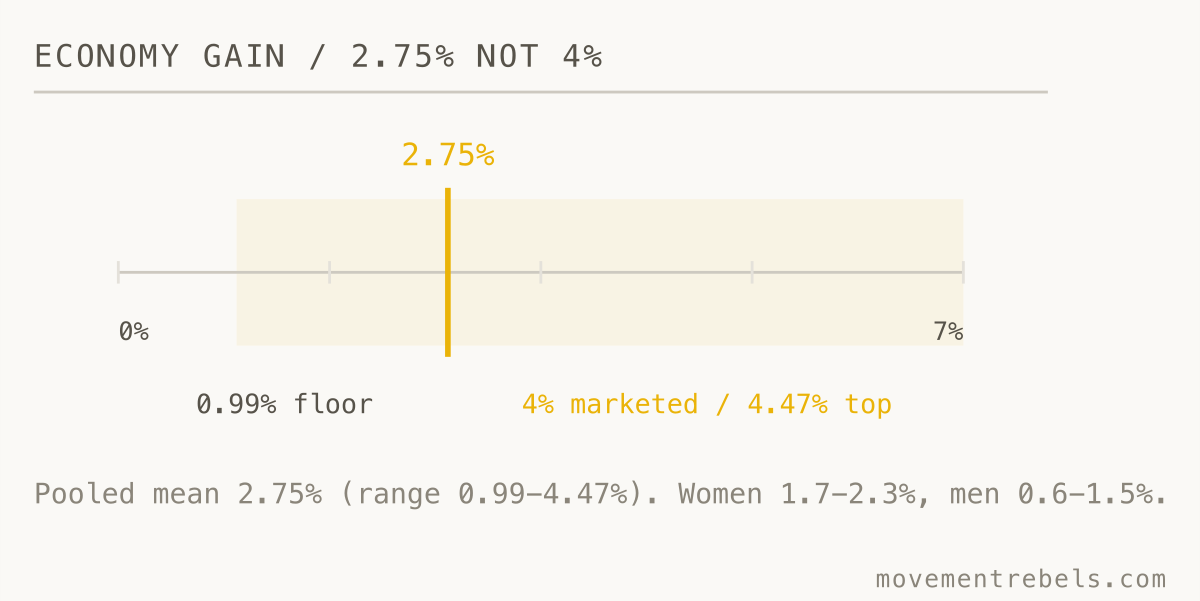
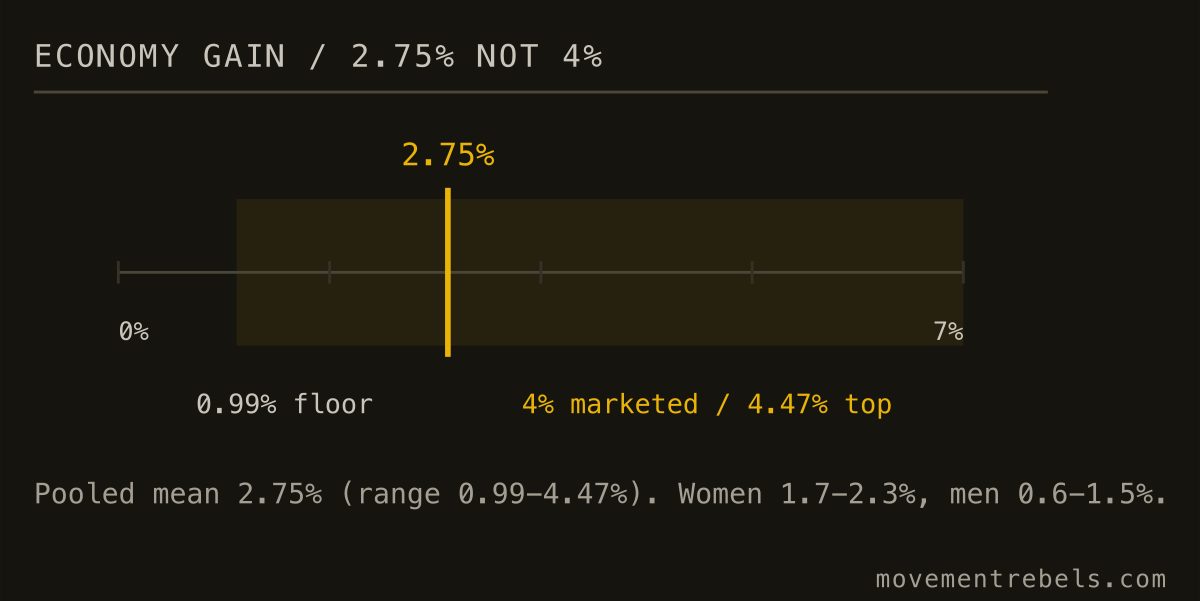
The 4% figure is real. It comes from a genuine, peer-reviewed study. It is also the best-case number for a specific group of runners at specific speeds, and roughly half the people tested in subsequent research got less than half that benefit. The footwear industry latched onto the ceiling of a confidence interval and marketed it as a floor.
That is not to say carbon-plated shoes do not work. They do, and the evidence is now substantial. Recent meta-analyses pooling multiple studies and hundreds of runners find mean running economy improvements around 2-3%, with a range that spans under 1% to over 4%. That is a meaningful spread. Some runners get close to the 4% headline. Others gain under 1%. A small fraction get no measurable benefit, or find a different model works better for their mechanics. The certainty of evidence for running economy gains is rated moderate, not high.
Understanding where you sit in that distribution, and whether you are racing often enough to justify the cost, is the actual decision this guide tries to help you make.
What the mechanism actually is
The foam is doing most of the work. That took researchers a few years and several shoe-dissection studies to establish clearly. Early coverage focused on the carbon fiber plate as the magic ingredient. More recent biomechanical reviews are clearer: it is the synergy of three design elements together.
First, the foam. Pebax-based (PEBA) materials like Nike's ZoomX store and return elastic energy more efficiently than traditional EVA. Resilience is the technical term: the proportion of energy put in that comes back out. PEBA foams recover more energy per compression cycle than EVA, and that advantage compounds with every stride.
Second, the curved carbon plate. It functions as a stiff lever through the metatarsophalangeal (MTP) joint, limiting how far the toe bends during push-off. Energy that would have been lost in that bend is redirected into forward propulsion. The plate's curvature matters: curved designs consistently outperform flat ones in economy testing.
Third, the toe spring and rocker geometry. The elevated heel-to-toe curve makes heel-to-toe transition more passive, reducing the muscular work needed to clear the toe from the ground and begin the swing phase.
Cut out only the plate (some researchers literally did this), and the economy advantage shrinks only modestly. Cut out the foam and replace it with EVA, and the advantage largely disappears. The foam is the foundation. The plate and geometry amplify it.
Who benefits, and by how much
This is where the marketing diverges most sharply from the evidence.
The foundational research establishing the roughly 4% figure tested high-caliber athletes across a range of speeds spanning approximately elite marathon pace. That is a critical qualifier. More recent meta-analyses show improvements across a range of training levels and speeds, so recreational runners are not excluded. But the effect does appear to interact with speed: stiffer setups tend to produce larger benefits at higher velocities, which is mechanically sensible because the energy storage and return cycle requires a fast enough ground contact to be efficient.
Research following trained runners over prolonged efforts has found running economy improvements in the 2-6% range that persist across the full session. But that research also consistently notes that the effect of advanced footwear technology on running economy varies considerably between individuals. Individual variability is not a footnote. It is a central finding across the literature.
Research testing multiple shoe models across runners has found substantial variability in which shoe is most economical for each individual. Some runners see large improvements. Others see none. And none of the standard biomechanical or anthropometric measures consistently predicted who would benefit: not cadence, not contact time, not height, not weight, not muscle architecture.
Comfort was also examined as a potential predictor in some studies, but it does not reliably forecast running economy response. The relationship between comfort and efficiency was trivial to small and inconsistent across shoe types. No simple field-measurable variable has yet been shown to reliably predict whether a given carbon shoe model will produce a meaningful economy gain for a specific runner.
The research notes one consistent asymmetry in the dataset: women appear to show larger relative performance gains than men (approximately 1.7-2.3% vs 0.6-1.5%). The evidence points to physiological factors: men in the studied samples are often performing closer to their aerobic ceiling, and differences in body mass and strength also appear to play a role.
The honest translation to race performance
Running economy and race performance are related but not the same number. A 2-3% improvement in running economy does not mean a 2-3% faster marathon. The conversion depends on your aerobic ceiling, your pacing, your fueling, your experience with the shoe, and race conditions. The relationship between running economy gains and race performance is also velocity-dependent and non-linear, so treat any conversion as a rough approximation.
As a rough working estimate, many coaches and researchers suggest the race performance gain may be somewhat smaller than the economy gain. A meaningful economy improvement in lab conditions might translate to a smaller but still real improvement on race day. At a 3:30 marathon, that could mean 3-4 minutes. At a 4:30 marathon, closer to 4-5 minutes. These are real minutes, and they do not require any training change. That is the genuine, honest appeal of these shoes. Run your current time through a race time predictor to see the time impact and you can put a real finish-time number on a potential performance shift.
Because the gain shows up as pace, a running pace calculator lets you check what shaving a few seconds per kilometre does across your race distance.
The catch is that lab conditions are not race conditions. Lab tests are conducted at controlled speeds on flat treadmills with rested legs. Races involve hills, fatigue accumulation, temperature, drafting choices, and pacing errors. The economy advantage does not evaporate at race day, but it does not necessarily arrive in full either.
Durability: the inconvenient midsole math
PEBA foams offer better initial energy return than EVA. They also wear out faster. Recent meta-analyses flag this directly: PEBA foams provide an initial advantage over EVA, but that advantage may attenuate with high mileage, indicating that functional durability is relevant to the metabolic effect.
Most carbon-plated super shoes are designed as race-day or race-simulation tools, not daily trainers. Practical consensus from coaches and runners who log mileage carefully puts peak performance life at 150-300 miles (roughly 240-480 km). Use them daily for training and the foam compression reduces the energy-return advantage before the upper or outsole shows visible wear. You would not know without a lab test that you are running in a degraded shoe.
The cost arithmetic flows from this. A pair of front-line super shoes costs $220-$280. At 200 miles of peak performance and 26.2 miles per marathon, that is roughly 7-8 race equivalents before meaningful degradation. If you race twice a year, the shoe lasts 3-4 years. If you train in them four days a week, the foam degrades in 3-4 months. Many serious runners keep a dedicated race pair with logged mileage and separate high-stack training shoes for the long-run volume. That is the correct approach, and it is also a meaningful additional gear cost.
The case for not buying them
The strongest argument against carbon-plated shoes is not that they do not work. It is that for a recreational runner focused on training consistency, injury prevention, and progressive load, the shoes have almost no role. The roughly 2-3% mean economy gain matters in competition. In a 10-kilometer Tuesday tempo run, it makes no measurable difference to your adaptation.
Training economy improvements from running cadence and form work, tempo runs at threshold, and structured hill training compound across months. A shoe benefit disappears when you take the shoes off. The order of operations for most recreational runners: get the training fundamentals right first, then buy a race shoe. Not the reverse.
There is also the injury question, which the research has not settled cleanly. The higher stack heights and altered mechanics of super shoes may shift load in ways that benefit some runners and create new stress points for others. The rocker geometry reduces ankle plantar flexion demand, which may reduce calf loading. Whether that redistribution is net positive or negative depends on your existing mechanics and injury history. If you have had chronic calf or Achilles issues, "try the shoe for a few weeks before a race" is not a safe testing protocol.
The case for buying them
If you race. That is the actual use case.
The honest appeal of a carbon-plated shoe is that it is the most evidence-backed legal performance advantage available at race day without changing a single thing about your training or physiology. For a runner targeting a meaningful goal time, a 3-4 minute improvement over a marathon from footwear choice is not trivial. For an athlete who has prepared for six months and wants every honest edge, buying the right shoe for race day is sensible gear management.
The "right shoe" caveat matters. Because individual variability is so high, the best practice before committing to a specific model is to run in it at race pace in training. Comfort at race pace is the best proxy for whether the shoe's geometry is compatible with your mechanics. Use them for your long runs in the 4-8 week build before the race to let your body adapt to the altered movement patterns. Do not debut a carbon shoe on race morning.
If you are preparing for a marathon or an Ironman-distance run leg, fueling strategy and pacing calibration will have a larger effect on your race result than footwear. Nail those first. Then choose your shoe.
The mechanism still being studied
One open question in the literature: does the running economy benefit come partly from reducing the metabolic cost of muscles and tendons that would otherwise absorb and dissipate energy, or partly from changed movement patterns that happen to be more efficient? If it is the latter, runners who do not naturally adopt those patterns may not benefit, even in excellent shoes. Biomechanical compatibility is called out in the research as a key moderator. This is an active area of research and the mechanism is not fully resolved.
What is clear is that the interaction between foam, plate, and geometry cannot be optimized in isolation. Shoe manufacturers who have released "stiff plate only" or "super foam only" versions without the full package consistently see smaller measured economy gains. The combination is what produces the headline numbers.
How Movement Rebels handles this
The coach does not tell you which brand to buy. It does help you decide whether a race-day shoe makes sense given your training load and race goals, and it prescribes the run-in sessions you need before race day so a new shoe does not become an injury risk.
When you log a session in carbon shoes via Garmin Connect (the native integration pushes structured workouts to your watch and reads completed files back), the coach can flag whether your heart rate at race pace in those shoes looks different from your training-shoe data at the same pace. That comparison is not a substitute for a lab economy test, but it gives a real-world signal. If your average HR at 5:00/km is 4-5 beats lower in the super shoes over multiple sessions at similar conditions, that is meaningful. If it is the same, the shoe may not be compatible with your mechanics.
For marathon or triathlon build blocks, the coach sequences tune-up races and race-simulation long runs in the race shoe so the adaptation is complete before the goal event. The marathon training with heart rate data guide covers how those race-pace calibration sessions are structured.
Recovery signals from Apple Health (native on the iOS app) feed into the coach's weekly readiness read. If HRV is suppressed after a long run in the new shoes and the pattern continues across two or three sessions, the coach will flag possible mechanical stress and suggest reverting to training shoes for the next long effort. Carbon shoes can alter load distribution. Monitoring the response matters, especially in the first 3-4 weeks of use.
Pricing
Movement Rebels covers the full picture: structured coaching, workout delivery to your Garmin watch, post-session analysis through Apple Health and Garmin Connect, race-day planning, and fueling tracking. A 7-day free trial covers everything. After the trial, Pro+ is $20/month for unlimited coaching. No card required on the trial.
One app instead of five.
Strength, endurance, recovery, fueling, planning, and your AI coach. All under a 7-day free trial. No card.
Start 7-day trialMarathon Training With Heart Rate Data: The Honest Playbook
HR-based marathon training is powerful and misunderstood. The honest version: what cardiac drift means for race day, when pace bea
Running Cadence and Form: What Matters, and What Doesn't
Kill the 180-cadence myth. Overstriding is the real problem, and a modest cadence bump is the fix backed by evidence. Here is what
Tempo Runs: Threshold Done Right
Tempo run physiology, honest pacing ranges, three session variants, and why the popular HR zone is wider than coaches admit. Build
Hill Training for Runners: Strength, Speed, and Economy
Hills are resistance training you can run. Short reps for power, sustained climbs for threshold, downhill for race skill. The hone