Marathon Training With Heart Rate Data: The Honest Playbook

Heart rate is the best tool recreational marathon runners have for pacing training, and it is also a metric with a documented flaw at the exact moment it matters most. Research on recreational marathoners has consistently found that heart rate stays elevated in the back half of a race while actual metabolic demand falls. HR stays high; effort required drops. The gap tends to widen the slower the runner. This means HR does not reliably reflect your effort percentage late in a marathon, and perceived exertion becomes more trustworthy for race pacing.
That is the finding most HR-zone guides skip. This one does not.
Here is the case for training by HR anyway, and the honest limits of the approach.
What Heart Rate is Actually Good At In Marathon Prep
The flaw above is a race-day flaw, driven by cardiovascular drift: the well-documented rise in HR over sustained duration even at a fixed pace, caused by plasma volume losses and a declining stroke volume. Large-scale studies on recreational marathon runners have found that HR decoupling from pace tends to begin around the 25 km mark on average, and that how early decoupling appears is one of the stronger predictors of marathon performance. The runners who held pace-HR coupling the longest finished fastest.
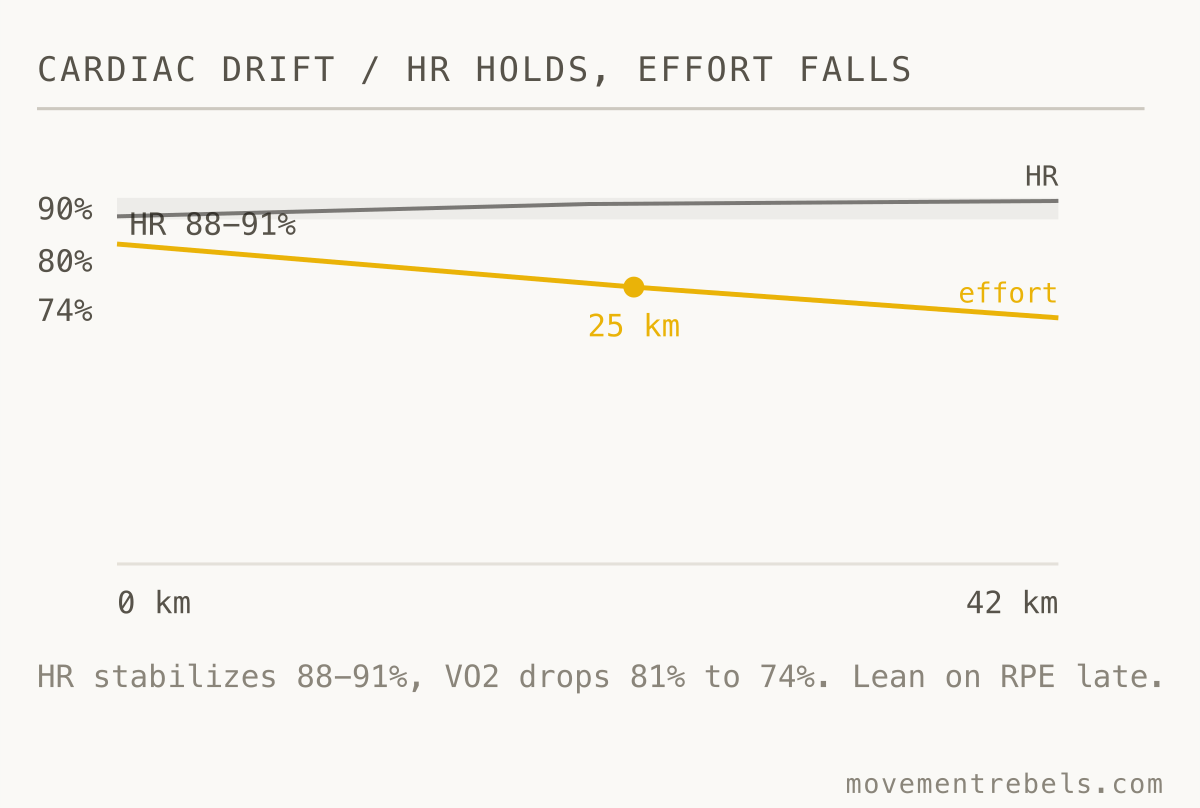
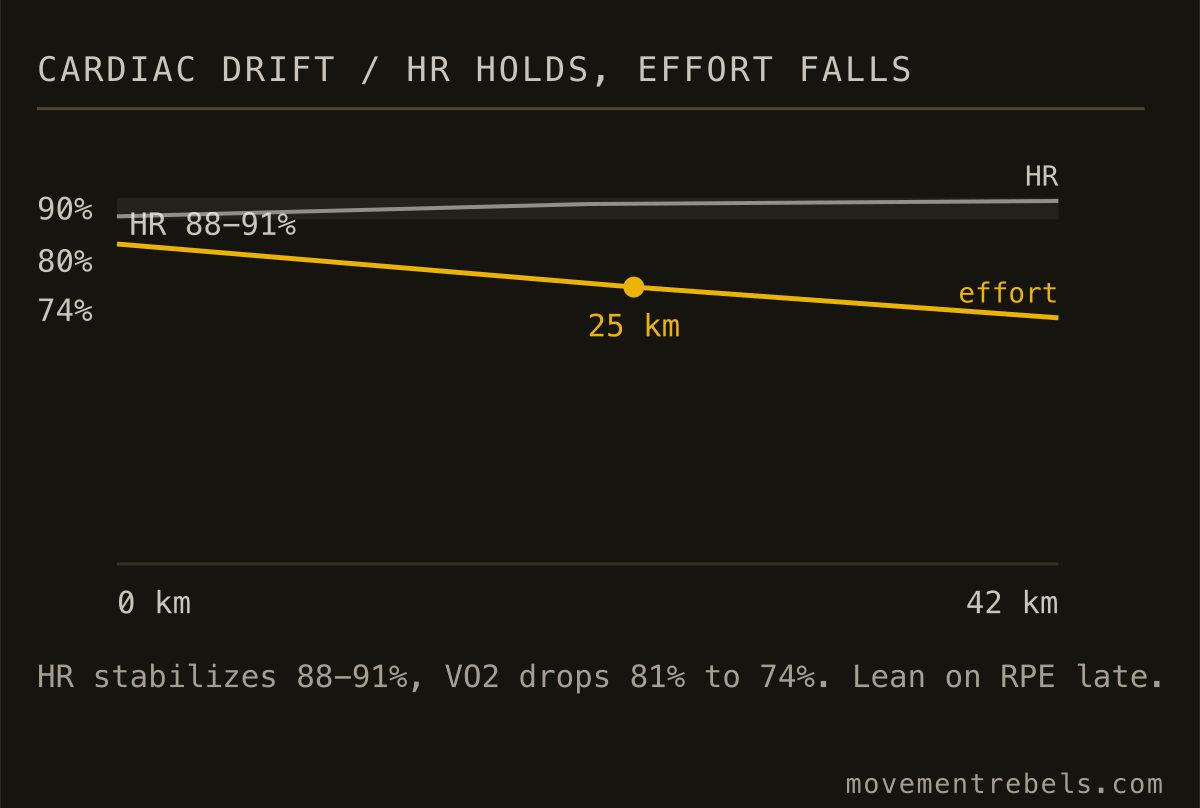
That tells you exactly where HR is useful in marathon training: in the weeks before race day, when your job is to build the engine that resists drift. You train by HR ceiling to keep easy runs truly easy. You track HR-to-pace coupling on long runs to watch your aerobic fitness actually building. And you use HR to police the most common mistake in recreational marathon prep: running long runs too hard.
Pace-based prescriptions get gamed because runners drift into Zone 3 when it feels productive. An HR cap on a 20-miler is not a constraint on your ego. It is the mechanism that keeps the session in the zone where fat oxidation, mitochondrial density, and cardiac stroke volume actually develop. Walk the hills. The watch buzzes when you cross the ceiling. That is the point.
For how to find your personal Z2 ceiling, and why generic 180-minus-age formulas can miss by 15 beats, see the Zone 2 heart rate guide. A heart rate zone calculator for marathon training turns your max and resting HR into the five zones this block runs on.
The Three Anchors of an HR-Programmed Block
Most of the training work in a 16-week marathon block sits at three distinct intensities. Everything else is either warm-up, cool-down, or recoveries between reps.
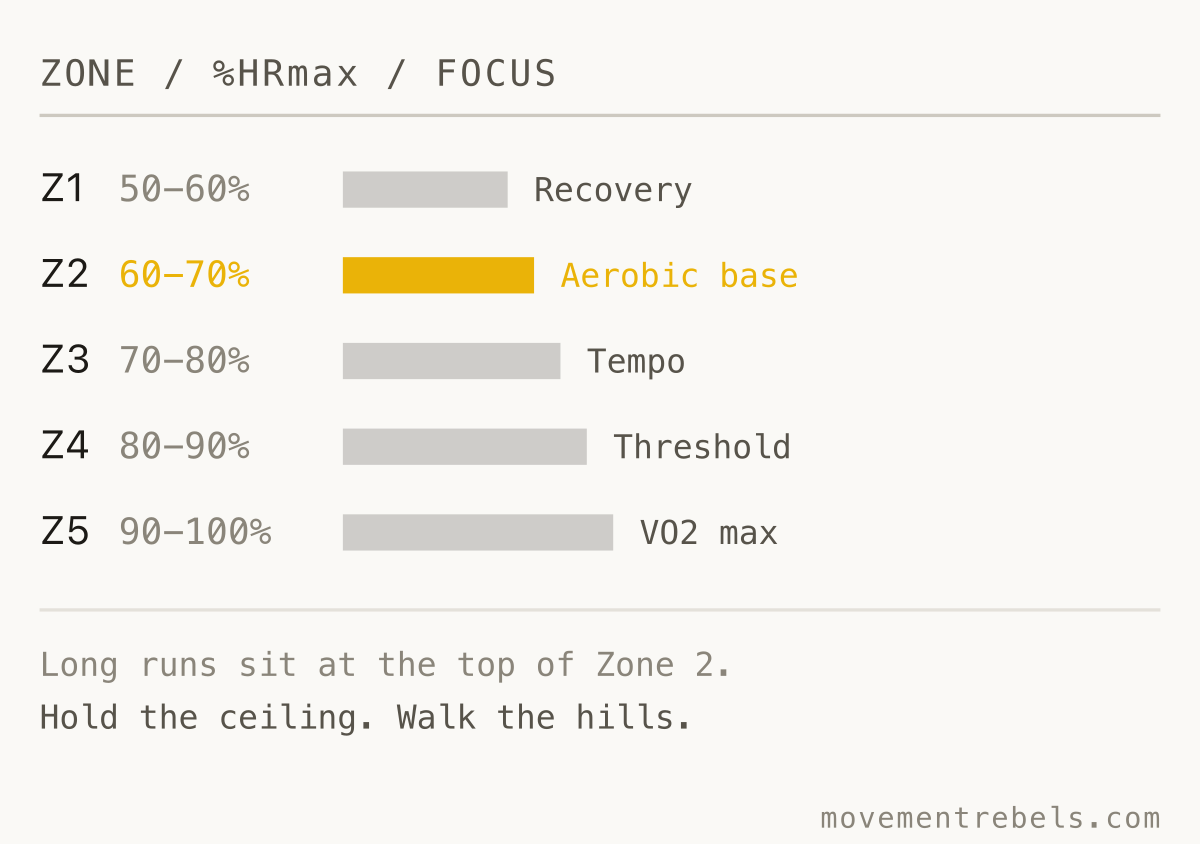
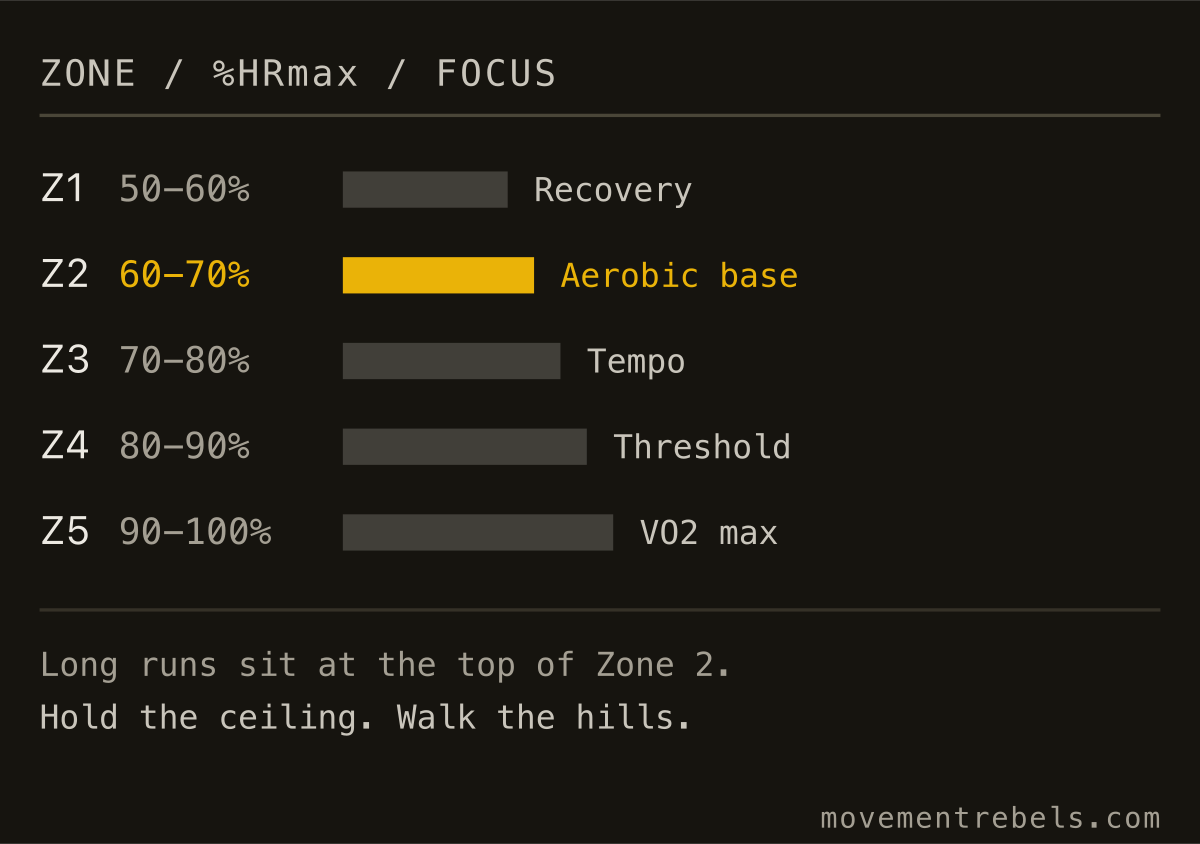
Long run: Zone 2 cap (roughly 70-75% max HR, or the ceiling of your aerobic threshold). The foundational session. The evidence broadly shows that heavy-load strength training improves running economy across a range of speeds, with the aerobic base underneath that economy coming from volume at genuine low intensity. Run long runs at the Z2 ceiling, not above. If you finish a 20-miler feeling like you wasted it, that signal is wrong. The session's job was physiological, not motivational.
Threshold: 88-92% of max HR, one to two sessions per week. Classic cruise intervals, 20-minute tempo blocks, ladder reps. This is the work that raises your lactate threshold so marathon pace settles below it. It is also where the evidence for marathon training is more contested than most guides admit: research on threshold interval training shows strong results for shorter race distances, but applicability to the marathon specifically remains less established. There are no large controlled intervention studies in marathon-specific populations. One weekly threshold session in base, two in peak weeks, is the practical standard. More is not always better, and the evidence does not support more anyway.
For the mechanics of the threshold session itself, the tempo run guide covers structure, pacing, and the common mistake of running every tempo too fast.
Race-pace work: 85-88% max HR at goal marathon pace, starting around week 8. This is where pace and HR have to agree. If your goal marathon pace requires 91% HR in training on fresh legs, the goal is too ambitious for current fitness. The HR does not lie about that. If you are chasing a Boston entry, a Boston qualifier calculator to check your standard shows the time your age and gender need, which anchors the goal pace you rehearse here. Most evidence on recreational marathoners finds they sustain HR in the mid-to-high 80s percent of maximum through the race, with success depending on how efficiently they hold that demand as pace slips in the later kilometres. Practicing race-pace HR in training builds the specific economy and tolerance that transfers to 42 km.
A 16-Week Skeleton
This is the structure Movement Rebels uses as a starting point for a sub-3:45 to sub-4:15 recreational runner, then warps based on what your body reports week to week.
Weeks 1-4: Base. Four to five runs per week, all Z2 except one strides session. Long run progresses from 8 to 12 miles. Two strength sessions. Goal: build aerobic ceiling, prime tendons for the volume ahead.
Weeks 5-9: Build. One threshold session per week added. Long run progresses to 16 miles, alternating a pure easy long and a long run with quality in the final 4-6 miles at race pace. Total weekly mileage builds steadily.
Weeks 10-13: Peak. Two quality sessions per week (threshold plus race-pace). Long runs reach 18-22 miles, the longest with substantial MP mileage in the back half. This is the block's make-or-break phase. Undercut it and you arrive at the start line unproven; overdo it without recovery and you arrive broken.
Weeks 14-15: Taper. Volume drops 30-40%. Intensity stays. Short, sharp threshold reps maintain neuromuscular sharpness without leaving you flat. Taper tantrums are normal: feeling sluggish in week 14 is not fitness leaving, it is inflammation and tissue stress resolving.
Week 16: Race week. Two easy shakeouts, one MP strider session three days out, race day.
Cardiac Drift: What to Watch in Long Runs
The cardiac drift pattern that breaks race-day HR tracking is actually useful diagnostic information in training. On a long run, track what happens to your HR at a fixed pace from mile 6 onward. If HR climbs 5-8 beats across two hours at a held pace, that is normal cardiac drift from plasma volume. If it climbs 15 beats in the first 90 minutes, something else is happening: dehydration, heat load, poor sleep the night before, or accumulated fatigue.
Research on pacing strategy and cardiac drift in sub-elite marathoners has found that positive splits (going out too hard) dramatically worsen drift and hurt finish times. Runners who held even pace showed less drift and faster results. Train for even effort, not even pace. On hills and in heat, let pace drop to hold HR. That is not slowing down. That is correct. A marathon pace band calculator turns your goal time into per-kilometre splits so you can hold even effort instead of chasing the early adrenaline.
This connects directly to recovery quality. If your resting HR has been elevated for three consecutive mornings, the long run HR will drift earlier. The resting heart rate trends guide covers what that 28-day baseline means and when elevated values actually signal something worth acting on.

Strength Is Not Optional
Most off-the-shelf marathon plans ignore strength or suggest two bodyweight circuits that are easy to skip. The injury research is mixed: one well-designed randomized trial on NYC Marathon runners testing a 10-minute bodyweight strength program found no significant reduction in overuse injury rates and no improvement in finishing times, suggesting program design and dosage matter considerably. The case for strength training still stands on mechanistic grounds: stronger glutes resist pelvic drop under fatigue; stronger calves absorb impact repetitions through 35,000 strides; stronger hip abductors protect knees on tired quads. The evidence broadly supports heavier, more structured strength work over minimal bodyweight circuits.
The MR plan keeps two 30-45 minute sessions in the schedule through peak weeks, dropping to one in taper. Heavy compound lifts at low rep ranges: deadlifts, Bulgarian split squats, calf raises, Romanian deadlifts, single-leg press. The goal is force production, not pump. The exercise codex covers form for every lift the plan prescribes, and the strength logger carries load across sessions so the coach knows what you are working at.
For the concurrent training model, the hybrid athlete training guide covers how to sequence strength and runs within the same week without one undermining the other.
Fueling the Block
A 60-mile peak week burns 6,000-8,000 calories above maintenance. Long runs over 90 minutes need 30-60 g of carbohydrate per hour during the session. Recovery within 60 minutes needs 1-1.2 g/kg of carbs plus 20-30 g of protein. Under-fuelling a marathon block is one of the most reliable ways to plateau, get injured, and arrive at the start line already depleted.
The fueling around long sessions guide covers the pre-run, during, and recovery nutrition protocol in detail. If you are running more than 50 miles a week and losing weight, you are under-eating. If your performance has stalled in week 8 and training has been consistent, check the nutrition log before you check the plan.
HR Monitoring and Your Wearable: The Honest Picture
One caveat before getting to the Movement Rebels setup. Optical HR from a wrist sensor has accuracy limitations at high intensities and during activities with significant arm movement or cold-induced vasoconstriction. A chest strap will be more accurate for precise threshold work. For long easy runs where you are staying clearly below Z2, wrist HR is fine. For race-pace intervals and threshold blocks, if you care about zone precision, the chest strap matters.
For HRV-based readiness before big training days, the HRV-guided training guide covers what the metric actually measures and where it is and is not worth acting on.
How Movement Rebels Handles This
Movement Rebels runs the full marathon block in one app. The coach builds an HR-anchored adaptive plan from your athlete profile, then adjusts it week by week based on what your body reports.
Garmin integration is live and bidirectional: structured sessions push to your watch in the morning with HR targets and alerts set, and completed activities sync back through the native Garmin connection so the coach reads what you actually ran, not what you planned.
Apple Health is live on the native iOS app. The coach reads HRV, resting HR, sleep, and all workouts that are present in Apple Health. If you wear a device that writes to Apple Health (Oura, for instance, exports sleep and HRV), those metrics flow in automatically. WHOOP's recovery and strain scores are proprietary and do not export to Apple Health, so MR cannot read them directly. The honest framing: bring that context to the coach chat and it will factor in.
Strava syncs in both directions. Activities appear in Movement Rebels for analysis, and the coach writes a session summary back to your Strava activity description after each run. MR does not use Strava data as a coaching input; the sync is a logging convenience.
When sleep tanks, the coach shifts the quality session to the next day. When HRV drops for three consecutive mornings, volume pulls back. When the race-pace HR stops aligning with your goal time, the coach will tell you before you find out at mile 20.
Pricing
Seven-day free trial, no card required. The full coaching surface, strength logging, Rebel Fuel, breathwork, and Garmin or Apple Health integration are all live in the trial. After the trial, Pro+ is $20/month for unlimited coaching.
Race Time Predictor
Project your finish time from a recent race.
One app instead of five.
Strength, endurance, recovery, fueling, planning, and your AI coach. All under a 7-day free trial. No card.
Start 7-day trialDurability: Why You Fade Late in a Race and How to Train It
VO2 max, economy and threshold describe you fresh. Durability is what holds in hour three. Here is what the research shows and how
Zone 2 Heart Rate: Find Your Real Z2
Your watch zone is probably wrong. 220-age misses individual max HR by 10-15 bpm. Here's how to find your actual LT1 ceiling with
Tempo Runs: Threshold Done Right
Tempo run physiology, honest pacing ranges, three session variants, and why the popular HR zone is wider than coaches admit. Build
HRV-Guided Training: Read the Signal, Skip the Noise
One low HRV night tells you almost nothing. The 7-day-vs-28-day trend tells you nearly everything. Here is what the evidence actua