Tempo Runs: Threshold Done Right
Most athletes run tempo wrong. It goes wrong in two directions: too easy, a glorified hard Z2 that never touches the lactate system, or too hard, a threshold interval session the athlete labels "tempo" because it sounds less frightening. The physiological window that makes a tempo run worth doing is narrow, and the HR targets coaches publish are a rougher approximation than almost anyone admits.
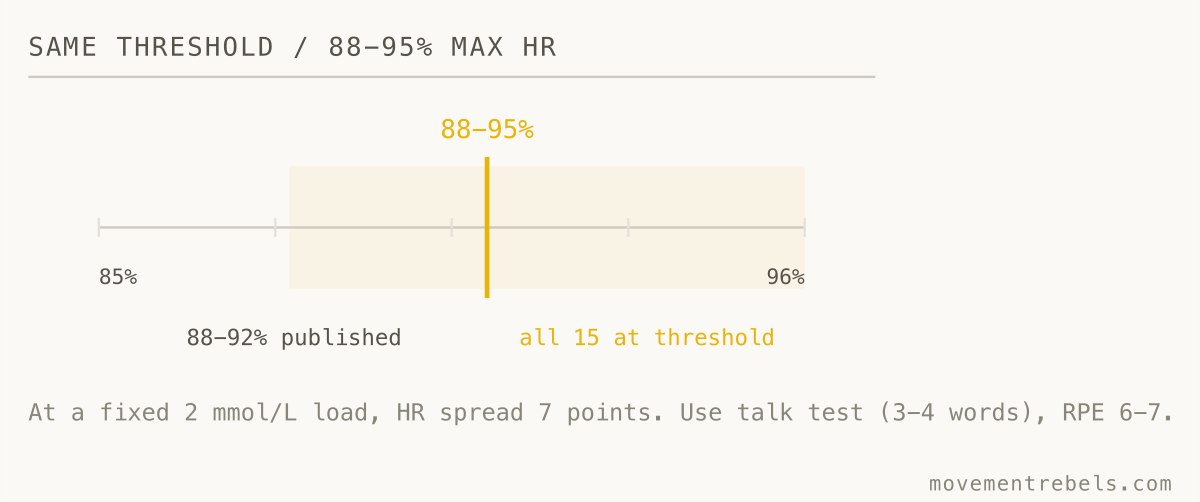
A 2023 study put trained runners on a target-intensity protocol set at the 2 mmol/L lactate level for 40 minutes and measured their heart rate. The target came from an incremental test. Measured blood lactate during the run varied considerably across athletes, and heart rates ranged from 88 to 95% of maximum for the same prescribed intensity. A 7-point spread. Set your target zone at "88-92% of max HR" and you have already excluded a meaningful share of people sitting right at threshold, which is why RPE and the talk test hold up better across a group of runners than the HR number alone.
None of that is a reason to skip tempo work: the physiological case is well-established, and the tool transfers across running, cycling, rowing, and triathlon better than almost anything else in the week. Pace it by what the session does to you. Not by the number on the watch.
What Tempo Is and Is Not
Tempo sits a hair under your lactate threshold (LT2), the intensity where lactate starts to accumulate faster than you can clear it, and below LT2 you can sustain work for a long time. Above it, the clock starts on how long you hold on. Tempo trains the hinge itself, improving the rate at which your mitochondria, slow-twitch fibers, and oxidative enzymes handle lactate as fuel at high workloads.
Arthur Lydiard called it "time trial training" in the late 1950s, and Jack Daniels systematized it as "T pace" in the 1970s, defined as the effort sustainable for roughly 60 minutes in a race context. Renato Canova labeled the same stimulus "marathon-specific work". The label moved. The physiology did not.
What it is not: an interval session. Not all-out either. A 40-minute tempo block should feel controlled and hard, never like something you survived, and if you finish one wrecked you ran threshold or VO2 work, not tempo.
How to Pace a Tempo Run Without a Lab Test
The gold standard is a direct lactate test. Most athletes will never do one. Next best is a 30-minute time trial: research comparing the 30-minute time trial to laboratory lactate measurements has found it produces accurate estimates of running velocity at lactate threshold. The practical application, validated by coaches working with this protocol: run 30 minutes all-out, and the average HR of the final 20 minutes approximates your lactate threshold heart rate (LTHR). Tempo work targets at or a touch under that value. Not a percentage reduction from it.
No time trial yet? Use these anchors in order of reliability:
- Talk test. You can force out three to four words at a time, not a full sentence. Hold a whole conversation and you have drifted under tempo. Fail to get a short phrase out and you have gone over.
- Nose breathing. Still able to nose-breathe? You are not at tempo yet.
- RPE 6-7 out of 10. Breath rhythm of 2:2, two steps inhale, two exhale. Uncomfortable but controlled.
- HR as a secondary check. Given the individual variation documented above, HR is there to catch obvious errors (a 10-bpm overshoot is a real problem) rather than to set exact pace, and while most trained runners land somewhere around 88-92% of max HR, those boundaries are not sharp edges. A heart rate zone calculator for the threshold range turns your own max and resting HR into that band, which beats borrowing a generic percentage.
One pacing detail matters more than the rest. HR lags. In the first 5 minutes of a tempo block your HR sits below where it will stabilize, so run by feel and pace in the opening minutes instead of chasing the HR target. 8 minutes in and still well below the ceiling? You are under-running. Overshot and still climbing? Ease off before drift compounds.
Three Tempo Variants
Classic tempo (20-40 minutes continuous). Warm up 15 minutes easy, run the tempo block, cool down 10-15 minutes easy, a format most marathon and half-marathon plans use because it trains the specific ability to hold a hard pace under accumulating fatigue with no interruption. New to threshold work? Start at 20 minutes and build to 40 over several weeks.
Cruise intervals (tempo intervals). Three to five reps of 8-12 minutes, short 60-90 second jogs between. The rest lets lactate clear slightly, which buys a touch more speed while the metabolic stimulus stays in the same neighborhood, and it earns its place when continuous tempo feels stale or when terrain makes a steady HR block impractical (hilly routes, road crossings). The Norwegian lactate-guided threshold model is a more structured version of that idea, multiple intervals with lactate measured every few reps to pin the pace, and it has produced world-class middle and long-distance runners. No controlled trial has yet compared it directly against traditional continuous tempo. Elite success is evidence, not proof.
Long-run tempo finish. A 90-120 minute easy-to-moderate run with the final 20-30 minutes at tempo pace. The closest you get to race-specific fatigue without racing. Use it sparingly, no more than once every 2-3 weeks, and only in the back half of a build, because starting it under-recovered wrecks two sessions for the price of one.
Frequency and Placement in the Week
One tempo session per week is the standard for most recreational runners in a building phase, and two only in a race-specific block where weekly volume is already high. Tempo is a high-stress session that takes 48-72 hours to recover from, so put it mid-week (Tuesday or Wednesday), far enough from the weekend long run that both sessions land on full legs.
For guidance on how tempo slots into a full week structure alongside Z2 and intensity work, periodization for recreational athletes covers the distribution decisions in detail.
The Cross-Discipline Transfer
Threshold is threshold. A 30-minute tempo on the bike at sweet-spot power (roughly 88-94% of FTP) trains the same lactate clearance machinery as a running tempo of equivalent duration, and so does 30 minutes on a rower at threshold pace. Two groups care about this.
Triathletes can rotate the tempo stimulus across disciplines, cutting orthopedic cost while the physiological signal stays intact, and in a complete triathlon training picture with AI-guided load management that cross-sport substitution logic sits at the center of the plan.
Returning or injured runners get the less obvious benefit. Achilles or knee will not tolerate 30 minutes at tempo pace yet? A cycling tempo session preserves the adaptation while the tissue heals. More on that in returning to training after injury.

Cardiac Drift: the Quality Signal
A clean tempo session holds HR within a 3-5 bpm band across the block at the same pace. Drift of 10 or more beats by the end while pace stays constant means one of three things happened: you started too fast, you are dehydrated, or you are under-fueled. Same signature for all three. All three mean the session paid less than the activity file makes it look.
Track drift over time. A tempo block that costs 91% average HR at pace X in week four of a build should cost less HR at that same pace by week ten, or the same HR at a faster pace. That falling cardiac cost is the adaptation you are chasing. If HR is not dropping or pace is not rising over a 6-8 week build, look at the session structure, the recovery, or the fueling.
For context on how HRV and resting HR trends confirm that adaptation is landing, HRV-guided training is the companion read.
Fueling a Tempo Run
A 40-minute tempo block is short enough that you need no fuel on the run. Long enough that the night before matters. Running tempo fasted is a viable deliberate training choice for some athletes in base phase; for most it kills pace and turns the session into a poor physiological stimulus.
The practical minimum: 30-50g of carbohydrates 60-90 minutes before, water on board, and no multi-day caloric deficit behind you. The evidence broadly points to nutrition and recovery as under-addressed factors that limit the training adaptations athletes get out of threshold work, however well the sessions are prescribed.
More on what to eat around hard sessions: fueling around long training sessions.
How Movement Rebels Prescribes and Adjusts Tempo
The coach does not write "30 min tempo" and leave the ceiling ambiguous. It sets a specific HR target from your most recent max HR estimate and threshold data out of completed sessions, then reads each finished workout back through Garmin Connect or Apple Health (native on iOS, which picks up HRV, resting HR, sleep, and workout data). The post-session debrief checks average HR against the ceiling, flags cardiac drift over the block, and says whether pace held.
The adaptive piece matters more than the prescription. Your morning brief reads HRV, sleep duration, resting HR trend, and prior-day load. Signals suppressed? The coach replaces tempo with Z2 of the same duration and explains the switch, because spending a hard-session credit on a body that cannot bank the adaptation wastes a training week.
Structured tempo sessions push straight to your Garmin watch through the native integration, HR zones and duration pre-loaded, and Strava users get a session summary written back to the activity description once the workout syncs. The coach builds that debrief from your completed activities in Garmin or Apple Health; Strava is never an AI input.
For how the coach handles marathon training with live heart rate data across a full build, the link between tempo prescription and long-run pacing is covered there.
When to Skip the Tempo and Run Z2 Instead
Most tempo guides never answer this one. Replace tempo with Z2 that day if any of these are true:
- HRV is down more than 10-15% from your recent baseline.
- Resting HR sits 5 or more beats above your rolling average.
- Sleep was under 6 hours and you feel it.
- You are in week one of a deload.
- You are less than 72 hours out from a race or an unusually long hard effort.
Tempo and zone 2 overlap less on physiology than on readiness. Both are valuable. You can always run Z2, and you cannot always run tempo productively.
Pricing
Movement Rebels covers the complete picture: strength, endurance, hybrid, planning, AI coach, nutrition tracking, recovery tools, and native integrations with Garmin, Strava, and Apple Health on iOS. One app instead of five.
The 7-day free trial gives you the full coach, the adaptive plan, structured workouts pushed to your Garmin, and the post-session analysis. No card required. After the trial, Pro+ is $20/month for unlimited coaching.
VDOT Calculator
Get your training paces from a recent race result.
One app instead of five.
Strength, endurance, recovery, fueling, planning, and your AI coach. All under a 7-day free trial. No card.
Start 7-day trial5K and 10K Training: A Weekly Plan to Race Faster
A specific 5K and 10K training plan: easy volume, one VO2max session, one threshold session, a long run, sample workouts with pace
Zone 2 Training: When It Works, When It's a Waste
Zone 2 is real, old, and oversold. Here's the honest version: when low-intensity volume is your highest-leverage work, when it isn
Zone 2 Heart Rate: Find Your Real Z2
Your watch zone is probably wrong. 220-age misses individual max HR by 10-15 bpm. Here's how to find your actual LT1 ceiling with
Marathon Training With Heart Rate Data: The Honest Playbook
HR-based marathon training is powerful and misunderstood. The honest version: what cardiac drift means for race day, when pace bea