Core and Hip Strength for Runners
Crunches. That's where most runners put their core work, flat on their back, banging out reps, then wondering why the form still falls apart late in a race. By then it's too late. Core and hip stability collapse starts miles earlier, in muscles too weak to resist the forces running piles onto a single leg. Fix the weak link and your late-race form stops falling apart. This guide goes deep on the hip and core, and for a broader look at how strength fits into a running program, read strength training for runners.
Why hips and core matter for running
You are not a metronome when you run. Every time the left foot lands, your whole body has to hold position against the rotational and sideways forces that leg creates: the right side of your torso wants to drop, the hips want to shift inward, the knee wants to cave. You have muscles dedicated to stopping all of that, and when they're weak you compensate, and compensation means you lean, you twist, you alter your stride. Hold that for kilometers and you've built an injury. The postural breakdown you notice late in a run is not a form cue problem. It's a strength problem. No amount of running cadence or form coaching fixes what weak hips have already broken.
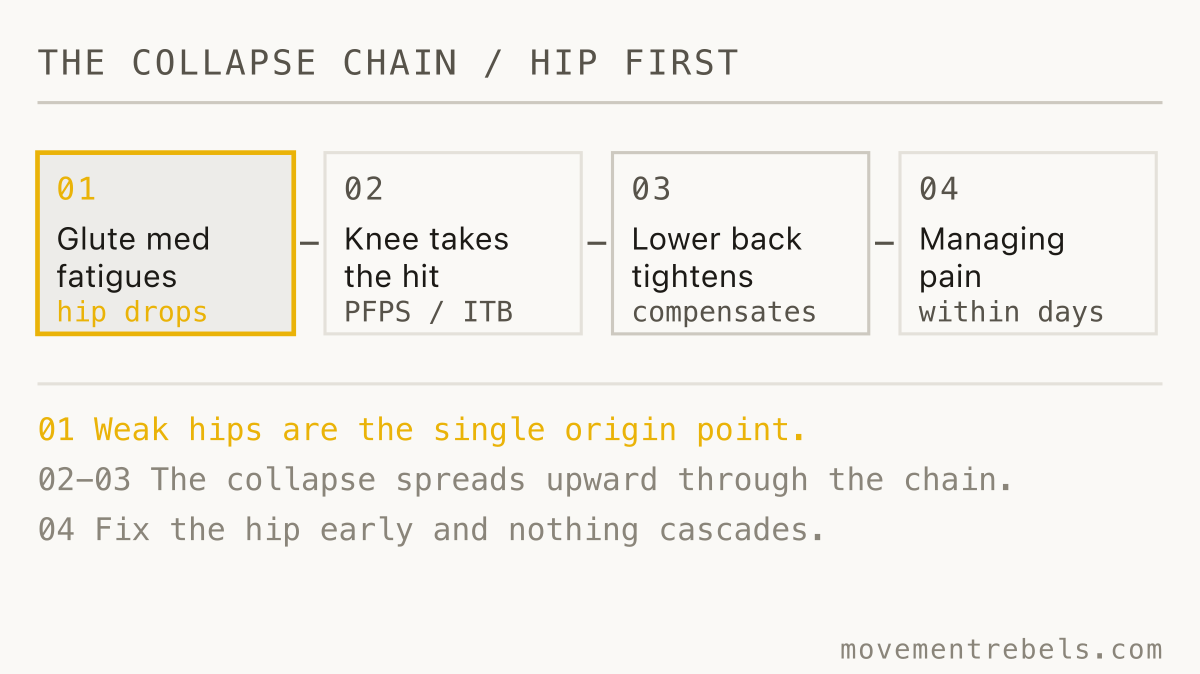
This is why distance runners hit the wall at the same point every season. The cardiovascular system rarely gives out. What gives out is the hip stabilizers: they fatigue, single-leg control goes, form collapses, and suddenly every footfall hurts. Then it spreads upward. Hips can't hold, so the knees take the hit, the lower back tightens to cover for both, and within days you're managing pain instead of chasing pace.
Your core is not your six-pack. It's the deep abdominal wall, the back, and above all the hip stabilizers, holding the trunk stiff while the legs move underneath. Get that right and your legs push straighter, your posture holds when fatigue arrives, and your joints absorb force instead of fighting your own biomechanics. Weak hips are the origin point for three different injury chains. Fix it early and nothing cascades.
The crunch myth
Crunches, sit-ups, endless floor work at high reps: that's most running-specific core work you'll see. It trains the spine to flex and extend. Running demands the opposite, that your spine doesn't move while your legs work, and the training that builds it is anti-movement: resistance to rotation, resistance to extension, resistance to collapse.
Crunches feel athletic because they burn. They burn because they're high-rep endurance work, the same endurance you already own from every run you've done, and none of that burn builds the stiffness and stability that protects you from injury.
Anti-movement is different. A Pallof press won't let your trunk rotate, a dead bug holds your back neutral while one leg travels away from it, and both are teaching the same job: stay rigid while everything else moves.
The muscles that matter
Three muscular jobs: drive, stabilize on one leg, hold the trunk together.
Gluteus maximus is the engine. It drives the hip back into propulsion and responds to heavy loading, the kind of loading most runners never give it, which is why hip thrusts and deadlifts belong in a runner's week. Late in a run, or on a climb, the glutes fatigue, and when they do, both propulsion and hip control drop off with them. Strengthen it. Your late-race power holds longer.
Gluteus medius stabilizes the single leg. One foot lands, the glute med on that side fires, and the hip stays level instead of dropping and collapsing inward. Weak glute med and the hip dips, the knee caves, the stride breaks down, which is why it's the muscle tied most directly to runner's knee, ITB syndrome, and hip imbalance injuries. A review of iliotibial band syndrome in runners found that strengthening the hip abductors reduces pain and improves function.
Deep core (transverse abdominis, multifidus, internal obliques) makes the trunk stiff and keeps the spine from rotating or bending when it shouldn't. Anti-rotation work lives here.
The injury link
Runner's knee (patellofemoral pain syndrome) and iliotibial band syndrome are the two most common injuries runners face, and both are strongly linked to weak hips and poor hip control. Whether weak hips are the first cause or a contributing factor is still debated.
On patellofemoral pain the evidence points two ways. Reduced hip strength, particularly hip external rotation and abduction, is strongly associated with the condition; the link to excessive hip adduction during running carries somewhat more mixed evidence, and either way the mechanism at the knee is the same: hips weak, knee angles inward to compensate, pressure lands on the wrong parts of the joint. Over time that pressure becomes pain.
ITB syndrome works similarly: weak glute medius allows your hip to adduct and rotate inward excessively, which increases friction and compression of the IT band at the lateral knee. The pain shows up at the knee. The driver sits higher up, at the hip.
Both respond to targeted strengthening. You don't need months of floor work; a few hard, focused sets on the right exercises change your biomechanics fast.

The exercises that work
Five patterns. Run them twice a week alongside your training, on a hard run day so you stack hard with hard, and the whole session takes 20 minutes if you keep moving between sets. The payoff is out of proportion to the time.
Pallof press (anti-rotation core). Stand sideways to a cable or band anchored at chest height, hold the handle at your chest, press it straight away from your body while your torso is begging to rotate toward the anchor. Don't let it. 3 sets of 8-10 per side, heavy enough that holding position takes focus, and what you're training there is your core's resistance to rotation, the job it has every time you run. Slight pause at full extension, then control it back. The return is half the movement. Rush it and you lose the stimulus.
Side plank (hip and core stability). 3 sets of 30-45 seconds per side. Simple and merciless. The moment your hips drop the set is over: a tight 30-second plank beats a sloppy 60-second one every time, so stop when the position goes instead of grinding out the clock. Once the basic hold feels solid, add a leg lift (bottom leg abduction, top leg abduction, or single-leg lift), variations that train hip abduction strength directly.
Single-leg Romanian deadlift (glute med and max, single-leg stability). Dumbbell in one hand, hinge at the hip on one leg, the other leg extending behind you for balance, and the working leg's glute med has to stabilize that hip against the weight the whole way down. 3 sets of 8-10 per leg. Each leg works independently, which is why this is the exercise that fixes imbalances, so do the weaker leg first, while you're fresh, and it gets a fair training stimulus.
Hip thrust (glute max and med). Shoulders on a bench, feet on the ground, weight across your hips, drive through the heels and lock the hips fully open. 3-4 sets of 6-10 heavy reps. Glute max learns to produce power here and glute med has to stabilize under load, and the lockout is where the lesson lands: squeeze hard at the top, 1-second pause. Running asks glute max to fire maximally on every stride.
Single-leg glute bridge (glute med and max, single-leg work). Everything the hip thrust gives you, one leg at a time. A weak side gets exposed immediately. 3 sets of 8-10 per leg. You'll often find one side produces noticeably less power, or can't hold the position as stably, and that's the side to emphasize over the next 3-4 weeks.
Five exercises, twice a week, a few hard sets each. Not 20 minutes of floor work. That's the complete hip and core program, done in 20 minutes.
How to program it
Stack this work with your running. Never on an easy day. Tuesday is a hard run day: intervals or tempo first, then 15-20 minutes later the hip and core work, while the nervous system is still switched on and your easy days stay easy. Use a training volume calculator to check that your total weekly sets across lifting and running sit inside what your recovery can handle.
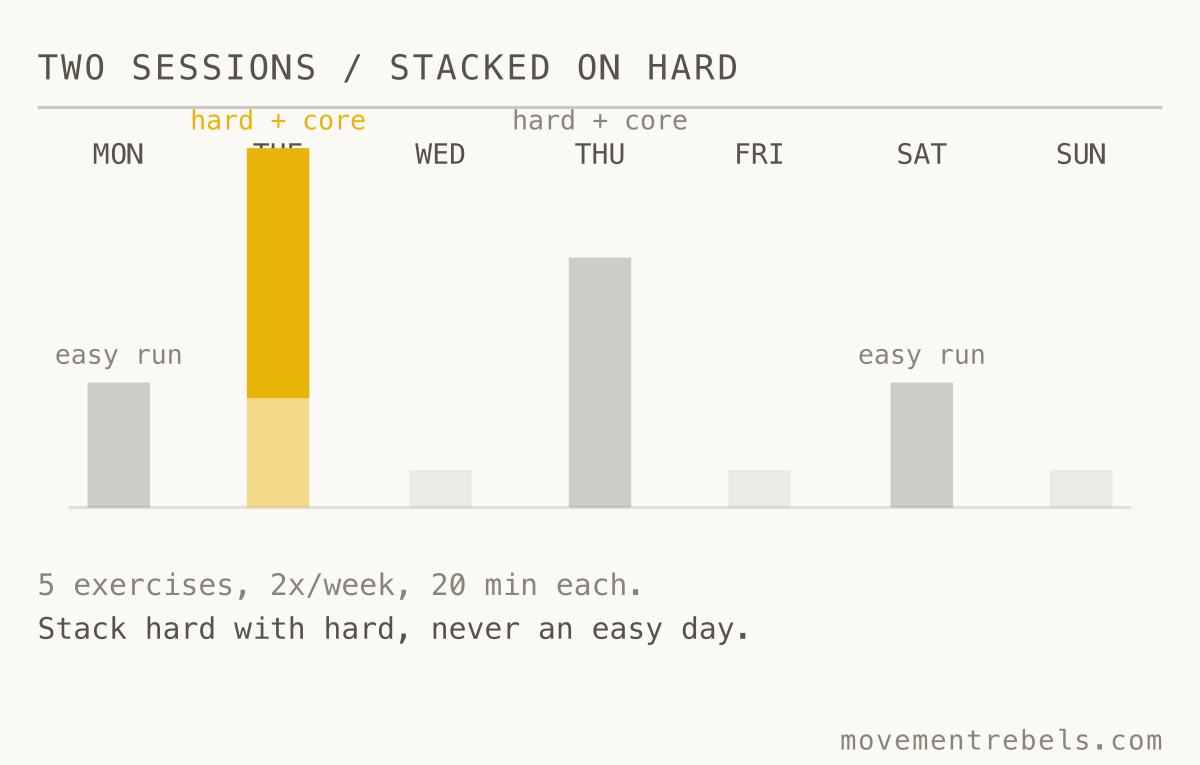
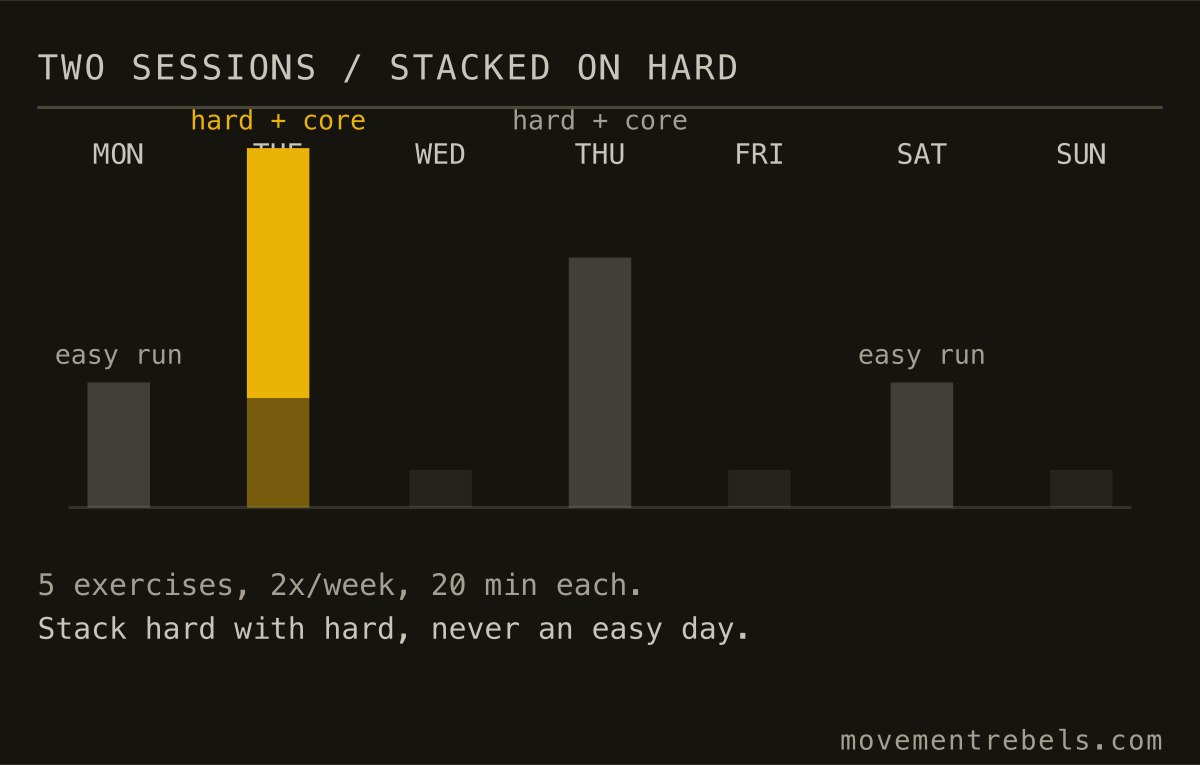
A five-run week looks like this:
- Monday: Easy run. No lifting.
- Tuesday: Hard run (intervals) + hip and core session.
- Wednesday: Easy run or rest.
- Thursday: Hard run (tempo or long) + hip and core session.
- Friday: Rest.
- Saturday: Easy run.
- Sunday: Full rest or easy.
2 sessions a week, 20 minutes each. The evidence on exercise-based injury prevention programs is mixed overall; the case for consistency is not, and two focused sessions beat sporadic floor work every time. Miss one session a month and nothing happens. Miss one every other week and it shows, which is the whole argument for showing up twice a week even after race season starts.
Add weight, not reps. When 3 sets of 8 single-leg RDLs feel controlled, add 5 pounds and start the climb again, because the strength comes from load and not from grinding out high reps. Use a calculator to track warmup sets leading into your working weight so you hit the target load ready to work, not cold and tentative.
Track your numbers. Weight and reps for each exercise, written down, every session. You'll see linear progress for 4-6 weeks, then a plateau, then another jump, and that progression is what builds resilience into your hips and core.
Common mistakes
Read this part twice. These are the errors that waste your time and invite injury.
Confusing quantity with quality. Thirty minutes of low-intensity core work does not beat three hard sets of Pallof press. Intensity drives adaptation. Count hard sets, not minutes.
Programming hip work on easy days. A hard leg session on an easy day turns that day into a hard day, and then you have no recovery day left in the week. Stack hard with hard. Protect the easy days. Non-negotiable.
Skipping single-leg work. Single-leg exercises are slower and harder than bilateral movements, and they are the only way to find and fix an imbalance. The injury usually shows up on one side. Single-leg work catches it.
Neglecting the glute max. Runners fixate on glute med because the link to hip stability is obvious, and meanwhile a weak glute max is what has them falling apart late in a race. Heavy hip thrusts build the power that lasts.
Starting with crunches. You already have core endurance. What's missing is stability and stiffness, so start with the Pallof press and dead bugs instead, because crunches don't teach your core the job it does when you run.
Dropping hip work during race season. Racing starts, the gym goes, and the thinking is that rest and easy runs are all that matter now. That's when form falls apart most. Hold one quick session a week: 2-3 sets of your main lifts, heavy, low reps. Maintenance only. 15 minutes, and it saves your late-race power.
How Movement Rebels fits
The hard part isn't knowing you should do this work, it's fitting it into the week without tanking your running. The Movement Rebels AI coach reads your Garmin and Apple Health data across the week, the hard runs, the recovery, the sleep, the readiness, and puts your hip and core session on the same day as your hardest run, when your body can absorb the stress. Flat week? Bad night of sleep? It pulls the strength volume back instead of stacking stress on top. And when your runs start sliding, or your form degrades late in a workout, it adapts the strength work to the exact weakness showing up in the data. It reads the imbalance instead of guessing at it.
Start this week. Two sessions, five exercises each, heavy and deliberate. The hips get stiffer under you, and the form that used to go late holds.
One app instead of five.
Strength, endurance, recovery, fueling, planning, and your AI coach. All under a 7-day free trial. No card.
Start 7-day trialStrength Training for Runners: Get Faster and Stay Healthy Without Bulking
How runners should lift to run faster and stay injury-free: the key lifts, heavy over high-rep, two sessions a week, plyometrics,
Returning to Training After Injury: Slower Than You Think, Faster Than You Fear
The 10% rule is not science. Tendons recover three times slower than muscle. Here is what the evidence actually says about coming
Hill Training for Runners: Strength, Speed, and Economy
Hills are resistance training you can run. Short reps for power, sustained climbs for threshold, downhill for race skill. The hone
Running Cadence and Form: What Matters, and What Doesn't
Kill the 180-cadence myth. Overstriding is the real problem, and a modest cadence bump is the fix backed by evidence. Here is what