Returning to Training After Injury: Slower Than You Think, Faster Than You Fear
The honest version of injury comebacks is uncomfortable: almost every piece of conventional advice is either unsupported by evidence or too conservative for the wrong reasons. The 10% weekly progression rule is not grounded in science. The "just listen to your body" instruction fails the moment your engine recovers faster than your connective tissue can. And the people who scream "do more" are usually selling you a comeback protocol that does not distinguish between muscle, tendon, and bone.
Here is what the evidence actually says, what the real gaps are, and how to use that to build a comeback that holds.
Why most reinjuries happen in week three, not week one
Reinjury rates after return to sport vary widely by tissue type and sport, but the pattern is consistent: the risk concentrates in the weeks after the athlete feels ready, not when they are still limping. The research broadly shows that rates span from near-zero to over 60% depending on protocol, with high rates clustering in programs that used static stretching and isolated exercises without functional loading. Structured, individualized rehabilitation algorithms cut reinjury risk compared to fixed protocols in nearly every study that compared them.
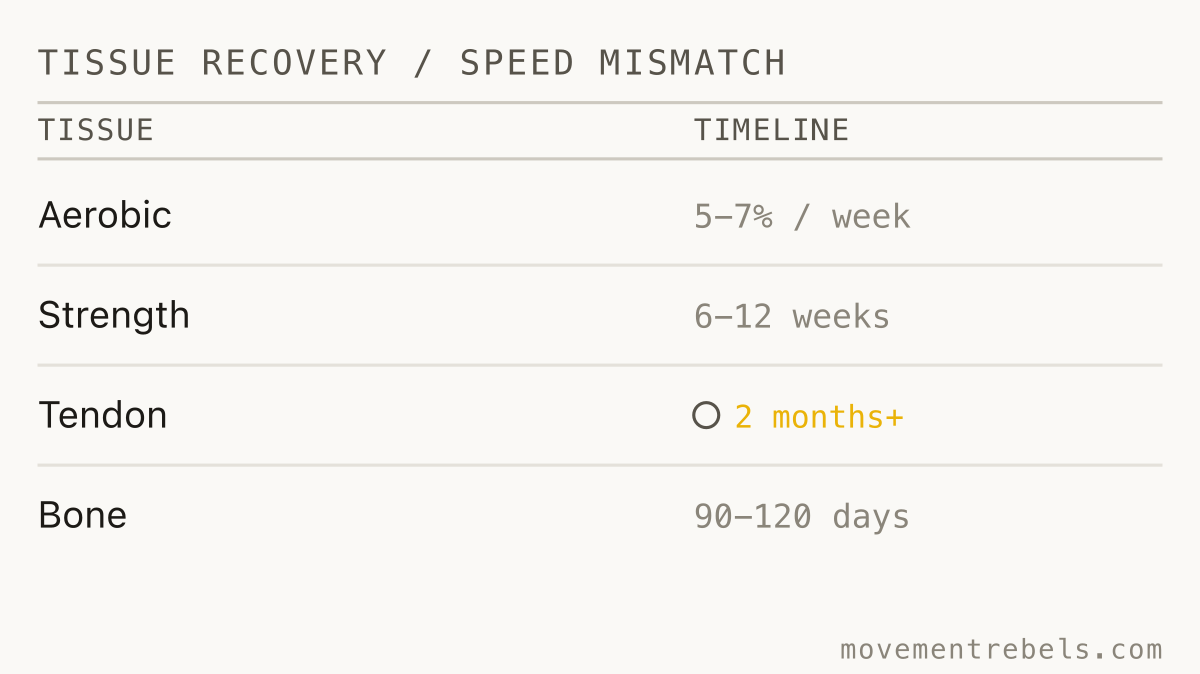
The reason the peak sits at weeks three and four is biomechanical, not motivational. Muscle soreness fades. Aerobic capacity recovers relatively quickly with real training. The central nervous system re-learns movement patterns sooner than connective tissue heals. None of that is the limiting factor. The limiting factor is collagen.
The evidence on muscle-tendon adaptation rates puts the mismatch in plain terms: strength gains appear in days (neural first, then hypertrophy over six to twelve weeks), but tendon stiffness, which is what lets you tolerate impact without micro-tearing, takes two months or more to improve after sustained loading. Detraining reverses tendon properties on roughly the same slow schedule. Six weeks off running and your aerobic fitness comes back in a few weeks of reconditioning, but your Achilles is still operating at the load tolerance of someone who has not run since before the break.
That gap is what gets people. You feel great. Your tissue is not. You hit your old pace at week three and at week four you pull the same structure in a different place.
The 10% rule: useful heuristic, not evidence
This is where the standard comeback guide does you a disservice. The 10% weekly volume increase rule is repeated as if it came from a randomized trial. It did not. The research on training parameters and running injuries has found explicitly that the popular 10% rule for increasing weekly distance is not justified. Studies comparing 10% progression to faster or slower progressions in novice runners found no injury-prevention benefit from the rule itself.
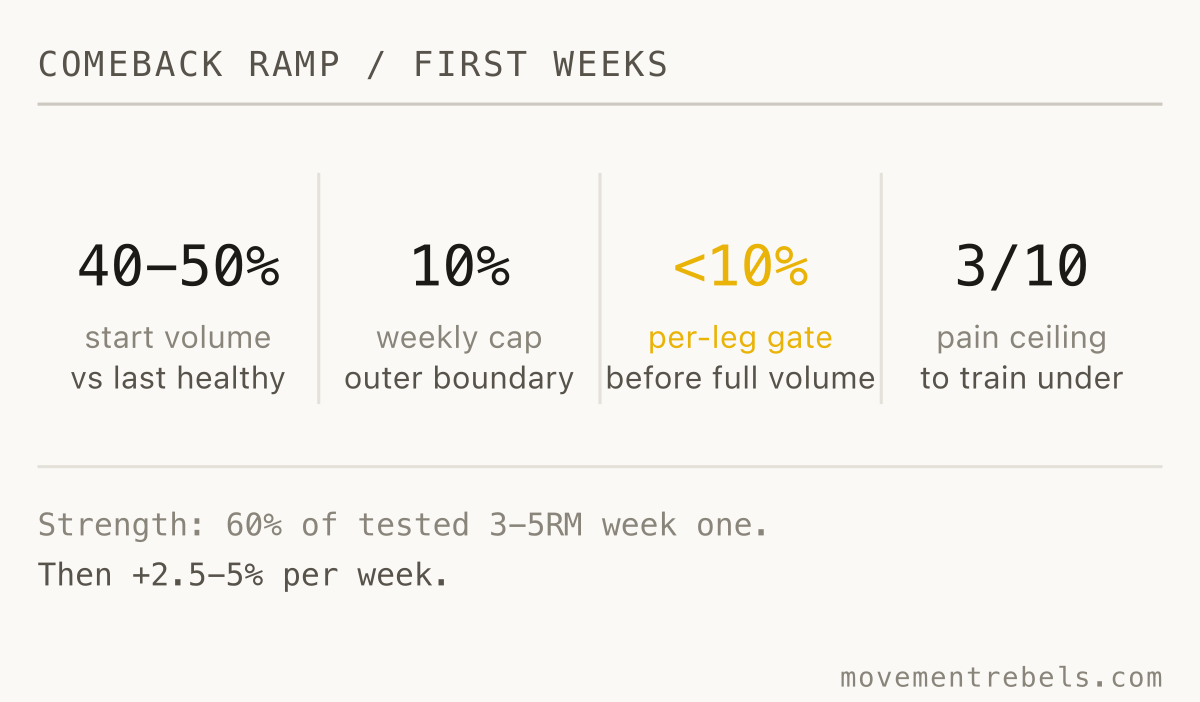
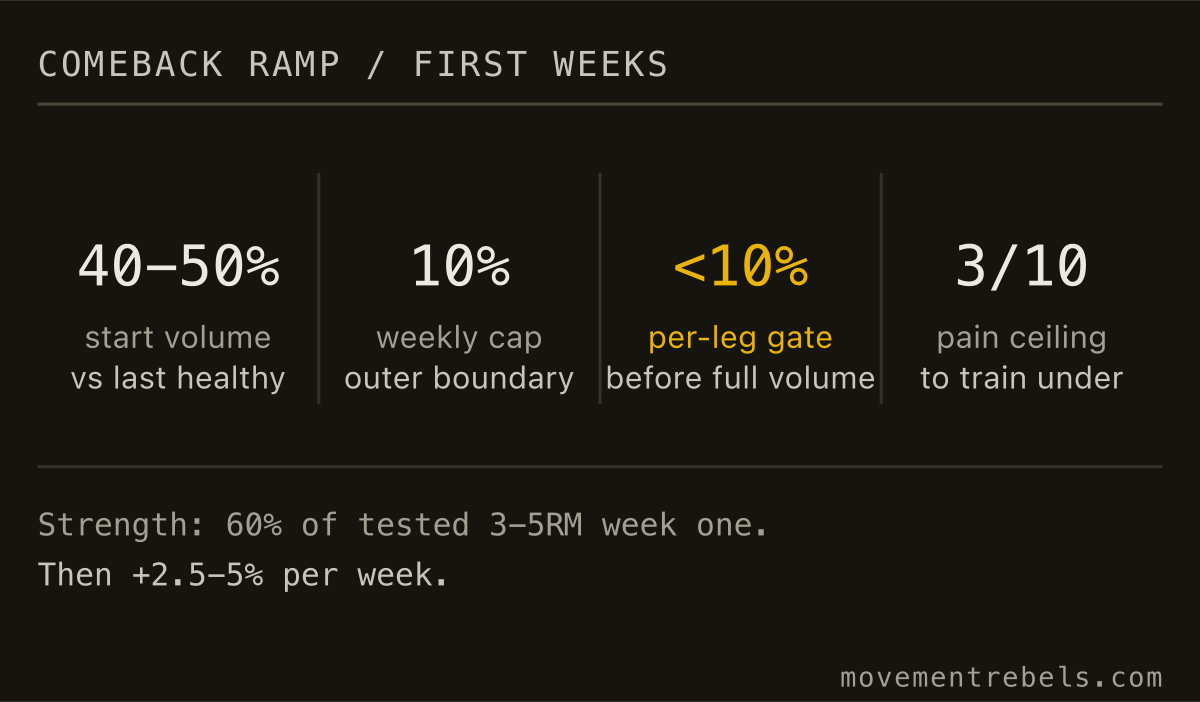
What does hold up: the risk increases sharply when a single session represents a large jump from the longest effort in the previous 30 days. Acute-to-chronic workload ratio matters more than a fixed weekly ceiling. The practical implication is that the 10% guideline is a useful outer boundary, not a guarantee, and the real check is whether your body is absorbing each week before you add the next one. A training volume calculator with MEV and MRV bands helps you stage that ramp so each week sits inside a guideline range rather than guessing the next jump.
For a runner returning after a stress fracture: start at 40-50% of last healthy volume, cap weekly increases at 10%, and do not accelerate that ramp because week two felt easy. Bone remodels on a 90-120 day cycle. You cannot negotiate with that timeline by training harder.
For strength athletes: test a conservative 3-5 rep set at a submaximal load, use 60% of that as your week one working weight, and add roughly 2.5-5% per week. If the lift was directly involved in the injury (squat after a meniscus repair, bench after shoulder reconstruction), skip the test, use a tempo set, and treat it as a new training block, not a continuation of the old one.
The strength case most endurance athletes skip
The single most reliable predictor of staying healthy through a run comeback is whether you have reintroduced structured strength work. Hip, hamstring, and calf work with progressive eccentric loading is well supported for reducing reinjury risk in running athletes.
The most robust single exercise in this category is the Nordic hamstring curl. The evidence broadly finds that the exercise increases both eccentric knee flexor strength and fascicle length, the two structural factors most directly linked to hamstring strain risk. The exercise looks simple. At full depth, under fatigue, it is brutally effective. Two sessions per week, progressed over four to six weeks, is the dose the evidence supports for protective adaptation.
The unsexy companion list: single-leg calf raises through full range, step-ups with load, heel-raised goblet squats. None of these go viral. All of them address the unilateral asymmetry that almost always persists after injury on one side and accounts for why the contralateral limb often takes the second injury. A 20% strength deficit on the injured side is not "almost back," it is the setup for week six.
The cold immersion note: if you are doing regular ice baths or cold water immersion during a strength rebuild, cap it at twice per week. Chronic post-exercise cold immersion blunts the hypertrophic signaling you are specifically trying to build. It is fine for general recovery. It is counterproductive as a daily habit when muscle mass is the goal.
What objective data actually tells you about readiness
Subjective feel is not useless. It is just insufficient on its own during a comeback, because your subjective feel lags the tissue by weeks in both directions (you feel terrible on day ten of full rest; you feel great at week three when connective tissue is still underbuilt).
HRV is the most accessible objective signal. The research consistently finds that reductions in HRV concurrent with workload spikes are associated with increased overuse injury risk. The mechanism is not magic: HRV is a proxy for autonomic recovery, and depressed HRV during a ramp phase means the nervous system has not caught up to the training load, which predicts tissue breakdown before pain appears.
The resting heart rate signal is coarser but more robust: 5+ bpm above your baseline for two consecutive days during a comeback is a reliable flag that your load has outpaced your recovery. It does not always mean back off. It means flag it, log it, and make the next decision with that information rather than ignoring it.
Pain itself is a signal, not a veto. A 0-2 out of 10 discomfort at the injured site during activity is generally safe to train through in most soft tissue injuries. A 4+ that does not clear within the first five minutes, or that is present the morning after a session, is telling you the load exceeded capacity. The old "no pain no gain" frame is useless in rehab. The updated frame: train to a 3/10 ceiling and monitor the next morning.
The missed factor: where you are metabolically when you return
Most injury-comeback guides discuss load progression and ignore the metabolic context entirely. The athlete who lost 1-2 kg of lean mass during a six-week layoff is returning with altered power-to-weight on the bike, different ground reaction forces on the run, and tendons that adapted to a lighter body. That is not a small detail. Pretending last year's volume targets apply to this week's body is one of the cleaner paths to a second injury.
Body composition tracking during the layoff and the early comeback weeks gives you a real calibration point. If you lost lean mass, your early targets need to reflect that, and the strength rebuild is not optional. It is the fastest way to restore the load tolerance your tissue had at peak fitness.
Hydration is more relevant than it sounds here. Tendons are roughly 70% water by weight. Underhydration measurably reduces tendon compliance. An athlete drinking 1.5 L per day is loading stiffer, less elastic tissue than one who is consistently at 2.5-3 L. It is a small lever, but during a comeback where every small lever matters, it is worth pulling. See hydration tracking for athletes for the practical framework.
Fueling, too. Coming back under-fueled is more damaging than the same ramp with adequate nutrition. Collagen synthesis requires vitamin C and adequate protein. If you are undereating during the comeback, you are slowing the exact repair process the plan depends on. The fueling guide for long sessions covers the overlap between caloric timing and recovery.

The psychological piece most physio plans skip
The research consistently finds that fear of reinjury predicts worse return-to-sport outcomes. Athletes who pass the physical criteria but return with unresolved movement fear tend to compensate biomechanically, which can shift load to adjacent structures. The research on psychological readiness and return to sport broadly supports this, though the exact mechanism and the degree to which movement fear independently predicts actual reinjury is still being studied.
This is not a therapy plug. It is a practical training point: if you find yourself consistently avoiding full range of motion on the relevant joint, dropping out of sessions early when the area feels tight (not painful, just tight), or catastrophizing mild soreness, you are probably dealing with movement avoidance that needs direct exposure, not more rest. The comeback plan needs to address it explicitly.
Build exposure progressively the same way you build load. Practice the movement that scared you at low speed, low load, controlled environment, before you trust it at full pace and full effort. The confidence that comes from repeated successful exposure is not motivational fluff. It resolves the compensation pattern and reduces actual reinjury risk.
Bone is on its own schedule and cannot be negotiated with
Stress fractures and reconstructive surgeries warrant a separate note. Bone remodels over a 90-120 day minimum cycle. No training approach, no supplement, and no device accelerates the structural remodeling timeline. What goes wrong here is simple: the athlete feels pain-free at six weeks (because the stress-fracture pain was periosteal, not structural), returns to full load, and finds at week eight that the bone was not ready.
The clearance criteria for bone injury return are imaging-based, not symptom-based. Pain-free means nothing without a follow-up scan showing callus formation or confirmed remodeling. If your clearance came from "it doesn't hurt anymore," push for imaging confirmation. For masters athletes especially, where bone mineral density is a genuine variable, this step is not optional.
Similarly, soft tissue reconstructions (ACL, Achilles, rotator cuff) have biologically enforced milestones. Graft incorporation after ACL reconstruction takes nine to twelve months, and the evidence shows that returning to cutting and jumping sports before nine months substantially increases reinjury risk regardless of how the athlete performs on a single-leg hop test at six months. The increase is large, not marginal. Criteria-based discharge (strength symmetry above 90%, functional testing, not just time) is the current evidence standard.
Using recovery data honestly alongside subjective feel
The signal worth following for daily decision-making during a comeback is a combination of: morning HRV trend (not a single reading), resting HR versus your personal baseline, quality of sleep (Apple Health reads this from compatible devices), and a 0-10 pain score on the relevant area before the session starts. No single signal is sufficient. All four together give you a real picture.
The honest caveat: HRV readings are noisy on any given day and require a baseline of at least two to three weeks to interpret meaningfully. Do not make large training decisions off a single low HRV morning. Look for trends across four to seven days. A consistently suppressed trend during a ramp is meaningful. One bad reading after poor sleep is noise.
If you are working with HRV-guided training or deload signals in your normal training, the same framework applies during comebacks, but the sensitivity needs to go up. What you might push through in a normal training block is worth pausing on in a comeback, because the cost of a setback is measured in weeks, not sessions.
How Movement Rebels handles return-to-train
The coach has a specific mode for comebacks. The plan drops to 40-50% of your stored pre-injury training volume on day one and locks the weekly progression ceiling. You can flag your injury in the coach chat (what tissue, how long the layoff, clinical clearance status), and the plan-gen rebuilds the calendar from there.
Three signals feed the daily adjustment. HRV trend comes in through Garmin or Apple Health (native on iOS), and a depressed trend downshifts the session before you start it. Resting heart rate running 5+ bpm above your personal baseline pulls the same lever. Before each session, the coach asks for a pain score on the relevant area and adjusts in real time: a 3/10 is a green light, a 5/10 triggers a tempo cap, a 7/10 replaces the session with recovery work.
Garmin Connect is live: the coach reads completed activities back through the native integration and grades them. If you ran 35 minutes of a 40-minute easy run with your heart rate consistently above target, that shows up. The next prescription adjusts. For Apple Health users on iOS, HRV, sleep quality, and resting HR come through the same channel: the coach reads them overnight and updates the next day's session before you open the app.
The strength logger tracks per-leg asymmetry. The coach holds you in the rebuild phase until the gap between injured and uninjured sides closes below 10%. It will not accelerate you to full run volume while a 25% strength deficit persists on the injured side, because that deficit is the reinjury in waiting.
Body composition tracking runs alongside all of this. If lean mass dropped during the layoff, the coach calibrates expectations accordingly: old pace targets do not apply to a body that is currently two kilograms lighter than it was at peak fitness. The recovery tools (breathwork, NSDR, sleep tracking) live in the same app, not separate ones, so the coach can read the actual recovery pattern rather than guessing.
One app, one picture, instead of four tabs that have never spoken to each other.
Pricing
Movement Rebels is one app for the full picture: strength, endurance, hybrid, planning, coaching, fueling, recovery, tracking. A 7-day free trial covers everything. After the trial, Pro+ is $20/month for unlimited coaching. No card on the trial.
One app instead of five.
Strength, endurance, recovery, fueling, planning, and your AI coach. All under a 7-day free trial. No card.
Start 7-day trialTraining Consistency When Life Is Busy: How to Keep Moving Without a Perfect Schedule
How to stay consistent when work and family eat the week: your maintenance dose, protecting intensity over volume, and a triage or
Return to Running After Injury: A Step-by-Step Plan That Does Not Rush the Tissue
How to return to running safely after injury without reinjury. Progressive phases, run-walk intervals, weekly mileage rules, and s
Training on GLP-1 Medication: Protect Muscle, Fuel Your Sessions
On semaglutide or tirzepatide? The honest athlete guide: the lean-mass risk in a steep deficit, why lifting and high protein are n
HIIT After 50: Intervals for the Aging Athlete
VO2max declines with age, but it still responds strongly to intensity. Here is how masters athletes keep doing real intervals with