Fitness Data Overwhelm: Signal vs Noise
Your watch tracks 200 metrics. Your ring scores your readiness three different ways. Your training app outputs TSS, CTL, ATL, ACWR, Body Battery, recovery time, race predictor, VO2max trend, stress score, respiration rate, SpO2, skin temp delta. By Tuesday morning you have read more dashboards than an air traffic controller, and you still do not know whether to run today.
This is the modern athlete's real problem. Not a data deficit. A decision deficit. Mountains of numbers, none of them weighted, all screaming at the same volume.
There is a more uncomfortable version of this problem that the wearable brands will not say out loud: most of that data was not designed to help you decide. It was designed to keep you engaged.
Why wearables show you everything
Consumer wearables compete on feature count, because feature count sells subscriptions and upgrades. A 2017 paper in the International Journal of Sports Physiology and Performance titled "Wearable Technology for Athletes: Information Overload and Pseudoscience?" called out this exact gap: a large chunk of wearable research focuses on the feasibility of capturing signals and validating device accuracy, not on whether athletes can actually use that data to make better decisions. The volume of trackable metrics grew faster than the decision frameworks to interpret them.
That is still true today. Every device-maker has strong commercial incentives to surface more metrics, not fewer. WHOOP shows strain, recovery, sleep performance, sleep consistency, respiration rate, skin temperature, blood oxygen, journal correlations, and monthly trends. Garmin adds Body Battery, Training Readiness, Acute Load, Training Status, VO2max, Race Predictor, Endurance Score, and Hill Score. Oura layers Readiness, Sleep, Activity, daytime stress, and resilience scores. None of those companies are wrong to track all of it. The sensors are cheap, the math is interesting, and some of it has real value. But "mildly interesting" and "actionable for today's training" are different categories.
The result, backed by a 2020 review in Frontiers in Sports and Active Living, is that wearable analytics work best as a complementary layer, not a standalone decision engine. The review's own conclusion: "the authors recommend against the use of any one variable to stratify injury risk." Which is to say: no single metric solves it. Integration does.
The metrics that actually drive decisions
Strip out the engagement metrics and what remains is a short list that any serious coach, human or AI, will actually weight. If your data still needs framing before it means anything, a heart rate zone calculator turns a raw max and resting HR into the five zones your sessions ride in.
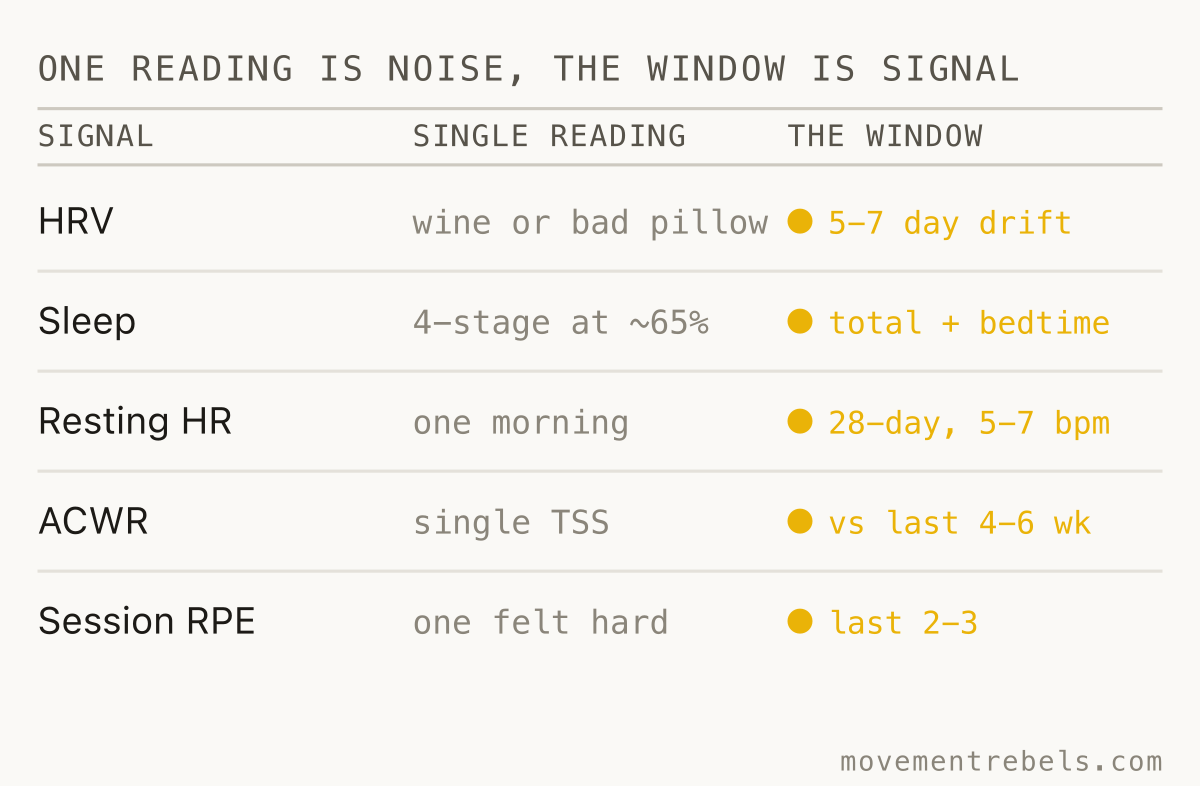
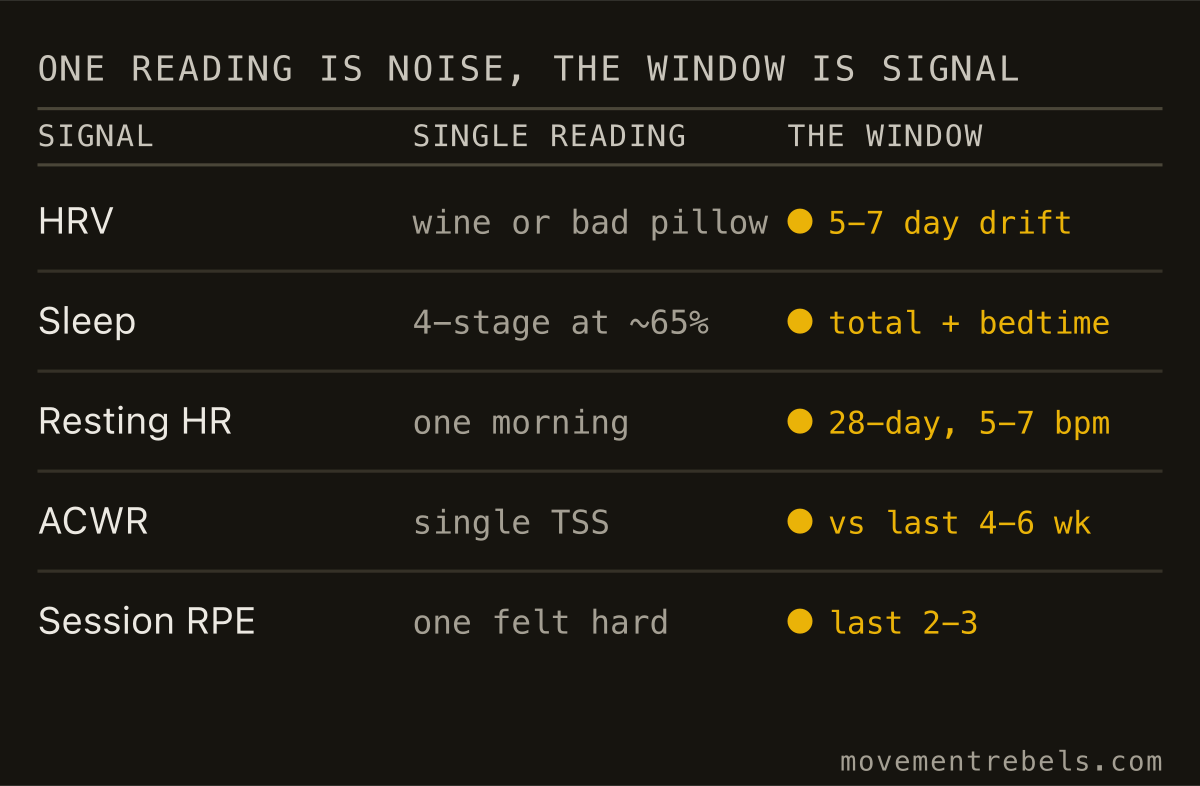
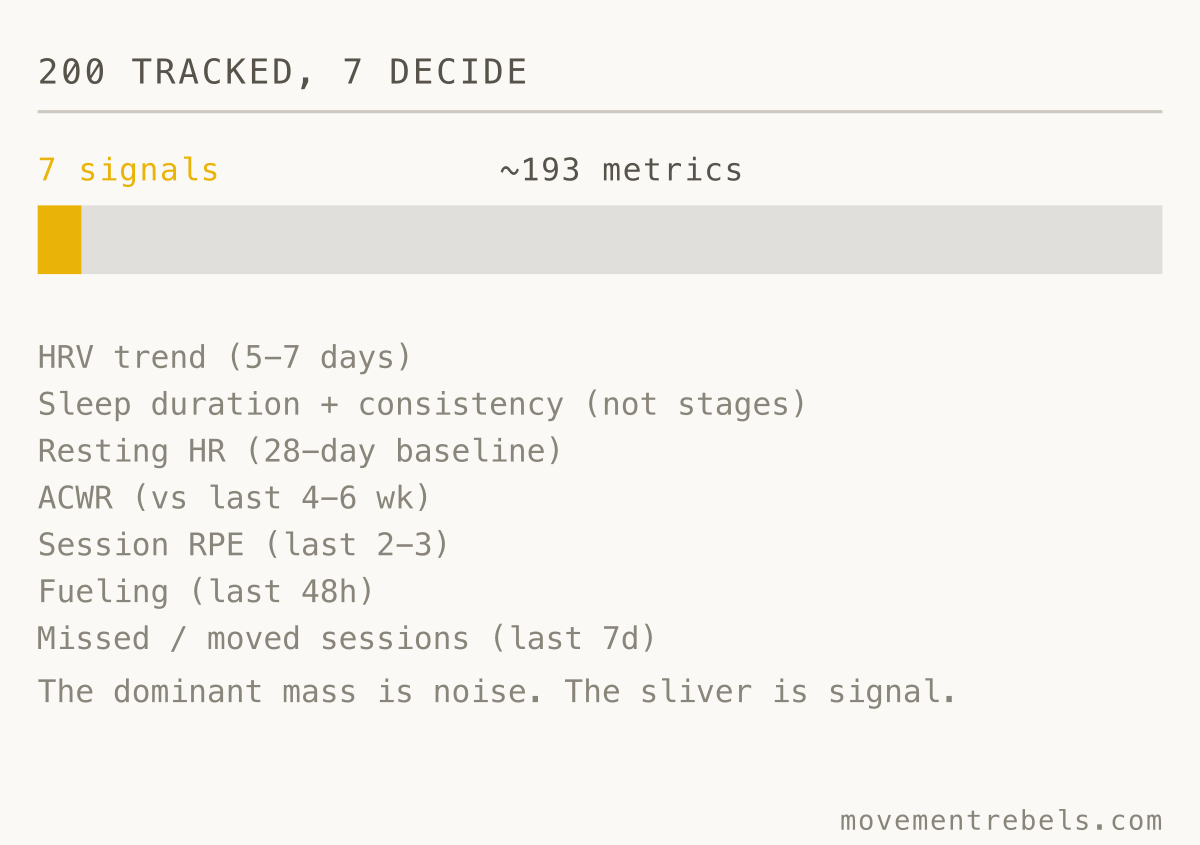
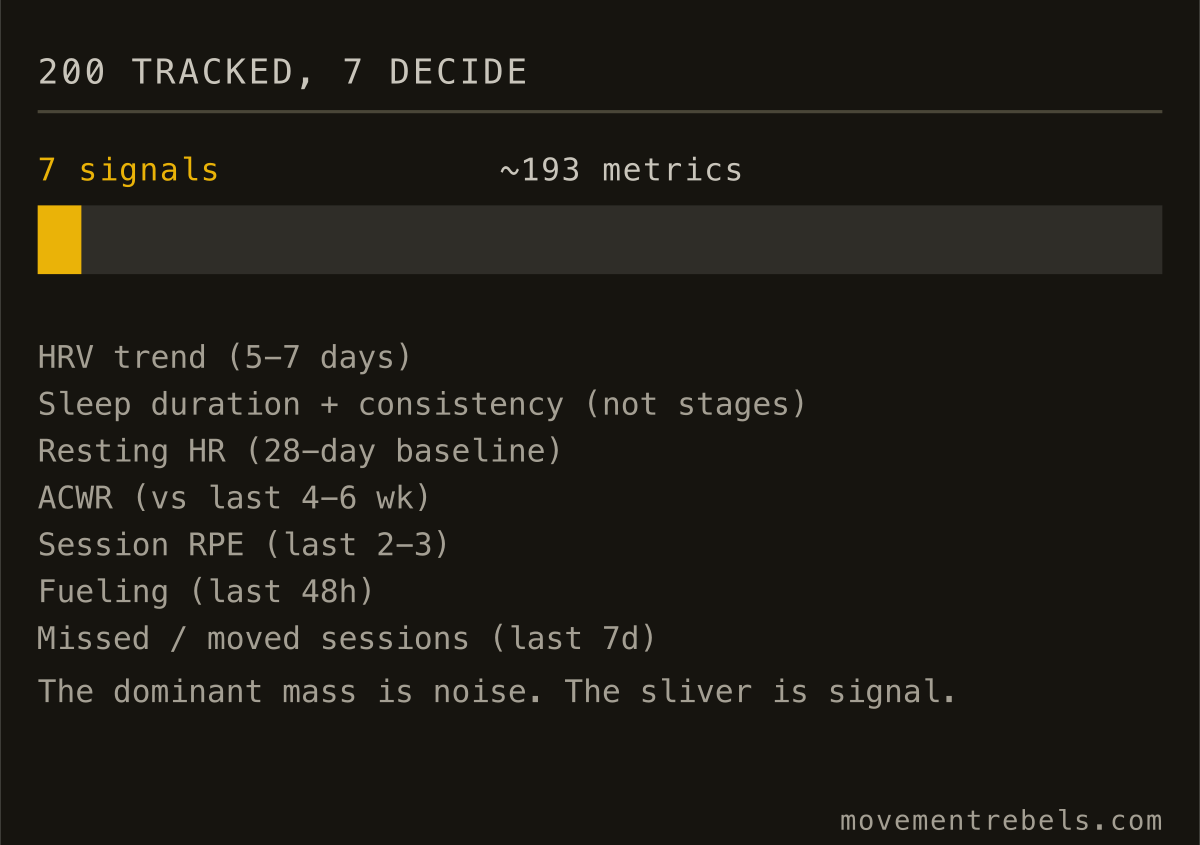
HRV trend over 5-7 days, not yesterday's number. A single low HRV reading could be one glass of wine, a bad pillow, or a stressful email. The Wu Tsai Human Performance Alliance notes that a sustained downward drift spanning 3-4 weeks is the signal worth responding to. Single-day dips are physiological noise. The trend is signal.
Sleep duration and consistency, not sleep stages. A 2024 meta-analysis published in npj Digital Medicine reviewed 62 consumer wearable setups and found that four-stage sleep classification (wake, light, deep, REM) achieves only about 65% accuracy on average. The algorithm confidently telling you that you got 47 minutes of deep sleep is largely a proprietary guess. What wearables measure well is total time asleep and consistency of bedtime. Those two inputs are what matter for recovery, and the guide on how sleep data adjusts your training covers how to act on them.
Resting heart rate over a 28-day baseline. RHR shows lower day-to-day variation than HRV, making it a more practical indicator of accumulated fatigue. A 5-7 bpm rise off your personal baseline is one of the most reliable early signals that your recovery is falling behind your load. See resting heart rate trends for how to read the 28-day line.
Acute-to-chronic workload ratio. Are you spiking volume relative to your last 4-6 weeks? A 2025 systematic review and meta-analysis in BMC Sports Science confirmed that ACWR is associated with injury risk, though the authors are careful to say it should be used cautiously alongside other inputs, not as a standalone gate. The ratio matters. The specific TSS number for any single session does not, though a training stress score calculator is handy when you want to see how a given session stacks against your recent weeks.
Session RPE on your last 2-3 sessions. A 2017 review in Frontiers in Neuroscience found that the session-RPE method has strong validity across sports and can serve as a standalone load-monitoring tool. It captures what no sensor can: the accumulated fatigue you felt in the last few kilometers, the session that felt like a 9 when the plan said 7. Subjective effort and objective markers used together are more informative than either alone.
Fueling over the last 48 hours. A 600 kcal deficit for three consecutive days changes what today's session should look like more than any recovery score does. Wearables do not measure this, which is partly why they keep getting the call wrong.
Missed or moved sessions in the last 7 days. Life load is training load. If you skipped two sessions, this week's training must reflect that. No algorithm knows this unless you tell it.
Notice what is not on this list: Body Battery, daily VO2max shifts, stress score, respiration rate, skin temperature delta, SpO2, race predictor, sleep stage percentages, or recovery countdown timers. They are not useless. They are downstream of the metrics above, or too noisy for daily decisions, or optimized to keep you in the app. VO2max is a good example: the daily wobble is noise, but if you want a real fitness benchmark you can estimate your VO2 max from a field test instead of watching the watch number drift.
Why filtering by hand consistently fails
You can do this filtering yourself. Open three apps every morning, eyeball the trends, cross-reference with how your legs feel, decide. People do it. It works, after a fashion.
But it fails in three specific ways. It costs 10-15 minutes every single morning, forever. It requires you to be a calm, rational analyst at 6 AM when you are not. And it does not integrate with the rest of what a coach needs: your training history, your goals, your phase of the plan, your nutrition log, your conversation from three days ago about how your hamstring felt.
Filtering is the easy part. Integration across all of those inputs simultaneously is what produces a better decision. That is the gap between a dashboard and a coach.
How Movement Rebels handles the filtering
The MR coach reads the short list above and ignores the rest.
When you connect Garmin, the coach reads your completed activities directly: the actual files, time in zone, power or pace, and how the load stacks against your recent baseline. The coach also pushes structured workouts back to your watch so the prescription arrives exactly where you need it. See pushing workouts to your Garmin watch for how that sync works.
On the native iOS app, the coach reads Apple Health: HRV trend, sleep duration and consistency, resting heart rate, and any workouts recorded in Apple Health. If you use an Oura Ring, it exports sleep metrics and HRV to Apple Health, so MR picks those up through that path. If you use a WHOOP, note that WHOOP does not export its recovery or strain scores to Apple Health. MR cannot read WHOOP scores directly. What you can do is tell the coach how you feel, and it factors that in. The coach is in chat for exactly that reason.
The coach cross-references your data against Rebel Fuel (your nutrition log) to check whether you have been under-eating. It reads your biohack history to see whether you have been doing recovery work or skipping it. It reads your perceived-effort tags from recent sessions. It tracks your menstrual cycle phase if you have enabled it, because training around the menstrual cycle is a real performance variable, not a wellness add-on.
Then it makes a call. Not "your Body Battery is 47 and your recovery is 73%, good luck." A decision, with reasoning attached, that you can push back on in one tap. "I know it says intervals but my calf is tight" gets a real adjustment, because the coach has your full picture, not just yesterday's scores.
For athletes building an aerobic engine, that integration matters especially when HRV is sending mixed signals. The HRV-guided training guide covers how to read that signal honestly, including when to trust a low number and when to train through it.
The honest limits
Strava is live: MR reads your Strava activity list and writes a session summary back to each activity's description after your coach debrief. What it does not do is feed Strava data into the AI analysis. The activity data flows in through Garmin or Apple Health; the Strava integration writes summaries out. If you want segments and leaderboards, or simply the number of people Strava has, keep Strava installed. The training brain lives in MR.
WHOOP and Fitbit do not have a direct MR integration. The path their data can reach MR is through Apple Health, where those devices support that export. WHOOP does not support it for its core recovery scores. Be honest about that when you set up your device stack.
If you are prone to overtraining, or returning from injury, data alone will not catch you before you tip over. The overtraining signs guide covers what the evidence actually supports versus what the apps claim to detect. And for planning purposes, getting the balance right across a training block is a periodization question as much as a tracking question. See periodization for recreational athletes for how to structure the load before you worry about monitoring it.
How Movement Rebels fits into your device stack
Movement Rebels is the coaching and planning layer that your device lacks.
Your watch measures load. Your ring measures recovery signals. Neither tells you what to do with that information in the context of your goals, your history, and the next six weeks of your plan. That is what the coach does. It reads what your devices capture, filters it to the short list that matters, integrates it with everything else, and gives you a decision.
You do not need to swap devices. You need a coach who can read them.
Pricing
Movement Rebels is a 7-day full-access free trial, no card required. After the trial, Pro+ is $20/month for unlimited AI coaching, the full 3,900+ workout library, and every recovery and fueling tool in the app.
One app instead of five.
Strength, endurance, recovery, fueling, planning, and your AI coach. All under a 7-day free trial. No card.
Start 7-day trialWHOOP vs Oura vs Garmin: Which One Earns Its Place?
WHOOP, Oura, and Garmin measure different things and sell different promises. The no-spin breakdown: what each measures, what it s
The Data-Driven Athlete: What It Means in Practice
Most athletes collect data but still train the way they were going to anyway. What data-driven requires, what research shows, and
HRV-Guided Training: Read the Signal, Skip the Noise
One low HRV night tells you almost nothing. The 7-day-vs-28-day trend tells you nearly everything. Here is what the evidence actua
Resting Heart Rate Trends: The 28-Day Line
One morning's RHR is mostly noise. Your wearable's sensor can swing 5 bpm on a good night. The 28-day rolling mean is where the si