Why Runners Should Deadlift
Ask a runner why they skip the deadlift and you get the same answer every time: it is a powerlifter's lift, not a distance athlete's. Backwards. The deadlift is the single most useful lift a runner can do, because it trains the posterior chain, and your glutes and hamstrings are the engine of your stride as well as the muscle group that fails first when you are tired and your form collapses. Deadlift and you get a stronger pushoff. Plus a posterior chain that holds up to the mileage.
Why the posterior chain drives your stride
Running is hip extension. Every time your foot leaves the ground your glutes and hamstrings pull the hip back and down and push your body forward, which is your primary engine of propulsion. The same chain is your brake. During the swing phase, when the leg swings forward, your hamstrings have to produce large eccentric forces to decelerate that leg and control the overstretching that would otherwise tear the muscle. Weak hamstrings, or hamstrings slow to activate, cannot produce that force. Classic hamstring strain.
Glutes stabilize the pelvis and drive hip extension. Weak ones make propulsion less efficient and shove stress through tissue that should never carry it, and the flip side of that is a strong chain: harder push off the ground, less energy wasted per stride. Strength training improves running economy largely through this stronger, stiffer drive off the ground.
The deadlift trains both roles in one lift. Concentric drive teaches your glutes to extend the hips with power, the eccentric lower teaches your hamstrings to control force under load, and that is the exact job they have when they decelerate your leg at the end of the swing phase.
The variants: trap-bar, conventional, Romanian
Not all deadlifts are equal for runners. What you pick decides what you build.
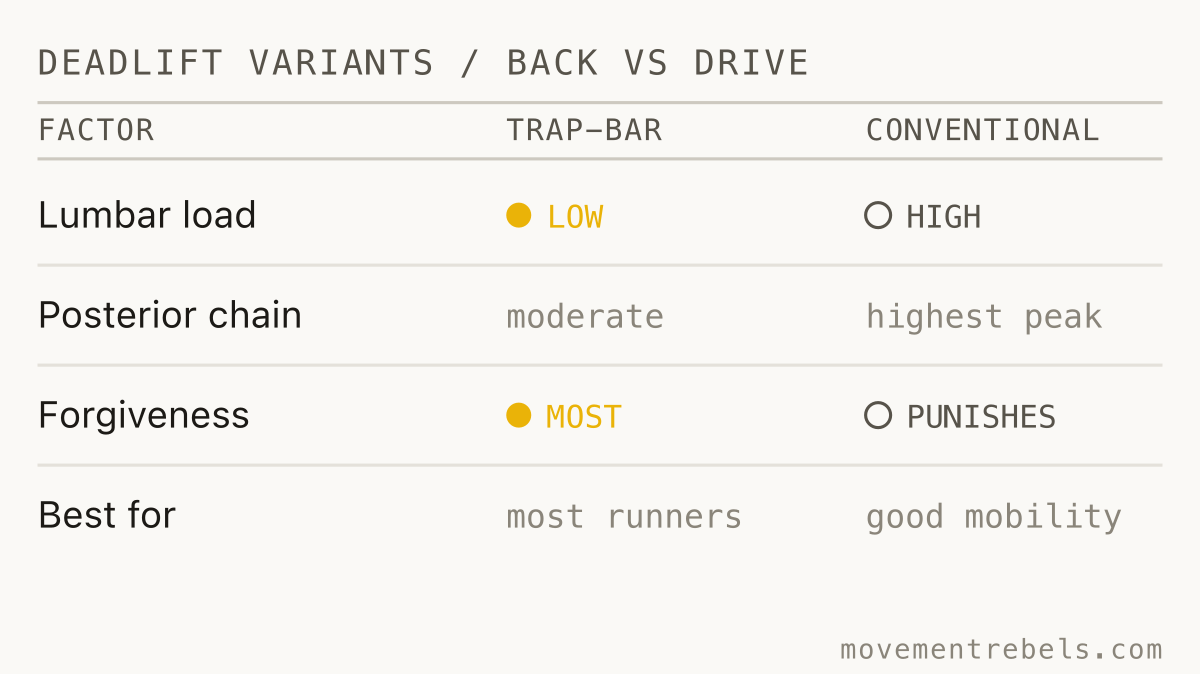
Trap-bar deadlift (recommended for most runners). Your hands sit at the sides of a hexagonal frame, so the center of mass lines up vertically over the bar instead of out in front of it, and that upright posture shortens the moment arm on your spine and lowers the peak demand on your lower back compared to a conventional barbell deadlift. How much less depends on the lifter and the load. The biomechanics research is consistent on the direction. Bar path runs nearly vertical, which makes it easier to learn and kinder to a lower back that is already a weak point. Quad activation goes up slightly. Fine. Your quads are not the weak link in a runner. Most forgiving variant, and the one most runners should choose.
Romanian deadlift (hamstring focus). A partial range-of-motion hinge. The bar stays on or near your thighs, knees stay slightly bent, and you hinge at the hip to load the hamstrings, so the eccentric emphasis puts the work in the lowering phase, which is where the hamstrings take the eccentric forces that prevent injury. The RDL teaches the posterior chain to brake and control load at longer muscle lengths, which is the vulnerable position during the swing phase. Run it as your main deadlift, or as supplemental work on your second strength day.
Conventional deadlift (high bar, full range). Barbell in front of your shins, hips lower, full range to lockout, and it emphasizes the posterior chain more than the trap bar while producing larger peak hip moments. You pay for that with higher lumbar shear force, because the bar travels in a longer arc away from your body and puts a longer moment arm on your spine. Good mobility, meaning you can hinge without rounding your lower back, plus no history of lower back pain: conventional can work. Most runners have neither. Limited hip mobility and an anteriorly shifted posture from sitting and running is the norm, and the trap bar forgives that while the conventional deadlift punishes it.
When to choose each. Any doubt about your mobility or your back, start with the trap bar and run it as your main deadlift for 8-12 weeks, then experiment. Romanian deadlifts go on a secondary strength day no matter which main variant you picked, because the eccentric emphasis and the hamstring isolation are worth too much for injury prevention to drop. Conventional is the pick when your mobility is good and you want maximum glute and hamstring stimulus. Not out of ego. Not because you think "real deadlifts" are the only option.
How to set up and the technical cues that matter
Simple movement, easy to do wrong. The cues below keep you safe and moving toward real strength.
Foot position. Hip-width stance, toes pointed forward or slightly out. Feet under your hips, not in front of them and not behind, with weight even across the whole foot and never drifting onto the toes.
The hinge, not the squat. Biggest mistake most runners make. They treat the deadlift like a squat, drop the hips too low, put the knees into flexion and load the quads, when the deadlift is a hip hinge with the hips starting high, the shins nearly vertical, and the load sitting on the hamstrings and glutes. Cue: push your hips back as if you are closing a car door with your butt. Hinge from the hip. Not the knee.
Neutral spine. Your lower back holds its natural curve. Not rounded, not hyperextended. Non-negotiable, because a rounded spine under load invites injury. If you cannot hinge without rounding, reduce the weight, add mobility work (more on that below), or switch to a trap bar and a slightly higher starting position that makes the neutral spine easier to hold.
Shoulders over the bar. At the start of the lift your shoulders sit slightly in front of the bar on a trap bar, or the bar lines up with mid-foot on a conventional pull. That puts the weight in a line your body can drive vertically.
Pull the slack out of the bar. Take a breath. Brace the core. Pull lightly on the bar until the slack is gone, which preloads the hamstrings and glutes and cues your nervous system that the heavy load is coming.
Explosive drive. The bar accelerates off the ground. Do not grind. Push the floor away with intent instead of chasing a smooth pull, because the explosion is the signal to your nervous system that this is power. Heavy load or not, move the bar up as fast as you can control it.
Lockout. At the top your hips and knees are fully extended and your shoulders sit slightly behind the bar on a trap bar. Lock out by driving the hips forward, never by hyperextending the lower back. Glutes squeezed. Core still braced.
Lower with control. The eccentric phase is where the hamstring work happens, so hinge at the hip on the way down, hips back, bar travelling down your legs, descent controlled the whole way. Do not drop the weight. A 3-second lower, or a 2-second lower if you are strong, builds the eccentric hamstring strength that prevents injury.
New to the deadlift, or months away from anything heavy? Film yourself from the side with your phone. You will see what you cannot feel: round shoulders, a rounding lower back, hips sitting too low, and those are the errors to catch and fix before the load gets heavy.
Programming the deadlift
The deadlift slots in like any other main lift. Cornerstone movement, once or twice a week, heavy load, low reps.
Load and reps: 3-5 reps per set at 80-90% of your one-rep max. A calculator to estimate your 1RM turns a recent heavy set into percentage loads, and a last rep that comes out hard but clean means you are in the right zone. Do not grind to failure. Stop a rep or two before the well runs dry.
Sets: 3-4 working sets, depending on experience. Beginners: 3 sets. Experienced lifters: 4 sets on the heavy day, 3 sets on the secondary deadlift if you run one.
Frequency: Once per week for most runners. Twice per week works during the off-season base phase if you split the variants, say trap-bar deadlift as the heavy lift on Tuesday and Romanian deadlifts as supplemental work on Thursday, but twice should not become your norm. It is a total-body effort and it demands real recovery. Once per week, heavy, is enough.
Where it sits in the week: Deadlift on the same day as a hard run, never on an easy day. Run first, or run later that evening, so the heavy lift is not sitting in your legs when the hard work starts. Forced to lift before the run? Make that run easy, or skip it. Do not run hard on pre-fatigued legs, and never deadlift heavy in the 1-2 days before a key workout or race.
RPE, not ego. Rate of perceived exertion (RPE) guides the session, not the weight loaded on the bar, and a calculator to estimate your RPE keeps you honest about effort. On a good day with the bar moving fast you can push to RPE 8 or 8.5, where 8 is hard and 8.5 is harder, with 1-2 reps left in reserve. Bad day, meaning poor sleep or life stress or a light week, and RPE 7 or 7.5 is enough. Across a season the gap between RPE 7 and RPE 9 is enormous for recovery and durability, and ego deadlifting, hitting the limit of your max every week, leaves you flat and weak after 4-6 weeks.
Warming up: Never start heavy cold. A warm-up set calculator builds the ramp to your working weight. Example: empty bar for 5, then 20% of your working weight for 5, then 40% for 3, then 60% for 2, then 80% for 1, then work. 5-10 minutes, and you hit the first work set ready instead of stiff. The warm-up primes your nervous system.
Single-leg variants and eccentric hamstring work
Trap-bar and Romanian deadlifts build bilateral strength and power, while single-leg and eccentric work hunt down the left-right imbalances that sideline runners, then fix them.
Single-leg Romanian deadlift (single-leg RDL). Stand on one leg, dumbbell or kettlebell in the opposite hand, and hinge forward while the free leg extends back as a counterbalance. The hamstring on your standing leg takes a direct eccentric load as the weight and your hip travel toward the ground, and asymmetry shows up fast: a side that is weaker or slower to activate announces itself as instability, or as a working leg that cannot control the load. Work both sides equally. 3 sets of 6-8 per leg, done after your main deadlift, with a weight you can manage. The point is control and finding the imbalance, not grinding to max load.
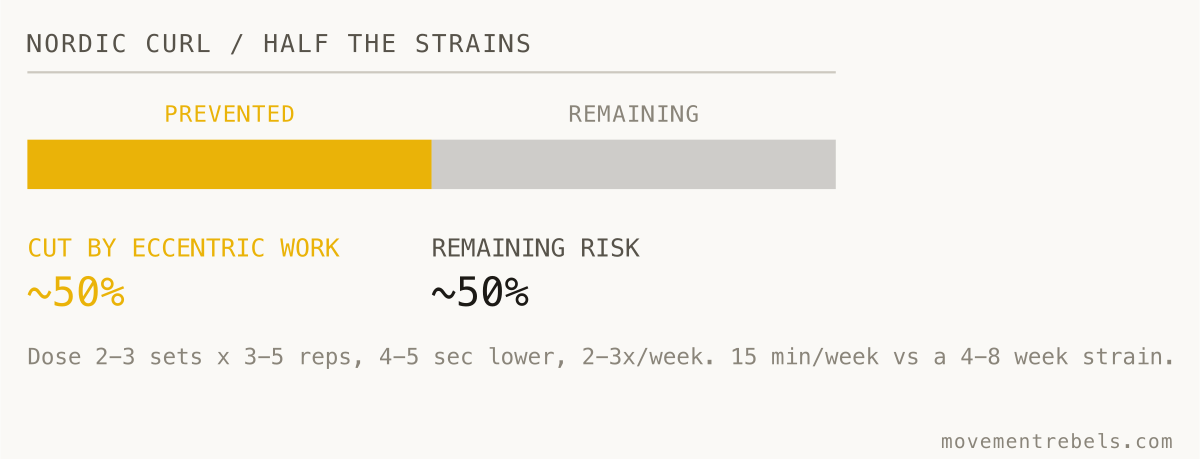
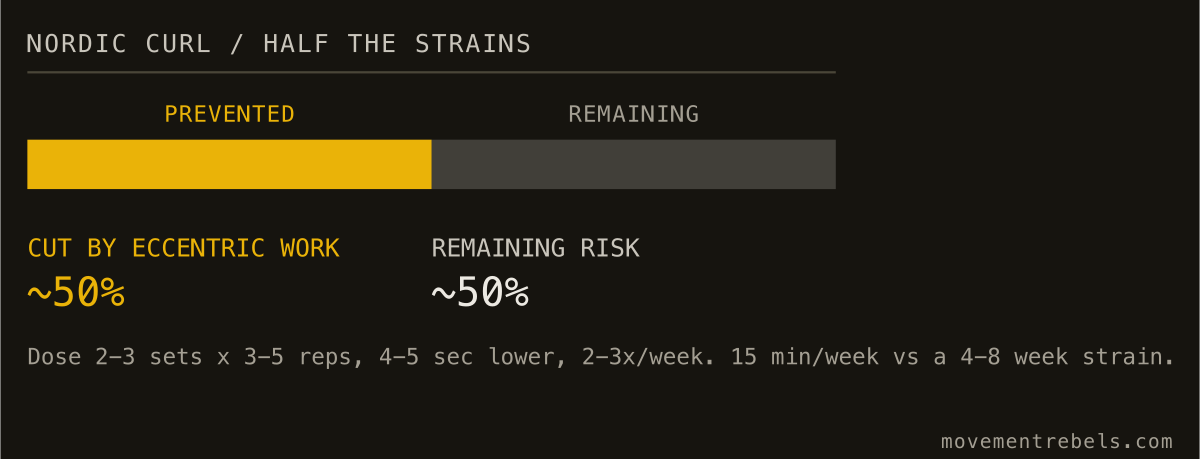
Nordic hamstring curl. The most effective eccentric hamstring exercise for preventing strains. Kneel on a mat or padded surface, get a training partner to hold your feet, and lower yourself forward under control, resisting the whole way with your hamstrings. No partner? Anchor your feet under a squat rack or a heavy barbell. The eccentric loading is enormous. Your hamstrings have to generate the force to lower a percentage of your body weight while operating at a long muscle length, exactly the position where they tear during running. Research shows eccentric hamstring training reduces hamstring injury risk significantly, cutting injury incidence roughly in half when compliance is high. Start conservatively: 2-3 sets of 3-5 repetitions, lower slowly (4-5 seconds), and let your hands help if needed. Weeks 1-2 you may barely make it to the bottom. By week 3-4 you lower under near-full control. This is not a high-volume exercise. 2-3 sets per week is enough, paired with your main deadlift or parked on a second strength day.
Single-leg and eccentric work stay in the program year-round. That is the trade: run hard next week, or limp through the next month.
Common mistakes: what costs you speed and durability
Runners break the deadlift in predictable ways. Avoid these:
Chasing max singles. Test your 1RM every week, or grind out a single at 95%+, and you will be flat for days. Heavy lifting means regular exposure to loads in the 80-90% range. Want your 1RM? Test it once or twice a year, and when you do, see how your deadlift ranks against strength standards, because the training benefit lives in consistent submaximal work, never in hunting your absolute max every week.
Deadlifting heavy the day before a key run. The biggest error on the list. A heavy deadlift, especially one you pushed hard on, leaves your glutes and hamstrings fatigued for 24-48 hours, and running hard on fatigued hip extensors changes your form, stresses tissues that should not bear the extra load, and raises injury risk. Plan the week around it: strength session on the same day as a hard run, run first and lift later, or at least 2 days clear of a quality session. Never heavy legs 24 hours before your key workout.
Starting the deadlift from too low. Squat-style the pull, drop your hips too far, and you load the quads while the hamstring emphasis disappears, because the deadlift is a hip hinge with a high starting hip position, not a deep squat. If you cannot hinge without rounding your back, spend 2-3 weeks on mobility work first. Returning to training after injury covers the framework, and heavy load goes back on once mobility improves, or you switch to the trap bar and start from a position that lets you hold neutral spine.
Rounding your lower back under load. A rounded lumbar spine inverts the natural curve and drives shear force into the discs. That is the path to injury. Round under load, cut the weight on the spot. Round even at light weight and the problem is mobility, not strength. Fix mobility first. Then load.
Programming heavy deadlifts on easy days. An easy day with a heavy deadlift in it is a hard day. Now there is no recovery left in the week. Hence the rule that hard runs and heavy strength land on the same day, that easy days stay easy, and that you keep a full easy day to recover.
Ego loading without recovery. Loading the bar heavy while you are fatigued, sleep-deprived, or buried in life stress is the fast path to overtraining and injury. A heavy session on a hard week compounds the stress. Wait for the easier week. The deadlift will still be there.
Skipping eccentric work. Nordic curls and eccentric hamstring work are the single most effective tool to prevent hamstring strains, which makes them non-optional, and the only barrier is compliance, because they are uncomfortable and they cost you 10-15 minutes per week. A hamstring strain costs you 4-8 weeks of training. 15 minutes a week is the bargain of the year.
How Movement Rebels fits
Knowing the deadlift matters is the easy part. The hard part is fitting heavy lifting into a week where you are also running hard, then knowing when to back off so you do not tip into overtraining. The Movement Rebels AI coach reads your Garmin runs and Apple Health data across the week: hard intervals, easy pace, sleep, recovery metrics if you have them. It lands the heavy sessions on days your body can absorb the load. Slept badly? Stressful week? Deadlift volume or intensity comes down instead of stacking stress on stress. The coach also knows where your deadlift sits in your season, from base-phase heavy work to race-week maintenance, and scales the stimulus accordingly, so the lift supports your running instead of competing with it. Heavier at the start of the season when racing is months away. Lighter and held steady once you are in race prep.
One app instead of five.
Strength, endurance, recovery, fueling, planning, and your AI coach. All under a 7-day free trial. No card.
Start 7-day trialStrength Training for Runners: Get Faster and Stay Healthy Without Bulking
How runners should lift to run faster and stay injury-free: the key lifts, heavy over high-rep, two sessions a week, plyometrics,
Hybrid Athlete Training: Concurrent Done Right
The interference effect is real but smaller than you think, and the rules for avoiding it are simpler than the hype suggests. Here
Returning to Training After Injury: Slower Than You Think, Faster Than You Fear
The 10% rule is not science. Tendons recover three times slower than muscle. Here is what the evidence actually says about coming
When to Deload: Reading the Signals Right
The 4-week deload rule is a template, not a law. Here are the actual physiological signals that tell you when your body is asking