Trail and Ultra Training: From Road Runner to the Mountains
The honest thing to say upfront: a fast road runner is not ready for a mountain ultra. That is not a knock on road fitness. It is a structural mismatch. The aerobic engine transfers fine. Almost everything else needs to be rebuilt from the ground up: eccentric quad strength for descents, power-hiking efficiency on steep climbs, gut tolerance for six to thirty hours of continuous fueling, and the mental recalibration required when minute-per-mile splits become irrelevant and total time-on-feet becomes the only metric that matters.
This guide covers what actually changes in the move from road to trail and ultra, what the evidence says about training the specific demands, and why the gear and supplement industry profits from overstating the complexity of something that is, at its core, about running a very long time in the mountains.
Why Road Fitness Does Not Transfer Cleanly
A road runner crossing into trail ultras typically has strong cardiovascular fitness, decent lactate threshold, and a dialed pacing sense. The pacing sense is the part that misleads. Road paces from a VDOT calculator still describe your fitness honestly, and they describe nothing about your splits on a 20 percent grade, so on trail the score belongs to effort rather than pace. What they often lack:
Eccentric quad capacity. Downhill running is mechanically unlike anything in flat road training. The quadriceps contract while lengthening to absorb each impact at a negative grade, the definition of eccentric loading. Research on downhill running has found that 30 minutes of steep descent can significantly impair maximal voluntary force for three full days, while markers of muscle breakdown such as creatine kinase remain elevated for around 48 hours and resolve by day four. Those studies used recreational runners. The takeaway is not "avoid downhills." It is that your quads need specific exposure before race day, not a surprise on the descent of a 10,000-foot mountain.
Hiking as a trained movement. Most road runners treat hiking as failure. In trail ultras it is a skill and, above certain grades, the physiologically correct choice. The biomechanical research on locomotion at grade consistently shows a crossover point well above what most runners expect: the published evidence places the zone where walking becomes more economical than running at roughly 15-16 degrees of incline (around 27-29% grade), not the gentler slopes where road runners tend to start walking. The exact threshold shifts with individual fitness, speed, and fatigue, but the principle holds: walking very steep climbs is not giving up time, it is spending energy correctly.
Fueling for hours, not minutes. A road half-marathon might need one gel. A 50k with 3,000m of gain needs a coherent fueling strategy running from hour one through hour seven or eight. The gut demands of ultra endurance are a genuine physiological adaptation, not just a matter of willpower.
Vert as its own training variable. Total elevation gain is a distinct stressor from flat mileage or even time-on-feet. A 50k with 3,500m of gain and a flat 50k require the same distance but are different races. Training plans built purely on weekly mileage misrepresent the actual load.
The Downhill Problem: Eccentric Loading and Repeated Bout Effect
Downhill running is where most road-to-trail transitions go wrong. A well-conditioned runner feels fine going up because uphill effort maps cleanly to cardiovascular strain they already handle. The descent is where road fitness hits a wall.
The eccentric muscle damage mechanism is the same one that makes the second day after heavy squats worse than the first. The muscle has to generate force while elongating, which causes structural disruption at the sarcomere level, delayed onset soreness, and reduced force capacity. In a road marathon, there is almost none of this. In a mountain 100-miler with 6,000m of descent, it accumulates for hours.
The good news: the repeated bout effect is real and strong. Expose your quads to controlled downhill loading in training and they adapt. A first major downhill session might leave you hobbled for three days. After four to six weeks of progressive exposure, the same descent causes a fraction of the damage. The practical protocol for road runners new to trails: add one quality downhill session per week from eight weeks out. Start with short, controlled repeats on a runnable grade, 60-90 seconds of descent at honest effort, full recovery between reps. Build the duration and grade over the block. By race week, your quads should have seen several sessions with 500 or more meters of cumulative descent. The body adapts. Do not skip this work because you feel fit.
The flip side: do not pile on too much too fast. The recovery demand from aggressive downhill work is real and invisible on easy metrics. Heart rate drops normally on recovery days. Creatine kinase does not. Athletes who add heavy downhill volume too quickly often arrive at a race with legs that feel fine aerobically but shred on the first major descent. See overtraining signs for the markers that tell you load has tipped the wrong direction.
Hiking as a Skill, Not a Concession
One of the most useful things a road runner can do before their first trail ultra is to practice power-hiking aggressively and specifically. Not a leisurely stroll. Head down, arms driving, poles forward, 4-6 km/h on a 15%+ grade, sustained for 30-60 minutes at a stretch.
A 2023 review in Bioengineering on the biomechanical and physiological effects of poles confirmed what experienced ultra runners already knew: pole use during steep ascents redistributes load from the lower body to the upper body, reduces ground reaction forces, and comes at the cost of modestly elevated heart rate and oxygen consumption. The evidence supports preserved lower-limb capacity and delayed fatigue onset over long climbs. The metabolic cost increase is real and is flagged in the research as a potential limiter for competitive athletes at high intensities, so the benefit is most pronounced over climbs lasting an hour or more where leg preservation outweighs the added cardio demand.
Poles are not mandatory. Races with significant technical terrain, net elevation gain above roughly 2,500m for a 50k distance, or sustained grades above 20% generally reward skilled pole use. Flat or rolling ultras do not, and carrying the weight of poles on terrain where they offer no benefit is a cost. Make the decision based on your specific race profile.
The hiking skill point is separate from poles. Whether or not you use poles, efficient power-hiking needs to be practiced under fatigue, on technical terrain, with a pack. A road runner who logs all training miles on flat pavement and walks for the first time under real mountain conditions at mile 30 of a 50-miler will be inefficient and slow. Hiking is a separate motor pattern and it trains like any other movement.
Vert as a Training Variable
Weekly mileage is the wrong primary metric for trail ultra training. Time-on-feet and vertical gain matter at least as much, and for mountain races they matter more.
The practical implication: if you are building toward a 50k with 2,500m of gain and your weekly training includes almost no elevation, you are building the wrong engine. The cardiovascular system will be fine. The specific muscular demands of sustained climbing will not be trained. And the descent capacity, as covered above, will definitely not be trained. Because raw pace on vert is meaningless, a grade adjusted pace calculator for vert lets you compare a steep climb to your flat effort and judge how hard a session really was.
A reasonable target for mountain ultra prep: weekly vert in training should approach 50-70% of the race's vert over your peak build weeks. If you live in flat terrain, this requires creativity: stadium stairs, treadmill incline, multiple laps of the same hill, weekend trips to actual hilly terrain. None of these are perfect substitutes for mountain running, but they beat ignoring the variable entirely. See hill training for runners for the specific protocols.
The periodization question for ultra training is also different from road training. Ultra events are so long that the "peak" fitness concept changes. You cannot sprint a 30-hour event. The most important adaptations are metabolic efficiency at very low intensities, structural tissue durability (tendons, plantar fascia, quads), and gut resilience. These take time to build and do not peak the same way VO2max-oriented fitness does. Back-to-back long run weekends, where Saturday and Sunday both carry significant time-on-feet and vert, are the closest training analog to what a race demands.
Fueling for Hours, Not Minutes
Fueling is the area where ultra training most clearly separates from road running, and where the consequences of getting it wrong are most severe.
A 2024 observational study in Scientific Reports tracked 22 athletes through a 100-mile ultramarathon using a flash glucose monitoring system that recorded readings every 15 minutes. The finding was direct: faster finishers consumed more carbohydrates per kilogram of body weight, especially in the first half of the race, and maintained more stable blood glucose throughout. Athletes with greater glucose fluctuations ran slower. The study did not prove causation with a controlled trial, but the signal was consistent: steady, aggressive early fueling correlated with better outcomes.
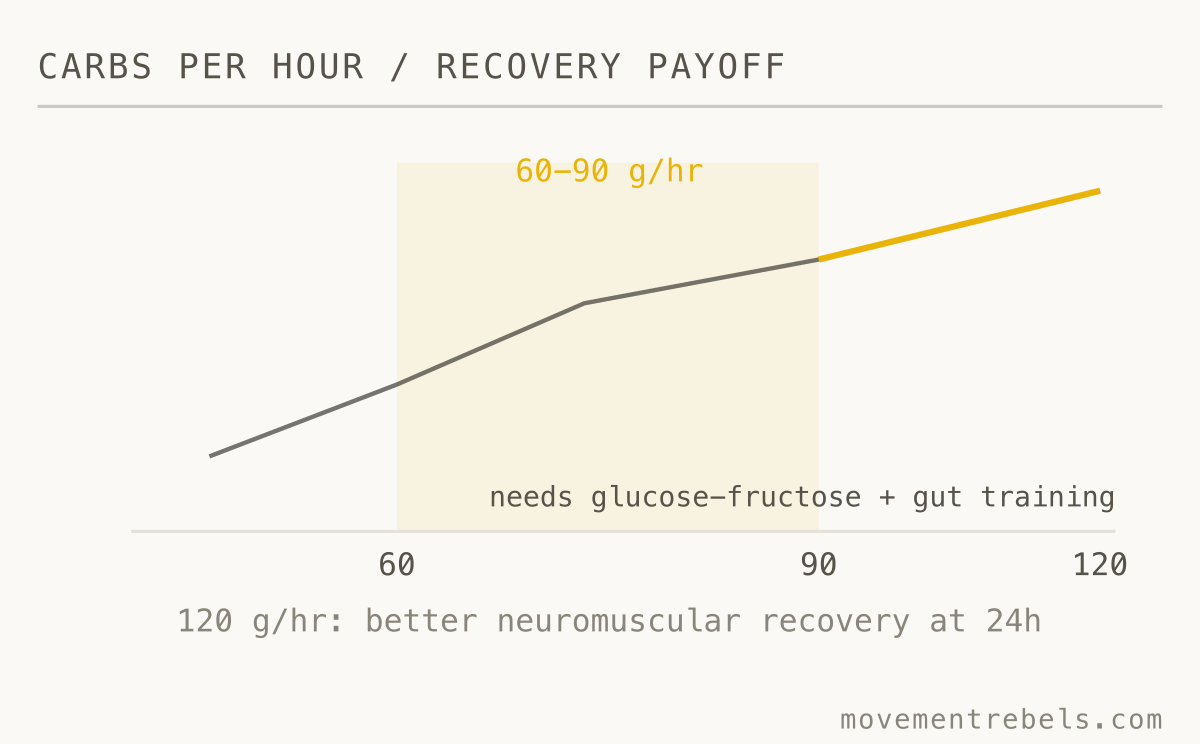
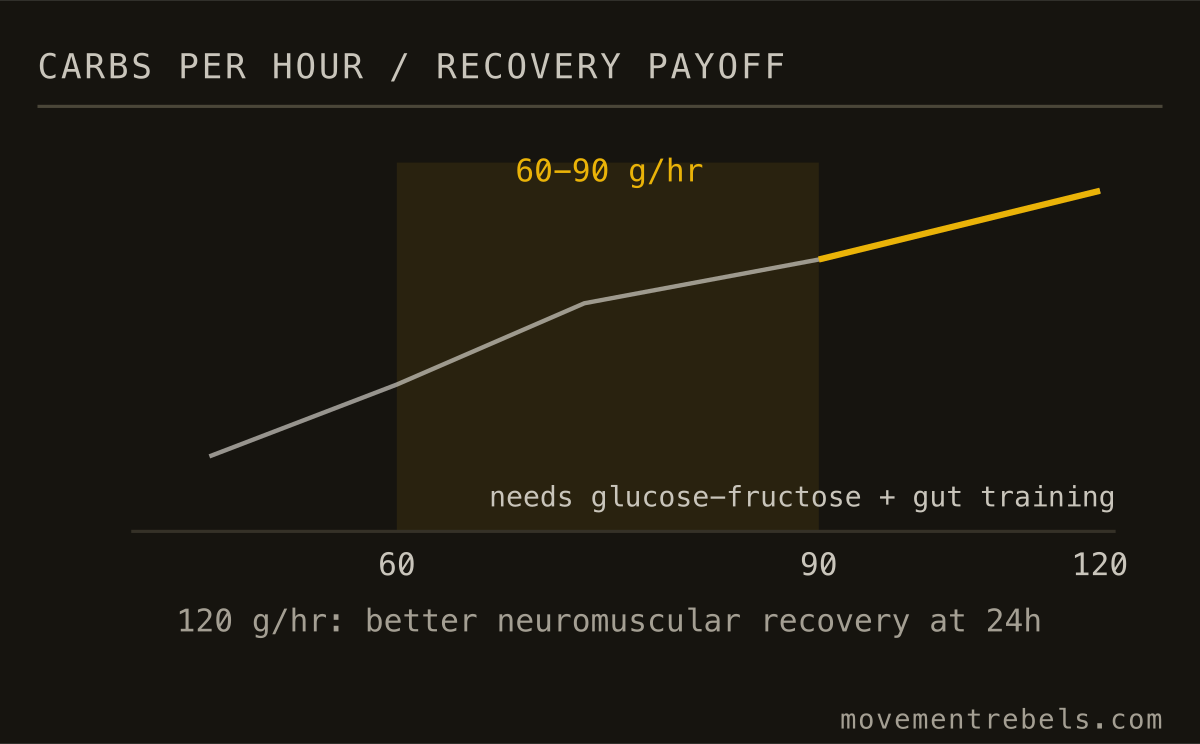
The current evidence-based recommendation for ultra-duration efforts is 60-90g of carbohydrate per hour as a working target, with some well-gut-trained athletes tolerating up to 120g/hour. A race nutrition planner for hours not minutes turns that hourly target into total carbs and fluid across your expected finish time, so you know what to pack and practise. Research broadly finds that higher carbohydrate intake during prolonged mountain efforts supports better neuromuscular recovery in the hours after the race, but tolerating those rates requires multiple-transporter carbohydrates (a glucose-fructose blend, not pure glucose) and genuine gut adaptation. Neither happens automatically.
The gut training component is not optional for serious ultra preparation. This means consuming carbohydrates at race-target rates during long training runs, progressively building tolerance over weeks, and testing every product planned for race day in conditions that approximate race conditions: sustained effort, heat or cold, rough terrain, and fatigue. The GI crisis at mile 40 of a mountain 100 is almost always preventable and almost always traced to inadequate fueling practice in training. For the detailed physiology and a practical protocol, see fueling around long training sessions and gut training for carb tolerance.
Sodium is the second variable. Sweat rates and sodium losses in ultra events lasting beyond six hours create a genuine electrolyte management challenge that does not exist in shorter road events. Hyponatremia (low blood sodium) is documented in ultra events and is more likely in athletes who drink ad libitum water without matching sodium intake. The practical approach: salty food and electrolyte products alongside carbohydrates, eating by schedule rather than hunger alone, and knowing your own sweat rate in the conditions you will race in. A sweat rate calculator for long hot efforts puts a litres-per-hour number on those losses from a simple weigh-in before and after a long run.
The meal timing question is less acute in ultras than in shorter events because the duration is long enough that gut motility eventually stabilizes. But the early hours matter most. Front-load fueling from the gun.
Zone 2 Base Still Matters: But the Long Run Changes
Ultra training's aerobic base is built the same way as any endurance discipline: high volume, low intensity, sustained Zone 2 effort. The difference is what the long run looks like.
A marathon long run tops out at 2.5-3 hours. A 50k build might include back-to-back days of 3 and 4 hours. A 100-mile build may include a single 6-hour day. The cardiovascular demand of these efforts is largely aerobic and manageable. The mechanical and metabolic demand is cumulative in ways that do not appear on a heart rate trace.
The single most useful training concept for ultra preparation is time-on-feet rather than pace or distance. Walking counts. Hiking with a pack counts. A 4-hour day with 1,500m of vert and mixed running and hiking is better preparation for a mountain ultra than a 4-hour flat run at steady pace. This is not an argument for shuffling through training without intensity. It is an argument for specificity: train the actual demands of the race, not the demands of a different race.
Recovery after big days needs to match the accumulated load. HRV-guided training is more useful in ultra prep than in shorter race training because the residual load from a major back-to-back weekend is often invisible by feel but clearly visible in morning readiness metrics. An athlete who feels "a bit tired" with an HRV 20% below baseline has not recovered from the previous weekend and is not ready for another hard stimulus. The data helps make that call without the ego bias that makes athletes run hard on days they should recover.
What the Industry Oversells
Trail ultra culture has a well-developed gear complex. Mandatory kit lists for mountain races are real and often sensible (jacket, emergency bivy, headlamp), but the commercial ecosystem around ultra running tends to overstate the requirement for specialized equipment and supplements.
Hydration vests: useful when aid station spacing exceeds 10 kilometers. Not required for shorter trail races with well-stocked aid stations.
Poles: useful for specific terrain profiles as described above. Not universally necessary. Not a beginner must-buy.
Sodium capsules: useful when aid station food alone does not cover losses, and as a backup to real food. Not a substitute for a proper fueling strategy.
The supplement industry pushes electrolyte products, specialized gels, and recovery compounds at athletes who often need none of them and simply need to eat more real food more consistently. The supplements that actually perform in endurance sport are caffeine (real, robust data), sodium (circumstantially important in heat and duration), and multiple-transporter carbohydrates. Almost everything else is margin.
Caffeine deserves specific mention in ultra events: it works, and in events lasting 12+ hours the timing strategy matters more than in shorter races. Using caffeine early (before you need it) reduces the option to use it when you hit a real low point. Most experienced ultra runners save caffeine for nighttime sections or known hard patches, not as an early-race ritual.
How Movement Rebels Handles This
Trail and ultra training inside Movement Rebels starts with race profile, not a generic plan. The coach reads your target race's vert, distance, time limit, and terrain type, then builds a block with appropriate progressive elevation, back-to-back long days, and downhill exposure built into the structure.
Garmin integration pushes structured sessions directly to your watch, with HR ceiling alerts for truly easy recovery days and effort targets for quality climbing sessions. After each long run, the coach reads the completed file back through Garmin Connect or Apple Health (native on the iOS app), noting time in zone, total vert logged, and pace patterns. A long run where you averaged 30% above your aerobic ceiling because the trail was exciting is noted and corrected in the next week's prescription.
Fueling logs from Rebel Fuel feed into the coach's picture. A 4-hour training day logged with only 60g of carbohydrates consumed gets flagged with a note about target intake for next weekend's session and a reminder to test the same products you plan to use on race day. The coach tracks cumulative fueling patterns across the block, not just single-session snapshots.
Recovery is read through the same lens as load. Apple Health pulls in HRV, resting heart rate, and sleep from the native iOS integration (supporting any device that exports to Apple Health). After a major back-to-back weekend, the coach holds the next hard session until readiness metrics recover, whether that takes two days or four. One app covers the plan, the watch file, the fueling log, and the recovery read. See apple health ai coach for how that data flows into coaching decisions.
Pricing
Movement Rebels is one app for the full picture: endurance coaching, structured workouts to Garmin, fueling logs, recovery tracking, and the AI coach that ties it together. A 7-day free trial covers the entire surface. After the trial, Pro+ is $20/month for unlimited coaching. No card on the trial.
One app instead of five.
Strength, endurance, recovery, fueling, planning, and your AI coach. All under a 7-day free trial. No card.
Start 7-day trialDurability: Why You Fade Late in a Race and How to Train It
VO2 max, economy and threshold describe you fresh. Durability is what holds in hour three. Here is what the research shows and how
Carbohydrate Timing for Athletes: Fueling Around Long Sessions
How many grams of carbohydrate and when: 1 to 4 g/kg before training, 30 to 90 g per hour through long sessions, and the 4 hour re
HRV-Guided Training: Read the Signal, Skip the Noise
One low HRV night tells you almost nothing. The 7-day-vs-28-day trend tells you nearly everything. Here is what the evidence actua
Zone 2 Training: When It Works, When It's a Waste
Zone 2 is real, old, and oversold. Here's the honest version: when low-intensity volume is your highest-leverage work, when it isn