Training Stress Score (TSS): Useful Number, Wrong Anchor
TSS is not the problem. Making it the anchor is.
Training Stress Score does one thing well. It squashes duration and intensity into a single comparable number, so sessions of different lengths in different disciplines can be stacked against each other on one axis. A 90-minute tempo run and a 3-hour endurance ride can both land near 130 TSS, and that comparison tells you something real about relative load.
TSS tells you what you put in. About what your body can absorb, it says nothing. Two athletes finishing the same 200 TSS ride are having completely different biological experiences when one slept eight hours and ate 400g of carbohydrate and the other slept five hours after four days in a calorie deficit. Same number on the screen. The cost in tissue and hormonal disruption is not the same.
That gap between session output and recovery capacity is where most athletes get into trouble with TSS, and this guide works inside the gap instead of pretending it is not there.
Where the number came from
Andy Coggan developed TSS in 2002, working from an earlier foundation laid by Eric Banister's impulse-response model from 1975, which proposed expressing performance as the balance between a slow-decaying fitness gain and a fast-decaying fatigue component from accumulated training. Coggan adapted that framework for power-metered cycling. TSS is the per-session input, the dose that feeds the model.
The formula: TSS = (duration in hours) x (intensity factor squared) x 100.
Intensity factor (IF) is your average or normalized power divided by your functional threshold power (FTP), so an hour at exactly your threshold gives IF = 1.0 and TSS = 100. That is the anchor. One hour all-out at threshold equals 100 TSS, and to compute TSS from Normalized Power and Intensity Factor for a single ride you run your NP and FTP through the calculator, which returns IF and TSS together.
The squared term matters, because intensity scales faster than duration: a 10% increase in IF at the same duration raises TSS more than adding 10% more time at the same IF. Physiologically honest. Hard is harder than long, per unit of time.
What TSS earns
The comparison function is real. It shows cumulative load across a mixed training week, run and bike and swim flattened onto one axis, and it is the foundation of chronic training load (CTL): an exponentially weighted moving average of daily TSS with a 42-day time constant. Every past day contributes with exponentially decaying weight, so CTL carries a long memory of your training history rather than a simple window. A rising CTL means fitness is accumulating. A CTL that climbs faster than your body can adapt means you are building a breakdown.
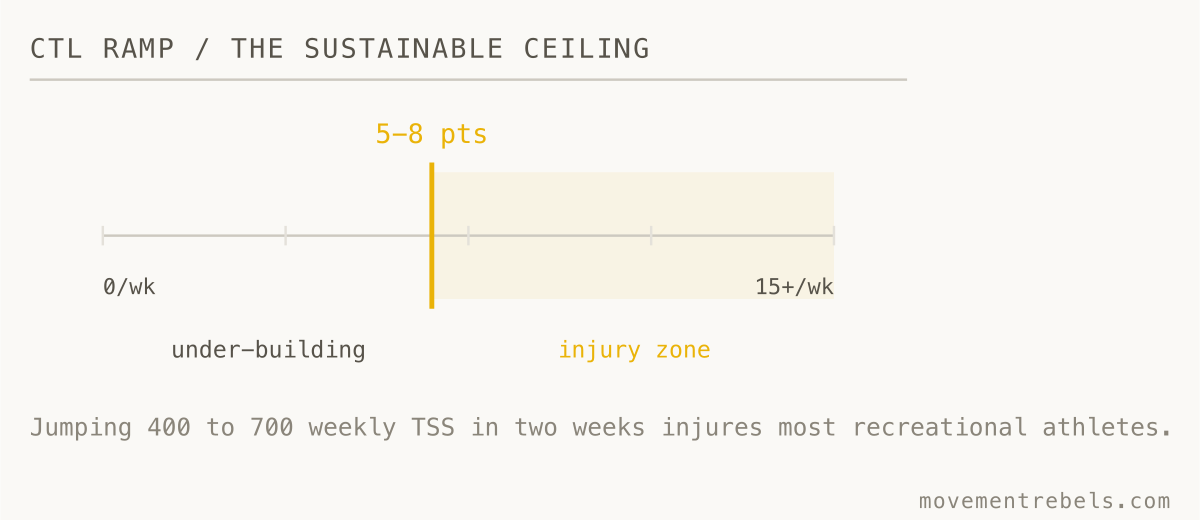
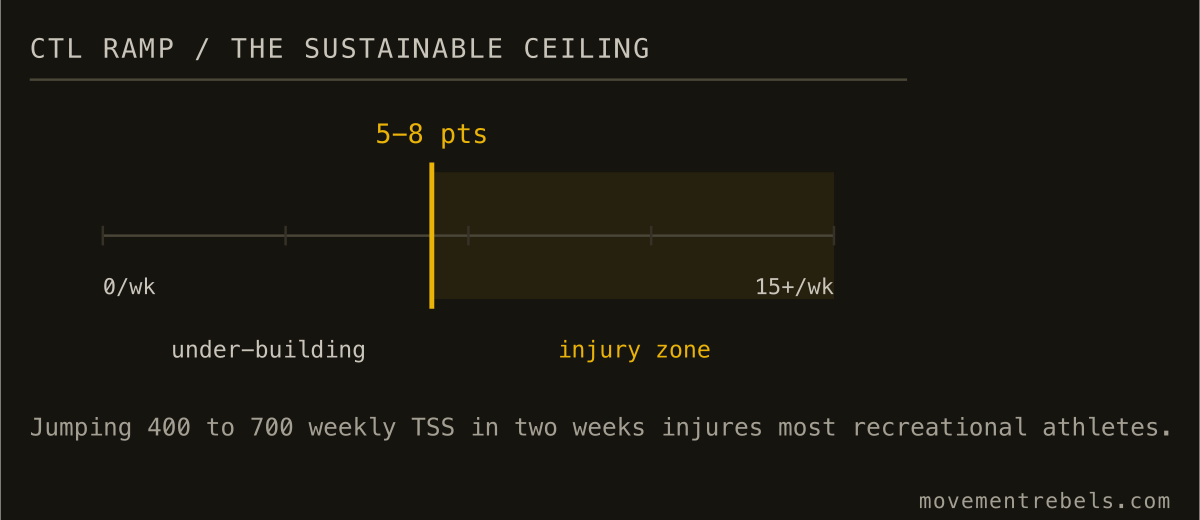
Ramp rate is where TSS earns its keep. A jump from 400 to 700 weekly TSS in two weeks will injure most recreational athletes, and the number shows you that ramp before your body forces the deload. Roughly 5-8 additional CTL points per week is the sustainable ceiling for most recreational athletes. Watch that rate. It is one of the highest-leverage uses of TSS.
For triathletes and hybrid athletes it is also the only sensible way to put a swim, a bike and a run on the same axis. Each discipline has its own TSS variant, watts-based for cycling, pace-based rTSS for running, hrTSS when power or pace data is unavailable, all of them imperfect translations and all of them directionally useful for tracking multi-sport load. The normalized power guide has the cycling-specific math behind IF and TSS.
Where TSS breaks
Here is the honest version. Peer-reviewed research on Banister-type models identifies several structural weaknesses: they assume the training effect is maximal at the end of a session, when real skeletal muscle adaptation unfolds over days, and they ignore psychological, nutritional and environmental variables. There is no mechanism in them for athlete-specific response patterns. Tested against modern alternatives on elite performance data, regularized machine-learning methods outperformed classic CTL/ATL frameworks in predictive accuracy.
None of that means throwing TSS away. It means knowing what it does not predict.
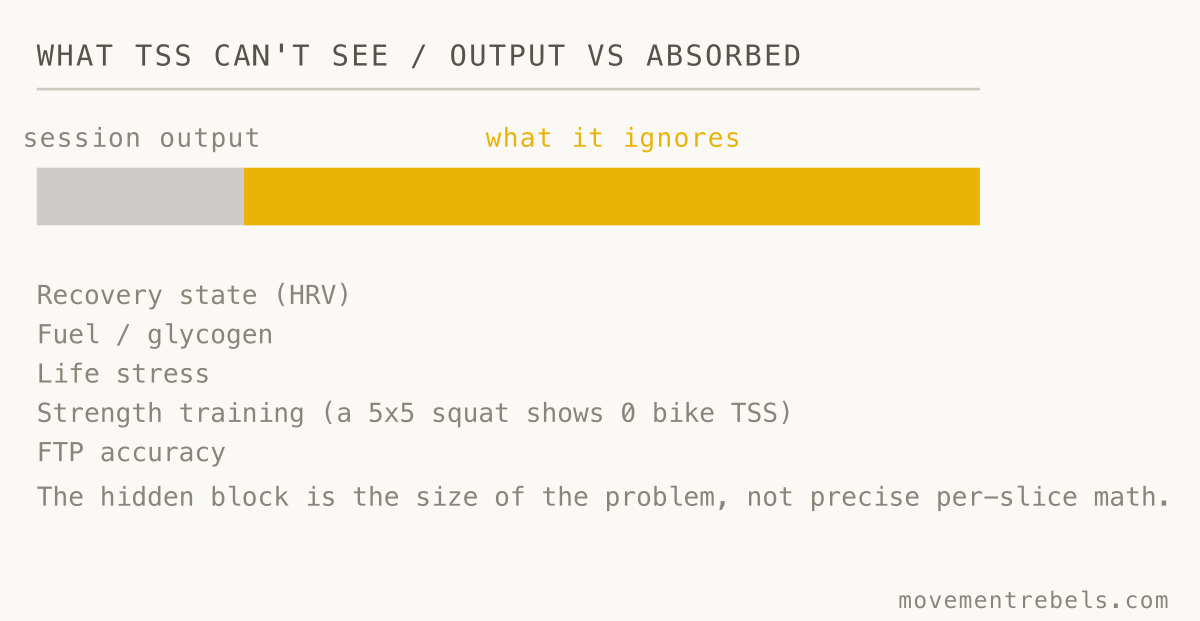
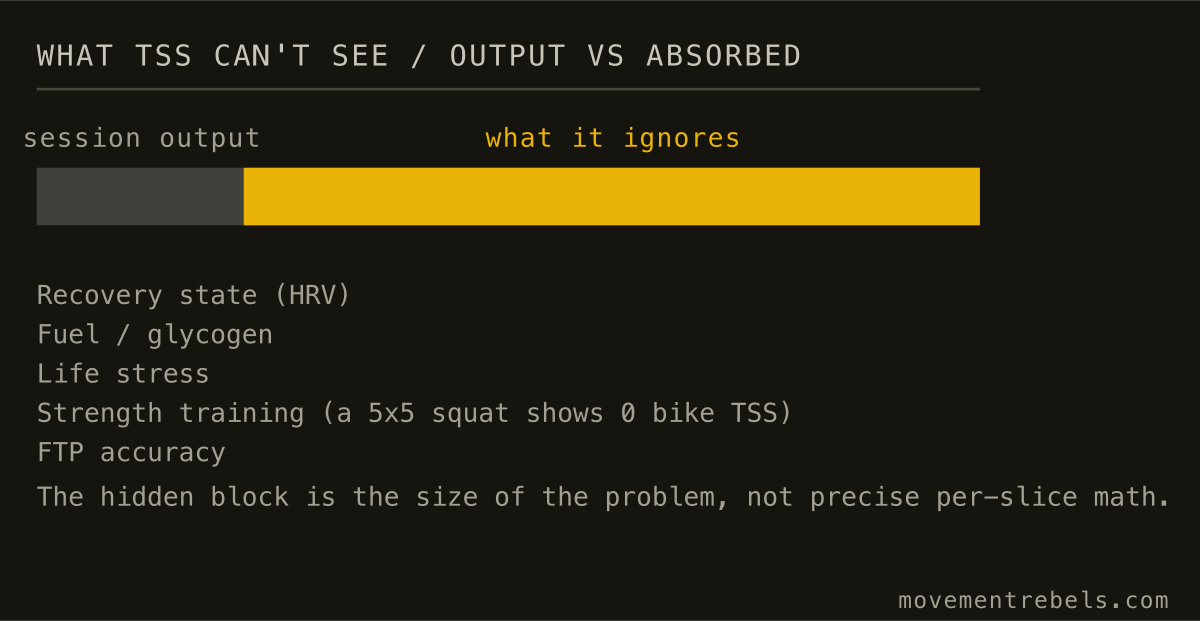
TSS does not see recovery state. A 150 TSS day with HRV 20% below your baseline is a different training stimulus from 150 TSS when you are rested and fresh, even though the number on the screen is identical. The hormonal and neuromuscular cost is not. HRV-guided training fills the gap TSS cannot.
TSS does not see fuel. Long aerobic sessions empty glycogen when carbohydrate intake is inadequate, and the next quality session pays for it. A week of 500 TSS well-fueled builds fitness. The same 500 TSS on a chronic calorie deficit digs a hole, and the number looks the same either way. Fueling around long sessions covers what that gap costs.
TSS does not see life stress. Evidence broadly shows that non-training stressors, poor sleep and travel and psychosocial pressure among them, meaningfully affect how athletes absorb training load, and a 100 TSS ride during a brutal work week is not the same session as 100 TSS in a calm recovery week.
TSS does not see strength training. A heavy 5x5 squat session does not appear in your bike TSS at all. Your legs know it happened. For hybrid athletes this is a persistent blind spot: strength load plus endurance load is the real total stress, and half of it never reaches the TSS chart.
TSS is only as accurate as your FTP. FTP is the denominator of the whole formula, and test-retest research on FTP in competitive cyclists shows the measurement itself carries meaningful noise, with reliability varying substantially depending on protocol. Set your FTP 10 watts too high and every ride's TSS is inflated, and a stale FTP after a training block does the same thing, inflating every session's cost by underestimating your real threshold. TSS chains to whatever number you tested last.
rTSS overcounts muscular damage from running. At the same TSS figure, running generally creates more muscle damage than cycling. The mechanism is biomechanical. Running is eccentric-dominant (muscles lengthening under load), cycling is concentric-dominant, and most evidence points to eccentric-dominant exercise producing greater muscle damage markers than concentric work at comparable loads, though the magnitude depends on context and training status. A 100 rTSS long run and a 100 bike TSS tempo ride are not the same recovery ask. The model treats them identically.
The historian's note: this idea is older than the app
Quantifying training dose to predict performance predates GPS, power meters and smartphones. Banister's impulse-response model from 1975 was running on collegiate swimmers long before the first cycling computer existed, and Phil Maffetone's MAF method from the early 1980s was another expression of the same idea: measure load, manage intensity, predict adaptation. The underlying physiology has not changed. What changed is the precision of the measurement, the accessibility of the tools, and the number of apps selling subscriptions built around the framework.
That context matters when you calibrate how seriously to take any single metric. For 50 years the idea behind TSS has been tested and found useful, and also found incomplete. TSS is a refinement of it. Trust the useful part. Do not outsource judgment to the number.
How Movement Rebels reads TSS
Movement Rebels treats TSS as one input in a multi-signal model, not the primary anchor.
When your Garmin syncs a completed workout, the coach reads the activity data, the session's calculated load included, and structured workouts you receive get pushed straight to your Garmin watch through the native integration, so the coached session and the actual output sit side by side. Apple Health (native on the iOS app) brings in HRV, sleep and resting heart rate from your wearable. Strava is a write destination: after the coach generates session analysis, it writes a coaching summary back to your Strava activity description. Strava activity data does not flow into the coach as an analytical input.
The coach layers all of it. Cumulative load from every discipline feeds the adaptive plan, so a hybrid athlete running alongside cycling gets both streams counted, not only the one that produces a power file. A 4x6 squat session logged in the strength tracker shows up as systemic stress even though it contributes nothing to your weekly rTSS.
HRV trend from Apple Health or your Garmin tells the coach whether your body is absorbing the load or accumulating it, sleep duration and quality add another layer, and fueling logged in the app shows whether the energy is there to back the training. HRV down, sleep short, TSS climbing: the plan pulls back. The trigger is the signals TSS ignores, not a missed TSS target.
Ask the coach why a session was adjusted. It tells you which inputs moved: load ramp, HRV trend, sleep data, fuel deficit, strength volume. That is how TSS gets useful, one signal among several you can interrogate instead of the single number you are trying to optimize.
For athletes building toward a goal event, the coach also uses TSS ramp rate to set periodization blocks: build phases where CTL rises steadily, peak phases where acute load spikes, taper phases where ATL drops faster than CTL to produce freshness. Periodization for recreational athletes shows how those phases work in practice.
How to actually use TSS
Watch the ramp rate, not the daily number. Weekly CTL growth of 5-8 points is the rough sustainable ceiling, and faster than that means you are outrunning your ability to absorb. Approaching a target event, expect controlled CTL climbs during build blocks and a deliberate ATL drop in the two to three weeks before race day. When to deload has the signals that confirm the taper is working.
Pair TSS with HRV and sleep. Rising TSS alongside stable or rising HRV means you are adapting; rising TSS alongside falling HRV means fatigue is outpacing recovery, and that second case is a deload signal regardless of what the training plan says. Overtraining signs covers what happens when you ignore that signal long enough.
Pair TSS with fueling. A high-TSS week on adequate carbohydrate and total calories builds fitness, and the same week underfueled builds a deficit. Log meals so the coach sees energy availability, not only training output.
Calibrate your FTP regularly. After any significant training block, a fresh threshold test keeps the denominator honest, because a stale FTP quietly corrupts every IF and TSS calculation downstream.
Treat rTSS and cycling TSS as rough equivalents for cumulative load tracking, and remember the muscular damage gap when you read recovery signals. After a long run your legs need more than the TSS number implies, and after a long ride the cardiovascular system may be more taxed than the legs.
TSS is not broken, it is incomplete. Use it where it works: session comparison and weekly ramp and the periodization model, then add the signals it cannot see and decide from the combination.
Pricing
A 7-day free trial gives you full access to the adaptive plan, the coach chat, activity sync from Garmin and Apple Health, fueling log, breathwork, NSDR, fasting timer, and every integrated wearable. No card required. After the trial, Pro+ is $20/month for unlimited coaching. The morning brief and weekly brief stay free for everyone.
TSS Calculator
Score any session's training stress from power and FTP.
One app instead of five.
Strength, endurance, recovery, fueling, planning, and your AI coach. All under a 7-day free trial. No card.
Start 7-day trialNormalized Power Explained: The Algorithm Is Sound, the Hype Around It Is Not
Normalized Power weights variable efforts to estimate real physiological cost. The math is solid. The blind spot the hype skips: N
HRV-Guided Training: Read the Signal, Skip the Noise
One low HRV night tells you almost nothing. The 7-day-vs-28-day trend tells you nearly everything. Here is what the evidence actua
Periodization for Recreational Athletes: Which Model, and How Much You Need
Linear, block, undulating: the honest evidence on which periodization model recreational athletes actually need, and what the rese
When to Deload: Reading the Signals Right
The 4-week deload rule is a template, not a law. Here are the actual physiological signals that tell you when your body is asking