Overtraining Signs: The Ones Worth Watching
Most people who say they're overtrained aren't. The real diagnosis is rare, has no reliable blood test or biomarker, and takes months to resolve. What's common, and what most people actually experience, is something the sports science literature calls non-functional overreaching: a buildup of training stress that outpaces recovery until performance slides, motivation craters, and every session feels harder than it should. The fix is weeks, not months. The window to catch it early exists. The problem is that most guides hand you a list of symptoms and call it a day, when the honest answer is that no single metric catches this reliably. You need a stack, and you need to read the trend, not the number.
The Spectrum: Three States, Three Different Fixes
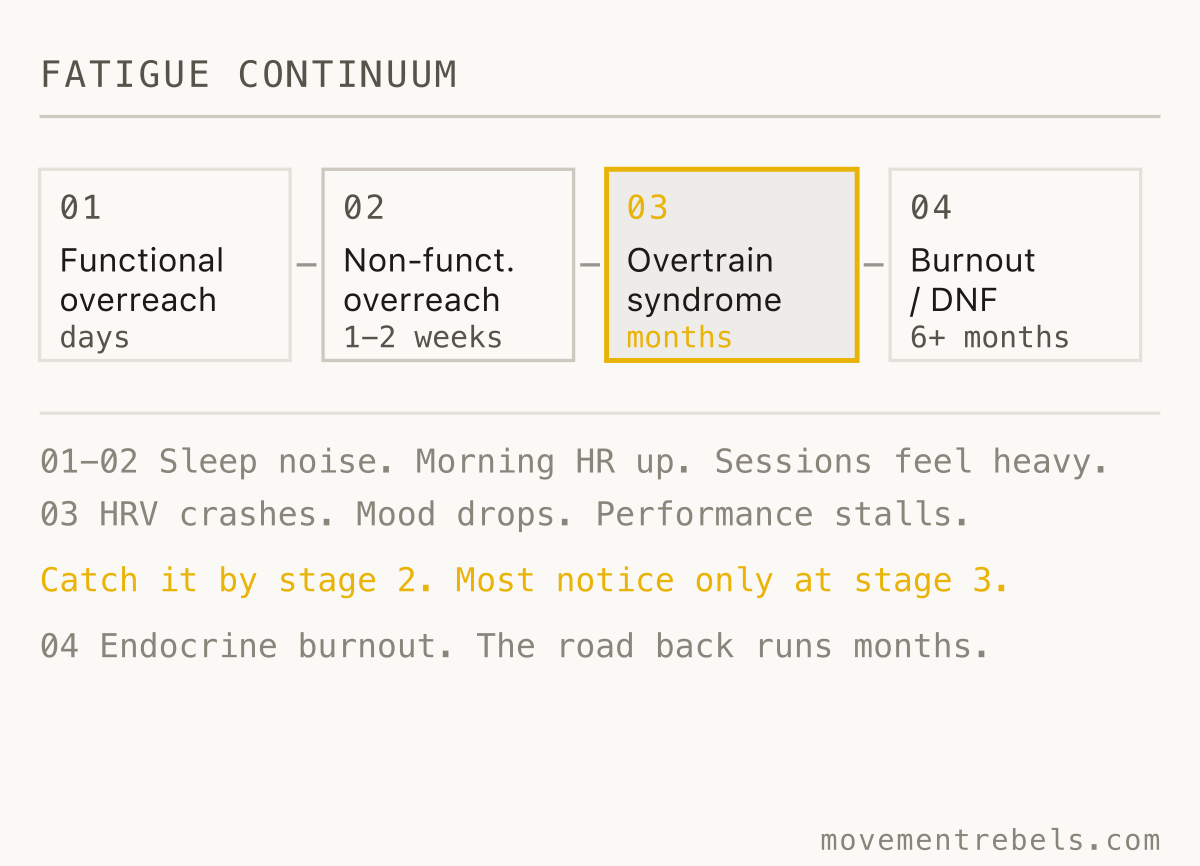
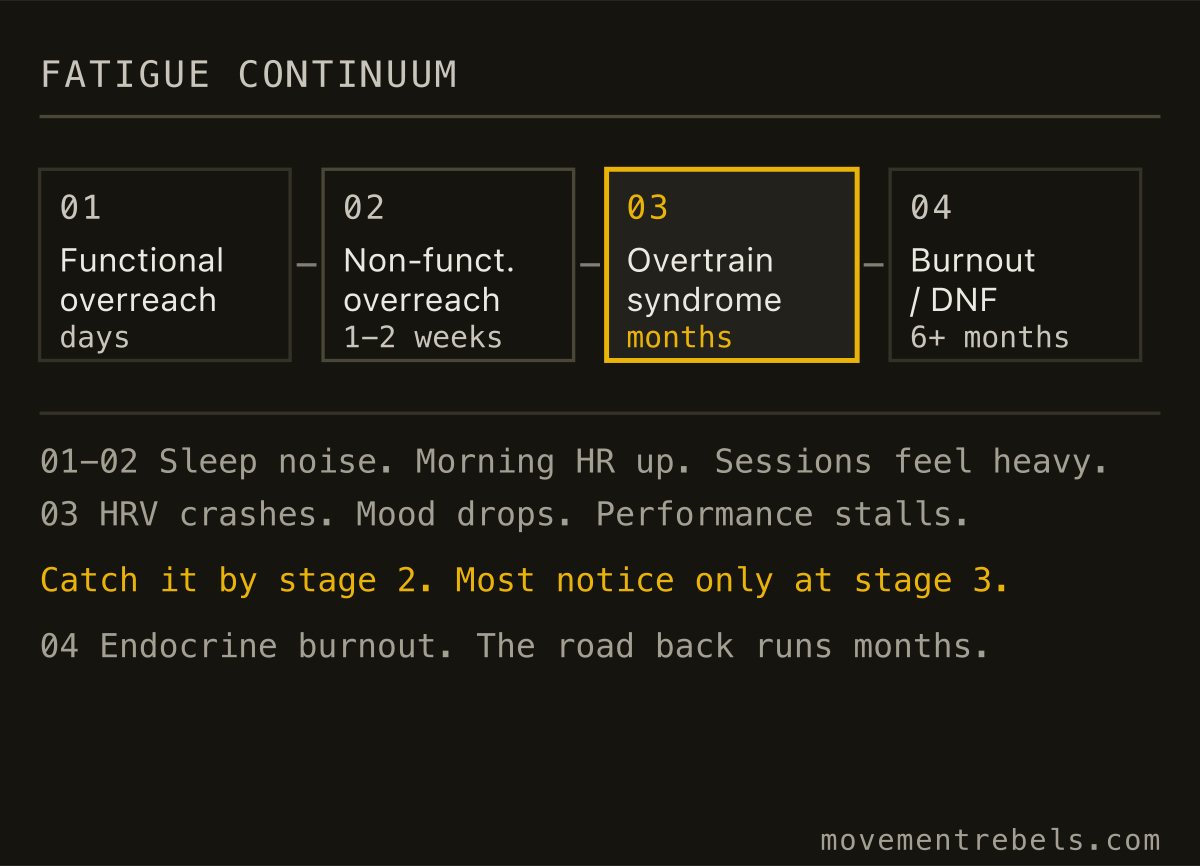
The 2013 joint consensus statement from the European College of Sport Science and the American College of Sports Medicine established the framework that sports scientists still use. There are three states on a continuum, and they have meaningfully different timelines and responses.
Functional overreaching is intentional and productive. You push training stress above your recovery capacity for 1-3 weeks, performance dips slightly, then you deload and supercompensate. Fitness goes up. This is the mechanism behind periodization and every meaningful training block.
Non-functional overreaching (NFOR) is where most recreational athletes land when things go wrong. Push too long, skip the deload, chronically under-fuel, or stack a stressful life period on top of heavy training, and performance stays flat or drops for weeks. Recovery time: 2-6 weeks of proper rest and nutrition. This is what most people mean when they say "overtrained."
Overtraining syndrome (OTS) is the rare endpoint. Hormonal disruption, mood disorders, immune dysfunction, performance loss that persists for months. The research consensus is clear: no single marker reliably diagnoses OTS, no gold-standard test exists, and OTS remains a diagnosis of exclusion. Doctors rule out other medical causes before landing on the label. Most age-group athletes never get there. They live in NFOR, mistake it for a motivation problem or a fitness plateau, and dig deeper.
Catching it at the NFOR stage is the whole point. That's when the deload still works.
Why No Single Metric Is Enough
The HRV tracking revolution created a reasonable but slightly misleading belief: that you can catch overtraining from one number on your watch. The reality is messier.
HRV is useful as a trend marker. A sustained suppression across multiple days, measured consistently at the same time in the same conditions, correlates with accumulated stress. The evidence broadly agrees that reduced HRV can reflect overreaching or overtraining, but the methodological quality of the supporting studies is fair at best, and HRV on its own is not a sensitive enough marker to act on alone. Single bad HRV morning tells you very little. A week-long downtrend with other signals is meaningful.
RHR trending up is similarly useful in aggregate, similarly unreliable in isolation. One elevated morning reading could be poor sleep, a glass of wine, early illness, or stress. Five elevated mornings in a row, with no obvious explanation, is a different story.
The honest framework: watch the stack, look for the trend, and treat individual readings as noise until you have 5 or more days of drift across multiple signals at once.
The Signal Stack
Any one of these can spike for boring reasons. The pattern across several days across multiple signals is where under-recovery stops being noise and becomes a trend worth acting on.
RHR trending up 5+ bpm vs your 28-day baseline. Not a single high morning. Five or more mornings of elevated RHR without a clear illness explanation means your sympathetic nervous system is stuck elevated. Movement Rebels pulls this from Garmin via the native OAuth integration and from Apple Health on iOS, where the native app reads HealthKit directly.
HRV down more than 10% from your rolling baseline. Noisier than RHR, but one of the cleaner sustained-trend signals when it holds for several days. Never act on a single reading. See the HRV-guided training guide for the full methodology.
Sleep quality dropping despite the same time in bed. Falling deep sleep percentage, more wake events, lower sleep efficiency. Your nervous system is attempting to recover and failing. Garmin sleep tracking feeds in directly; devices that push to Apple Health flow into the native iOS app.
Performance decoupling on familiar workloads. Same Zone 2 pace, higher heart rate. Same prescribed power, higher RPE. Same lifts, bar speed drops. This is the most objective signal in the stack. When your outputs degrade at constant inputs, something systemic is off.
RPE diverging from objective HR or power. You log a session as RPE 8 that should have been a 6. Subjective effort rising faster than objective load is one of the earliest behavioral signals.
Rebel Fuel showing a chronic energy deficit. This is the one most athletes miss entirely, and it is frequently the root cause rather than a symptom. You cannot out-recover an under-fueled training block. The hormonal picture in true OTS is complex: research finds that blunted growth hormone and ACTH responses to stimulation tests are among the more consistent markers, while cortisol responses show conflicting results across studies. What is well established is that chronic under-fueling directly drives HPA axis dysregulation regardless. If Rebel Fuel shows 500-800 kcal below your training-day target for two weeks, the coach surfaces it directly: "You're not overtrained, you're underfed." For an endurance athlete in a build phase, that distinction is everything.
Mood, motivation, and mental sharpness. Dreading sessions you used to look forward to, unusual irritability, difficulty concentrating. Soft signals, but consistently reported across both NFOR and OTS literature, and often the first thing athletes notice and the last thing they act on.
A Note on What Wearables Can and Cannot Tell You
HRV scores, readiness scores, and recovery percentages from consumer wearables are calculated from different algorithms using different inputs. None of them directly diagnose overreaching. What they do provide, if used consistently in the same conditions each morning, is a window into trend. That trend, read alongside training load, nutrition, sleep architecture, and subjective feel, gives you an actionable signal before performance tanks visibly. To put a number on the training-load half of that picture, you can score your training stress with TSS and watch the per-session figure trend over the weeks.
The key word is "alongside." A low readiness score on a single bad night is not a warning. A low readiness score after five days of hard training, elevated RHR, degraded sleep efficiency, and a declining mood log is a warning worth taking seriously.

What the Coach Reads and What It Does
When three or more signals in the stack drift together for 5 or more days, Movement Rebels doesn't throw a generic warning banner. The coach reads across all available surfaces simultaneously and rewrites the plan. A typical intervention in the morning brief looks like this:
"RHR up 6 bpm vs baseline for 6 days, HRV down 14%, sleep efficiency at 78% versus your 28-day average of 89%, and Rebel Fuel shows you've been 600 kcal under target on training days this week. Pulling the threshold sessions off Wednesday and Saturday, dropping overall volume 30%, adding an NSDR session before bed tomorrow. Eat more carbohydrates today. We pick threshold back up next Monday if HRV has stabilized."
That is the coach reading wearable data, training log, nutrition log, and sleep data in a single pass and editing your actual calendar. Same place you go to do the work. No separate recovery app to check.
What to Do When You're Already in the Hole
If you recognize yourself in the signal stack above, the playbook is established and well-supported.
Cut training stress 40-60% for 7-14 days. Not zero. You can track weekly hard sets against your recoverable-volume ceiling to see how far over the line you have been and how much to pull back. Easy aerobic movement, mobility, technical drills, light strength to maintain neural patterns. Total rest can actually slow recovery in trained athletes: the parasympathetic system responds better to gentle movement than to complete inactivity. Keep moving, but keep it truly easy.
Eat to recover, specifically carbohydrates. Carbohydrate intake matters directly for cortisol normalization and immune function. If you are also managing body composition, a recomp deficit during NFOR makes the recovery slower. See body recomposition tracking for where to draw that line. Track it honestly. Snap your meals if logging feels like friction.
Protect sleep aggressively. Caffeine cutoff by early afternoon. Alcohol off the table during recovery weeks (it fragments sleep architecture and suppresses deep sleep, which is when a lot of HPA axis recovery happens). Phone out of the bedroom. The 4-7-8 breathwork protocol before bed actually shifts parasympathetic tone measurably for most people.
Track RHR and HRV daily. When RHR returns to within a beat or two of baseline and HRV stabilizes at or above your rolling average for 5 or more consecutive days, you ramp training back. Not before. Going back too early is the most common mistake. It feels like recovered. It isn't.
Schedule the next deload before you need it. Don't wait for the next crash. See when to deload for the proactive cadence, typically every 4th week for hard-training athletes and more frequently during peak build phases.
How Movement Rebels Handles This
The coach watches the full signal stack across every surface that feeds into the app. Garmin's native OAuth integration pulls RHR, HRV, sleep data, and completed workouts directly. The native iOS app reads Apple Health, which is where data from wearables that write to HealthKit lands. Rebel Fuel adds the nutrition and fueling layer. The breathwork and NSDR tools contribute to the biohack history. The strength logger tracks RPE and bar speed on lifts.
When signals drift together across 5 or more days, you get a specific, actionable warning with a rewritten plan, not a banner. A restructured week, already on your calendar, already pushed to your Garmin as structured sessions. One app reading across your fuel, your sleep, your watch, and your training load, because they all live in the same place.
Pricing
Movement Rebels is one app for the full picture: strength, endurance, hybrid, planning, coaching, fueling, recovery, and tracking. A 7-day free trial covers the entire surface. After the trial, Pro+ is $20/month for unlimited coaching. No card on the trial.
One app instead of five.
Strength, endurance, recovery, fueling, planning, and your AI coach. All under a 7-day free trial. No card.
Start 7-day trialHRV-Guided Training: Read the Signal, Skip the Noise
One low HRV night tells you almost nothing. The 7-day-vs-28-day trend tells you nearly everything. Here is what the evidence actua
When to Deload: Reading the Signals Right
The 4-week deload rule is a template, not a law. Here are the actual physiological signals that tell you when your body is asking
Sleep and Training Performance: The Lever Nobody Respects
Sleep outperforms every supplement, wearable, and recovery tool you own. Here's the honest evidence, what actually trashes it, and
Resting Heart Rate Trends: The 28-Day Line
One morning's RHR is mostly noise. Your wearable's sensor can swing 5 bpm on a good night. The 28-day rolling mean is where the si