Preserving Muscle and Strength Through Menopause: Why Lifting Gets Harder and What Works
Your working weight feels heavier than it did eighteen months ago and the scale has barely moved. That combination confuses a lot of women in their late forties, because every article on the subject assumes muscle is the thing vanishing. Measured properly, muscle mass barely budges across the menopause transition. Strength and power fall many times faster. That gap is what your training has to answer.
Strength falls faster than muscle does
The SWAN cohort tracked body composition against the date of the final period rather than against age, which is the only way to see what menopause itself does. Lean mass in that cohort fell about 0.2% a year across the transition, against a small annual gain before it, a window running from two years before the final period to about eighteen months after.
Now the force numbers. The Finnish ERMA cohort followed 232 women aged 47 to 55 from perimenopause through to postmenopause over 14 to 18 months. Handgrip force fell 2.1%. Knee extension torque fell 2.6%. Vertical jump height fell 2.6%. Walking speed did not change, which is why nothing feels wrong until you load a bar.
Put those side by side. Lean mass leaving at a fifth of a percent a year, force and power leaving at 2.6% in a little over a year. The tissue is mostly still there. What it will do on command is not.
One ERMA finding should stop the usual advice cold: the most physically active women gained handgrip strength and lost more jumping height than the inactive ones. Being busy is not the same as being loaded.
Why the same session stops working
Two things change at once, and they compound.
The first is anabolic resistance. Muscle in older women answers a given dose of exercise and protein with less building than it used to. In a 2024 trial, 16 postmenopausal women averaging 60 years lifted, with or without whey afterwards, and myofibrillar protein synthesis rose for a two hour window either way but the four hour total never beat the resting condition. A review of this literature found the response to resistance exercise blunted in three of four studies in older women, and to protein feeding in three of six.
The second is everything around the muscle. A meta-analysis put musculoskeletal pain at 71% of perimenopausal women, 4,144 of 5,836, with 1.63 times the odds of the premenopausal group. A shoulder that objects to overhead work, a hip that takes three sets to warm up. None of that is in your head, and all of it quietly shrinks the load you put on the bar.
So the session that maintained you at 42 sits under threshold at 52. Same weights, same sets, less answer.
Heavy loads are the signal that still gets through
The intervention data is far more encouraging than the observational data.
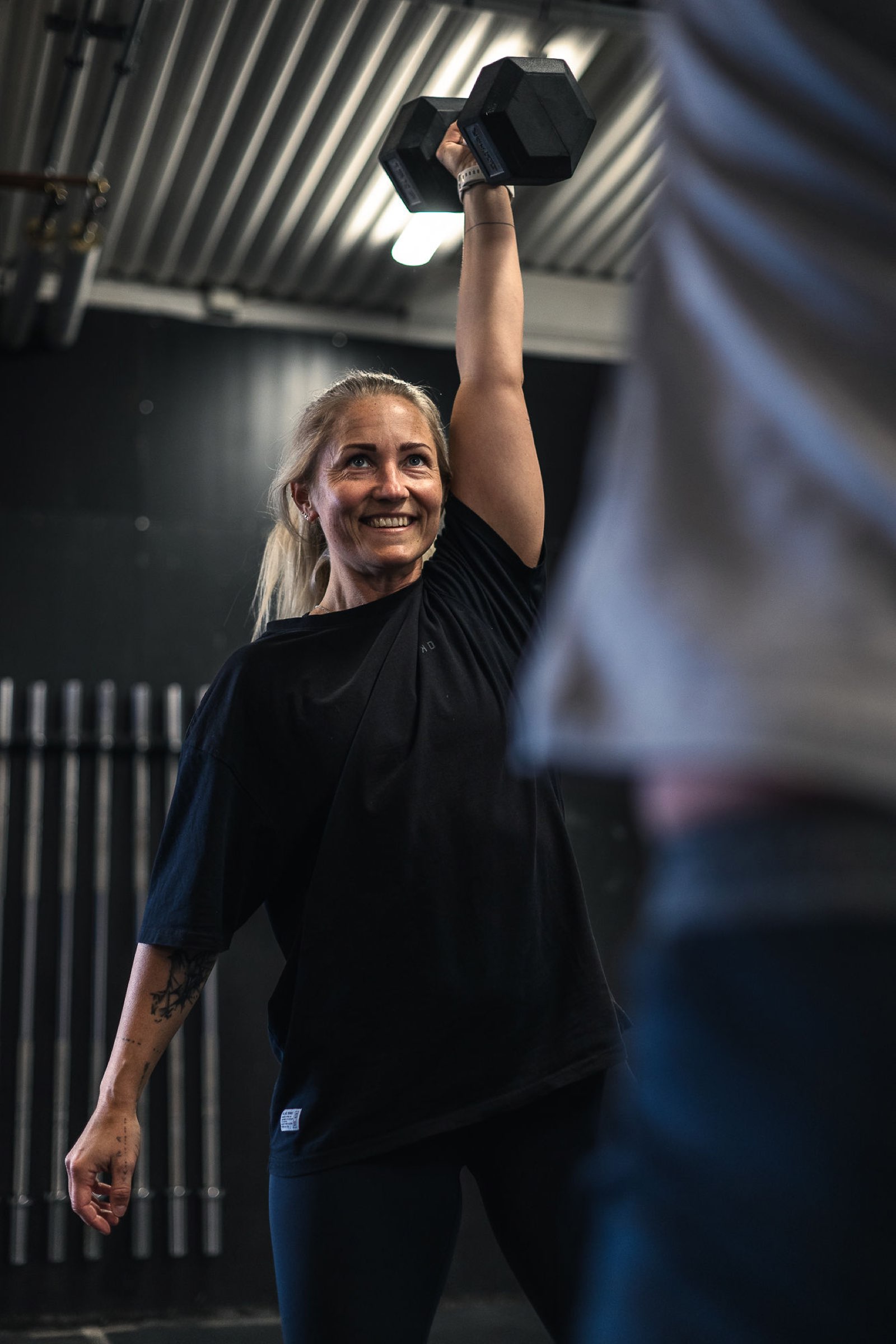
STOP-EM took 40 women averaging 52.9 years, half perimenopausal and half early postmenopausal, through nine months of twice weekly supervised lifting. Five sets of five at 80 to 85% of one rep max on a modified deadlift, box back squat, a press and a pull, with drop landings in the same sessions for bone. Lean mass rose 1.2% while the waitlisted controls lost 0.8%, a between-group difference of 0.90 kg. Back squat one rep max climbed 30.5% and deadlift 21.7% between week 12 and week 36. Leg power separated by 97 watts.
A separate trial ran the same idea faster. Ioannidou and colleagues put 55 postmenopausal women averaging 58 years through 12 weeks of free weights, three times a week: box squat, deadlift, lat pulldown, lateral raise and a single arm carry, load set by reps in reserve with 5 to 10% added most weeks. Skeletal muscle mass rose 1.2 kg in the training only group. Box squat one rep max went up 34 kg and deadlift 22 kg in twelve weeks.
Two trials, two frequencies, one shared feature: compound lifts, low reps, a load that climbed week after week for months. Neither protocol looks like a circuit.
The practical version: four to six compound lifts, three to five sets of three to six reps, 80 to 85% of your max on the main ones, two to three minutes of rest, and every set stopped a rep short of failure. That last part is not softness. Training close to failure buys little extra and costs recovery you no longer have spare. Set your percentages from a recent hard set with a 1RM calculator and ramp into them with a warm-up set plan.
The 24 week ramp
Read this as a route rather than a schedule. The load column is the destination the trials above used, and the first two phases exist so you arrive there with technique that holds. STOP-EM did the same, three months of technique and building before anyone touched 80%, with a trainer or exercise physiologist watching every session. If you have never pulled a bar off the floor, get weeks 1-4 coached in person. Already lifting heavy? Start at week 9. If a phase feels unfinished, repeat it: nothing here is improved by arriving early.
| Phase | Sessions / week | Main lifts | Load | Checkpoint |
|---|---|---|---|---|
| Weeks 1-4 | 2 | 3 sets of 8 | RPE 5-6, light | Every rep looks the same as the first |
| Weeks 5-8 | 2-3 | 4 sets of 6 | 70-75% of 1RM | Adding load most weeks without strain |
| Weeks 9-12 | 2-3 | 4 sets of 5 | 75-80% of 1RM | Last rep hard, never grinding |
| Week 13 | 2 | 3 sets of 5 | Hold last load | Deload: cut sets, keep the weight |
| Weeks 14-18 | 2-3 | 5 sets of 5 | 80-85% of 1RM | This is the trial dose. Live here |
| Week 19 | 2 | 3 sets of 5 | Hold last load | Second deload |
| Weeks 20-24 | 2-3 | 5 sets of 3-5 | 85%+ on one lift | Retest a single main lift at week 24 |
| Ongoing | 2 minimum | 3-4 sets of 5 | 80%+ | Two heavy sessions a week, permanently |
movementrebels.com
Two sessions is the floor. STOP-EM got its results on two a week and Ioannidou on three. When the week collapses, protect the two.
Protein: a bigger per meal dose, and what it will not fix
The per meal number matters more than the daily total now, because of the anabolic resistance above. The most cited estimate comes from Moore and colleagues, who found muscle protein synthesis plateaued at 0.40 g per kg of bodyweight per meal in older men against 0.24 in younger men. Worth saying plainly: that study was in men, and the equivalent work in postmenopausal women is thin. Treat 0.4 g/kg as a working estimate rather than a law. For a 68 kg woman it lands near 27 g per meal, which is three eggs plus yoghurt, not a bowl of cereal. Run your own number, then go look hard at breakfast.
What protein will not do is stand in for load. The Ioannidou trial had an arm worth knowing about: one training group also ate 2.5 g per kg of fat free mass, about 122 g a day, and got no additional muscle or strength over the group on its normal diet. Protein clears a floor. The bar does the work. The protein guide has the daily target and how to spread it.
The opposite error costs more. A steep calorie cut while you are holding lean mass in your fifties is the fastest way to lose the thing you are training to keep, and training through a deficit has rules of its own.
Creatine, at the honest size of the effect
Creatine is the one supplement with real data here, and the effect is smaller than the internet suggests. A meta-analysis of creatine plus resistance training in older women pooled 8 studies and 176 participants. Upper body strength improved with a standardised mean difference of 0.35. Muscle mass and lower body strength missed significance overall. In trials running 24 weeks or longer, lower body strength reached it. Muscle mass did not, at any length. The authors graded the evidence quality as low.
A broader review of creatine across women's health concluded that 5 g a day or more supports muscle and strength gains in postmenopausal women, while finding no benefit to bone. So: 5 g a day, every day, judged after six months rather than six weeks, alongside the lifting rather than in place of it. The supplement guide covers the rest of the shelf.
What to cut when the week goes wrong
The plan does not fail on a good week. It fails in week 11, on the third short night, when the session gets moved and then dropped. It survives by shrinking in the right order.
- Cut sets before you cut load. Three sets of five at your working weight keep the signal the trials ran on. Five sets at 70% do not.
- Drop the hard cardio first. Intervals cost recovery and return nothing to the bar. On a short week they go before a single heavy set does.
- Deload on a schedule, not a feeling. Every fifth or sixth week, cut volume and hold intensity, the way weeks 13 and 19 do in the table above. When to deload covers the general case.
- Do not test a max in a bad week. A failed retest after three short nights tells you about your sleep, not your strength.
- Keep hormone therapy in the doctor's office. Pooled across 12 randomised trials and 4,474 participants it slowed lean mass loss by 0.06 kg, which was not statistically significant. There are good reasons to take it. Holding muscle is not one of them, on the pooled evidence.
- Retest instead of guessing. Strength falls fastest and is the hardest thing to feel. Put a number on it twice a year.
FAQ
I have not lost weight but I have lost strength. Is that normal?
Yes, and it is the pattern the research predicts. Lean mass falls slowly across the menopause transition, around 0.2% a year in the SWAN cohort, while measured force and power fell 2.1 to 2.6% in a little over a year in the ERMA cohort. The muscle is mostly still there. What changes is how much of it you can call on, which is why the scale looks fine and the bar does not.
Can I get the same result from bands, bodyweight and classes?
Probably not, on the evidence available. Both trials that produced meaningful gains in peri and postmenopausal women used barbells with load that climbed over months, at 80 to 85% of one rep max in STOP-EM. The ERMA data also found that generally active women lost more jumping height than inactive ones, which suggests being busy does not substitute for being loaded. If a barbell is not available, the principle still holds: something heavy, progressed weekly, for low reps.
How much protein should I eat in one sitting?
Aim for roughly 0.4 g per kg of bodyweight per meal, which is about 25 to 30 g for most women. The estimate comes from dose response work in older men. Treat it as a working target, not a precise threshold. Spread it across three or four meals instead of loading dinner. Breakfast is where most women fall short, and fixing that one meal usually fixes the daily total too.
Is creatine worth taking through menopause?
It is worth taking, with modest expectations. Pooled data from eight trials in older women found a small improvement in upper body strength and no significant effect on muscle mass overall, though trials lasting 24 weeks or more did show gains in both upper and lower body strength. Five grams daily, judged after six months. The pooled bone data show no benefit, and it does nothing on its own without the training.
Will hormone therapy protect my muscle?
Not reliably, based on the pooled evidence. A meta-analysis of 12 randomised trials with 4,474 participants found hormone therapy slowed lean mass loss by 0.06 kg compared with controls, a difference that was not statistically significant. That is not an argument against taking it, since it is prescribed for other symptoms with real benefit. It is an argument against expecting it to do the job that the lifting does.
Everything aches. Should I train through it?
Some of it, carefully. Musculoskeletal pain affects around 71% of perimenopausal women, so waiting for a pain free week means waiting a long time. Work around the specific joint that hurts rather than cancelling the session: swap overhead press for a landmine press, trap bar for straight bar, box squat for a full squat. Sharp, new or one sided pain is a different category and belongs with a physio.
How Movement Rebels fits
The hardest part is that you cannot feel strength leaving. It goes many times faster than the muscle, and by the time a lift feels wrong you have been under threshold for months.
Movement Rebels closes that gap with a number. The Proving Ground banks your field tests across push, pull, core, power and engine, scores each against age and sex standards as a percentile, and marks each result fresh, fading or stale as it ages. A strength number that has gone old looks old, instead of hiding behind a lift that still feels fine. Alongside it, the coach reads your logged lifts and PRs and your Garmin or Apple Health sleep, resting heart rate and HRV. A retest that comes back lower next to steady sleep is a programming problem. The same number next to three short-sleep weeks and a rising resting heart rate is a recovery problem, and the fix is cutting sets while holding the weight.
Two things to write in yourself. The coach cannot see what you eat, so your per meal protein target goes into the Notes for your coach field, next to your menopause stage and the shoulder that will not press overhead. It sits in front of the coach on every plan. Then give it a lift number and a month, and it builds the arc backward from there.
One app instead of five.
Strength, endurance, recovery, fueling, planning, and your AI coach. All under a 7-day free trial. No card.
Start 7-day trialBone Density Loss in Female Athletes: Prevention Through Strength, Nutrition, and Load
How female athletes prevent bone density loss from RED-S, hormonal stress, and imbalanced training. Resistance training dose, calc
Masters Athlete Training After 40: What Holds You Back
The research is clear: most VO2max decline after 40 comes from training volume reduction, not aging. Here's what actually changes,
Protein for Endurance and Hybrid Athletes: How Much, When, and Why
Practical daily protein targets for endurance and hybrid athletes: how to pick a number in the 1.6-2.2 g/kg range, how to split it
Training to Failure: How Hard Is Hard Enough?
You do not need to grind every set to failure. Stopping at 1-2 reps in reserve builds the same muscle while keeping you fresh. Wha