Normalized Power Explained: The Algorithm Is Sound, the Hype Around It Is Not
Normalized Power does one thing well: it converts a messy, variable ride into a single number that better represents the physiological cost than raw average power. The core math has peer-reviewed backing. What the cycling performance industry does not advertise is that NP is downstream of FTP, and FTP is a shaky input. Build on a stale FTP and your NP-derived training load, Intensity Factor, and TSS all drift away from reality, silently. The algorithm is not the problem. The inputs are.
This guide covers what the algorithm actually does, why the nonlinear weighting is physiologically justified, where it falls apart, and what Movement Rebels does with NP once your ride syncs in.
Why Average Power Lies for Variable Rides
Physiological cost scales nonlinearly with intensity. Two minutes at 350 watts followed by two minutes at 50 watts is not the same as four minutes at 200 watts, even though the averages match. The hard surge depletes glycogen, drives lactate accumulation, recruits fast-twitch fibers, and leaves a metabolic debt the easy coasting cannot cancel.
A 2020 study in Frontiers in Physiology confirmed this directly: fifteen elite cyclists rode matched average power at both low and high intensities, once steady, once variable. The variable condition produced significantly higher VO2, heart rate, and blood lactate at both intensities. Perceived effort, interestingly, did not scale the same way: at high intensity, RPE was similar despite the physiological gap. The implication is that how hard a ride feels is not a reliable index of how much it actually cost.
Average power treats every second as equal. Real-world riding almost never is: lights, descents, climbs, attacks, soft-pedaling. For a flat indoor trainer ride at locked wattage, average and NP are essentially identical. For any ride with variability, which is most outdoor cycling, average power undersells the true cost. Sometimes badly.
The Algorithm (Two Minutes, Worth Your Time)
Andrew Coggan developed Normalized Power in the early 2000s, codified in the first edition of "Training and Racing with a Power Meter" (Allen and Coggan), to answer a simple question: what constant wattage would have cost the same as this variable ride? The calculation is four steps:
- Compute a 30-second rolling average of power across the ride. This smooths pedal-stroke noise and accounts for the lag between a power spike and the full physiological response.
- Raise each smoothed value to the fourth power.
- Average all those fourth-power values.
- Take the fourth root of the average.
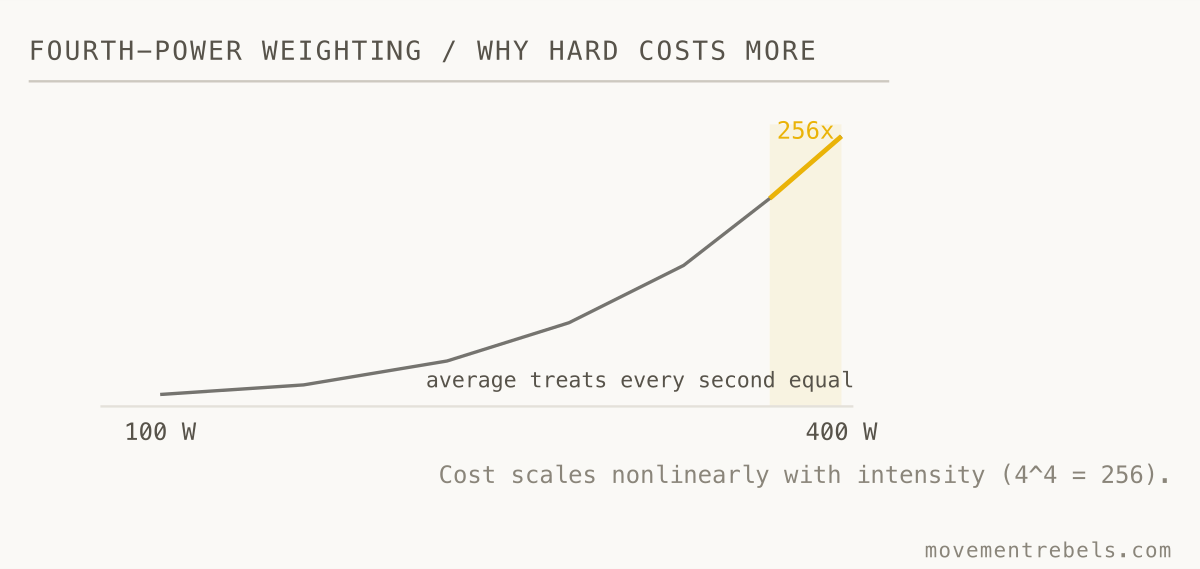
The fourth-power weighting is where the nonlinear physiology lives. A 30-second segment at 400 watts contributes 256 times more to the NP calculation than a segment at 100 watts (four to the fourth is 256). That ratio roughly matches how glycogen utilization, lactate production, and stress hormone responses scale with intensity. Philip Skiba's xPower uses a 25-second exponentially weighted average instead of Coggan's linear 30-second window, arguing the exponential decay better represents the body's actual integration of effort. Both produce nearly identical results in practice, as a 2023 terminology review in the Journal of Science and Cycling confirmed, noting the two are mathematically equivalent for most riding conditions.
The 30-second window also means short, maximal spikes are dampened. A 3-second sprint to 900 watts does not carry the same NP weight as 30 seconds at 600 watts. That is the correct behavior: your aerobic system does not pay the full cost of a 3-second burst the way it pays for a sustained hard effort.
Variability Index: What NP and Average Power Together Tell You
Once you have NP, you get a diagnostic ratio at no extra cost: Variability Index (VI) = NP divided by average power. A perfectly steady ride has VI of 1.00. A punchy criterium might hit 1.25. A well-executed time trial sits near 1.02-1.05. To run the three together off one ride, this Normalized Power, IF and VI calculator does the full set.
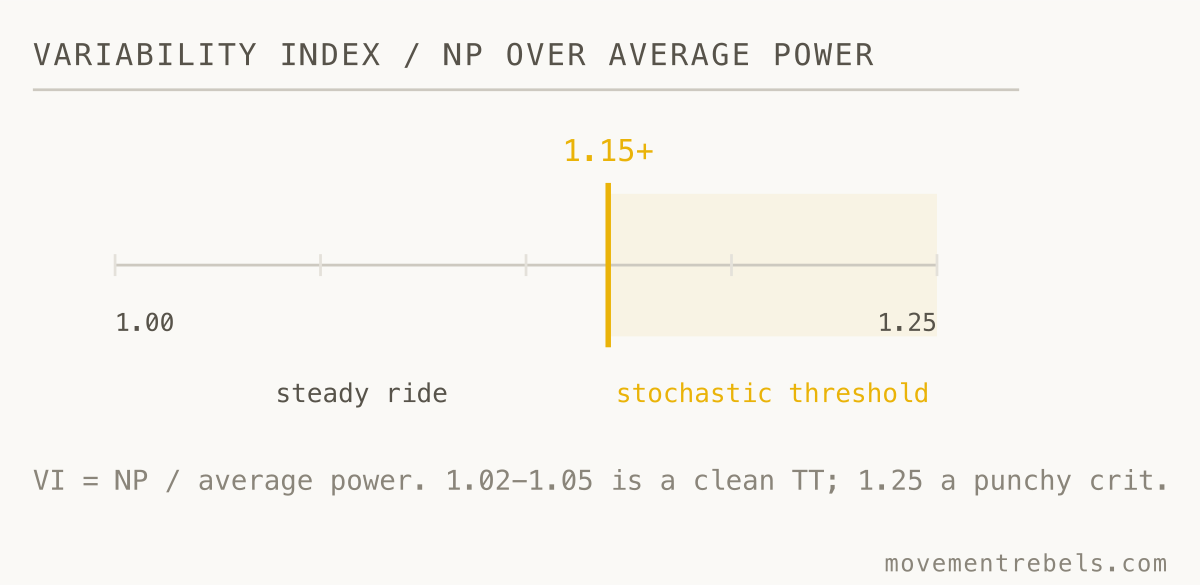
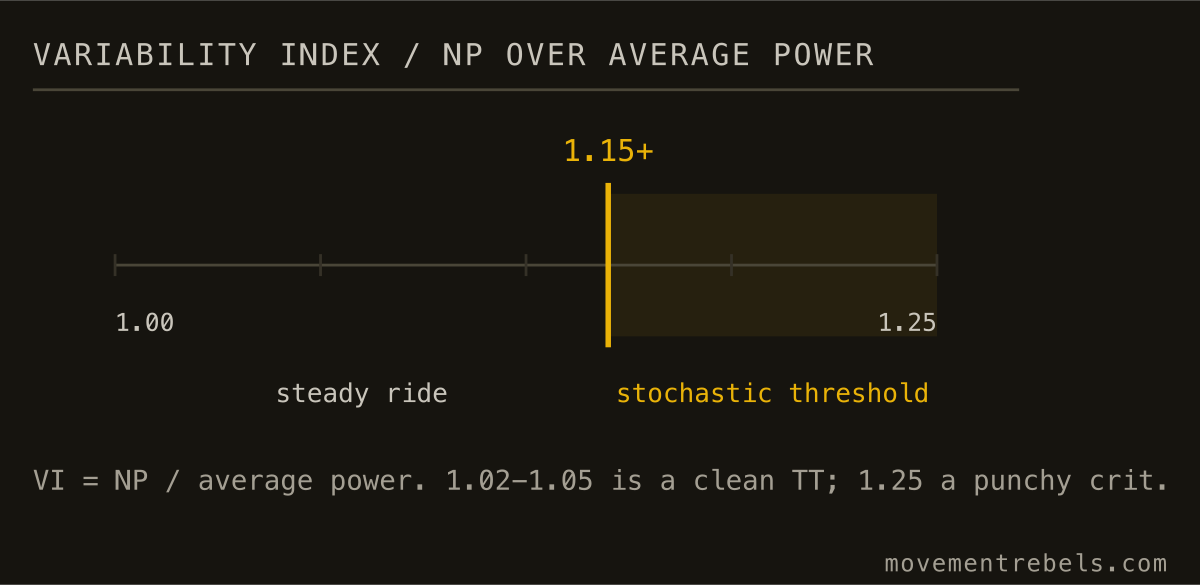
VI tells you something that neither NP nor average power reveals alone: how cleanly the ride matched its intent. If you planned a two-hour aerobic base session and VI came back at 1.18, you spent a significant portion of the ride spiking into threshold and above, even if average power looked modest. The adaptation target shifted without your permission.
For base building, high VI is a warning. For race simulation or fartlek sessions, high VI is the whole point. The number means different things in different contexts, which is why it needs the session intent alongside it, not just the raw value. See Zone 2 training for why those accidental spikes matter more than most athletes realize.
NP, FTP, and the Fragile Stack Above It
NP feeds two more metrics:
Intensity Factor (IF) = NP divided by FTP. A two-hour ride at IF 0.75 was aerobic work. The same duration at IF 0.92 was close to threshold, even if average power suggested otherwise. The same FTP also sets your cycling power zones from your FTP, so the IF you read maps onto the seven Coggan zones you train in.
Training Stress Score (TSS) = duration in seconds, multiplied by IF squared, multiplied by 100, divided by 3600. TSS is the number that feeds load management and periodization. It is covered in full in the Training Stress Score guide.
The stack is: NP sits on FTP. IF sits on NP. TSS sits on IF. A stale FTP cascades wrong numbers all the way up. This is the blind spot the software rarely surfaces, because no product profits from telling you your FTP might be off. If your fitness has shifted meaningfully since your last test, your TSS scores from the past four weeks are potentially all wrong, and the training load picture they paint is fiction.
A 2022 systematic scoping review of cycling power meters in PMC examined 74 studies of power meter validity and accuracy. The hardware is generally reliable. The conceptual inputs (FTP as a fixed threshold, the assumption that four-power weighting perfectly models all intensity types) carry more uncertainty than the software interface suggests. NP is a proxy, not a measurement.

Where NP Actually Breaks Down
Three honest limits, beyond the FTP problem:
Short, maximal efforts. A 25-minute criterium with continuous surges will produce an NP the four-hour aerobic-cost model was not designed for. The number still has directional value, but treat NP from efforts under 40 minutes, especially chaotic ones, with more skepticism than you would a three-hour road ride.
Rides with long zero-power stretches. A descent where you coast for eight minutes at zero watts drops average power significantly, inflating VI and making the ride look choppier than it was metabolically. You were actually recovering during those zeros, not paying a cost. The algorithm cannot distinguish coasting from soft-pedaling.
Indoor versus outdoor. The same NP indoors usually feels harder. No descent micro-rests, reduced cooling, different muscle recruitment from no balance demands. Do not treat an 180-watt NP indoor session and a 180-watt NP outdoor ride as identical loads. The hybrid athlete training context matters here too: strength training the day before artificially suppresses what you can produce on the bike, and NP will read low without reflecting detraining.
How Movement Rebels Uses NP
The coach reads NP from your Garmin sync. Garmin is the primary live integration: completed activities come in natively, and the coach pushes structured workouts directly to your watch. Strava is a parallel sync for activity storage and social logging; the coach also writes a session summary back to your Strava description, but Strava activity data does not feed the coach's AI analysis (activity data reaches the coach only through the Garmin native path). NP is the primary load signal for cycling, not raw average power. Three places this shows up:
Adaptive interval prescription. When the coach writes the next threshold session, it scales target watts off your recent NP history at threshold-range efforts, not a stored FTP guess from six weeks ago. If recent NP at similar perceived effort is trending higher, the next block steps up. If NP is sagging while heart rate is climbing, the coach pulls back and writes recovery work, and tells you why. The push to Garmin watch integration means the session lands on your wrist with power targets already set.
VI flags on execution drift. If your scheduled Zone 2 endurance ride keeps returning with VI of 1.15 or higher, the coach flags it. You are not riding endurance, you are riding stochastic threshold. The recovery debt accumulates either way, and the next week's prescription needs to account for it.
Cross-domain context. NP on the bike is one signal. If your HRV-guided readiness is trending down and your Rebel Fuel log shows three days of under-fueling, the coach reads all of it together. Declining NP at the same RPE is often not a fitness problem. It is a fuel or recovery problem. That cross-read between power data, nutrition logs, sleep, HRV, and biohack history in one timeline is what a single-purpose power analytics tool cannot do. For more on how load signals combine into the broader training picture, see adaptive training plans.
FTP calibration. The coach watches for signs that your stored FTP has drifted from reality: repeated sessions where your NP consistently undershoots prescriptions with low RPE, or where IF calculations produce TSS scores that look inconsistent with how you are recovering. When the signal suggests the anchor is off, the coach will flag it and prompt a retest rather than silently compounding the error.
The Part Nobody Sells
Here is the honest accounting. NP is a proprietary-ish algorithm with no single peer-reviewed validation paper of its own. The physiological rationale is strong (fourth-power weighting of intensity is real, the nonlinear scaling is documented), and the 2020 Frontiers in Physiology study on variable versus constant power confirms the core premise. But NP specifically, with its exact 30-second window and fourth-power exponent, was tuned to fit the physiology rather than derived from it. The Journal of Science and Cycling note about terminology confusion matters: NP and xPower are nearly the same calculation with slightly different window shapes, sold by competing platforms as proprietary innovations. Neither is more or less valid than the other.
Use NP. It is better than average power. Know that it is a physiologically motivated approximation, not a measurement of actual metabolic cost. Pair it with RPE, check your FTP anchor quarterly, watch VI as a session quality signal, and use periodization principles to structure the load it generates. That is the full picture.
How Movement Rebels Handles NP
To summarize the integration: Garmin syncs in live and is the source the coach reads NP from. The coach uses it to prescribe next sessions with appropriate power targets, and writes structured workouts with those targets back to your Garmin watch. Strava is a parallel sync for activity logging and social context; the coach also writes a session summary back to your Strava description. VI gets logged and flagged when execution drifts from intent. FTP calibration gets surfaced when the data suggests the anchor has shifted. None of this requires a separate power analysis subscription.
Pricing
Movement Rebels is one app instead of five: strength logger, endurance planning, hybrid programming, snap meal, hydration, breathwork, NSDR, cold exposure, fasting timer, body comp, biohack history, and an always-on coach under one subscription. Seven-day free trial, no card required. Pro+ is $20 per month for unlimited coaching after the trial.
FTP Calculator
Estimate your FTP and seven power zones.
One app instead of five.
Strength, endurance, recovery, fueling, planning, and your AI coach. All under a 7-day free trial. No card.
Start 7-day trialCycling Power Zones Explained: How the 7-Zone Model Maps to Your Training
Learn the 7-zone Coggan power model: what each zone trains, common mistakes, and how to use FTP to structure your cycling training
Training Stress Score (TSS): Useful Number, Wrong Anchor
TSS quantifies session load well. The mistake is treating it as a recovery metric. Here's what it measures, where it breaks, and h
Zone 2 Training: When It Works, When It's a Waste
Zone 2 is real, old, and oversold. Here's the honest version: when low-intensity volume is your highest-leverage work, when it isn
HRV-Guided Training: Read the Signal, Skip the Noise
One low HRV night tells you almost nothing. The 7-day-vs-28-day trend tells you nearly everything. Here is what the evidence actua