Training Stress vs Life Stress: Why Your Plan Should Bend to a Bad Week
Your body does not know the difference between a hard interval session and a brutal week at work. Both drive up cortisol, suppress vagal tone, and drain the same autonomic recovery budget. The interval session is a deliberate stressor you chose. The work deadline, the poor sleep, the toddler at 3am, the difficult conversation on Monday morning: those are stressors you did not choose. They land in the same account.
Training plans that ignore this are not training plans. They are aspirational schedules that break the moment life shows up.
The idea has a name: allostatic load. It was coined by neuroscientist Bruce McEwen in the 1990s to describe the cumulative wear on the body from repeated or chronic stress exposure. The key insight is that the sources of that stress are interchangeable at the physiological level. Exercise is a stressor. Work is a stressor. Sleep deprivation is a stressor. Relationship tension is a stressor. They all activate the HPA axis, elevate cortisol, pull sympathetic tone upward, and suppress the parasympathetic nervous system that recovery depends on. The body does not ring-fence your training load from the rest of your week.
What Allostatic Load Actually Measures
Allostatic load is not a feeling. It is measurable physiology.
Research using physiological markers including blood pressure, cholesterol ratios, inflammation markers, glucose metabolism, and cortisol excretion consistently finds an inverse relationship between cumulative allostatic load and HRV: as stress burden rises, total HRV falls, and vagal (parasympathetic) HRV shows the most pronounced decline. The association between allostatic load and cardiovascular stress reactivity is particularly strong.
That relationship matters because your morning HRV reading is, in part, an index of this cumulative burden, not just last night's training session. An HRV dip on a day you rested is not a sensor glitch. It is allostatic load.
The mechanism runs through the same pathway as training fatigue. Sympathetic nervous system activation suppresses vagal tone. Cortisol and catecholamines rise. Inflammation markers tick upward. Repair and adaptation slow down. The only difference is the proximate cause: intervals versus inbox.
The Sleep Chapter Nobody Wants to Read
Sleep is the single most underrated training stressor.
A 2025 meta-analysis in Frontiers in Neurology covering 11 studies and 549 participants found that sleep deprivation significantly reduces RMSSD, the parasympathetic HRV metric your wearable reports, with a standardised mean difference of -0.24. It simultaneously elevates the LF/HF ratio (SMD 1.47), a marker of sympathetic predominance. In plain terms: one poor night shifts the autonomic system toward the same stress-dominant state as a hard training block.
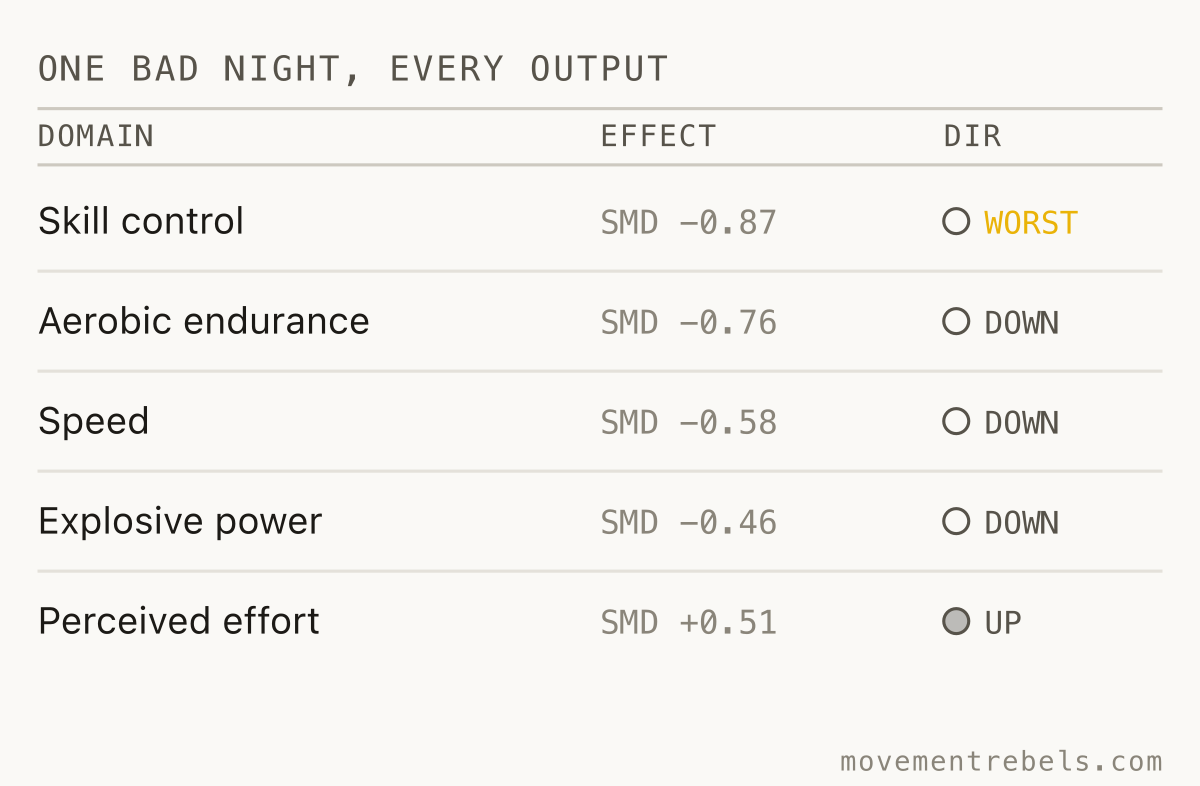
The performance cost is not subtle. A separate 2025 meta-analysis on sleep deprivation and athletic performance found aerobic endurance impaired at SMD -0.76, skill control at SMD -0.87, speed at SMD -0.58, and explosive power at SMD -0.46. Rating of perceived exertion rose by 0.51 standard deviations. Sessions feel harder than they should because they are harder: sleep-deprived athletes are working above the effort that the pace or power would normally require.
This matters because recreational athletes regularly stack two or three poor nights, add a moderate training load, and wonder why they feel terrible. The training was not too hard. The total load was.
The sleep and training guide covers the repair mechanisms in more detail. The short version here: no sleep intervention in the recovery toolkit overrides inadequate sleep quantity and quality.
Work Stress Is Not "In Your Head"
The idea that professional stress is somehow separate from physical training stress is a convenient fiction. The physiology disagrees.
A 2024 review in Frontiers in Psychology using a PNEI (psychoneuroendocrinological-immunological) framework found that psychosocial stress elevates cortisol and suppresses immune function in athletes, increasing injury susceptibility and impairing performance through the same HPA axis disruption as physical overload. The authors concluded that total stress load, not training load alone, determines whether an athlete enters productive adaptation or starts sliding toward non-functional overreaching.
The European College of Sport Science and the American College of Sports Medicine put it directly in their joint consensus statement on overtraining syndrome: overtraining syndrome is the outcome of a training plan that fails to balance exercise stress with non-training life stress and recovery. That sentence should be in every coaching certification. It almost never is.
Non-functional overreaching, the precursor to full overtraining syndrome, is defined as a performance decrement from accumulated training AND non-training stressors with recovery taking weeks. Not days. Weeks. The line between "hard week, I just need the weekend" and "I have been in a hole for three weeks" is crossed quietly. Fatigue is the symptom. Total load is the cause.
What Your Data Actually Shows
Your wearable cannot read your email. But it reads the physiological footprint your email leaves.
HRV is sensitive to all of this simultaneously: training load, sleep quality, illness, alcohol, and psychosocial stress all leave autonomic signatures. That sensitivity is the point. A morning reading below your 7-day baseline is not specifically saying "you trained too hard." It is saying "total recovery demand is outpacing recovery supply right now." Your job is to figure out why.
Three readings that pattern together into a reliable signal of high total load:
- Morning HRV trending downward across 3 or more consecutive days, without a training-load explanation (a light week with suppressed HRV is nearly always life stress or sleep deficit, not fitness loss). To rule training in or out, quantify your weekly training load in tonnage and hard sets and check whether the number justifies the dip.
- Resting heart rate 3 or more bpm above your 14-day average on multiple consecutive mornings
- Perceived effort elevated on sessions that should feel controlled, sessions where pace or power is the same as last week but effort is a 7/10 instead of a 5/10
Any one of these can be noise. Two or three together, without a hard training block to explain them, is the signal. The resting heart rate trends guide covers how to read your personal baseline trend without overreacting to daily variation.
The HRV-guided training guide explains how to act on these readings session by session. The principle here is simpler: if HRV and RHR tell a consistent story across several days and the training log does not explain it, look at the rest of the week.

The Plan Should Flex, Not Break
A rigid training plan is a fragile one. The goal is not to abandon structure under pressure. It is to adjust the right variables when total load is high.
Hard weeks in life call for soft weeks in training. Here is what "soft" actually means in practice:
Demote the quality sessions, not the easy ones. Your Zone 2 run can go ahead. Your VO2max intervals cannot. Autonomic systems are already taxed by life stress; interval sessions drive cortisol higher and extend the suppression window by another 24-48 hours. Easy aerobic work under the first lactate threshold is low enough on the sympathetic demand curve that it does not meaningfully add to the burden and keeps the habit alive.
Volume before intensity. If something has to go, cut the hard portions first. Keep total movement. A 45-minute Zone 2 run when the plan said 8x800m is not a failure. It is a smart trade that keeps recovery on track. To make that trade ahead of time, you can build a progression block that bends volume around a hard week.
Sleep is the non-negotiable. No training trick substitutes for it. If you have a choice between one extra hour of sleep and completing the strength session, the sleep wins. This is not opinion. It is what the data on sleep deprivation and performance consistently says.
The week after a bad week needs to be actually easy. Stress hormones do not zero out the moment the stressful period ends. Cortisol suppression and HPA axis dysregulation can persist for days after the triggering event is resolved. Coming out of a hard life week and immediately resuming full training volume is the most common pattern before non-functional overreaching sets in. Take an easy week even when you feel ready to go again.
For the full framework on when "adjust the day" becomes "adjust the entire week," see the when to deload guide. For the warning signs that total load has tipped into non-functional overreaching territory, the overtraining signs guide covers each red flag.
What This Means for the Economist
It is worth asking who benefits from the "push through" culture.
The supplement industry benefits: cortisol-blocking stacks, stress-formula adaptogens, and recovery aids all sell better when the premise is "train hard regardless of life, just add this." The coaching software industry benefits from training plans that look impressive on a schedule and demand the user treat every week identically. The wearable industry benefits from making readiness a daily anxiety-generating metric, because anxiety drives engagement.
None of that changes the physiology. The body does not care about the revenue model. Allostatic load is cumulative. Flexibility is adaptive. Training stress and life stress compete for the same budget.
How Movement Rebels Handles This
The coach reads HRV, resting heart rate, and sleep data from Garmin and Apple Health (native on the iOS app). That data is visible every morning. When HRV trends low and resting heart rate trends high for two or more days without a hard training block explaining it, the coach adjusts the upcoming session prescription.
That means: if today was supposed to be threshold intervals and your morning data shows a 12 percent HRV dip alongside elevated RHR, the session gets demoted to Zone 2 with an explicit effort cap. Not cancelled. Adjusted. The structured session still pushes to your Garmin watch with the right zones and targets for where you actually are today, not where the original plan assumed you would be.
For Garmin users, the integration is bidirectional: the coach reads the activity file after the session and checks how the adjusted session actually went. Time in zone, HR drift, effort consistency. If you stayed under the cap and the data confirms it, the next day's prescription reflects that you recovered well. If you drifted high despite the adjustment, the following day stays conservative.
The goal is a plan that bends to the real week, not the ideal week. Most athletes do not have ideal weeks. A coach that only works during ideal weeks is not much of a coach.
See adaptive training plans for the broader framework on how session prescriptions shift across a training block as the data accumulates.
Pricing
Movement Rebels is one app for the full picture: strength, endurance, hybrid, planning, coaching, fueling, recovery, tracking. A 7-day free trial covers the entire surface. After the trial, Pro+ is $20/month for unlimited coaching. No card on the trial.
TSS Calculator
Quantify training load to weigh it against life stress.
One app instead of five.
Strength, endurance, recovery, fueling, planning, and your AI coach. All under a 7-day free trial. No card.
Start 7-day trialHRV-Guided Training: Read the Signal, Skip the Noise
One low HRV night tells you almost nothing. The 7-day-vs-28-day trend tells you nearly everything. Here is what the evidence actua
Overtraining Signs: The Ones Worth Watching
True overtraining syndrome is rarer than you think, has no reliable biomarker, and is almost never what recreational athletes have
Sleep and Training Performance: The Lever Nobody Respects
Sleep outperforms every supplement, wearable, and recovery tool you own. Here's the honest evidence, what actually trashes it, and
Resting Heart Rate Trends: The 28-Day Line
One morning's RHR is mostly noise. Your wearable's sensor can swing 5 bpm on a good night. The 28-day rolling mean is where the si